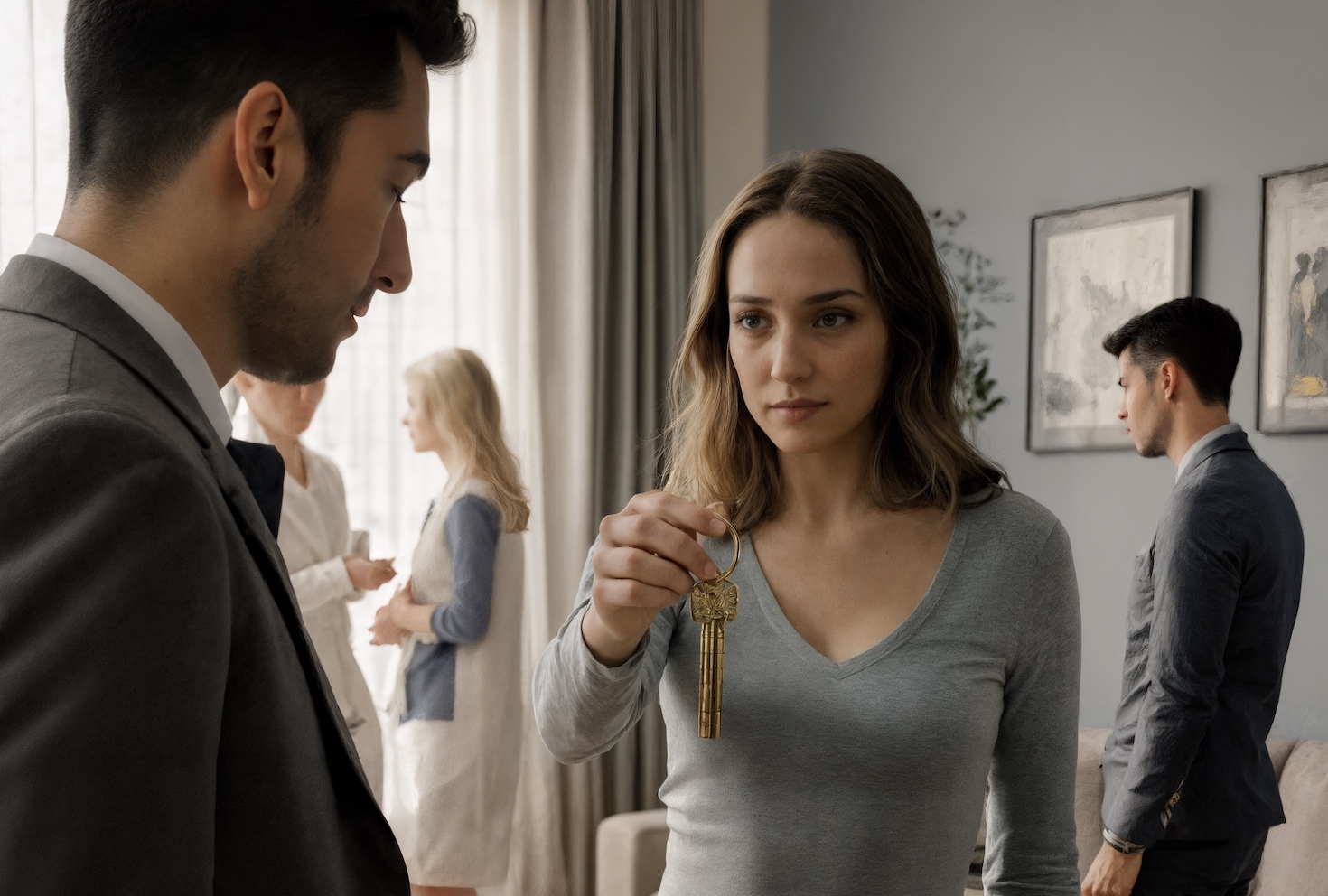
“Why did you lie?” Olya asked softly—almost under her breath—standing at the kitchen window and watching the sparse drops of a cold November rain cling to the sill.
“Why did you tell them it was possible?”
Dima, sitting at the table, didn’t respond right away. He scrolled through his phone, pretending he was busy. His face carried that familiar expression—worn-out, slightly guilty, but stubborn—like he was fifteen again, digging in his heels in front of his father, arguing for something he wasn’t even sure he believed.
“I didn’t lie,” he muttered at last. “I just said it might work.”
“‘Might’?” She gave a bitter half-smile. “So to you, ‘might’ means you can invite your entire clan to move into our place?”
He stayed silent. Outside, bare poplar branches clawed at the gray sky in gusts. The apartment smelled of chicken soup, but the warmth of that scent only made Olya feel heavier—comfort, in a moment like this, felt like cruelty.
“Dima.” She turned toward him. “Do you even understand this isn’t a weekend visit? They have three kids. Three, Dima. They’re loud, they scream, their toys get everywhere. I can’t do that again. I didn’t agree to live in a daycare.”
“Don’t start,” he snapped, shoving the chair back as he stood. “You’re always saying, ‘I didn’t agree,’ ‘I’m not ready.’ They’re family. Families help each other—that’s how it works.”
“Family?” She narrowed her eyes. “They’re your family. Not mine.”
He paused, then spoke quietly, pressing each word as if he could force her to give in.
“Have you even thought about what they’re dealing with? They were thrown out. They’ve got no money. The kids are little. And you’ve got this big, comfortable apartment—space, peace, everything. What would it cost you to help?”
“It would cost me plenty, Dima,” she said. “My peace of mind. My time. My personal space. Is that nothing to you?”
“Oh, for God’s sake.” He paced the kitchen, fists clenching. “You always make it about you. It’s always ‘mine, mine.’ Your apartment, your dishes, your furniture. So what am I here—just a lodger?”
She looked at him for a long time. Then, very calmly, she said, “No. A husband. One who should’ve talked to me first.”
His face twitched. He wanted to reply, but didn’t. And Olya understood—arguing was useless.
The next day she woke up early. Outside, the light was dull and colorless—November had been especially bleak this year: rain, sleet, wind that rapped at the windows like an uninvited guest. She turned on the kettle, went into the kitchen, and saw a note from Dima on the table:
“Went to Mom’s. Need to help them with their things. Back by evening.”
The kettle clicked. Olya stood there with her mug, a cold shiver sliding down her spine. He hadn’t just refused to reconsider—he’d gone to help them pack.
By evening he really did return—tired, soaked through, but oddly pleased.
“Looks like we got it sorted,” he said, shrugging off his jacket. “They’ll come tomorrow.”
“Tomorrow?” Olya’s voice rang like glass. “You didn’t even discuss it with me!”
“Olya, enough!” he flared. “I can’t keep going in circles. They’ll stay a couple of weeks, no more. Then they’ll move out.”
“‘A couple of weeks,’” she repeated. “You don’t believe that yourself.”
He didn’t answer.
The next day, when the doorbell rang, Olya stood in the middle of the living room as if bracing for a siege.
The entire procession filled the doorway: Zoya with a bright, triumphant smile; Andrey slumped as if he already felt guilty; and three children—one clutching a phone, another holding a stuffed rabbit, and the youngest girl in shiny boots with markers tucked into her pockets.
“Hi, Olyenka!” Zoya burst inside as if she owned the place. “We’re here, just like we agreed!”
“I didn’t agree,” Olya said quietly, but Zoya was already past listening.
She kicked off her boots and started barking orders:
“Masha, don’t run on the carpet! Vitya, put the bag by the wall! Andryusha, help with the suitcases!”
Dima lingered off to the side, looking like he’d love to vanish into thin air.
“Oly… you don’t mind, right?” he asked carefully.
“A bit late to ask,” she said.
From the first minutes it was obvious: the nightmare had only begun.
The youngest, Artyom, cried almost nonstop. Masha decorated the mirrored wardrobe door with marker “to make it prettier.” The oldest, Vitya, shut himself in Olya and Dima’s bedroom, connected to the Wi-Fi, and announced he had to “study.”
Meanwhile Zoya rummaged through the kitchen, opening cabinets and narrating her opinions out loud.
“Wow—everything’s so neat, like a museum! No wonder you’re bored all day by yourself. Don’t worry, it’ll be fun now!”
Olya didn’t respond. She stood at the window, jaw clenched, counting to ten.
By evening the apartment had turned into chaos. Crumbs on the table. Children’s jackets on the couch. Someone’s backpack on the windowsill. Olya washed dishes and tried not to think.
Dima came up behind her and wrapped his arms around her shoulders.
“Just hang on a little, okay? They won’t be here forever.”
She dried her hands and turned to face him.
“Dima, this isn’t about ‘hanging on.’ It’s about respect. About the fact that I no longer understand who actually makes decisions in our home.”
He let out a heavy breath.
“There you go again with your principles…”
She pulled away sharply.
“Yes. Principles. Because if you don’t have them, then pretty soon it won’t matter where you sleep, who you live with, or who gets to tell you what’s ‘right.’”
He went quiet. Something like fear flickered in his eyes.
The next day everything got worse.
Without asking, Zoya rearranged the living room furniture—“so the kids could play more comfortably.” Andrey dragged an old armchair out of storage and planted it by the TV. Masha spilled juice on the carpet.
Olya tried to talk to Dima, but he waved her off.
“What do you want me to do?” he said. “They’ve got kids. Don’t work yourself up.”
By evening Olya couldn’t take it anymore.
“Dima,” she said, “this ends. Tomorrow you tell them they need to move out.”
He stared at her like she’d lost her mind.
“You want me to throw my sister out—with the kids? In winter?”
“I want you to choose,” she answered. “Between me and this circus.”
Silence. Only behind the wall, Masha squealed with delight—cartoons blasting at full volume.
That night Olya couldn’t sleep. She lay in the dark listening to someone snoring in the next room, to floorboards creaking under чужие footsteps—someone else’s steps.
She could feel something inside her breaking—not loudly, but for good.
I won’t let it happen, she thought. I won’t let them make me the villain again. I won’t let my home become a hallway people pass through. Let him hate me if he must—better that than me hating myself.
She rolled onto her side and closed her eyes.
Tomorrow there would be a real conversation. No detours.
In the morning the kitchen was quiet. The kids were still asleep. Zoya and Andrey had gone to the store. Dima poured himself coffee.
Olya walked in and sat across from him.
“We need to talk.”
He didn’t argue.
“I know what this is about,” he said. “Just not today. Give it a couple days, okay?”
“No,” she said firmly. “Today. Otherwise it’ll be too late.”
“Too late for what?” he asked, tired.
“For us.”
He lowered his eyes. A nervous tic jumped along his cheek.
“Are you giving me an ultimatum?”
“No. I’m drawing a line,” she said. “Either we decide this together—and they leave—or I leave.”
He looked at her for a long time, intensely, as if he were seeing her for the first time.
“You’re not kidding?”
“No,” she said. “I don’t know how to joke anymore.”
At that moment the front door slammed—Zoya and Andrey were back, rustling grocery bags.
“Oh! We scored dumplings on sale!” Zoya announced brightly. “We’ll boil them up—feed everyone!”
She set the bags on the table, yanked open the fridge… and finally noticed the tension on their faces.
“Did something happen?”
Olya looked at Dima.
“Tell her,” she said quietly.
He hesitated for a long time. Then exhaled.
“Zoya… you need to move out.”
Zoya froze, a jar still in her hand.
“What?”
“I’ll explain later,” he tried to soften it. “It just can’t go on like this. Olya and I…”
“You and Olya?!” Zoya snapped. “And what about us? Are we garbage now—after everything?”
Olya stood silent. Dima, not looking at her, repeated:
“Tomorrow.”
Zoya threw the jar into the sink.
“So that’s it. You’re kicking us out. Your own blood! I hope you—”
“Enough,” Dima said, hard. “I’ll handle it.”
Zoya stormed out, slamming the door.
Olya sat down and covered her face with her hands. Dima stayed quiet.
“Thank you,” she managed at last. “For finally understanding.”
He didn’t answer.
Late that night, when the apartment had gone still, Olya heard him talking on the phone in the hallway.
He spoke in a whisper, but she caught every word.
“Mom, I can’t anymore. Yes… yes, she insisted. No, it’s not that I’m against you, it’s just… I’ll sort it out later. I told them to move out, but… yes, Mom. I got it.”
November slipped quietly past its midpoint. Drizzle gave way to the first snow, and the air turned sharp—smelling of wet asphalt and cheap coffee poured from kiosks by the bus stop.
A week passed since Zoya left. Or rather—since she supposedly left.
The first two days she and the family really did stay in a rented place. Then the calls began. At first, neutral:
“Olyenka, hi! Listen, do you happen to have an old kettle? The landlord didn’t leave one, and I don’t want to buy a new one if we’re moving soon anyway.”
Then more demanding:
“Olya, what are these hotel prices you sent me? We can’t afford that! Maybe Dima can help—he promised, didn’t he?”
And a week later Olya found out Zoya and the kids were back at their place again—not “to live,” just “for a day.” No call. No warning. She simply opened the door with her key—the key she never returned.
Olya came home from work that evening. A mountain of shoes in the entryway. Children’s jackets. The smell of fried onions. A cartoon screaming from the TV.
She stood in the hall until Zoya appeared—in house slippers, a towel over her shoulder, smiling like everything was perfectly normal.
“Olyenka! We’re here… just for a bit! The landlord shut off the water and the kids need somewhere to wash, right? So we came. That’s okay, yeah?”
Olya inhaled slowly.
“You could’ve at least called.”
“Oh, we didn’t want to bother you!” Zoya said, genuinely surprised. “We’re family!”
She went back to the kitchen, clattered a pot lid, called the kids to dinner. Dima sat at the table, gloomily picking at his food, not looking at his wife.
Olya stood in the doorway, feeling something inside her chest turn to ice.
Later, when Zoya had put the kids to bed and went to the bathroom, Olya shut the bedroom door behind her and faced Dima.
“Dima, I’m not doing this again.”
He rubbed his temples, exhausted.
“I told her—just a couple of days. They really do have issues with the apartment.”
“And who gave them the key?” Olya asked.
He hesitated.
“Well… I forgot to ask for it back.”
“I see,” she said. “So now the key to our home is basically public property.”
He didn’t respond. He only turned away and lay down, pulling the blanket over himself.
Olya sat at the window for a long time. Snow fell thick and heavy, sticking to the glass. And she thought: This is how marriages collapse—not from affairs, not from poverty, but from small, sticky indifference. When someone is beside you, but not with you.
On the third day of the “visit,” Olya snapped.
She came home early and saw Zoya and the kids eating lunch at her table. Everything she’d cooked “for the week” had been pulled from the fridge. A circle of sunflower heads sat on the kitchen sill, and a ketchup stain spread on the couch.
“Stop,” Olya said quietly, though her voice trembled. “This isn’t your home, Zoya.”
Zoya set down her fork and slowly turned.
“Listen, Olya, you’re always on edge. Relax! We’re not thieves. We’re not breaking anything. The kids need somewhere to live. Don’t be so heartless.”
“Heartless?” Olya repeated. “You call breaking into someone else’s apartment ‘kind’? Do you even remember what conscience is?”
“Oh, here we go. You should pity the kids, not your wallpaper.”
At that moment Dima came out of the hallway. He looked at both women—tired, rumpled, as if he’d aged ten years overnight.
“Enough,” he said. “You’re both acting like—”
“Like who, Dima?” Olya cut in. “Like someone who cares who lives in her home? Or like someone who’s used to other people deciding everything for her?”
He didn’t answer.
That night Dima packed a bag and went to his mother’s. Olya heard the door close softly. He didn’t say goodbye.
She didn’t cry. She just lay staring at the ceiling until the first pale strips of morning light carved dull lines across the wall.
The days blurred into a gray streak. Dima didn’t call. Zoya left again—supposedly “for good.” But Olya felt it wasn’t over.
Sometimes it seemed to her that the whole story was a sticky snowball rolling through their lives, picking up lies, чужие voices, the neighbors’ stares, his mother’s gossip.
In the stairwell, Rita—the older woman always walking her little dog—once leaned toward Olya and whispered:
“So it’s true, yeah? A scandal with the relatives? Don’t worry, dear. Hang on. Men always cling to their family first… then they crawl back to their wives.”
Olya only smirked. Let him crawl, she thought. But deep down she knew—he wouldn’t.
Two weeks passed.
One evening she sat at the kitchen table drinking tea when her phone buzzed.
Dima: “I’ll stop by tomorrow. We need to talk.”
Nothing else.
He came the next morning. Not in a jacket, but in an overcoat—as if he wanted to look official. He brought a bag of apples.
“Mom asked me to give these to you,” he said awkwardly.
Olya let out a small laugh.
“Your mom asked? Or you just didn’t know how to start?”
He sat down.
“I don’t want to fight,” he said. “Everything went too far.”
“I agree.” She set a cup in front of him. “I’m just not sure we have anything left to discuss.”
He dropped his gaze.
“I know I was wrong. But you also… could’ve been softer. It’s not a war.”
“Not a war?” Olya cut him off. “Then what is it? When someone stops considering you, makes decisions over your head, brings strangers into your home—what do you call that? Peace?”
He stayed quiet.
Olya continued, her words steady now:
“I can’t live waiting to see who calls tomorrow—your sister, your mother, your nephew—and announces they’ll be here ‘for a couple of days’ again. I need a home, Dima. My home. Without invasions. Without manipulation.”
He said quietly, “I just wanted to help.”
“There are different ways to help,” she replied. “But you chose the one where I didn’t matter.”
Dima sighed, stood up, and walked to the window. Outside, snow fell smooth and soft—like a new chapter someone had just started writing.
“So what now?” he asked.
“I don’t know,” she answered honestly. “But not like before.”
He was silent, then turned back.
“Maybe I should move out for a while. To… think.”
Olya nodded.
“I think that’s right.”
He stared at her for a long moment—as if searching for words and finding none. Then he left, closing the door gently behind him.
Three days passed.
She lived alone. The apartment was quiet—only the hum of the refrigerator, and in the evenings the sound of the neighbor putting on his kettle through the wall.
Sometimes she caught herself listening—waiting for footsteps, for keys in the lock, for a call. But nothing came.
Then, suddenly—her phone rang.
The screen read: Zoya.
Olya slowly answered.
“Yes?”
“Olya…” Zoya’s voice sounded unusually subdued. “We moved out. Found a room on the edge of town. Don’t tell Dima I called. I just wanted… to say thank you.”
“For what?” Olya asked cautiously.
“For putting us in our place,” Zoya said. “We really did get too bold. I stirred everything up—your husband, his mom, everyone. I’m sorry.”
Olya said nothing.
On the other end she could hear a child laughing—muffled but real, bright and happy.
“Okay, I won’t keep you,” Zoya added. “Take care of him, alright? He’s… lost without you.”
The call ended.
That evening Olya stepped out onto the balcony. Snow was falling again—slow, thick. Far away streetlights glimmered, and the city looked dusted with a glaze of silence.
She stood wrapped in her sweater, thinking how strangely life works: sometimes everything has to collapse before you finally understand what matters.
Then, behind her, the lock clicked quietly.
She turned. Dima stood in the doorway. No words. No bag. No explanations.
He walked up and stopped beside her. For a few seconds they just stood, watching the snow fall.
“You came back?” she asked softly.
He nodded.
“If it’s not too late.”
She studied him for a long time, then said, “Not too late. But from now on, it will be different.”
He nodded. And for the first time in weeks, Olya felt it—not cold, not resentment—just a tired, living warmth in her chest.
She didn’t know if they would make it.
But she knew one thing for sure: no one would ever turn this home into a public hallway again.
And outside, the snow kept falling—steady and quiet—like the final period at the end of a long argument.