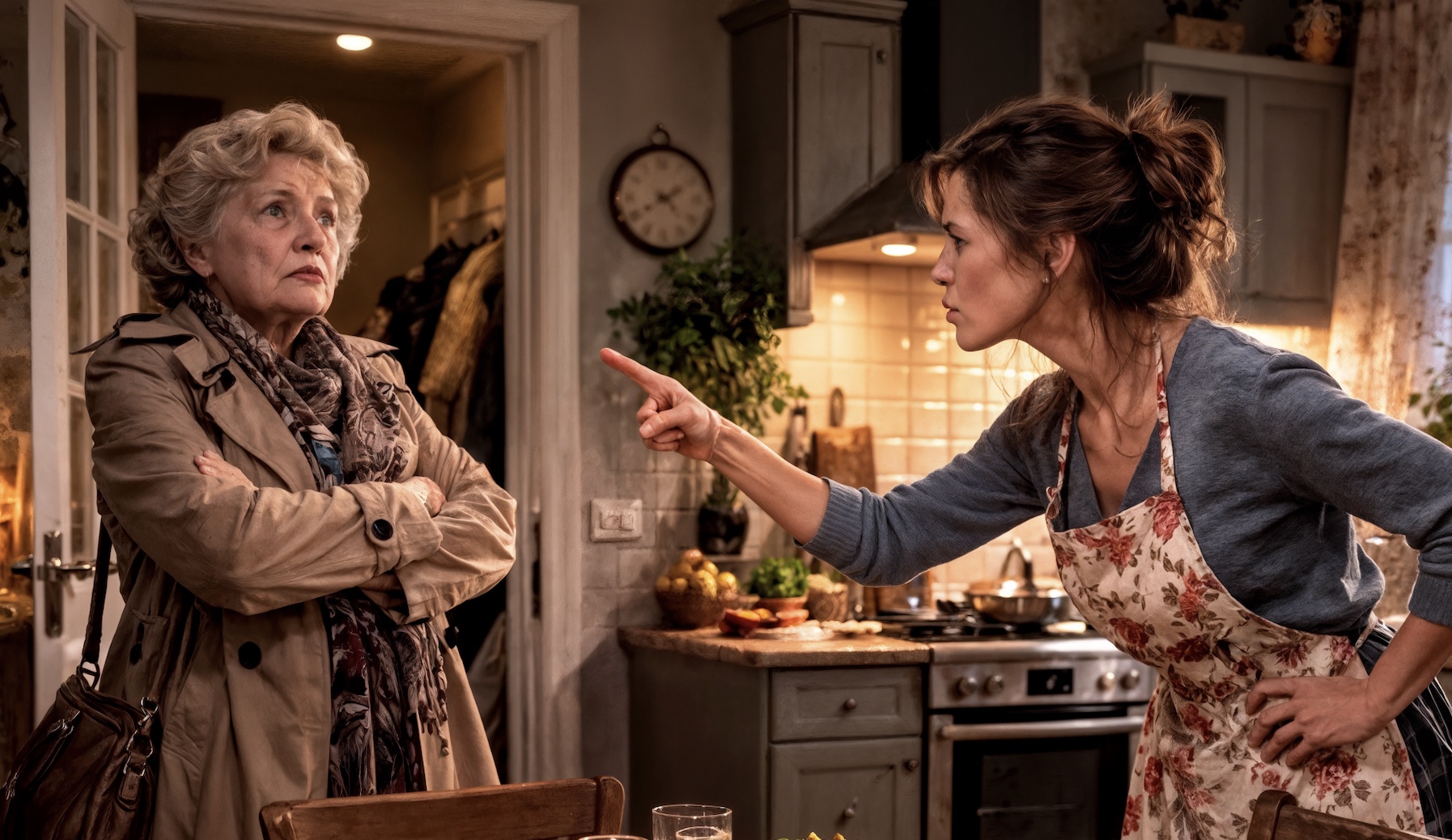
Sveta had just pulled a tray of cookies out of the oven when the doorbell rang—sharp and relentless. She grimaced. She already knew that ring by heart.
Through the peephole she spotted a familiar silhouette in a dark navy coat with a fur collar. Alevtina Sergeyevna stood there, gently rocking on her heels, her face set in the same habitual dissatisfaction that seemed to come as naturally to her as breathing.
Sveta let out a slow breath and opened the door.
“Good afternoon, Alevtina Sergeyevna.”
“Afternoon? It’s practically evening,” her mother-in-law replied, marching straight into the entryway without waiting to be invited and shrugging off her coat. “Well? Are you going to help me, or are you just going to stand there?”
Sveta silently took the coat and hung it up. Alevtina Sergeyevna had already stepped out of her boots—leaving them right in the middle of the hallway—and walked into the living room, scanning the place like an owner checking whether everything was still in order.
“Would you like some tea?” Sveta asked as she headed back toward the kitchen.
“Of course I would. What kind of question is that?” her voice carried from the living room. “And bring something to go with it. I’ve hardly eaten anything all day.”
Sveta filled the kettle and took out her jasmine tea—her favorite. Alevtina Sergeyevna preferred strong black tea, but today Sveta didn’t ask. She arranged the cooled cookies on a plate and added a few store-bought wafers.
When she carried the tray into the living room, her mother-in-law was already settled into an armchair, legs crossed, flipping through a magazine she’d picked up from the coffee table.
“That’s all?” Alevtina Sergeyevna’s eyes swept over the cups, the teapot, and the plate of cookies. “Seriously?”
“What exactly is bothering you?” Sveta asked, setting the tray down and sitting on the couch.
“Sveta, sweetheart,” her mother-in-law said, putting the magazine aside and leaning forward like a teacher explaining basics to a dull student. “That is not how you host guests. Do you understand? Cookies and wafers are fine for a children’s party—nothing more.”
“I wasn’t expecting guests,” Sveta said calmly as she poured the tea.
“That doesn’t matter! I came, didn’t I?”
“You came without warning. I didn’t know you were coming.”
Alevtina Sergeyevna straightened, her cheeks flushing.
“I don’t need to warn anyone before visiting my own son’s apartment! This is my Alyosha’s home, and I have every right to come here whenever I please—no invitations, no announcements.”
Sveta quietly stirred sugar into her cup. Her mother-in-law was only getting started.
“You need to learn your place in this family, girl,” Alevtina Sergeyevna said, her tone growing more and more lecturing. “I’m his mother. I gave birth to him, raised him, paid for his education. And who are you? His wife? Wives come and go. A mother is forever.”
“Alevtina Sergeyevna…”
“Don’t interrupt when elders are speaking!” her mother-in-law cut her off sharply. “That’s exactly what I want to discuss: manners. How a decent daughter-in-law behaves in a respectable household.”
Sveta leaned back, took her cup, and sipped. The tea was fragrant and soothing.
“In our family,” Alevtina Sergeyevna continued, “we’ve always respected our elders. A mother-in-law is the head of the family for a young wife. I should be your authority, understand? You should listen to my advice, learn from me how to keep a home and how to take care of your husband.”
“My household is perfectly fine.”
“Oh, sure it is!” her mother-in-law twisted her mouth. “Cookies with tea—that’s what you call fine? Where’s the pie? Where are the homemade preserves? Do you even have your own jam?”
“Alevtina Sergeyevna, I’ll repeat myself: I didn’t invite you over. If I had, I would’ve set the table accordingly.”
“That arrogance is exactly what concerns me!” her mother-in-law raised her voice. “You think you can speak to me like that? I’m your husband’s mother! You’re supposed to be quieter than water, lower than grass. You speak only when you’re asked. Those are the basics, girl—the basics of family hierarchy!”
Sveta set her cup down. A heavy silence settled in the room.
“You’re the very last person in this family,” Alevtina Sergeyevna continued, apparently mistaking Sveta’s silence for agreement. “The very last. First comes Alyosha, my son. Then me—his mother. And only then everyone else. Including you. No—especially you. A young wife has to earn her place over years of proper behavior—obedience and respect for elders.”
She stood and began pacing, clearly enjoying her own momentum.
“I can see how you look at me. You think I’m old, outdated? No, dear. These are centuries-old traditions, proven by time. In my day, daughters-in-law knew their place. Homes were spotless, food was always ready, husbands were happy. And now? Careers, business trips, meetings. And the family? And the husband? Alyosha comes home—what does he get? Cookies?”
Sveta listened quietly, almost detached. She was waiting for the monologue to run out of steam—waiting for the moment she could finally say what she should have said long ago.
“You must understand,” Alevtina Sergeyevna said, sitting again and looking down at Sveta as if from a pedestal, “as long as I’m alive, I will be the main one in this family. It’s my duty as a mother and as the elder. And you must accept it. Obey, listen, respect. Otherwise what kind of wife are you to my Alyosha?”
The silence stretched. Alevtina Sergeyevna stared at Sveta expectantly, clearly waiting for apologies, remorse—maybe tears.
Sveta slowly placed her cup on the table, straightened, and met her mother-in-law’s eyes.
“Alevtina Sergeyevna,” she said softly, perfectly calm, “let me explain something to you.”
Her mother-in-law blinked, surprised.
“First: you’re nobody to me,” Sveta said plainly, stating it like a fact. “You’re my husband’s mother. That’s it. That doesn’t make you the head of my family, my authority, or my supervisor. It makes you a relative I’ll respect only for as long as you respect me in return.”
“How dare you—”
“Second,” Sveta continued without raising her voice, “this apartment belongs to me. I bought it before the wedding with money I earned myself. I haven’t even registered Alyosha here yet—our documents are still in process. So legally, he doesn’t even live here on paper yet. And you—certainly not.”
Alevtina Sergeyevna opened her mouth, but Sveta raised a hand.
“I’m not finished. Third: money. I earn more than Alyosha—much more. It’s not his fault; that’s just how life turned out. He’s a wonderful man and a good professional. My salary is simply higher. And most of our household budget comes from my income.”
Sveta stood, walked to the window, then turned back.
“And now let’s think about the future, Alevtina Sergeyevna. You’re not getting younger. Sooner or later you’ll need help. Maybe financial—medicine, doctors, everyday expenses. Maybe physical—rides somewhere, help around the house. Who will you turn to?”
Her mother-in-law’s face slowly lost color.
“To Alyosha, of course. To my son. And he’ll want to help you because he’s a good man and a loving son. But think: whose money will pay for that help? Who will decide how much we can allocate from our family budget? Who will go with you to the doctor when Alyosha is working and it’s harder for him to take time off than it is for me?”
Sveta returned to the couch and sat down, crossing her legs.
“I will decide. Me. How much to give, whether to give at all, how often, and what exactly for. It will be my money, my decisions, my time. So tell me—how generous do you think I’ll be toward someone who walks into my home uninvited, lectures me, insults me, tells me I’m nobody, and demands I stay silent and obedient?”
The room fell into dead quiet. Only the wall clock ticked.
“You see,” Sveta said, still calm—almost friendly, “those ‘centuries-old traditions’ worked back when a wife depended completely on her husband and his family. When she had no home, no money, no career. When she was given shelter and food, and paid for it with obedience. But times have changed.”
She poured herself more tea. Her hand didn’t tremble.
“Now it’s me supporting your son—not the other way around. This is my apartment, my money, my home. And if anyone here needs to be ‘quieter than water, lower than grass,’ it’s not me. And if someone has to ‘earn their place in the family through years of proper behavior,’ that’s you, Alevtina Sergeyevna—because your place here depends entirely on whether I choose to have you in my home or not.”
Alevtina Sergeyevna sat gripping the armrests, her face mottled—pale one moment, red the next.
“I… I’ll tell Alyosha!” she finally spat out. “He has to know how you speak to me!”
“Go ahead,” Sveta shrugged. “Tell him. Tell him you came without an invitation, started lecturing me, humiliating me, trying to put me in my place. And then listen to what he tells you. Alyosha loves you—that’s true. But he loves me too. And he knows exactly who brings in most of the income, whose name the apartment is in, and who pays the bills.”
Sveta set her cup down and glanced at the clock.
“You know, Alevtina Sergeyevna, I don’t want to fight with you. Truly. I’d love to have a good relationship with my mother-in-law. I could invite you over, set a proper table, even ask your advice sometimes. But that requires mutual respect—not rank, not hierarchy, not ‘you’re the last person in the family.’ Respect. Equal, human respect.”
“You… you’re shameless!” her mother-in-law’s voice trembled. “I’m a mother! A mother always—”
“A mother always has a special place in her child’s heart,” Sveta interrupted calmly. “But not in my home, not in my wallet, and not in my life. In my life you’re a guest—and you need to behave accordingly. Come by invitation, or at least warn us in advance. Don’t teach me how to live in my own apartment. Don’t set rules in my home. These are basic things, Alevtina Sergeyevna.”
Her mother-in-law rose slowly from the chair. Her face looked carved from stone.
“I’m leaving,” she said through clenched teeth.
“Goodbye,” Sveta stayed seated on the couch. “And please close the door behind you.”
Alevtina Sergeyevna walked into the entryway. Sveta heard her tug on her coat, pull on her boots. The front door slammed.
Sveta leaned back and closed her eyes. Her heart was pounding—this conversation had been hard, despite how calm she’d sounded. She hated conflict. She hated confrontations. But it had to be done—long ago.
She stood, gathered the dishes, carried them into the kitchen, washed the cups, and put away the cookies. Then she turned on music and started making dinner. Alyosha would be home in a couple of hours, and she wanted to cook his favorite—oven-baked chicken with vegetables.
Time passed. Sveta chopped vegetables, marinated the chicken, set the table. Thoughts buzzed in her head, but she tried not to replay the earlier argument. What was done was done. Let Alevtina Sergeyevna digest what she’d heard. And if she really called Alyosha to complain—well, then they’d have to talk about it. But Sveta was sure Alyosha would understand. He knew his mother’s character, knew how controlling and tactless she could be.
The key turned in the lock right at seven.
“Sveta, I’m home!” her husband’s cheerful voice rang out.
She stepped out of the kitchen, wiping her hands on a towel. Alyosha stood in the entryway taking off his jacket, grinning from ear to ear.
“Hi, love,” he said, hugging her and kissing her. “Mmm, that smells amazing! What are you cooking?”
“Your favorite chicken. It’ll be ready in half an hour.”
“Perfect! I’ll have time to change and take a shower.” He headed to the room, already pulling off his shirt. “How was your day?”
Sveta paused in the kitchen doorway, watching him go. Then she smiled.
“Normal. Worked, cooked. Nothing special.”
“Mom didn’t call?” his voice came from the other room.
“No,” Sveta answered. “She didn’t.”
“Strange. She usually calls on Wednesdays. Oh well—maybe she was busy.”
Sveta went back to the kitchen and checked the chicken. The crust was golden, juices bubbling along the edge of the baking dish. Another twenty minutes and it would be perfect.
Over dinner, Alyosha talked about work—about a new project, about how his boss had missed deadlines again. Sveta listened, nodded, asked questions. A normal evening. A normal family life.
“So you really had nothing interesting happen?” Alyosha asked, spooning himself a second helping. “By the way, this chicken is unreal. You’re a magician.”
“Thanks,” Sveta smiled. “And really—nothing. Absolutely nothing special.”
She looked at her husband—his kind eyes, his smile, the way he ate with such genuine pleasure. And she understood she’d done the right thing. Some conversations shouldn’t be carried to husbands—they should be spoken to the person who truly needs to hear them. Directly. Without intermediaries.
Alyosha shouldn’t have to be torn between his mother and his wife. That wasn’t fair to him. And Sveta—Sveta was fully capable of standing up for herself.
“What are you thinking about?” Alyosha asked, covering her hand with his.
“Oh, nothing,” she said, turning her palm and weaving her fingers through his. “Just thinking how lucky I am with my husband.”
“I’m the lucky one,” he said, lifting her hand to his lips and kissing it. “And lucky with this chicken too. Can I have one more piece?”
Sveta laughed and reached for the baking dish.
An ordinary evening. An ordinary life. And let it stay that way—calm, steady, without unnecessary drama or endless confrontations.
As for Alevtina Sergeyevna… well, time would tell. Maybe she’d understand. Maybe she’d learn to respect other people. Or maybe she wouldn’t. But Sveta had done what she needed to do—and her conscience was completely clear.
The evening moved along unhurriedly. After dinner they washed dishes together—Alyosha washed, Sveta dried and put everything away. Then they watched a series, sitting on the couch, pressed close to each other. The everyday life of two people who love each other and are building their own family.
And no outsider has the right to tell them how to do it.