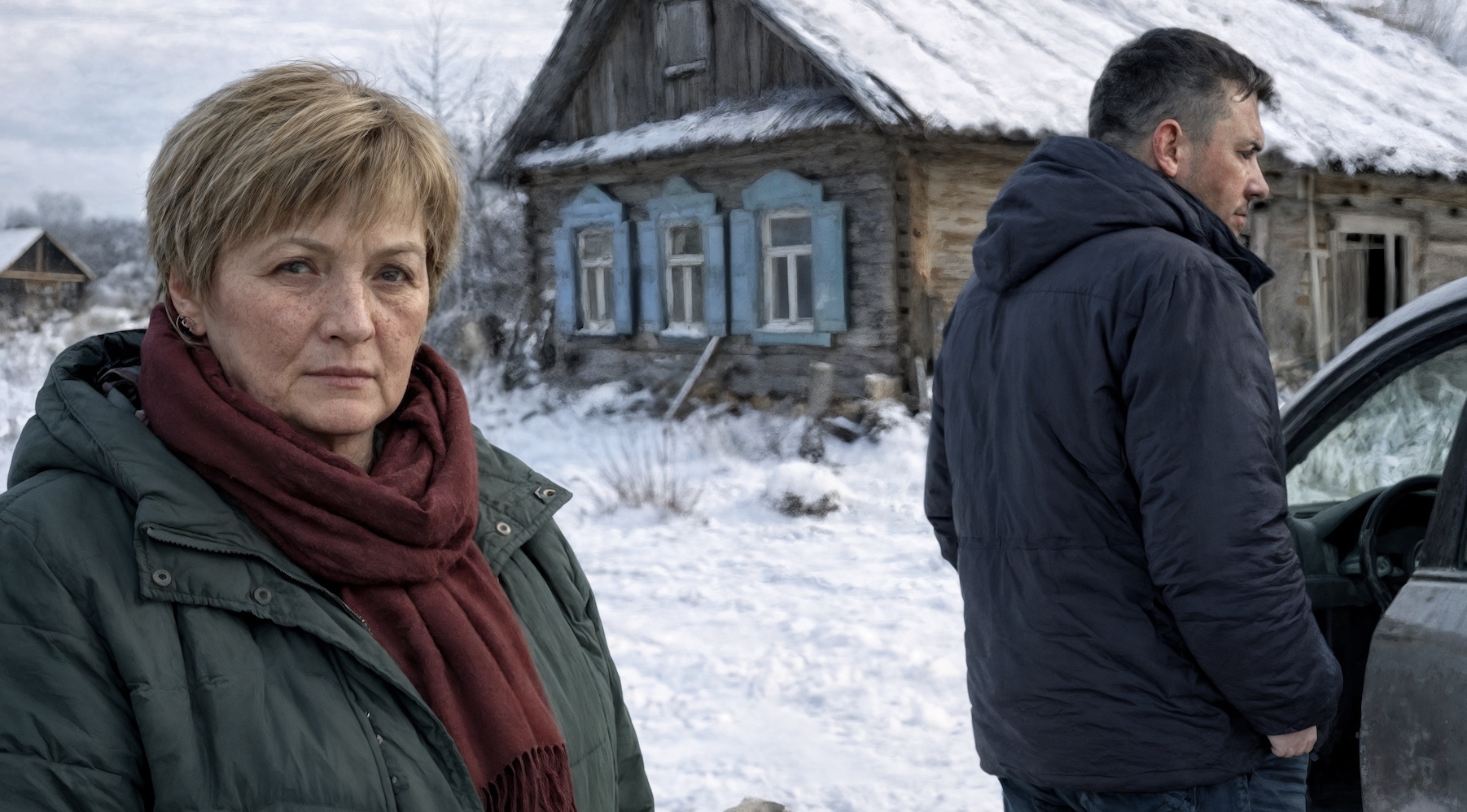
Anna Stepanovna sat in the back seat, staring out the window. Her son, Vladislav, had been driving her out of town for nearly three hours. His wife, Oksana, stayed behind and didn’t even come out to see her off. But then again—what was there to say goodbye to?
“Mom, you get it,” Vladislav said, keeping his eyes on the road. “Oksana and I are squeezed into a two-room apartment. We’re planning for a baby. Out there it’s clean air, quiet… You’ll like it, I swear.”
Anna didn’t respond. She had spent thirty years in a school kitchen to raise three children after her husband died when their family was still young. Her daughters lived far away and called once every six months. Vladislav had promised he’d take her in. Two weeks ago, he brought her to his place. And last night Oksana exploded right at dinner.
“I’m not living in the same apartment with some random old woman!” the daughter-in-law screamed. “Let her go to her daughters if she’s so ‘important’!”
Vladislav didn’t answer his wife then. But in the morning, he told his mother to pack.
The car stopped beside a crooked old hut in an abandoned village. Anna Stepanovna stepped out and looked at her son. He wouldn’t lift his eyes.
“There’s firewood in the shed. I’ll leave you groceries. I’ll come back in a month and see how you’re settling in,” he said, hauling out two sacks, a crate of canned food, and bags of grains and pasta.
“Don’t come back,” she said quietly. “Live your life with your Oksana. Have children. Just don’t throw them away one day, like you’re throwing me away now.”
Vladislav jerked as if she’d slapped him. But he started the engine and drove off without looking back. Anna Stepanovna was left alone. The wind pushed snow along the empty street. No voices, no footsteps—nothing. She gathered the bags and went inside.
It was colder in the hut than outside. The stove clearly hadn’t been used in years. The windows were boarded, the wallpaper hung in ragged strips. An old broom lay in a corner. She picked it up and began sweeping out the dirt. Her hands knew what to do, even if her head felt hollow. It was easier not to think that way—easier not to admit her life had been tossed aside.
Sleep wouldn’t come that night. She managed to light the stove, but it barely warmed the room. Anna lay under her coat, thinking of her children. She remembered rocking them to sleep, going without meals so they wouldn’t. She remembered working double shifts just so Vladislav could wear a proper suit to graduation. And now he’d dumped her here like garbage.
Close to midnight something heavy scraped at the door. She flinched and grabbed the fire poker. On the threshold sat a massive dog. His fur was matted into knots, a torn wound gaped on his side, and amber eyes looked up at her—tired, not threatening, as if he’d already accepted the worst.
Anna brought a bowl of bread softened in water. The dog devoured it in seconds, then stared at her with such gratitude that her chest tightened. She laid an old blanket near the door.
“Stay,” she whispered. “Neither of us has anywhere else to go.”
The dog curled up and didn’t move until morning. She called him Gloom. He started following her for firewood, showing her paths through the forest, keeping watch by the door at night. For the first time in days, the weight on her heart eased just a little.
But the firewood ran out quickly. So did the canned food. One day Anna went outside and climbed down into an old cellar to see if there was anything useful. She expected cold dampness, but under her feet the ground felt soft. She shifted stones along the wall and found a narrow fissure. Clear water seeped from it—perfectly transparent. She scooped some into her palm and washed her face. The water was clean, gentle, almost comforting.
The next morning she woke up and didn’t immediately understand what was different. Her joints didn’t ache. Her hands didn’t hurt. She stepped toward a broken shard of mirror on the wall—and gasped. The wrinkles looked softer, her skin brighter, as if ten years had quietly slipped away.
Down in the cellar she discovered an old leather-bound notebook. The handwriting was uneven, but readable:
“Whoever finds these lines, know this: this house stands on special ground. The water heals the body, but it reveals itself only to those whose hearts have not turned hard with resentment. I, Fyodor the stove-maker, lived here twenty years after those closest to me betrayed me. But I did not become bitter. The house gave me a second life. It will give you one too—if it accepts you.”
Anna Stepanovna closed the notebook and wept. For the first time in all those days, she wasn’t crying out of self-pity—she cried out of relief. She had been rejected, thrown to the edge of the world… and yet this cursed hut had become her rescue. Here, she could begin again.
A blizzard arrived a week later. Wind rushed down from the hills and swallowed the village in white. For three days Anna didn’t leave the hut. Gloom lay calmly by the stove, but on the third night he suddenly leapt up and began to howl. He clawed at the door, paced, whined so desperately that her heart squeezed tight.
“What is it? Is someone out there?”
She threw a shawl over her shoulders, took a kerosene lamp, and opened the door. The wind nearly knocked her down. The dog surged forward, glancing back, waiting for her to follow. The storm stung her eyes. After several minutes they reached a ravine. A car roof jutted out of a snowbank.
Anna подняла the lamp. Inside the car sat a man, head tilted back, eyes closed. She yanked the door with all her strength—it gave. The man was unconscious, but breathing. Gloom braced himself, and together they dragged the stranger all the way to the hut.
Anna stoked the stove harder, stripped off his frozen clothes, wrapped him in blankets. Then she hurried down to the cellar for the spring water and fed it to him in tiny sips. By morning he opened his eyes.
“Where am I?” he rasped.
“You’re safe. Don’t try to get up yet.”
“My name’s Denis. I was headed to a client in the next district—I repair antique clocks. The car slid on the turn. I thought that was it.”
“Don’t thank me,” she said, nodding toward the dog. “Thank that quiet one. He led me to you through the storm.”
Denis stroked Gloom’s head. Over the next days he stayed in the hut, regaining strength. Anna fed him from her thin supplies and gave him water from the source. His bruises faded quickly, the soreness eased. Denis was surprised, but he didn’t press her with questions.
One evening he sat by the stove and looked at her for a long time.
“Anna Stepanovna… why are you here? In the middle of nowhere, completely alone?”
She hesitated, then told him—briefly, without embellishment. About the children who pushed her out. About the daughter-in-law who screamed at her. About the son who couldn’t find the courage to defend his mother. Denis listened, his brow furrowed.
“How could they?” he said, shaking his head. “You gave them your whole life, and they tossed you here like something useless.”
“Maybe I’m the one to blame,” she murmured. “I gave too much, asked for nothing back. They got used to me always being there… always forgiving.”
“That isn’t a fault,” Denis said quietly. “That’s your strength. You saved my life when you can barely survive yourself. Not everyone could do that.”
A week later Denis was on his feet. He didn’t leave right away. Instead, he started repairing everything that had broken in the house. He fixed the old wall clock, strengthened the door hinges, sealed the window gaps, patched the shed roof. His hands were skilled; he worked fast and sure.
“Why are you doing all this?” Anna asked.
“Because I want to,” he said. “Because you deserve a decent life. And because I feel good here.”
Spring came suddenly. The snow melted in a matter of days, revealing dark earth. Denis went back to the city to fetch tools and supplies. He promised he’d return in a week. Old Gloom—almost as if he’d been waiting for that moment—walked into the forest one morning and never came back. Anna searched for him for two days, calling, but he vanished without a trace.
That same evening a puppy wandered up to the porch—gray, amber-eyed, identical to Gloom. It whined and begged to be let inside. Anna lifted it into her arms and cried—not from grief, but from gratitude. It was as if her old friend had sent her a companion so she wouldn’t be alone.
Denis returned as promised. He brought boards, paint, and saplings—apple trees and cherries. For the next month they worked together. He strengthened the foundation and painted the window frames. She dug a garden and planted potatoes and carrots. In the evenings they sat by the stove, drank from the spring, and talked about everything and nothing.
One day a truck pulled up to the house. An elderly man climbed down from the cab, leaning on a cane.
“Hello, kind people,” he said. “I heard there’s healing water here. My leg hasn’t healed since a road accident—half a year now. Doctors just shrug. Could I try your water?”
Anna poured him a mug. The man drank and sat on the porch. Half an hour later he stood up and took a few steps without his cane. His eyes widened in disbelief.
“What on earth…? It doesn’t hurt at all! I haven’t walked like this in three years!”
The news spread quickly. People began arriving from nearby villages. Some brought food, others helped with chores. Anna Stepanovna turned no one away. She welcomed everyone warmly, offered water from the spring, shared whatever she had.
Denis stayed and settled in a neighboring hut, which he repaired as well. He moved his workshop there and fixed clocks for anyone who brought them. Between him and Anna Stepanovna grew a quiet bond. They didn’t speak of feelings, but each of them knew they were no longer alone.
One evening, as they sat on the porch watching the sunset, a familiar car rolled up. Vladislav got out. He was alone—no Oksana. His face looked worn, his eyes red.
“Mom,” he stopped a few steps from the porch. “I came to take you home. Oksana left me a month ago. She said she couldn’t live with a man who betrayed his own mother. I was left alone. I finally understood what I’d done.”
Anna Stepanovna stood and walked up to him. She looked into his eyes for a long, careful moment.
“Vladislav, I’m glad you understand it now. But I’m not going home. This is my home now. These are people who need me. This is my life.”
“But Mom… I’m alone,” his voice trembled. “I don’t have anyone…”
“You’re not alone,” she said gently. “You have your sisters, your friends, your work. And most importantly—you have a conscience that finally woke up. That’s already something. Come visit if you want. But don’t try to take me away from here.”
Vladislav stood in silence. Then he nodded slowly, got back into the car, and drove off.
Anna returned to the porch where Denis sat. The puppy ran up and pressed its muzzle into her hand.
“Do you regret it?” Denis asked softly.
“Regret what?” she replied. “He made his choice then. I’m making mine now. I’m happy here—truly happy for the first time in years.”
By autumn Anna Stepanovna’s house had become a place people came to for more than water. Those who were crushed in spirit drove here too—people who had been betrayed, abandoned, humiliated. She welcomed each one, fed them simple food, gave them spring water, and talked with them deep into the night. Many left different than they arrived, faces lighter, hope back in their eyes.
One day Denis told her, “You turned this forgotten house into a place where people find themselves again.” Anna only smiled. She wasn’t looking for praise or gratitude. She simply lived the way her heart demanded.
Her children never truly came back. They called sometimes, asked how she was doing. She answered briefly and politely. The resentment was gone now. Only a quiet sadness remained—that they still hadn’t learned to value what they once had. But that was their road, their choice.
She had her own road: a house at the edge of an abandoned village, a healing spring in the cellar, a faithful dog on the porch, Denis in the neighboring hut, and people who arrived seeking help and comfort. It was her second life—the one she chose with her own hands. And in it, she was happy.
Old Fyodor the stove-maker had been right. The house accepted only those whose hearts stayed clean despite pain—and it gave them what people had taken away: purpose, hope, and peace.