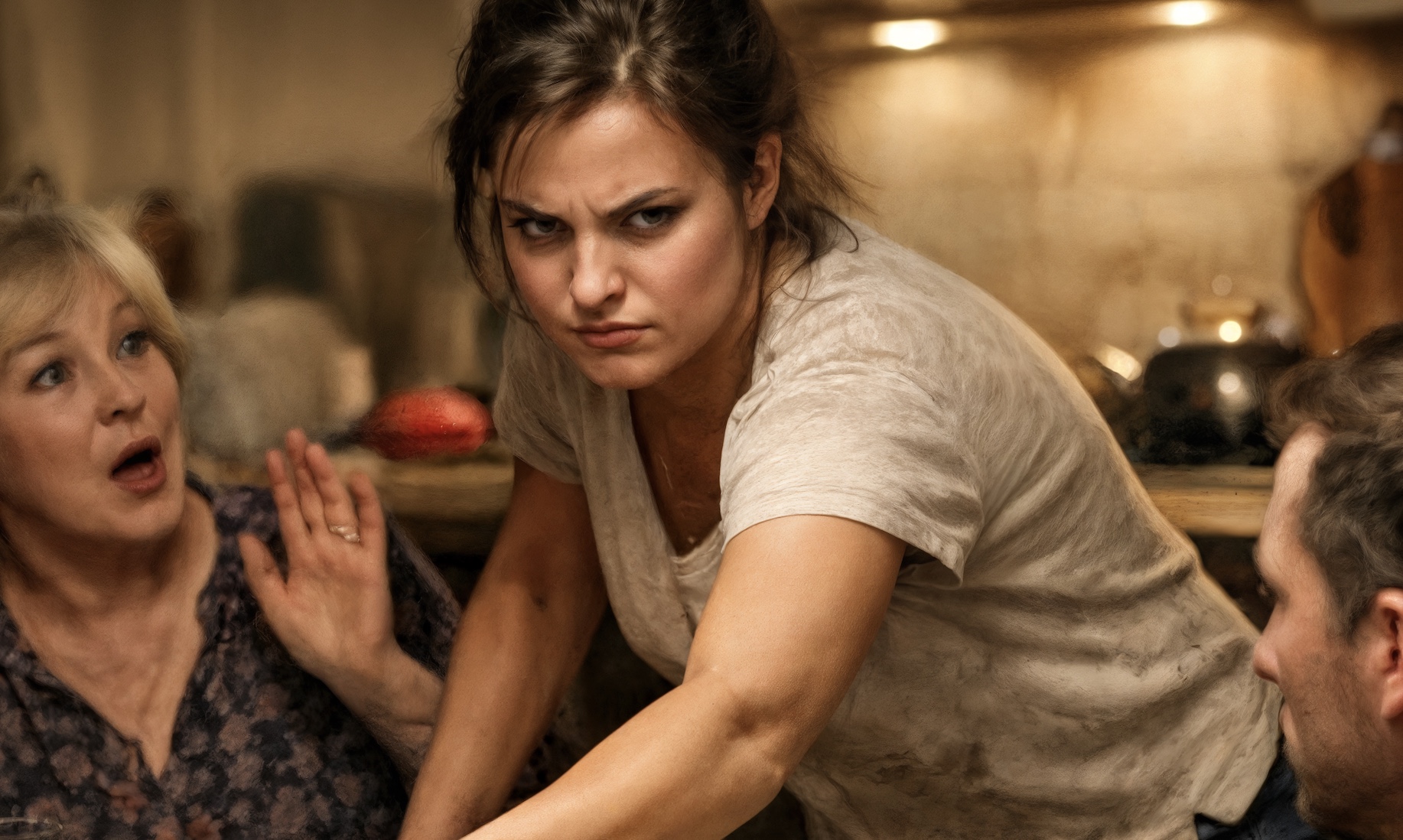
Viktoria was setting plates on the table when the doorbell rang. Exactly six o’clock. Her mother-in-law always arrived to the minute, as if Galina Nikolaevna had a Swiss clock ticking inside her.
“Coming, coming!” Vika called, wiping her hands on a towel.
She opened the door. Galina Nikolaevna stood on the doorstep in a beige coat, a handbag resting in the crook of her arm. The woman stepped inside, took off her coat, hung it on the rack, and scanned the entryway with a critical look.
“Good evening, Galina Nikolaevna,” Viktoria greeted her.
“Evening,” the mother-in-law replied with a brief nod. “Is Andryusha home?”
“He is. He’s in the other room playing with Masha.”
Galina Nikolaevna walked into the living room, where Andrey was building a construction set with their five-year-old daughter. She hugged her son, kissed him on the crown of his head, and smoothed Mashenka’s hair.
“So, my dears—how are you?”
“Fine, Mom,” Andrey said, getting up from the floor. “Let’s go to the table. Time for dinner.”
Galina Nikolaevna went into the kitchen and sat in her usual seat by the window. She inspected the table setting—a white tablecloth, porcelain plates, napkins tucked into rings. Her expression didn’t change.
Viktoria served the meal: chicken fillet in a creamy sauce, stewed vegetables, mashed potatoes. She’d cooked for three hours, doing her best to make everything delicious. Andrey liked chicken, and Masha loved mashed potatoes.
They sat down together. Viktoria plated the portions and sat last. The air felt tight with tension, though no one had spoken yet.
Galina Nikolaevna picked up her fork, cut off a piece of chicken, and put it in her mouth. She chewed slowly, then winced and set her fork down. She pushed her plate toward the edge of the table, as if distancing herself from the food.
“Is something wrong?” Vika asked cautiously.
Her mother-in-law sighed and shook her head.
“Viktoria, dear… I gave you my recipe notebook. Remember?”
“I remember,” Viktoria nodded, feeling that familiar irritation begin to bubble up inside her.
“Then why don’t you use it?” Galina Nikolaevna continued. “Everything is written down—how much salt, how much cream, which spices.”
“I cook using my own recipes,” the daughter-in-law replied, trying to stay calm.
“Your own,” the mother-in-law repeated with a faint, knowing smile. “I can tell. Too much salt. And it’s very rich. My Andryusha is on a diet—he shouldn’t be eating such heavy food.”
Andrey kept chewing without looking up from his plate, nodding at his mother automatically.
“Mom’s right, Vika,” he mumbled. “It really is a bit salty.”
Under the table, Viktoria clenched her fists. The smile on her face froze, turning stiff and unnatural. Masha watched the adults with big eyes, not understanding why Grandma was unhappy.
“Granny, I like it,” the girl said.
“Mashenka, sweetheart, you’re still little,” Galina Nikolaevna said gently. “You don’t understand what real food is yet. When you’re older, I’ll teach you how to cook properly.”
Viktoria put her fork down and took a sip of water. She breathed deeply, counting to ten. Don’t snap. Not in front of the child.
Dinner continued in uneasy silence. Galina Nikolaevna didn’t touch the chicken again, eating only the vegetables. Every now and then she tossed in another comment—the potatoes were a bit dry, the carrots overcooked, the sauce too tart.
Andrey agreed with everything his mother said. Viktoria stayed quiet, finishing her portion. Anger boiled in her, but she wouldn’t show it.
At half past seven, Galina Nikolaevna got ready to leave. She hugged her son, kissed her granddaughter, and gave Viktoria a small nod.
“Andryusha, call me tomorrow,” she said at the door. “And think about the food. Health is more important than taste.”
The door closed. Viktoria stayed in the kitchen and began clearing the table. Andrey lingered to help, stacking dishes into the sink.
“Listen, Vika,” he started carefully. “Maybe you really should use less salt? Mom isn’t saying it for no reason.”
Viktoria set a plate in the sink more sharply than she meant to. Porcelain clinked against metal.
“Your mother always has something to say,” she replied without turning around.
“Well, she’s experienced,” Andrey continued. “She’s been cooking her whole life. She knows how it’s supposed to be.”
“I cook too,” Viktoria argued, turning on the tap. “And not badly, by the way. You’ve never complained before.”
“I’m not complaining,” he said. “I’m just saying it could be improved. Mom wants to help.”
Viktoria shut off the water and turned to him.
“Help? She criticizes my cooking at every dinner. Every time she finds something to nitpick. That isn’t help. That’s humiliation.”
Andrey frowned.
“You’re exaggerating. Mom is just sharing her experience.”
“Experience,” Viktoria repeated bitterly. “Right.”
Andrey shrugged and went into the other room. Viktoria stayed alone in the kitchen, washing the dishes, wiping the table, putting leftovers into the fridge.
Every evening was the same. Galina Nikolaevna came, sat down, and started criticizing. Too salty. Too greasy. Too dry. Too spicy. There was always something.
And Andrey went along with it—nodding at his mother, repeating her words. He never defended his wife. Never said the food was fine.
Viktoria dried her hands and leaned against the countertop, closing her eyes. How much longer could she take it?
The next evening, Galina Nikolaevna came again. Right at six. Viktoria served a baked casserole with meat and vegetables. She tried hard, using a new recipe she’d found online.
Her mother-in-law took a bite and put down her fork.
“Viktoria, dear, did you add spices?”
“I did,” the wife nodded. “Basil and oregano.”
“Too many,” Galina Nikolaevna said, shaking her head. “They overpower the meat. I wrote in the notebook—spices should be minimal.”
Andrey nodded, agreeing. Viktoria stayed silent, chewing her casserole. Inside, everything was boiling, but nothing showed on the outside.
Another week passed the same way. Every evening—a visit. Every dinner—criticism. Galina Nikolaevna found flaws in everything. Too much onion. Not enough pepper. The chicken was tough. The fish was dried out. The soup was watery. The porridge too thick.
And Andrey kept echoing her. He agreed with his mother. He repeated her remarks after Galina Nikolaevna left.
“Vika, maybe you’ll actually try cooking from Mom’s recipes?” he suggested one night. “She didn’t collect them for years for nothing.”
Viktoria stood at the stove, stirring a stew, and didn’t turn.
“I cook the way I know how,” she answered. “Your mother can cook her way in her own home.”
“Well, Mom cooks differently,” Andrey insisted. “Tastier. More… correct.”
Viktoria turned off the stove and faced him. Her cheeks burned, her hands trembled. Her patience snapped.
“I’m cooking for my family, not by your mother’s menu!” Viktoria shouted.
Andrey froze with his mouth open. He hadn’t expected those words from her.
“What?”
“You heard me,” she shot back, louder. “Enough! I’m sick of the constant comparisons! I’m sick of being treated like the worst cook in my own home!”
Andrey’s face twisted. He grabbed a kitchen towel and hurled it onto the counter.
“What do you think you’re doing?!” he yelled. “My mother is trying to help! She’s sharing her experience! And you’re ungrateful!”
Viktoria stepped closer.
“Help? Your mother humiliates me every night! She criticizes everything I make! And you back her up!”
“Mom is right!” Andrey snapped. “The food really isn’t how it should be!”
“How it should be?” Viktoria repeated. “By whose standards—Galina Nikolaevna’s?”
Andrey jabbed a finger toward her.
“My mother helped you! When Masha was born, who watched her? Who taught you how to care for a baby? Mom did! And you can’t show even basic respect!”
“Respect?” Viktoria felt her voice crack. “Where’s your respect for me? Where’s your support? Every single time you take your mother’s side!”
Andrey grabbed his head in frustration.
“Because Mom is right! She’s always right! She has experience, she has knowledge!”
“And I don’t?” Viktoria shouted back. “I cook for you every day! I try to make it good! And all I ever hear is criticism!”
“Because you could do better!” Andrey yelled. “But you’re lazy! You don’t want to learn from Mom!”
Viktoria laughed—sharp and broken, almost hysterical.
“Learn? From a woman who thinks I’m useless? Who comes every night just to prove I’m a pathetic housewife?”
“Mom doesn’t think that!” Andrey argued. “She just wants you to grow!”
“Grow,” Viktoria echoed. “You mean become her copy.”
Andrey clenched his fists.
“You’re selfish! You only think about yourself! You’re trying to drive a wedge between me and my mother!”
“I’m tired!” Viktoria screamed. “Tired of being invisible in my own home! Tired of hearing that your mother is better—her food tastes better, her recipes are ‘more correct’!”
“Because it’s true!” Andrey shouted. “Mom cooks way better than you ever have—and she always has!”
It felt like a physical blow. Viktoria stepped back, her face turning pale.
“I understand,” she whispered. “So that’s how it is.”
“Yes, that’s how it is!” Andrey turned and stormed into the hallway. “I’m done with your hysterics! Mom raised me alone—she gave her whole life for me! And you can’t show her the simplest respect!”
“Respect,” Viktoria repeated softly. “Fine. Respect your mother. As much as you like.”
Andrey yanked on his jacket and grabbed his keys.
“You know what? Enough! I’ve had it! Live however you want! I’m going to Mom’s!”
“Go,” Viktoria nodded. “And don’t come back.”
He jerked the door open. The slam thundered so loudly the window glass trembled. Viktoria stood in the middle of the kitchen, staring at the closed door.
From the child’s room came crying. Masha had heard the shouting and got scared. Viktoria went to her daughter and wrapped her in her arms.
“Hush, sunshine, hush. It’s okay.”
“Mom… why were you and Dad fighting?” Masha sobbed.
“Adults argue sometimes,” Viktoria explained, stroking her hair. “It’s nothing terrible.”
But inside, she knew it wasn’t just an argument. It was the end.
Andrey didn’t come back the next day. He didn’t call or text. Viktoria didn’t go after him. She cooked dinner for herself and Masha. Without Galina Nikolaevna at the table, the apartment was quiet and peaceful.
A week passed. Then a second. Andrey still didn’t show up. Viktoria understood—he was living with his mother now. There, he was fed properly, by the recipes in the notebook.
Let him live there. Let him enjoy Mom’s perfect meals.
A month later, a letter arrived from a lawyer. Andrey had filed for divorce—an official petition to dissolve the marriage.
Viktoria read the papers and signed them. She wasn’t surprised. She wasn’t even upset. She just signed.
The apartment stayed with her—they’d bought it before the marriage using money from the sale of her previous place. Andrey didn’t contest it. He picked up his belongings when she wasn’t home and left the keys on the table.
Galina Nikolaevna stopped coming at six o’clock sharp. She didn’t ring the bell. She didn’t sit at the table with her critical remarks.
Viktoria cooked dinners for herself and Masha—whatever she wanted. She salted to taste. She added as many spices as she felt like. She experimented with recipes from the internet.
Masha ate with enthusiasm and praised her mom.
“Mom, this is so good! Can I have seconds?”
“Of course, sunshine,” Viktoria smiled, giving her a second helping.
No comments. No criticism. No comparisons to Galina Nikolaevna.
Freedom—real, complete freedom in her own kitchen.
The divorce was finalized three months later. Viktoria went to the registry office alone and received the certificate. Andrey sent a representative—he didn’t come himself.
Her ex-husband occasionally took Masha for the weekend. He arrived to pick up his daughter in silence and brought her back the same way. He didn’t come into the apartment; he waited in the stairwell. He transferred child support into a separate account.
Viktoria didn’t ask how he was doing. She didn’t care whether Galina Nikolaevna cooked for him from her flawless recipes. It didn’t matter.
What mattered was this: no one told her anymore how things “should” be. How much salt. How many spices. Which ingredients to use.
Viktoria cooked the way she wanted. And it was the best feeling in the world.
That evening she sat down to dinner with Masha—potato bake with cheese, a vegetable salad, and dried-fruit compote. Simple food, but tasty.
“Mom, is Grandma Galya not coming anymore?” Masha asked.
“No, sunshine, she won’t,” Viktoria answered.
“And Dad?”
“Dad will take you sometimes. For a walk, maybe to the movies.”
Masha nodded and kept eating. Children adjust quickly—much more easily than adults.
Viktoria finished her compote and carried the dishes to the sink. She turned on the water and began washing the plates.
Outside, dusk deepened. Streetlights blinked on one after another. The city settled into its evening quiet.
And in Viktoria’s kitchen it was bright, warm, and calm—without criticism, without reproaches, without endless comparisons.
Just her kitchen. Her food. Her rules. And it felt wonderful.