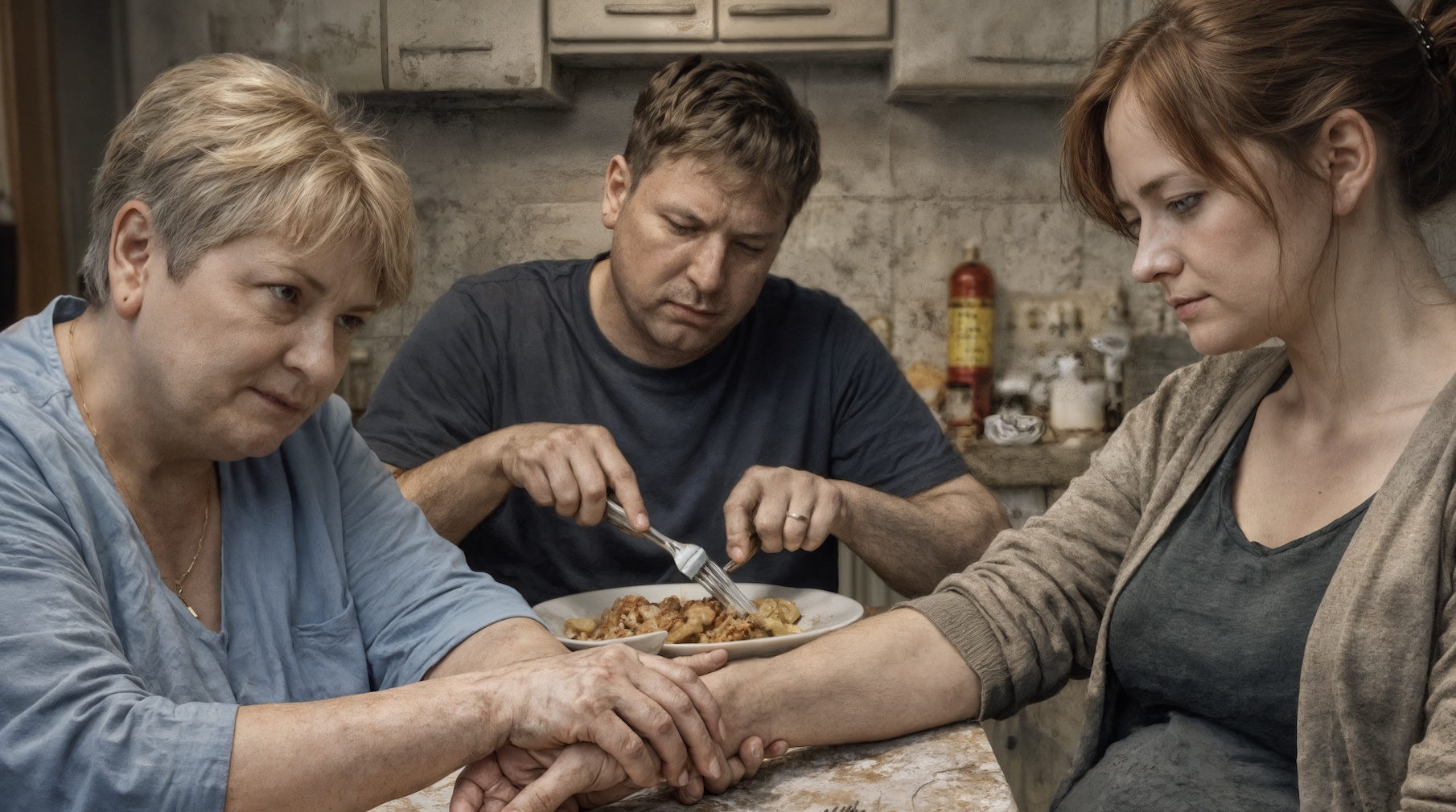
Marina stood in the middle of the kitchen and watched her husband, Oleg, carve off a piece of juicy pork chop with pure enjoyment. The smell was so rich it made her stomach cramp—she was eight months pregnant, and she wanted that meat so badly. Her hemoglobin had been dropping for three months straight. The doctor had prescribed iron and insisted she eat more beef, liver, and pomegranates.
Marina reached out with her fork toward the shared platter.
“Uh-uh, sweetheart—where are you going?” an old hand clamped around her wrist.
Her mother-in-law, Lidiya Ivanovna, peered at her over her glasses with that smile you want to scrub off with sandpaper.
“You can’t have that, Marinochka. It’s fatty, it’s fried. You’re already swollen—look at your legs: stumps, not ankles! What did the doctor say? Diet!”
She slid another plate toward Marina. A boiled zucchini sat on it like a punishment.
“Here. Eat this. Vitamins, fiber—good for the baby.”
“Lidiya Ivanovna, I need protein. I’m hungry. A zucchini doesn’t fill me up.”
“Hunger isn’t your aunt—you’ll live,” the older woman snapped, serving herself a second helping of meat. “I carried two children on nothing but potatoes and I was fine. They grew up strong. But you women today only think about your bellies. Oleg—tell her!”
Marina looked to her husband—her Olezhek, her supposed надежда и опора. A mid-level manager who loved lecturing about how the man is the head of the pack.
“Marin, Mom’s right,” he said. “You’ve really… gotten big. It’s hard for you to walk, and the swelling… It’s bad for the baby. Eat vegetables—you’ll both be healthier.”
At that moment the baby kicked hard under her ribs, as if he, too, was offended: “Are you serious, Dad?”
Marina watched the two people closest to her devour the meat—bought, by the way, with shared money—while she, carrying the heir of that “head of the pack,” choked down bland zucchini.
That evening she didn’t cry. She ate the zucchini in silence, but somewhere deep inside—where unconditional love for her husband used to live—a tiny, cold crystal of ice appeared.
They lived in a rented two-bedroom apartment and split the bills. Marina was a music teacher, and before maternity leave she worked herself to the bone: school lessons, private students, side gigs at concerts. She knew the value of every ruble, and she had one goal—her “Sacred Stash.”
Marina was terrified of pain and humiliation. The horror stories her friends told—about being in the on-call shift where staff scream at you, “Stop yelling—wasn’t painful spreading your legs!”—made her break out in cold sweat. So she saved up for a paid birth: a private room, an epidural, a doctor who would hold her hand instead of insulting her.
The money sat in a little box on the top shelf—her insurance against hell. Three weeks before her due date, she went to her husband.
“We need to go sign the contract. I’ve saved sixty thousand. Please add ten—taxis, the hospital bag, small stuff.”
Oleg sat at the computer playing tank games. When he heard the word “money,” he didn’t even turn around.
“Marin… there’s something.”
“What ‘something’?”
“There’s no money.”
“What do you mean, no money?” Her voice shook. “You got a bonus last week. And where is my sixty thousand? It was in an envelope!”
Oleg finally turned, as if doing her a favor.
“Mom needs dental work, Marin. Her bridge basically collapsed, she can’t chew, she’s in pain. I gave her everything.”
For a second, the world tipped.
“You gave my money—the money for childbirth—to your mother’s teeth?” Marina whispered, because her voice was gone. “And me? How am I supposed to give birth—in the hallway?”
Lidiya Ivanovna appeared in the doorway, wiping her hands on a waffle towel, looking ready for battle.
“What are you yelling for? Big princess!” she barked. “You’ll lie in a shared ward—your crown won’t fall off. I gave birth in a field, cut the cord with a sickle, and I survived! Teeth are health. I need to chew so I can babysit my grandson.”
“You will not be babysitting my son,” Marina said quietly.
“What did you say?” her mother-in-law shrieked. “Oleg! Did you hear how she talks to your mother?”
Oleg grimaced.
“Marin, seriously—three days in the hospital, you’ll manage. We’re family. We help each other.”
Family. The word echoed in Marina’s head. Family is sharing your last crust of bread. But when a husband takes his wife’s safety net so his mother can comfortably eat her cutlets—that isn’t family. That’s parasitism.
But the point of no return wasn’t even that. It came a week later.
It was deep night. Marina’s heartburn was torturing her, so she got up for water. The kitchen door was ajar. Cigarette smoke drifted out—her mother-in-law was smoking by the window again, though Marina had begged her a hundred times not to. And there were whispers.
Marina froze.
“Oh, sweetheart, just look at her,” Lidiya Ivanovna hissed. “Dark hair, shifty eyes—looks like some gypsy nonsense. And you’re fair, you take after the Morozovs: blue eyes, pale skin.”
“Mom… Marina’s Russian too,” Oleg protested weakly.
“Russian, Russian… I know those musician girls! Tours, concerts, drunken banquets—she fooled around, Olezhek, I’m telling you, she fooled around.”
“Mom, don’t start…”
“I’m not starting, I’m opening your eyes! Look at the ultrasound. The doctor said the nose is big, and you have an aristocratic nose—thin! We’ve never had noses like that in our family. Are you going to feed someone else’s kid? Work your whole life for чужое семя?”
Silence hung in the air. Marina stood in the dark hallway, her hand pressed to her belly.
Protect me, she begged in her mind, speaking to her husband. Tell her to shut up. Throw her out. Come on!
“I don’t know, Mom…” Oleg sighed. “I’ve thought about it too, the timing is kind of… weird. And that nose.”
“There!” his mother whispered triumphantly. “Listen to your mother. She’ll give birth, then we’ll see. If he’s dark or big-nosed, write a refusal immediately. We’ll do DNA. I won’t let you raise a bastard.”
“Fine,” Oleg muttered. “We’ll look at the baby. If there are doubts, we’ll do a test. I didn’t sign up to raise someone else’s child.”
Marina didn’t burst into the kitchen or throw a fit. She went back to the room, lay down on the sofa—her mother-in-law had long taken over the bed because her “back hurt”—and stared at the ceiling until morning.
In the morning, as soon as Oleg left for work, Marina opened the box and took out the only thing she still had of real value: her grandmother’s heavy gold bracelet, old imperial style, about thirty grams. She’d saved it for a black day.
That day had arrived.
She pawned the bracelet and got thirty-five thousand. It wasn’t enough for a paid delivery, but it was enough to buy the truth. She didn’t go to a baby store for a crib—she went to a federal lab.
“Non-invasive prenatal paternity test. Rush.”
“That’s expensive, miss,” the receptionist warned, eyeing Marina’s huge belly and cheap puffer coat. “Twenty-five thousand.”
“I don’t care,” Marina said. “That’s the price of my freedom.”
The birth was hell. They brought her to an overcrowded maternity hospital. Six women lay in the labor ward—someone screaming, someone praying. The doctor came once every three hours. The midwife was nasty: “Why are you yelling? Should’ve thought earlier when you were spreading your legs.”
Twelve hours of pain, humiliation, and terror—but Marina endured it, clenched her teeth, and held onto one thought only:
I have to survive. Take my son and leave.
When the baby finally cried, the midwife plopped him onto Marina’s belly.
“A boy. Eight pounds six. Healthy.”
Marina looked at her son. He was beautiful. And he was Oleg’s copy—same eyes, same chin. Only his skin looked slightly darker, yellowish—normal newborn jaundice.
“Well, that nose is dad’s,” the midwife snorted. “Like a potato.”
Marina gave a bitter little smile.
Discharge day.
Marina stepped out onto the maternity hospital steps, swaying with weakness. Her face was gray, dark shadows under her eyes. Down below, on trampled dirty snow, stood Oleg holding three pathetic carnations wrapped in plastic. Next to him was Lidiya Ivanovna in a brand-new fur coat—apparently, the teeth could wait.
A little farther off, near a car, stood Marina’s parents. They had come from another city as soon as they heard she’d given birth. Marina had told them not to approach Oleg until she came out.
Oleg walked toward her with a fake smile.
“Well—congrats on the heir! Let me see him!”
Lidiya Ivanovna swooped in like a hawk, rudely tugging back the blanket.
“Let’s see… oh!”
She recoiled theatrically, a gloved hand flying to her mouth.
“Olezhek! Look!”
“What?” Oleg leaned in.
“He’s black!” his mother shrieked. “Look at the skin! A gypsy! And the nose—like a potato! We’ve never had that!”
Oleg blinked, confused, staring at his son—but he wasn’t seeing a baby. He was seeing everything his mother had poured into his ears for months.
“Marin…” he looked up at his wife. “He really… looks kind of dark. And not like me.”
“It’s jaundice, Oleg. Half of babies get it. It will pass in a week.”
“Jaundice!” his mother snorted. “Sure, keep telling yourself that! It’s a different bloodline, I warned you! Don’t you dare put your name on him. Demand DNA—right now! We’re not taking that into our home!”
People around them started to stop—other couples, a photographer, nurses. The scene was grotesque: a new mother with a baby in her arms, and a mother-in-law screaming about “cheating.”
Oleg hesitated. He was ashamed, but his mother’s voice was louder than his conscience.
“Marin, I’m sorry…” he forced out. “But Mom’s right—let’s do the test for peace of mind? We’ll stop at a clinic right now, I’ll pay. I can’t do it any other way… you understand… I need to be sure.”
Marina’s father stepped forward, fists clenched, ready to smash his son-in-law into the asphalt.
“Dad, stop!” Marina snapped.
She handed the baby to her mother and unzipped her bag.
“I knew you’d say that, Oleg.”
“What?”
“I heard your conversation in the kitchen two weeks ago—about me ‘sleeping around,’ about ‘a bastard,’ about writing a refusal. I heard everything.”
She pulled out a document folded into quarters, stepped close, and looked him straight in the eyes.
“You made me give birth in hell after you handed my delivery money to your mother for her teeth. You fed me tasteless zucchini while you stuffed your face with meat. You talked about me like I was trash behind my back. And now you’re doubting me?”
“Read it,” she barked. “Read it out loud.”
“Probability of paternity…” Oleg began, his voice trembling. “99.9%. Biological father: Morozov Oleg Sergeyevich. Date of test: ten days ago.”
His mother snatched the paper from his hands, scanned it, her face mottling red.
“It’s fake!” she screeched. “She paid for it! Photoshopped it!”
Marina didn’t even look at her. She looked only at her husband.
“It’s from a federal lab. There’s a QR code—verify it. And now listen carefully.”
She stepped back toward her parents’ car.
“You, Oleg, will see your son only if the court allows it. Child support—twenty-five percent of all your income, including bonuses. Plus a fixed amount for my support until the child turns three. I already spoke to a lawyer. You’re going to pay us nearly half of what you earn.”
“Marin…” Oleg turned white. “Marin, come on… we got heated… we made mistakes… We’re family.”
“Family?” Marina smiled—small, sharp—and that smile scared him. “Family is sharing your last piece of bread. Not eating steak while your pregnant wife goes hungry. You made your choice. You chose your mother’s teeth. So live with her.”
“Let’s go, Dad,” she said, climbing into the car.
Marina’s father gave Oleg a look so cold Oleg’s shoulders hunched. The car pulled away.
Oleg stood there holding three miserable carnations in one hand and a paternity report in the other. His mother screamed after the departing car, flailing her arms, but her shrieks drowned in the city noise.
Two months passed.
Marina lived with her parents in another city. The baby’s jaundice cleared within a week, and now he was a tiny copy of Oleg—same eyes, same nose. Only Marina hoped he’d take his character from his grandfather instead.
The doorbell rang on a Saturday morning. Oleg stood on the doorstep—thinner, hollow-eyed, dark circles under his eyes. In his hands: huge grocery bags and a bouquet of roses.
“Marin…” he started in a sugary voice. “I brought food… good meat, tenderloin, like you love. Fruit. And money—here.” He held out an envelope.
“Mom understands now, Marin. She won’t interfere anymore. She was just worried… Forgive me? Come back. I’m the father. I miss you.”
Marina stood in the doorway—calm, beautiful, with a new, steel strength in her eyes. From the kitchen came a stunning smell: her father was grilling steaks on an electric grill.
“Thanks, but no,” Marina said evenly. “We’re not starving.”
“Marin… you can’t do this. You’re ruining a family over a piece of meat?”
“Not over meat, Oleg,” she replied. “Over the fact that you betrayed me when I was at my most vulnerable. You’re not a man—you’re an extension of your mother.”
She pulled a big red apple from her robe pocket and took a loud, crisp bite without breaking eye contact.
“You know, I eat what I want now. And nobody counts the bites in my mouth or checks my ankles for swelling.”
“But my son…”
“The child support arrives on time—good job. Keep it that way. Visits happen on the schedule the court approved. The next one is in two weeks, with me present.”
She began to close the door.
“Marin, I love you!” Oleg shouted in desperation, trying to wedge his foot into the doorway.
“Move your foot,” Marina’s father said calmly from behind her.
Oleg jerked his foot back.
The door shut.
Marina walked back into the kitchen. Her mother rocked the baby, humming softly. Her father placed a juicy medium steak onto Marina’s plate.
“Eat, sweetheart,” he said. “You need strength.”
Marina smiled, cut off a piece, and for the first time in a year, she felt truly full— and completely free.