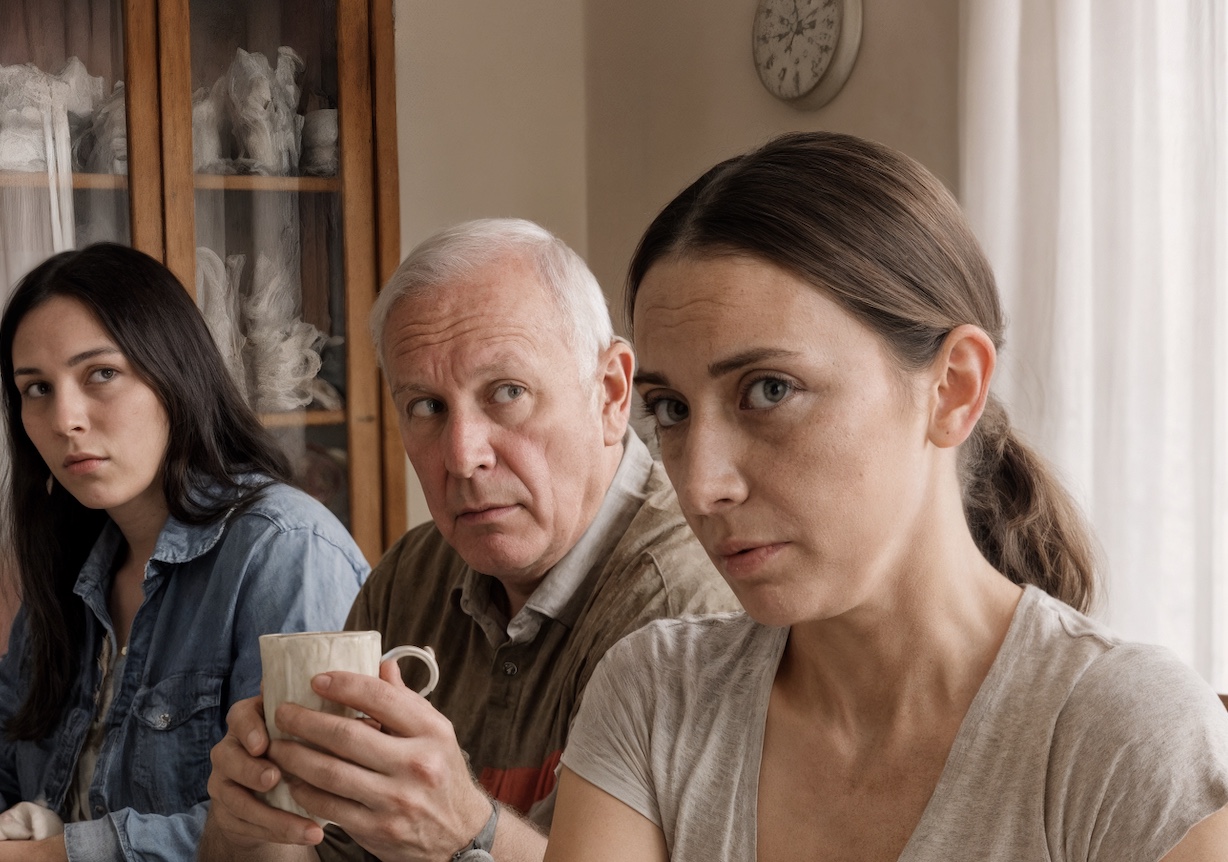
The sun had only just begun to reach into the cramped kitchen of a typical two-bedroom apartment—one Tanya had bought with a mortgage three years earlier. Winter kept pushing in through the windows, but the radiators worked faithfully, filling the place with a steady, cozy heat. Tanya sat with a mug of coffee, sorting through bills spread across the table. Checking the household budget every Saturday morning had become her own quiet ritual. At thirty-eight, an accountant with fifteen years of experience, she approached money with the seriousness and meticulousness of someone who didn’t believe in “it’ll work out somehow.”
Her phone buzzed on the table. It was only eight o’clock, and yet her sister’s name was already lit up on the screen. Tanya let out a slow breath, gathering herself. Vika didn’t call for no reason—especially not this early.
“Hey, Tan,” Vika cooed in a syrupy voice. “Did I wake you?”
“No, I’ve been up for a while,” Tanya said, taking a sip of coffee, waiting for the inevitable.
“Listen, I’ve got this problem… Katya’s school said we have to pay for a class trip. I completely forgot, and they’re leaving tomorrow. Four thousand… You know how it is—payday’s still a week away.”
There it was. Another request.
Tanya glanced at the neat columns of numbers in her notebook. Her monthly budget was planned down to the last ruble: the mortgage, utilities, groceries, transport. A small amount was set aside for a summer vacation—the first one she’d hoped to take in three years.
“Alright. I’ll send it,” Tanya replied curtly, making a note. “When will Katya be back?”
“Monday evening,” Vika said, relief finally slipping into her voice. “Thank you, Tanyush! You understand—I’m doing it for my kid. I don’t want her to feel like she’s missing out.”
When the call ended, Tanya opened her banking app and transferred the money. It was already the third time she’d “helped out” this month. First it had been antibiotics for Katya, then an unexpected washing machine repair. Vika always knew exactly how to serve a request: You’re the older one… You get it… Just this once.
Tanya remembered how it had started. Five years earlier, Vika had divorced her husband and ended up alone with her daughter. Back then, the asks were real emergencies—food, medicine, clothes for a growing child. Tanya couldn’t refuse with her sister crying and her niece looking so quietly miserable. And she didn’t want to refuse. Tanya earned good money, lived alone, and could afford to help people she loved.
A week later, when Tanya dropped by their mother’s place, she found Vika there with a brand-new handbag.
“That’s really pretty,” Tanya said before she could stop herself.
“Right?” Vika lit up. “I grabbed it on sale at Liniya—only six thousand! Sometimes I want to spoil myself too.”
Something tightened inside Tanya. Six thousand for a bag—after “not having enough” for the school trip just a week earlier? She stayed quiet, not wanting to spoil the atmosphere.
The door opened and their mother walked in—Irina Pavlovna, an energetic sixty-three-year-old with carefully styled gray hair.
“Tanechka’s here!” she exclaimed warmly. “Perfect timing—I baked vatrushki, your favorites.”
Over tea, the conversation drifted exactly where it always drifted: money.
“Vika told me you’ve been helping her,” Irina Pavlovna said, resting her hand on her eldest daughter’s shoulder. “Good girl. That’s how family should be. You’re like the man of the family now—good salary, responsible.”
“Mom, Vika has a stable job too,” Tanya said, startled by the comparison.
“But she has a child!” her mother objected, shaking her head. “And anyway, it’s harder for a woman. What do you make, Vik?”
“Twenty-five,” Vika shrugged.
“See?” Irina Pavlovna turned to Tanya. “And you—what is it, around sixty thousand?”
“Mom, I’m a chief accountant. That’s a serious position with serious responsibility,” Tanya said, feeling uncomfortable that her income was now family conversation.
“Exactly!” Irina Pavlovna declared as if she’d proven something. “So you should help. Family is responsibility.”
Tanya sat there, stunned by how matter-of-fact her mother sounded. When had helping stopped being a choice? When had it turned into an obligation?
Spring brought fresh requests. Vika called to ask Tanya to pay for Katya’s English courses—twelve thousand for six months. Then she wanted a new smartphone for herself “so I can be reachable for work.” By June, their mother joined in: fix the refrigerator, replace the kitchen window.
Every time, Tanya reached for her wallet or opened her banking app. Every time, she caught those expectant looks. Every time, she heard the same magic phrase: You get it.
Then came the day management announced they were cutting bonuses because the company was struggling. Tanya’s income dropped by a third, while her essential payments stayed the same. She’d have to tighten everything—maybe even give up the vacation.
That evening, Vika texted:
“Hi! I need your help. Katya wants to go to a seaside camp with her class. The trip is 35k. I can pull together half, but the rest… you know how important this is for a child.”
Tanya stared at the screen. Seventeen and a half thousand—that was exactly what she’d been saving for her own vacation.
“Have you had a vacation recently?” her coworker Svetlana asked when she noticed the dark circles under Tanya’s eyes.
“Three years ago,” Tanya rubbed her temples. “I just can’t seem to get away.”
“Work or money?” Svetlana asked gently.
“Both,” Tanya said vaguely. “And… family circumstances.”
“I get it,” Svetlana nodded. “My brother’s the same. The minute payday hits, he’s calling to ‘borrow.’ But I drew a line ages ago. Love is love, but money is labor and time. No one has the right to control your resources unless you choose to give them.”
Those words stuck. No one has the right.
Tanya remembered every moment she’d handed money over without thinking. Every time she’d postponed her own plans. Every time she’d traded comfort for guilt.
Vika called three times, but Tanya didn’t pick up. That evening another message arrived:
“What’s going on? Why aren’t you answering? Are you helping with the camp or not? Katya already told everyone she’s going!”
Tanya took a deep breath and typed:
“Not this month.”
Her phone blew up with replies:
“Are you serious?”
“What am I supposed to tell Katya?”
“I thought I could count on you.”
“You’ve gotten spoiled. You used to be different.”
That last line hit hardest. No thanks for everything before. No understanding. Just accusation.
The next morning, Irina Pavlovna called.
“Tatyana, what do you think you’re doing?” her mother snapped. “Vika cried all night! Katya was dreaming about that camp!”
“Mom, they cut our bonuses,” Tanya said evenly. “I can’t help the way I used to.”
“But it’s for the child!” Irina Pavlovna steamrolled on. “Can’t you endure a little? You’ve spent your whole life thinking only about yourself!”
Something inside Tanya cracked. Only about myself? After years of constant help? After all the silent transfers?
“Mom, let’s talk later,” Tanya said, ending the call before her mother could continue.
Two days later, the family gathered for their second cousin Aunt Klavdiya Mikhaylovna’s birthday. Tanya didn’t want to go, but refusing would only give them another reason to talk.
The aunt’s living room was crowded with relatives. The table sagged under food. Tanya chose a seat in the far corner, hoping to be invisible. But when it was time for gifts, every eye swung to her.
“Where’s your present, Tanechka?” Aunt Klavdiya asked. “You usually give such wonderful things!”
Tanya pulled out a small box with silver earrings. Modest, but tasteful.
“That’s all?” her aunt said, disappointed. “Last time you gave me a whole tea set.”
An awkward silence fell. Vika sat across from Tanya, pointedly not looking at her. When tea was served, their mother said:
“Tanya, run to the store and get a cake. We don’t have enough dessert.”
Everyone looked at Tanya, waiting for her usual agreement—waiting for her, as always, to pay.
Tanya caught her niece’s gaze. Katya was watching with a strange expression—part expectation and… hope? No. Calculation. The girl already knew her aunt never refused.
The silence stretched. People waited.
“I’m not going,” Tanya said calmly, taking a sip of tea. “If we need a cake, we can chip in.”
Relatives exchanged glances. No one had expected that. Vika snorted as if Tanya had said something indecent. Aunt Klavdiya blinked, unsure how to react.
“Fine,” Irina Pavlovna pressed her lips together. “We’ll manage without cake.”
The rest of the evening dragged by in a strange, tense fog. Tanya left early, claiming she had a headache. In truth, her head really did ache—but not from physical pain, from the weight of her thoughts. For the first time in her life, she’d told her family no, and the feeling was both frightening and… freeing.
Two weeks later came another important day: Irina Pavlovna’s birthday. In recent years, that celebration had become Tanya’s unspoken job: a restaurant table reserved in advance, a gift (usually a household appliance or jewelry), cake and champagne—everything quietly placed on the eldest daughter’s shoulders as if it were inevitable.
That morning, Tanya called her mother.
“Happy birthday, Mom,” she said warmly.
“Thank you, sweetheart,” Irina Pavlovna replied, reserved. “What time are you coming? Everyone’s getting here at four.”
“I’ll be there at four,” Tanya confirmed and hung up.
At the appointed time, Tanya climbed to the second floor of the concrete five-story building where her mother lived. Her hands were empty—just a small shoulder bag and a modest bouquet of chrysanthemums. No grocery bags. No heavy gift boxes.
Vika opened the door and looked Tanya over with barely concealed surprise.
“Where’s… everything?” she blurted out.
“What do you mean—everything?” Tanya asked calmly, holding out the flowers.
“Well… the food, the cake…” Vika hesitated, unable to say the words she really meant.
“I brought flowers,” Tanya replied and walked in, slipping off her shoes.
The rest of the family was already in the living room. Uncle Kostya—Irina Pavlovna’s brother, a heavyset man with thinning hair—sat in an armchair by the window. Vika’s husband Viktor hovered awkwardly near the balcony, tugging at a shirt button. Katya, now thirteen, sat with her face in her phone. Irina Pavlovna was bustling around the kitchen.
The table looked unusually bare: a bowl of Olivier salad, sliced sausage, bread, a few pickles on a plate. No birthday cake. No signature chicken baked with cheese and potatoes that Tanya usually ordered. Not even a bottle of champagne.
“Tatyana’s here!” Vika announced, following her sister in.
“You came alone?” Irina Pavlovna leaned out of the kitchen, scanning Tanya from head to toe.
“Yes,” Tanya said. “Who were you expecting?” She kissed her mother’s cheek. “Happy birthday, Mommy. Chrysanthemums—your favorite.”
“Thank you,” Irina Pavlovna took the bouquet, but the disappointment showed in her eyes. “And… nothing else?”
Tanya pretended not to hear the hint.
“Sit down, everything’s ready,” Irina Pavlovna sighed, putting the flowers in a vase.
Everyone took their places at the table. Vika opened her purse and started counting cash, whispering something to her husband. Viktor only shrugged, as if to say, What do you want me to do?
“I didn’t think we’d have to order things ourselves,” Irina Pavlovna sighed dramatically as she served the salad. “Tanechka always organized everything.”
Tanya calmly spread butter on bread and took a bite, not reacting.
“Maybe we should order pizza?” Vika suggested, eyeing her sister. “Tan, what do you think?”
“Good idea,” Tanya nodded. “Who’s placing the order?”
“Well… you usually do,” Vika said, nudging her phone toward Tanya.
“Then let’s have you do it this time,” Tanya smiled, taking a sip of water.
A heavy pause fell. Everyone stared at Tanya, as if she’d jump up any second, apologize, and pull out her wallet. But Tanya kept eating her salad and chatting about nothing—small talk about the weather.
“Maybe we can all pitch in,” Uncle Kostya finally offered, breaking the silence. “A thousand each?”
“I’ve only got five hundred on me,” Viktor muttered.
“And I don’t have any money,” Katya said with a shrug, still not looking up from her phone.
“My pension comes in three days,” Uncle Kostya sighed.
Vika silently placed a thousand-ruble note on the table, pointedly looking at Tanya.
“Here,” Tanya said, adding her own thousand calmly. “That’s enough for a couple of pizzas.”
“But you used to pay for everything,” Vika snapped. “What happened?”
“Nothing happened,” Tanya said with a shrug. “Everyone pays for themselves. Isn’t that normal?”
“But it’s Mom’s birthday!” Vika protested.
“Exactly,” Tanya agreed. “That’s why we’re all here—to поздравить Mom. All of us. Together.”
Viktor looked almost relieved by the shift. He quickly pulled out his phone and started choosing pizzas before the conflict could flare further.
Time crawled. Conversation didn’t flow. Irina Pavlovna kept throwing wounded looks at her eldest daughter. Vika jiggled her leg under the table.
“So are we giving gifts?” Katya asked once they were done with the pizza.
“Of course,” Vika said, pulling out a small box. “Here, Mom—this is from me, Katya, and Viktor.”
Inside was an inexpensive bottle of perfume. Irina Pavlovna thanked them, but it was obvious the gift didn’t meet her expectations.
“And you, Aunt Tanya?” Katya asked, staring with curiosity.
“The flowers,” Tanya said simply. “Mom’s favorite chrysanthemums.”
“That’s it?” Vika couldn’t stop herself.
“Yes,” Tanya nodded. “Beautiful flowers for a beautiful woman.”
The room sank into a heavy silence. Tanya finished her tea, checked the time, and stood.
“I should go,” she said. “I have to get up early tomorrow. Happy birthday again, Mom.”
When the door closed behind her, the apartment went utterly quiet. Irina Pavlovna stared at the chrysanthemums in the vase. Vika tapped her fingers on the table. Viktor breathed out in secret relief. Katya finally lifted her eyes from her phone and looked around at the adults.
“What happened to Aunt Tanya?” the girl asked. “Why is everyone acting weird?”
“Aunt Tanya changed,” Vika hissed. “She used to be normal, and now… she’s gotten spoiled.”
“Looks to me like she just stopped sponsoring everyone,” Viktor said unexpectedly. “And good for her.”
“What?!” Vika spun toward him, outraged.
“What?” Viktor shrugged. “How long were we supposed to ride her back? She has her own life, her own expenses.”
“Whose side are you even on?” Vika raised her voice.
“The side of common sense,” Viktor said, for once looking his wife straight in the eye. “We’re all adults. Enough waiting for someone else to solve our problems.”
It was as if the power had been cut. The silence was so complete you could hear the old wall clock ticking. But it wasn’t electricity that had gone—it was unspoken expectations, invisible patterns the family had lived by for years, suddenly collapsing.
Tanya walked through the evening streets, breathing in the cool spring air. A strange sense of freedom filled her chest. It wasn’t that she had stopped loving her family—no, the love was still there. But the chains of silent obligation, the invisible threads of guilt and duty that had wrapped around her for years—those were gone.
Loving someone doesn’t mean paying for everything, she thought, turning up her coat collar against the wind. Somewhere deep inside, a small hope flickered: that one day her family would understand—real relationships are built on equality and mutual respect, not financial dependence.