For Elena, the last two years had been a marathon—an endurance run against death, and for a moment it felt as if she was starting to pull ahead. A complicated diagnosis. Doctors who offered no comfort. And then—hope. A new experimental treatment. A costly surgery abroad that offered a real chance.
So she began her race.
She worked herself to the bone, took any side gig she could find, and sold the few pieces of jewelry left to her by her mother. Her son, Anton, helped too. Seeing how hard she fought, he contributed what he could, even if it wasn’t much. Together they opened a savings account and gave it a name that felt like a promise: “Hope.”
Two weeks ago, they closed it.
They had reached the target amount. The money sat in her personal account, waiting to be transferred to a clinic in Germany. The surgery was scheduled for the end of the month. Elena drifted around her tiny apartment as if she’d grown wings. She had made it. She had torn a few more years of life from fate itself.
Only one thing spoiled the joy.
Her relationship with her son and his fiancée, Svetlana, had become strained. Ever since Anton announced the engagement, Sveta—ambitious, chilly, with the measuring gaze of an appraiser—had been steadily, methodically pulling him away from his mother. “Your mom babies you too much,” “We have to build our own separate life,” Elena overheard in fragments whenever she called.
The wedding news was a surprise, but a happy one. She had dreamed of seeing her son married.
“Mom! We decided to get married!” he announced brightly over the phone. “In a month!”
“My son, what wonderful news!” she said, tearing up. “I’m going to prepare such a gift for you two!”
“Don’t, Mom, really—don’t worry about it!” he laughed. “We already got ourselves a gift!”
She didn’t understand what he meant.
Not until today.
He came by that evening. Without Svetlana. But he didn’t come empty-handed—he arrived carrying an aura of Elena’s triumph, as if he’d borrowed it and put it on like a jacket. He wore an expensive new suit, smelled of costly cologne, and looked downright elated.
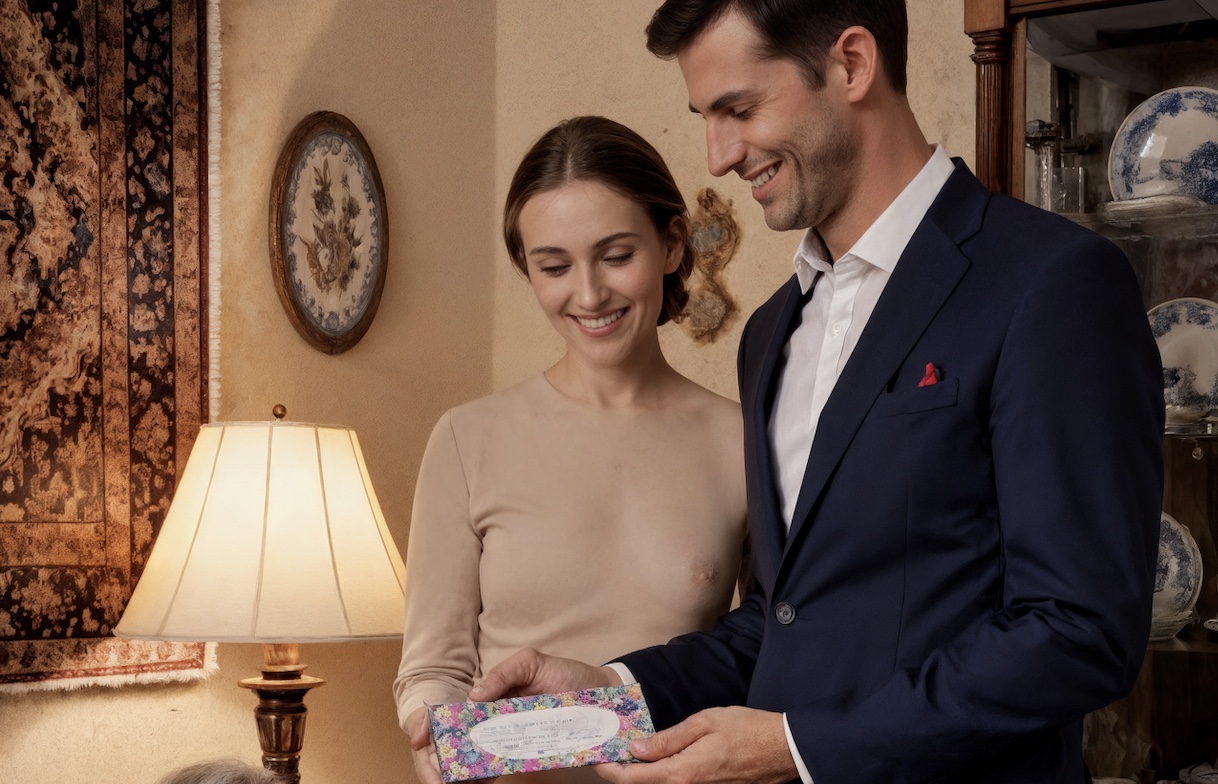
“Mom, sit down. I have two things to tell you,” he said, taking the chair opposite her and pulling a snow-white envelope from his pocket.
Uneasy, she sat.
“First,” he said with a smile, handing it over, “this is the invitation. To my and Sveta’s wedding.”
Her hands shook as she took the thick card stock. Elegant calligraphy. Embossing. Everything about it screamed money.
“And second,” he went on, his smile widening, “you don’t need to buy us a present.”
“Why?” she asked.
“Because we already took it,” he said, leaning back, pleased with himself. “We took the savings you’d set aside for your surgery.”
Silence. Only the old clock on the wall kept up its indifferent ticking. Elena stared at him—at her own son—unable to process it. It had to be some monstrous, cruel joke.
“W-what… what did you just say?” she whispered.
“I’m saying we took the money you saved,” he replied cheerfully. “This morning I transferred it from your account to ours. You gave me the passwords yourself, remember? ‘So I can help you pay bills.’ Well—consider me helpful.”
He said it the way someone might mention buying bread.
“But… what about… the operation?” she asked, and her world—so fragile, so hard-won from death—began to crack.
“And this, Mom, is the best part of our plan!” He leaned forward, eyes shining with the brilliance of his own idea. “Sveta and I thought it through. That operation—it’s so much stress for you. Flights. A foreign country. Anesthesia. Recovery. And the wedding? That’s stress too! Guests, noise, chaos. We realized you can’t possibly handle both. It would literally kill you.”
He paused, letting her “take in” the depth of his so-called concern.
“So we found the perfect solution! We decided to sacrifice your operation for our celebration. And so you won’t feel indebted, we decided that money will count as your wedding gift. And even more than that!”
He smiled—his most charming, most lethal smile.
“Consider it a payoff.”
“A payoff?” Her voice was barely there. “What do you mean, ‘a payoff’?”
“You know—buying you out of all the wedding hassle,” he explained. “You won’t have to run around stores picking out a present. You won’t have to sit through the banquet, listen to endless toasts, smile at relatives. You’re free! We’re giving you freedom! You can just stay home and look at the photos on social media. Isn’t that perfect?”
Elena stared at her son—at the man who had just delivered her a death sentence with a grin and called it a gift. He hadn’t only stolen her money. He had stolen her hope. He had stolen her future. And he’d done it not in rage, but with a light, carefree ease.
He hadn’t just robbed her.
He had traded her life for his wedding—and was completely convinced it was a good deal.
“I…” She tried to speak, but her throat seized.
“Don’t say anything, Mom,” he said, standing up. He leaned down and kissed her cold, damp forehead. “I know you’re grateful. We did everything for your own good.”
Then he left, abandoning the white envelope on the table—an invitation to his wedding.
And to her funeral.
She sat in the quiet, her body shaking in heavy, uncontrollable tremors. She looked at the invitation. Then at her phone. She knew what she had to do: call the clinic. Cancel everything. Tell them she wasn’t coming. That she had… changed her mind.
After the door closed behind Anton, Elena remained motionless for a long time. The glossy white rectangle lay on her worn kitchen table like a headstone—marking her life, her hope, her son.
She didn’t cry. The shock was so total it seemed to paralyze feeling itself. Slowly, as if in a dream, she stood and went to the phone. Her hand dialed the number of the German clinic, a number she knew by heart like a prayer. A polite, slightly nasal administrator answered in English. And Elena, in the flawless language she’d learned back in college, said what she had to say:
“Hello. My name is Elena Volkova. I was supposed to come for surgery on the 28th. I’m forced to cancel.”
“Are you alright?” the voice asked, concerned.
“No,” she answered honestly. “But it doesn’t matter anymore.”
She hung up.
That was it. The final period. The bridge to her future was burned—and the match had been struck by her own son.
The days that followed turned into a slow, sticky descent into darkness. The joint pain she used to silence with hope and painkillers—now that hope was dead—became the ruler of her body. Every step was torture. Every breath took effort. Her small apartment became a prison. She barely got out of bed. She stared at the ceiling while her life replayed itself.
She saw herself young and strong, working two jobs so her little Anton would have everything: the best toys, the best clothes, the best tutors. She denied herself everything. Her only luxury was a dream—that one day, in retirement, she’d go to Paris. She gave him all of herself, without reserve.
And now her greatest project had returned her “investment.”
He had bought himself a wedding—with her life.
The outside world reached her in scraps. Friends called and invited her out; she lied and said she’d caught a cold. Relatives called, thrilled about her son’s “wedding of the century.” She listened to their chirping and silently ended the call. They were all guests at a feast where she was the main course.
On social media she saw the photos. Anton and Sveta choosing rings. Anton and Sveta tasting wedding cake. They were beautiful, happy, radiant. Under the pictures—hundreds of likes and comments: “Perfect couple!” “Wishing you a lifetime of love!”
Not one of those people knew the price of the celebration.
She began to fade. She understood it. And she didn’t care. There was nothing left to fight for.
And then, at the very bottom of her despair, came a phone call that changed everything.
It was Marta—Elena’s old university friend who had moved to Germany twenty years earlier. They rarely saw each other now, but the bond between them had held.
“Lenka! Hi! I’m in Moscow for two days—passing through!” Marta shouted cheerfully into the phone. “Drop everything, I’m coming over right now!”
“Don’t, Marta… I don’t feel well,” Elena tried to refuse.
“That’s exactly why I’m coming,” Marta cut in.
Marta burst into Elena’s silent, sick apartment like a storm—bright, loud, smelling of expensive perfume and another life entirely: freer, wider, braver. She took one look at Elena—pale and gaunt—at the mess in the apartment, and her smile vanished.
“Alright,” she said. “Talk.”
And Elena, for the first time in weeks, told someone everything. The illness. The money. The son. The wedding. The words: “Consider yourself bought off.”
Marta listened, and her eyes grew darker with every sentence. When Elena finished, Marta was quiet for a long moment.
“I see,” she said at last. “So your puppy decided he can devour his own mother and wag his tail over her bones.”
“He’s not a puppy, he’s—”
“He’s a monster, Lena. And you’re his victim—already lying down to die. Well, I’m not agreeing to that.”
She stood up.
“We don’t have much time. But we’re going to try.”
Her plan was insane, reckless—and maybe Elena’s last chance.
Marta worked for a major German media holding company. She was a producer.
“I know a journalist,” she said, tapping quickly on her phone. “Sharp as a knife. This is his kind of story. We won’t take them to court—too slow, too dirty. We’ll give them a different kind of trial. A public one.”
The next day, a young man with a cynical expression arrived at Elena’s apartment with a camera. He spoke with Elena for two hours. He recorded everything. Elena showed her medical documents. Her bank statements. The wedding invitation.
“And now,” Marta said when they were done, “we need Act Two. Their reaction.”
Wedding day.
A glamorous restaurant outside the city. Hundreds of guests. Bride and groom—beautiful and glowing—accepting congratulations. And at the height of the party, after enough champagne has softened everyone’s senses, he appears: the journalist. Microphone. Camera. He walks straight up to the newlyweds.
“Anton, Svetlana, hello!” he says with a broad smile. “My name is Alexei, I’m a correspondent for a European news agency. We’re filming a piece about modern Russian weddings. Yours is the most lavish we’ve seen! Tell me—what’s the secret? Did your parents help?”
Blinded by the attention of foreign press, Anton and Sveta pose eagerly.
“Yes,” Anton says, wrapping an arm around his wife. “My mother helped us tremendously. She gave us the most generous gift you could imagine.”
“Really?” the journalist says warmly. “And what was it, if you don’t mind my asking?”
“She… she gave us everything she had,” Anton declares with theatrical pride. “So we could start our life beautifully. She’s a saint.”
And at that exact moment, the big screen behind them—the one that had been playing their love story in photos—switches to a different image.
Elena’s face. Close-up. Pale. Worn down. And text across the screen:
“My name is Elena. I am 58 years old. This is my son. Today he is celebrating his wedding. And I am preparing to die—because the money I spent two years saving for my surgery, he stole to pay for this banquet.”
The video lasted only a minute. No insults. No screaming accusations. Just facts. Medical reports. Bank transfers. And Elena’s quiet voice—full of pain.
The hall went rigid. The music died. Guests stared at the screen, then at the bride and groom.
Anton and Sveta turned around, watched, and their radiant faces collapsed into masks of horror.
The performance was over.
The trial had begun.
No one needed to explain anything. The guests understood instantly. People began backing away with disgust. Others pulled out phones to film. Sveta’s parents—wealthy, respectable—looked at their new son-in-law with icy contempt.
“I think we can end our report here,” the journalist said to the camera. “It seems we’ve just witnessed a very modern—and very frightening—Russian wedding.”
Then he left.
And they stayed behind—alone in the ruins of their celebration.
Elena didn’t see any of it. She was sitting in her quiet apartment, looking out the window. She knew what she had done. Was it cruel? Maybe. But it was the only way to be heard. Not by Anton—by the world.
She didn’t know what would happen next.
But she did know one thing: she was no longer afraid.
A week later, she received a call—from a German charitable foundation.
“Frau Volkova,” a German voice said, “we saw the report about you. We were deeply moved. Our board has made a decision. We will cover the full cost of your surgery.”
Elena stood holding the phone while tears ran down her cheeks—only these weren’t tears of grief. They were tears of hope.
She didn’t know if she would survive.
But she did know she would live whatever time she had left—day, month, or year—not as a victim.
As a winner.
She had lost her son.
But it seemed she had just gained the whole world.