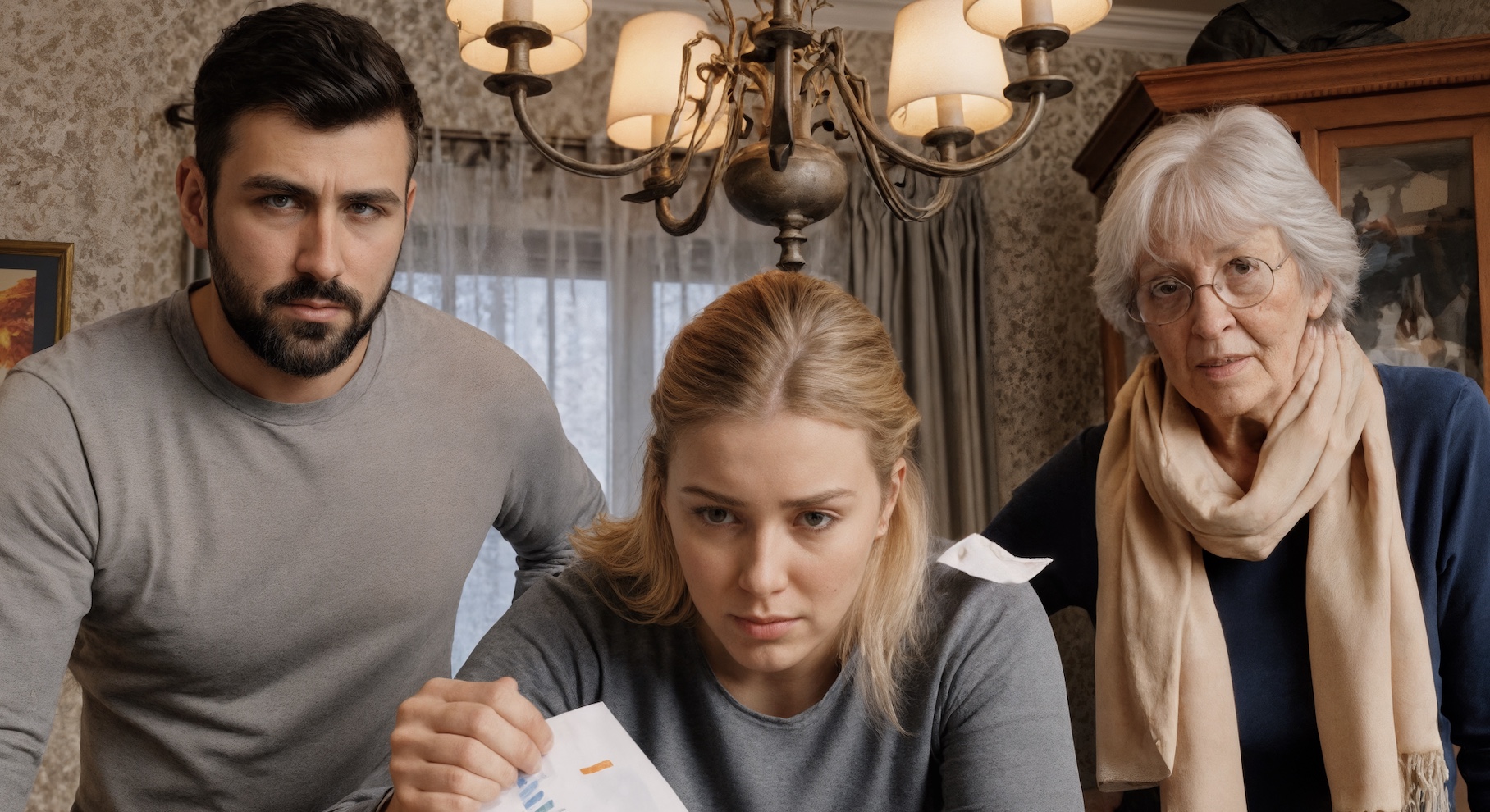
— Do you even hear me? — Sergey’s voice was stretched tight, like a string about to snap. — You seriously don’t get how important this is? Mom said the windows are dirty—couldn’t you at least wipe them down? It’s… humiliating!
Marina lowered her bag to the floor. Inside were rags, plastic sacks, and empty sour-cream tubs that Tamara Petrovna kept for reasons known only to her. The bag gave a dull clink, and the sound echoed in Marina’s chest like a hollow bell.
— I hear you, — she said without looking up. — I hear you, Seryozha. I hear you perfectly.
She was tired. But not tired of rags, not tired of bleach burning the skin on her fingers. Not even tired of her husband’s mother, whose “well, you’re the homemaker” always sounded like a sentence. This was a different kind of fatigue—thick, heavy, like lead. The kind that comes when a person stops being afraid.
Sergey didn’t see it. He saw only what he always saw: a picture where the wife owes, where “family” always tips to one side of the scales—while he and his mother stand firmly on the other.
— You don’t respect my mother! — he shouted, and his voice cracked. — She’s alone, do you understand? It’s hard for her. You have to help. It’s your duty!
Marina slowly straightened. Her spine popped, as if it were saying goodbye to something. She looked at him: tall, well-groomed, forty years old—yet with the face of a boy who didn’t get his ice cream.
And suddenly she wanted to laugh. Quietly, inside herself. At the sheer absurdity.
— Duty, you say… — she replied calmly, but each word landed like a nail. — Then let’s make a schedule.
She grabbed the grocery notebook, tore out a sheet, and sat at the table. The ink scratched.
— Your mom on the left. Mine on the right. Saturdays we scrub at your mother’s—together. Sundays, we do mine—together. Grocery runs split fifty-fifty. Clinic trips—together. Garden, dacha—together. You wash windows, I mop floors. You scrub the tub, I clean the stove.
— Wait… — Sergey hesitated. He wasn’t used to this cold, businesslike Marina. His wife had always been soft, forgiving—“fine, okay.” Now it was like a stranger was sitting at their kitchen table.
— Why together? I work, I’m tired! — he snapped, as if reciting an old, memorized line.
Marina lifted her eyes. No anger. No pity. Only level, even cold.
— I work too, Seryozha. And I’m no less tired. But if we’re family, then we split everything equally. Or—each of us handles our own mother. Choose.
She set the pen down. And went quiet.
The evening passed in silence. But not the kind of sulking that melts away with dinner and a movie. This silence was deaf and deep, like being underground.
Sergey wandered around the apartment, chewing on words he never said. Marina cooked dinner—calmly, unhurriedly, as if she were fulfilling a contract. Not a reproach. Not a request.
The next day she didn’t speak first. The third day—either. And by the end of the week Sergey realized: the familiar script had broken.
Saturday. Nine a.m.
Marina yanked the blanket off him.
— Up. According to the schedule, we’re cleaning at your mom’s today.
— What? — he tried to burrow back under the covers, but her tone left no room for bargaining.
An hour later they were already in the car. He was tight with anger. She was calm—like iced water in a glass.
Tamara Petrovna greeted them cheerfully, but her eyes offered more of a nod than warmth. She hugged her son, pressed him close, fussed over him. Marina got only a quick glance and a dry: “Come in.”
— Marin, start with the kitchen, — Sergey ordered, like a foreman on a job site. — I’ll sit with Mom.
Marina nodded. Put on gloves. And walked away.
Behind the living-room wall came laughter, the flip of an album, memories of “sweet little Seryozhenka—how he was as a child…” And in the kitchen—grease baked into tile, yellow streaks on the walls, a rag that would never come clean again.
An hour later the kitchen shone. Sergey, meanwhile, had wiped the TV.
— See? I’m helping too! — he said, squaring his shoulders proudly, like a schoolboy showing off an A.
Marina didn’t answer. She simply pressed the mop harder into the floor.
When they left, she didn’t say a word. But her eyes had a gleam—dangerous, predatory. Sergey didn’t notice. He tried to joke, to tell anecdotes. She stared out the window.
— Tomorrow at ten, my mom’s, — Marina said as she stepped out of the car. — Don’t be late.
He opened his mouth to protest. But something in her steady, quiet voice shut it for him.
Sunday.
Valentina Ivanovna was a completely different woman. Kind, warm, without theatrical sighs. The house smelled of books and fresh bread.
— Come in, kids. I baked a pie.
— Thanks, Mom, but we came to work, — Marina answered.
Sergey breathed out in relief. Sat at the table. Got tea and a slice of pie. Picked up his phone. And dissolved—as if he were a guest, not someone on a “work day.”
Marina and her mother hauled boxes, scrubbed windows, pulled out old things.
— Seryozha, help! — Marina called.
He stood up grudgingly, carried one box, and returned to his phone.
— Great job, girls! — he said later with a smile, when Valentina and Marina—sweaty and exhausted—dragged a rug out to the balcony.
“Girls.” The word turned into a blade.
Marina froze. Turned. Looked at him so sharply he actually flinched.
— We’re finished, — she said. — Mom, thank you. Time to go.
At home she walked up to him without even undressing, without taking off her coat.
— Yesterday I spent four hours on my knees at your mother’s. Today I hauled heavy things at mine. You drank tea, ate pie, and laughed. Explain this to me, Seryozha: your duty is that I serve your mother. And mine is to handle your mother, my mother, and you on top of that? How does that work?
— I… I’m tired… — he mumbled.
— Me too. But you taught me something: being tired is a reason to rest—for you. So now it’s a reason to rest for me, too.
She said it and went into the bedroom.
And Sergey stayed standing.
Alone.
It wasn’t a blowup.
It was a diagnosis.
The week after that conversation felt like a chess match with no rules. Sergey waited for Marina to “cool off.” He was used to it: first a fight, then apologies, then everything goes back to normal. But now—silence. Cold, dry silence. Marina moved through the apartment like a neighbor: cooked only for herself, washed only her own clothes, even rinsed her mug separately and set it on the rack separately.
At first Sergey laughed. “She’ll play around and stop.” Then he got angry. Then he started swinging wildly—from tenderness to commands, from pleading to accusations. Nothing worked.
It was like she’d turned off the part of herself that was “wife.”
One evening, when he came home from work, Valentina Ivanovna was standing in the entryway. Marina’s mother. A small, wiry woman in an old coat, holding a string bag.
— Hello, Seryozha, — she said calmly. — Is Marina home?
— She is, — he frowned. — But why are you here so late?
— My wiring’s acting up. The lights flicker—today it almost caught fire. I thought maybe I should call an electrician.
Sergey stalled. Normally he would’ve said, “I’ll come tomorrow and take a look.” But now the words stuck. Because he understood: if he said no, Marina would hear it. And if he said yes—he’d actually have to go.
Marina came out into the hallway, hair tied back, her gaze quiet.
— Mom, I’ll come tomorrow evening and check it. And if needed, we’ll call a professional.
— Thank you, sweetheart, — Valentina smiled. — All right, I’ll go.
She left.
Sergey looked at his wife.
— You’re going yourself? Electricity is a man’s job!
— A man’s job? — Marina gave a small, sharp smile. — You’re always tired. I’m used to it. Besides, we’re handling our own moms now, remember?
And she walked into the room.
The next day Sergey drove to Tamara Petrovna’s—not because he wanted to, but because he understood Marina wouldn’t take a single step anymore. But Tamara met him differently.
— Son, — she whined, — what’s going on with you two? Marina speaks to me so coldly now. And with you she’s become… strange. I call her—she answers briefly, in a rush.
Sergey frowned. He didn’t want to admit he’d lost control.
— Women’s moods, Mom. It’ll pass.
But inside, he felt it: something was slipping away. Quietly, but for good.
At work his coworker Oleg—a smirking guy with a divorce behind him—slapped him on the shoulder.
— Watch it, Seryoga. Be careful. When a woman cuts off her emotions, that’s worse than yelling. When she yells, she still cares. When she goes quiet—she’s already gone.
Sergey brushed it off, but the words lodged in his head.
And at home something strange was happening.
They lived together, but like neighbors. Shared the apartment and the bills. Sometimes crossed paths in the hallway: “hi,” “good evening.” Sometimes in the kitchen—she’d put a pot of soup on the stove and pour herself one bowl. He’d fry eggs—for himself, only himself.
And one day, on Sunday, Marina brought home a woman around thirty. Tall, short haircut, wearing a men’s jacket.
— Meet Lena, — Marina said. — She’s an electrician. She came to look at Mom’s wiring.
— And why bring her here? — Sergey asked, grim.
— Because I called her. Lena’s a neighbor from the next building.
Lena nodded. Smirked. There was something in her eyes that made Sergey’s skin prickle—an easy superiority, like she’d already understood everything.
— Your hallway outlet sparks, — she told Marina. — I’ll check it too.
And without asking permission from the “man of the house,” she went straight to the fuse box.
Sergey stayed silent, but inside he boiled. He suddenly realized he was becoming unnecessary—even in his own home.
That evening Marina sat on the couch, writing in a notebook.
— What’s that? — he asked.
— Budgeting. — She didn’t even look up. — If we’re neighbors now, we split everything: utilities, internet, groceries.
— Wait, what if I bought meat?
— Then it’s your meat. I bought my vegetables—so they’re my vegetables.
And she kept writing.
It all started to feel like a theater of the absurd. Sergey would come home and not recognize the apartment. She lived there as a separate person. Not a servant, not a wife. Just a neighbor. She smiled at him the way a neighbor does. Said “thank you” for the salt. And that was it.
And the calmer she was, the more he felt like… a tenant.
One night he woke up to an odd sound. Got up and went to the kitchen. And there were Marina and that electrician, Lena. Sitting at the table, drinking tea. Laughing softly—but genuinely.
— What are you doing? — his voice came out sharper than he meant.
Marina turned calmly.
— Talking about a book.
— At three in the morning?
— Why not? — Lena smirked. — Everyone has their own schedule.
Sergey went quiet. Stood there like a stranger.
For the first time he thought: what if Marina is already gone? Not physically—but in her soul.
The next day he called Oleg.
— Listen… what if your wife… well, it’s like she’s not your wife anymore?
Oleg laughed.
— Too late, brother. If you can feel that, she’s already not your wife.
That evening, sitting in his car by the entrance, Sergey caught himself thinking for the first time: What if I really am alone?
At home, Marina was talking to her mother on the phone. Quietly, calmly. But every “Mom, I’m with you” sounded like she had only one family now.
Sergey listened from the other room. And understood: the experiment was over.
Not for her.
For him.
Saturday morning. With a bright, upbeat voice Sergey announced:
— I’m going to the garage, then to football. You’ll go to your mom—on the way, stop by mine and buy groceries. I’ll leave money.
As if none of it had happened. As if their talks and the schedule were a fantasy.
Marina stood by the window, holding a mug of cold tea. She turned slowly. Her face was calm, almost gentle—but in that calm there was no space left for him.
— No, — she said.
— What do you mean, “no”? — irritation jumped into his voice, like he was talking to a child refusing to put on a hat.
— I mean I’m done taking care of your mother.
She picked up that very sheet with the schedule—creased, stained with coffee, forgotten on the windowsill. And tore it. In half. Then again. And again. The pieces drifted to the floor like snow.
— Our “Family” project is closed, — she said evenly, like an announcer. — The experiment showed that “partnership” for you means I work, and you merely attend. Well, this app is no longer supported. It’s been deleted.
Sergey went pale.
— What are you even saying? — he tried to raise his voice, but Marina lifted a hand.
— Don’t. From now on, everyone lives for themselves. Your mother is your responsibility. Mine is mine. I’m not your wife. I’m your neighbor. We split the bills and the square meters. That’s all.
Her voice was firm, without hysteria. And that was more frightening than any screaming match.
The following days he ping-ponged. First he tried to soften her: brought flowers, suggested dinner. Then he attacked: “You’re selfish! You ruined the family!” She looked at him steadily, with tired pity.
And then something happened that he didn’t expect.
One evening Tamara Petrovna walked into the apartment. No doorbell. No warning.
— Sergey! — her voice rang with outrage. — What am I hearing?! What is this nonsense? Marina refused to help me! You allowed that?!
She stood in the entryway, heavyset, with a bag and a scarf, smelling of mothballs and dill like a thick cloud.
Marina stepped out of the room. Calm. In jeans and a sweater.
— Yes, I refused, — she said. — Now it’s only you and your son. These are your relationships.
Tamara gasped.
— Ungrateful! I treated you like a daughter—
— No, — Marina cut in. — You never accepted me like a daughter. To you I was a maid. Well, the maid quit.
Sergey stood in the middle of it all, pale—like a teenager caught with a failing grade.
— Mom… — he started.
— Quiet! — Tamara screamed. — Your wife is a cold-hearted egoist! How did you let this happen?!
Marina turned and went into the kitchen. Calmly. As if it no longer concerned her.
That night Sergey understood: the house had split down the middle. His mother demanded the return of the “proper wife.” Marina quietly began separating her things in the closet onto different shelves. The word “we” vanished from their vocabulary.
And the louder Tamara shouted, the calmer Marina became.
One morning he woke up and saw a note on the kitchen table:
“I live here, but not with you. We share space, not a life. I am not yours. I’m your neighbor. You did this.”
Underneath—her handwriting, neat and even.
He sat with that note in his hands and understood for the first time: there would be no scandal. No chance to rewind.
She had left the game.
And the longer the silence stretched, the louder it became.
The End.