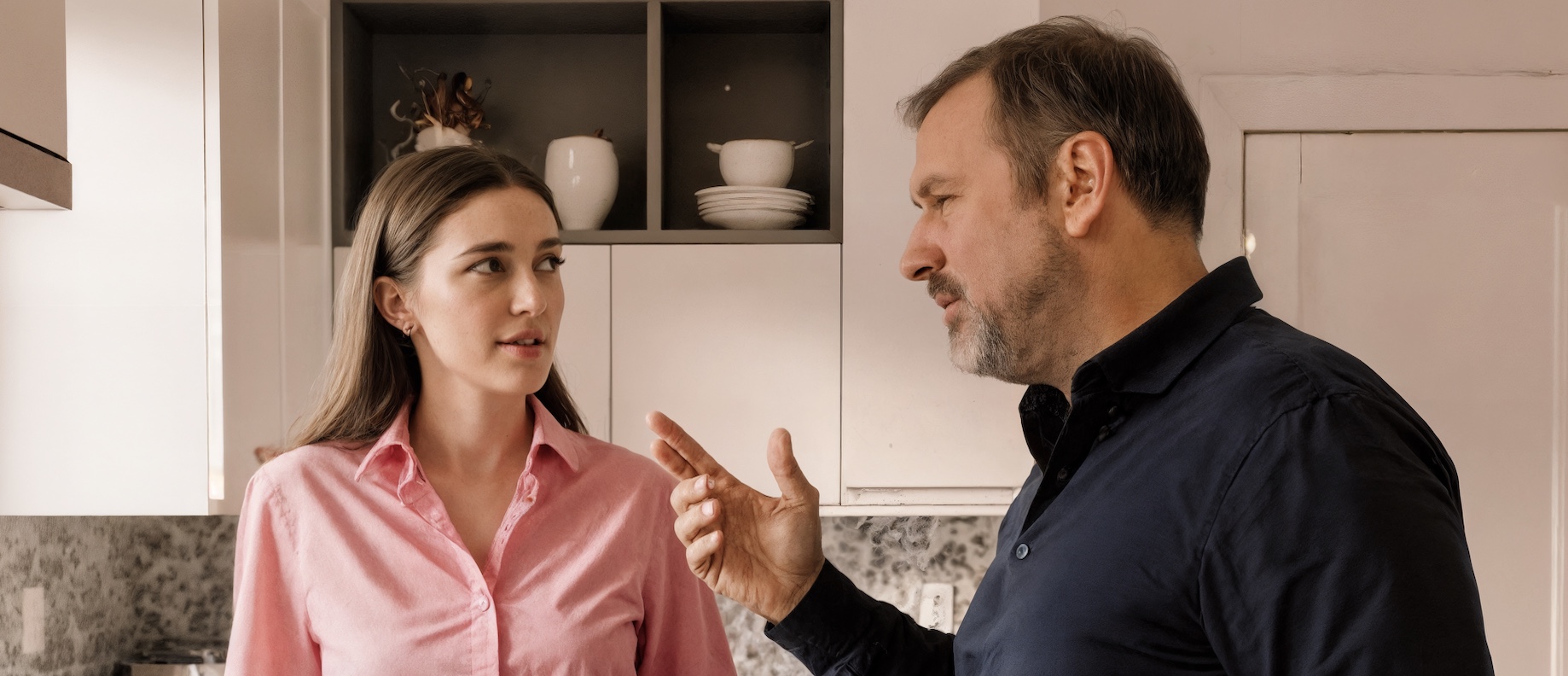
Ira noticed Andrey’s phone had lit up for the third time in the last half hour. He didn’t even glance at the screen, still chewing his mashed potatoes like a machine. She knew who was calling—knew with the same certainty you can predict rain from the heavy clouds hanging outside.
“It’s Lyudmila,” she said, not as a question.
Andrey looked up, and something that resembled guilt flashed in his eyes—mixed with irritation.
“How do you know?”
“Because she always calls right before she wants something. And because you’re scared to answer.”
He set his fork down and finally looked at the display. A fourth call. He sighed as if someone had just demanded the impossible of him, and picked up.
“Lyuda, hi… What happened?”
Ira didn’t bother pretending she couldn’t hear. Lyudmila’s voice was so loud that her words burst through the speaker—hysterical, demanding. She was crying. Again. Ira had long since lost track of these tears. Lyudmila cried when no one loaned her money. She cried when she wasn’t invited on vacations. She cried when Andrey couldn’t drive across the city to pick her up at two in the morning. Tears were her all-purpose weapon, and she wielded them like a professional.
“Lyuda, calm down… Yeah, I understand… Of course—come over…”
Ira felt something inside her turn to ice. Come over. That one phrase meant chaos was about to charge back into their lives wearing her husband’s sister’s face.
Andrey ended the call and sat in silence for a moment, staring at his plate.
“Igor left her,” he finally said. “She’s in a meltdown. Said she can’t be alone.”
“And?”
“I told her she could stay with us for a couple of days. She really has nowhere to go.”
Ira pushed her plate away. Her appetite disappeared instantly, as if it had never existed.
“A couple of days,” she repeated quietly.
“Yeah. Just until she calms down and figures out what to do next.”
“Andrey, we both know it won’t be just a couple of days.”
He looked at her with reproach, and Ira read everything in that glance: you’re heartless; you don’t understand; she’s my sister; how could I refuse her when she’s struggling. All those unspoken accusations hung between them—thick and sticky, like a web.
“She’s going through a divorce,” he said at last, and his voice carried that defensive edge Ira heard every single time Lyudmila was involved. “She needs support.”
Ira wanted to argue. She wanted to remind him of the last time Lyudmila moved in “for a couple of days” after a fight with her previous boyfriend—and stayed three weeks. She wanted to say his sister had long learned how to live at other people’s expense, shifting every crisis onto her brother’s shoulders. She wanted to shout that they had their own life, their own plans, their own space.
But she said nothing.
Because she knew: in any battle between wife and sister, Andrey always chose his sister. Not because he loved her more, but because his sister carried a stamp of obligation—guilt, duty, some strange responsibility rooted in their childhood, in a place Ira could never reach.
Lyudmila arrived an hour later with two enormous bags and eyes swollen from crying. She burst into the apartment like a hurricane, threw her arms around her brother’s neck, and sobbed so loudly the neighbors could probably hear every word.
“He left! He just packed his stuff and walked out! Said I smothered him with my love! Can you believe that?!”
Andrey patted her back, murmuring soothing nonsense. Ira stood off to the side, watching the scene with an odd sense of distance. Lyudmila was only a year older than her, yet she behaved like she was sixteen—infantile, eternally in need of rescue, incapable of handling life on her own. And there was always Andrey, ready to lend money, fix problems, offer his shoulder.
“Irishka, could you put the kettle on, please?” Andrey asked, not even looking at her.
Ira went to the kitchen obediently. She filled the kettle, took out cups, and felt a dull irritation building inside her. Why was she the one expected to serve a woman who believed the world owed her everything? But she stayed silent. She always stayed silent.
Over tea, Lyudmila recounted the details of her breakup. Igor was an “egoist,” “cold,” “incapable of real feelings.” Ira listened and thought about how, two years earlier, when Lyudmila first met Igor, he’d been a “prince on a white horse,” “the perfect man,” “destiny.” Now he was a villain—like all the others before him.
The pattern was polished: fall in love, idealize, demand more and more attention, push the man to the boiling point, get rejected, declare him a monster—then run to her brother for comfort.
“Lyuda, did you eat anything today?” Andrey hovered with concern.
“I can’t eat. There’s a lump in my throat.”
“You have to eat something. Ira, can you make sandwiches?”
And again it was Ira, make it. Not I’ll do it, not I’ll go. Just Ira, do it. Because that’s what a wife is for, right? To serve her husband’s family, to solve their problems, to sacrifice herself on the altar of “family ties.”
She made the sandwiches. Put them down on the table. Lyudmila ate three, drank sweet tea, and asked for more. The lump in her throat seemed to have vanished.
Days turned into weeks.
Lyudmila settled into their living room and turned it into her private bedroom. Ira woke up at six to make it to work and tried to move quietly so she wouldn’t wake her sister-in-law. But Lyudmila woke up on her own—around eleven—and that’s when her day began. She’d shuffle out in a robe, wearing an unhappy expression, and immediately announce that there was “nothing normal” in the house.
“Andryush, is this the only cottage cheese you have? I don’t eat this. I’m allergic.”
“You’ve never been allergic to cottage cheese,” Andrey said carefully.
“Well, I am now! With this divorce, my health is falling apart!”
And Andrey would go to the store for different cottage cheese. Then a different yogurt. Then special bread. Then vitamins Lyudmila saw in an ad. The list of demands grew, and Andrey obediently catered to every whim.
Ira came home exhausted, dreaming of quiet and peace, and froze in the doorway. Loud music blasted. Lyudmila was laughing on the phone as if no divorce had ever happened. In the kitchen there was a mountain of dirty dishes because “Lyuda had no strength” and Andrey “was working late.”
Which meant Ira would be the one washing.
“Irishka,” Lyudmila would appear in the kitchen doorway, “can I invite my friends tonight? We need to discuss something important.”
Could she say “no” in her own apartment?
Apparently not—because it would sound “heartless,” because “Lyuda needs her girlfriends,” because “it won’t be long.”
The friends arrived at nine and stayed until one in the morning, loudly dissecting awful men while drinking the wine Ira had bought with her own money. Ira lay in the bedroom with her face pressed into the pillow, thinking this had to be some kind of absurd joke. She’d become a hostage in her own home.
Whenever she tried to talk to Andrey about it, he looked at her as if she were proposing to throw his sister onto the street in the dead of winter.
“She’s having a really hard time,” he repeated like a prayer. “Let’s just endure a little longer.”
“Andrey, it’s been three weeks.”
“So what? She’s my sister. I can’t abandon her now.”
“And what am I—part of the furniture?”
“Don’t start. You can see what state she’s in.”
What state? The one where she demanded special groceries, hosted late-night parties, spent an hour in the bathroom using all the hot water, and dictated what everyone watched on TV?
That state?
But Ira said nothing again. She was tired of fighting. Tired of trying to break through. She knew it wouldn’t happen.
And then the notary called.
Aunt Vera had died a month earlier, and only now did Ira learn she’d left her an inheritance: an apartment in a good neighborhood and a solid amount of savings. Aunt Vera had no children and lived alone. Ira had been the only relative who visited, helped, cared. And now that care had come back to her as an unexpected gift.
Ira sat in the notary’s office with the documents in her hands and couldn’t believe it.
An apartment. Money. Freedom.
A chance to start over, if she ever needed to.
She came home in a lifted mood. For the first time in weeks, she actually felt like smiling. The entryway smelled of pie, and for a moment she was surprised—did Lyudmila cook? Impossible.
But in the kitchen it was Andrey, pulling a tray from the oven. Lyudmila sat at the table flipping through a magazine.
“You’re back!” Andrey looked unusually excited. “How did it go?”
“Fine,” Ira said cautiously. “I was at the notary.”
“And?”
“Everything’s finalized. The apartment and the money are mine now.”
She expected her husband to be happy for her—to hug her, to say something warm.
Instead, Andrey’s face lit up. He actually clapped his hands.
“Perfect timing with your inheritance!” he exclaimed. “My sister could really use an apartment right now!”
Ira went still. His words hung in the air, and for a few seconds she couldn’t even grasp what they meant.
Then it hit her.
“What did you just say?”
“Come on, think about it,” Andrey said, so absorbed in his bright idea he didn’t notice her expression changing. “Lyuda has nowhere to go. Igor kicked her out. And now—what luck! You get an apartment and Lyuda can live there. It’s the perfect solution!”
“The perfect solution,” Ira echoed, her voice sounding strange even to herself. “To give your sister my inheritance.”
“Not give—let her stay. Temporarily. Until she gets back on her feet.”
Lyudmila looked up from the magazine, and the triumph in her eyes—her absolute certainty that she was entitled to this—made Ira feel sick.
“Andryusha’s right,” her sister-in-law chimed in. “It really is perfect timing. I mean, I wouldn’t want to impose, but since it worked out this way… God, I’ve dreamed of having my own place! Can I pick the wallpaper for the bedroom myself? And we need new furniture—your aunt probably lived in some old Soviet-style interior.”
Ira stared at them both—at her husband, glowing with pride at his “genius,” and at his sister, already decorating someone else’s apartment in her mind—and something inside her snapped.
A thin thread of patience she’d been pulling for years finally broke.
“No,” she said quietly.
“What do you mean, ‘no’?” Andrey blinked.
“No. I’m not giving Lyudmila the apartment. It’s mine. My inheritance.”
Silence fell.
Andrey stared at her like she’d slapped him.
“Ira… are you serious?”
“Completely.”
“But… she’s my sister! She has nowhere to go!”
“She’s thirty-four, Andrey. Thirty-four. She’s an adult. She can work, rent a place, deal with her own life. I’m not obligated to support her.”
“Support her?” Lyudmila sprang up, her face twisting. “You think I’m using you?”
“Yes,” Ira said calmly. “That’s exactly what I think. You use your brother. You live at his expense, you demand, you throw tantrums, you set rules in someone else’s home. And now you’re reaching for my inheritance. No. Enough.”
“Andryusha!” Lyudmila sobbed, and on cue the tears poured out. “Did you hear what she said? She’s throwing me out!”
Andrey’s gaze darted between his sister and his wife, and Ira saw it—the moment he chose. Saw his face harden, his lips press into a thin line.
“How can you be so selfish?” he breathed. “My sister is in trouble and you’re thinking only about yourself!”
“Only about myself?” Ira laughed, and the sound was bitter. “Me, who put up with your sister in my home for three weeks? Me, who washed her dishes, made her meals, cleaned, stayed quiet when I wanted to scream? I’m selfish?”
“You’ve always been cold,” Lyudmila cut in, wiping her tears. “I told Andryusha you weren’t the right kind of wife. A real woman should be warm, caring, family-oriented. But you… you only care about money.”
“Money?” Ira felt rage boil up inside her. “What money? The money I earned honestly? The inheritance from the aunt I loved and took care of? And what have you earned, Lyuda? What do you have to be proud of besides your ability to manipulate your brother?”
“She’s going through a divorce!” Andrey raised his voice. “She’s depressed! She needs help!”
“She’s not depressed,” Ira snapped. “She’s living like a parasite. She’s used to you fixing everything for her. And you let her. You’re ready to sacrifice our marriage so your sister can keep living off other people.”
“What are you saying?”
“I’m saying I’m done. Done being last. Done with your sister being the priority in our family, not me. Done with being exploited.”
“Exploited?!” Lyudmila screeched. “How dare you! I’m not asking anything for myself! I just need support!”
“You demand everything for yourself,” Ira said wearily. “Special cottage cheese, special bread, hot water, silence when you want to sleep, a party when you want entertainment. You live here like a queen, and Andrey and I are your servants. And now you want an entire apartment. For free. Because it would be ‘nice to have.’”
“I’m your sister!” Lyudmila shouted at Andrey. “How can you let her talk to me like this?”
Andrey looked at Ira, his eyes full of anger and confusion.
“Ira, if you don’t give Lyuda that apartment, I… I don’t know if I can forgive you.”
The words landed like a sentence.
Ira stared at her husband and saw a stranger. Had she really spent years with a man who could issue an ultimatum over his sister’s whims?
“Alright, then,” she said slowly. “You choose your sister.”
“I’m not choosing! I just want you to be more human!”
“More human?” Ira laughed again. “You know, Andrey, I wanted you to be more human too. To notice my needs. To protect me instead of your sister. To see me as your wife, not your household staff. But apparently that’s asking too much.”
She turned and walked into the bedroom. Pulled out a bag and began packing. Her hands shook, but she forced herself to move slowly, methodically: jeans, shirts, documents, toiletries.
Andrey stormed in.
“What are you doing?”
“Leaving.”
“You can’t leave!”
“Yes, I can. And I am. I’m not living in this circus anymore.”
“Ira, wait… Let’s talk calmly.”
“About what, Andrey? About how I’m supposed to hand my inheritance to your sister? About how I’m supposed to keep tolerating her demands? About how in your value system I’m dead last?”
“That’s not true! I love you!”
“You love the idea of me,” Ira corrected. “You love a convenient wife who doesn’t cause problems—who cooks, cleans, stays quiet, and fulfills your family’s wishes. But the real me—with feelings, needs, and the right to my own life—you don’t see. And I don’t think you ever have.”
“You’re exaggerating!”
“No, Andrey. I’m finally seeing it clearly. For years I bent and adjusted and sacrificed. And what did I get? A husband who, the moment I receive an inheritance, doesn’t think about us—about our future—but about how his sister can benefit from it.”
She zipped the bag and looked at him. His eyes were filled with confusion and a childish hurt. He genuinely didn’t understand what he’d done wrong.
“Where will you go?”
“To a hotel first. Then to Aunt Vera’s apartment. I’ll live there. Alone. For once, I’ll have a home where no one uses me.”
“So that’s it?” Andrey’s voice wavered. “You’re destroying our family over an apartment?”
“Not over an apartment,” Ira said tiredly. “Because in our ‘family,’ I don’t exist. There’s you, your sister, and a convenient empty space that’s supposed to serve you. That isn’t a family, Andrey. That’s exploitation.”
She took her bag and walked out.
In the living room, Lyudmila sat there—no longer crying, but scowling with anger.
“Leaving?” she tossed out. “Good. Nobody’s stopping you.”
Ira paused at the doorway and looked at her.
“You know, Lyuda, I hope one day you grow up. Learn to take responsibility for your own life. Stop being the eternal victim of circumstances. But I’m not waiting for that day. Because I’m thirty-two, and I want to live my life—not be a prop in yours.”
“You’ll regret this!” Lyudmila shouted after her. “Andryusha won’t forgive you!”
Ira closed the door and stepped onto the landing. The air felt fresh—almost intoxicating. She inhaled deeply and felt a heavy weight slide off her shoulders.
Down below, the evening city hummed: cars, people, glowing shop windows. Ordinary life rolling on, indifferent to anyone’s drama. Ira caught a taxi and gave the address.
In the car, she pulled out her phone and stared at the screen. Not a single message from Andrey. Not one call. He wasn’t trying to stop her. He wasn’t running after her, begging her to come back. Because at that very moment he was probably comforting his sobbing sister—assuring her she wasn’t at fault, that Ira was simply “strange” and “cold.”
Oddly enough, it didn’t hurt.
Inside, everything felt empty—but the emptiness wasn’t heavy. If anything, it felt freeing. As if she’d finally shed a skin that had been too tight for years.
In her new apartment, Ira sat on the bed and looked out the window. The city blinked with lights. This was her apartment now. Her home. Her life.
And Lyudmila could stay with her brother—keep demanding, keep crying, keep manipulating. Only now it wouldn’t be Ira’s problem.
She pulled Aunt Vera’s photograph from her bag: an old black-and-white snapshot, Vera smiling—young, beautiful, full of life.
“Thank you,” Ira whispered. “Thank you for giving me freedom. I won’t let you down. I promise.”
And in that moment she knew: for the first time in years, she’d made the right choice. A choice to live for herself, not for other people’s expectations. It was scary.
But it was necessary.
Her phone buzzed. A message from Andrey: “Come back. Please. We’ll talk everything through.”
Ira looked at the screen and tapped “delete.”
There was nothing to talk about. She had already made her choice.
And that choice was herself.