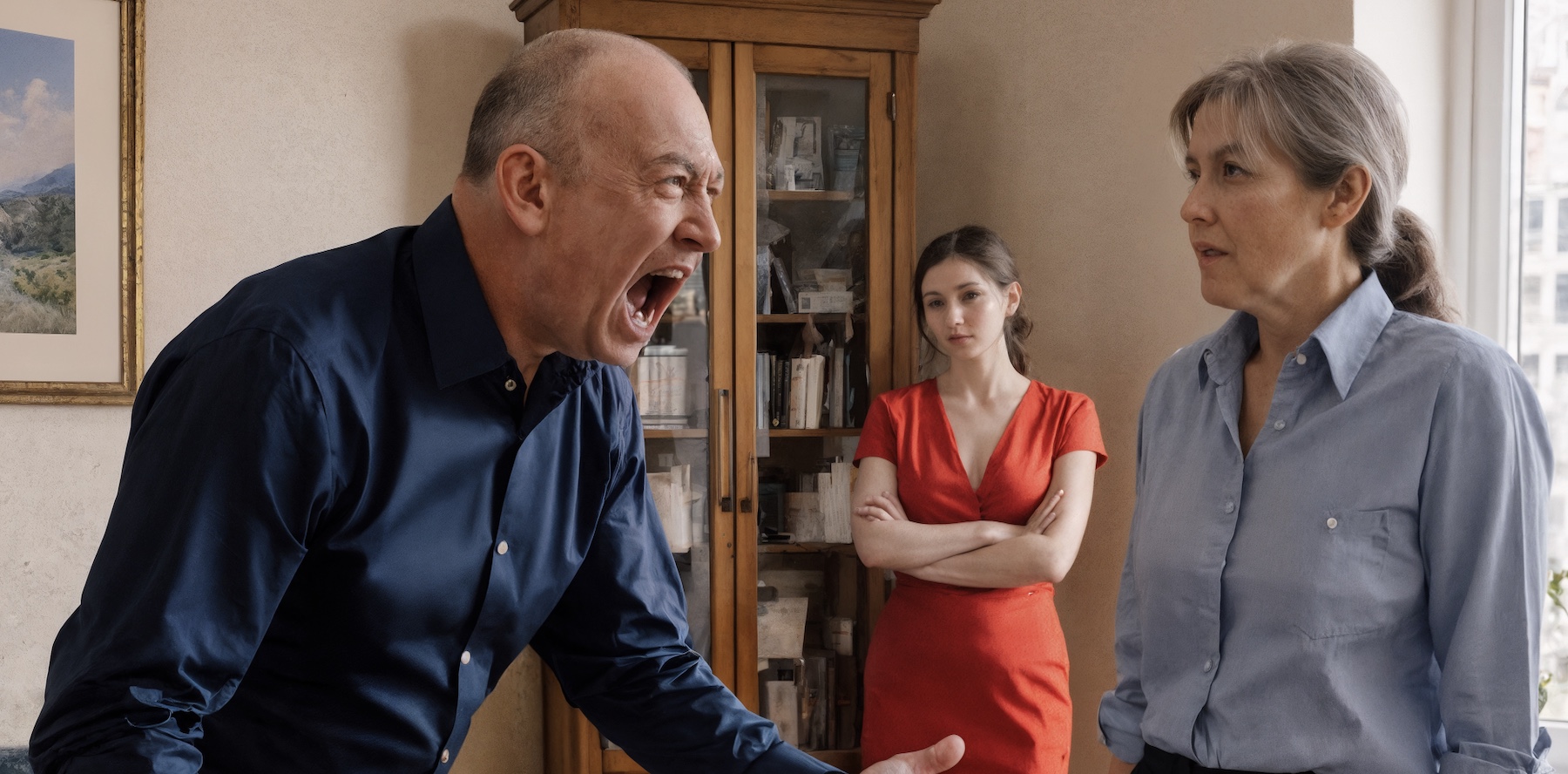
Gleb slammed the keys onto the table so hard they rang against a ceramic vase.
“And what are you moaning for?” he barked. “Yeah, I cheated on you—but I’m happy now! And I’m taking the house and the car. I’m tired of your hysterics, you get that? I put up with it for thirty-two years. I’m done.”
Inga stood by the window with her back to him. Beyond the glass, the first October snow was falling—wet, sticky, turning instantly into dirty slush. Just like this whole life, she thought. It starts out so beautifully, and then… Her fingers tightened around the edge of the sill, then released—what was the point of holding on to something already collapsing?
“The car too, then…” Her voice came out oddly level. “The one I paid off for five years while you were ‘building your business’?”
“Don’t start!” Gleb snapped, raising his voice. “I’m the breadwinner in this family!”
“You were.” She turned around. Forty-nine. Gray streaks at her temples, fine lines at the corners of her eyes—yet her gaze… Gleb shivered. He’d never seen that look on her face. Not tears, not pleading, not even rage. Something else. Cold. And very calm.
“Pack your things by Sunday,” he threw over his shoulder and walked out, slamming the door.
Inga stayed by the window. The snowfall thickened. Her phone buzzed—Tamara, her work friend: “How are you? I saw yours outside Shokoladnitsa with a redhead. Hang in there.”
A redhead. Twenty-eight years old. His secretary at the office. Inga had known for about three months. First it was lipstick on his collar. Then the constant “I’ll be late from work.” And one day she saw a text: “Miss you, bunny.” Bunny. Her husband had turned into “bunny” for a girl young enough to be his daughter.
And the apartment… A four-room place near Akademicheskaya. Twelve years ago they’d put it in his name to get a lower mortgage rate—Gleb’s income statement looked more impressive. Back then she agreed because they were family—what did it matter whose name was on the papers?
Inga walked into the kitchen and poured herself a glass of water. Her hands weren’t shaking. Strangely enough. Something inside her had clicked, like a switch flipping. Thirty-two years of marriage. Two grown children. A mountain of shared memories—and here he was, standing across from her, declaring he’d take everything. And that he was happy.
The next morning, Inga didn’t go to work. She went downtown. The law office was in an old Stalin-era building near Chistye Prudy. A woman around fifty-five in a crisp, severe suit listened closely, occasionally making notes.
“So the apartment is in his name, and the car as well,” Eva Borisovna said, leaning back in her chair. “Any savings?”
“Two accounts. One in my name—one hundred thirty thousand. I was putting it aside for the grandchildren. The other is in his name, but I thought… I mean, the money was ours…” Inga trailed off.
“You thought you were a family,” the lawyer said with a nod. “I understand. But the law is on your side. Everything acquired during the marriage is split fifty-fifty, regardless of whose name it’s under. We’ll need documents that show your contribution to the household.”
“I’ve worked as an accountant for thirty years…”
“Perfect. Bank statements, income certificates, receipts for major purchases—everything helps. And one more thing,” Eva Borisovna added, studying her carefully. “If you have proof of his affair, it can influence how things go.”
Inga left the office feeling like a different person. A plan began to take shape—clear, step-by-step. She called Tamara.
“Your nephew works in IT, right? Can you ask him for a small favor?”
Gleb came back three days later, cheerful and pleased with himself, smelling of unfamiliar perfume.
“I’ve been thinking,” he began, sprawling lazily on the couch. “Let’s do this without court—nicely. You leave the apartment to me, I sign the car over to you. And I’ll throw in a hundred thousand on top. Fair, right?”
“A hundred thousand,” Inga repeated. “For thirty-two years.”
“Oh, you always exaggerate…” He grimaced. “I’m not throwing you out on the street. You can rent a little one-bedroom somewhere on the outskirts. You don’t need much.”
“And where will you live?”
He smirked. “None of your business. But if you’re curious—I’ll buy a new place. Something more spacious. This one’s old anyway. Needs renovating.”
Inga didn’t speak. She looked at him and thought—how did she not see it before? The vanity. The arrogance. Or maybe she did see it… and endured it. For the kids. For peace. For the illusion that things would get better.
“No,” she said quietly.
“What do you mean, no?”
“I’m not agreeing to your terms. I filed for divorce. We’ll divide everything through the court.”
Gleb’s face flushed red.
“Have you lost your mind?! I’m offering you a decent deal!”
“That’s not decent, Gleb. That’s bullying.” Inga stood up. “And yes—I know about the second account. The one you opened last year in your mother’s name. You transferred one and a half million there.”
He went pale.
“How do you—”
“Doesn’t matter. What matters is that money is marital property too. And it will be divided as well.”
The court proceedings began in November. A gray building on the outskirts, peeling paint in the corridors, the stale smell of bureaucracy. Gleb brought his lawyer—a young, aggressive man in an expensive suit. Inga came with Eva Borisovna.
The first hearing was mostly procedural. But Inga noticed it—Gleb was nervous. He’d clearly expected her to fold, to get scared, to accept his terms.
After court, Eva Borisovna suggested they stop at the café across the street.
“We have a strong position,” she said, pouring tea. “Especially since you’ve documented your job and your contributions. And those transfers to his mother’s account—an obvious attempt to hide assets.”
“And the apartment?” Inga wrapped her hands around the warm cup. “Could I lose it?”
“No. At worst, the court orders him to pay you half the value. But more often, they divide it in kind—sell it and split the proceeds.”
Inga nodded. The home… their home, where the children were born, where birthdays were celebrated, where she hung wallpaper, chose curtains, planted flowers on the balcony. Now it was just square meters that had to be divided.
Gleb declared war. He called the kids, complaining that their mother was “stripping him clean.” He told friends how “greedy and cruel” Inga was. He even made a social media page about her and posted nasty things.
Their son stayed silent. Their daughter called.
“Mom, what’s going on? Dad says—”
“Dad says what’s convenient for him, Nastya.” Inga didn’t go into details. “The court will decide.”
“But he wouldn’t really kick you out…”
“He was planning to do exactly that.”
Silence on the line. Then a quiet: “Mom… if you need help…”
“Thank you, sweetheart. I’ll manage.”
And she did. She went to work, gathered documents, met with her lawyer. In the evenings she sat in the emptied apartment—Gleb had moved in with his redhead—and drank tea by the window. She watched the city lights and the life that kept flowing, indifferent to other people’s dramas.
The second hearing was intense. Gleb’s lawyer argued that Inga “didn’t contribute,” that “the husband earned everything,” that she had “lived off him.” Eva Borisovna dismantled every claim methodically—producing certificates, statements, witness accounts.
“Your client worked for thirty years,” she said dryly. “Her salary was comparable to her husband’s income. She paid for groceries, children’s clothing, utilities. This is confirmed by documents.”
Gleb squirmed in his chair. The redhead sat in the courtroom, meeting his eyes for support. Inga saw her—thin, flashy, with provocative nails. A girl playing adult games.
The judge announced a recess until the following week.
Outside, Gleb grabbed Inga by the elbow.
“Stop. Enough already! You’re ruining me!”
She pulled free.
“You’re ruining yourself. I just want what I earned.”
“What you earned!” He sneered. “You lived in my apartment, drove my car—”
“Ours, Gleb. That’s called ‘ours.’ Forgot the word?”
He stepped closer, looming.
“You’ll regret this…”
“You already regret it,” Inga replied evenly. “You just don’t know it yet.”
The third hearing was decisive. The judge read the ruling: the apartment and the car were marital property and would be divided equally. The savings accounts as well. The account opened in Gleb’s mother’s name was recognized as an attempt to conceal assets; the funds would also be split.
Gleb’s face turned purple.
“This is unfair!”
“This is the law,” the judge cut in.
The apartment was sold. Gleb could have bought out Inga’s share, but he didn’t have the money—half of the “hidden” funds also went to his ex-wife.
Inga received her portion in cash and bought a two-bedroom apartment near Yugo-Zapadnaya. Not big, but hers. Completely hers.
A year passed.
Inga stood at the window of her new place—without Gleb, without his things, without his presence. Outside, snow was falling. The same wet October snow.
Her phone buzzed. A message from Nastya: “Mom, Dad and that woman… they broke up. He says she ‘used’ him. Can you imagine?”
Inga smiled to herself. She could. More than he knew.
She poured a glass of wine and sank into the armchair by the window. The city glittered with lights. Below, people hurried along—each carrying their own joys and sorrows, victories and defeats.
And she sat in her own apartment. Alone, but not lonely.
Free.
And happy.