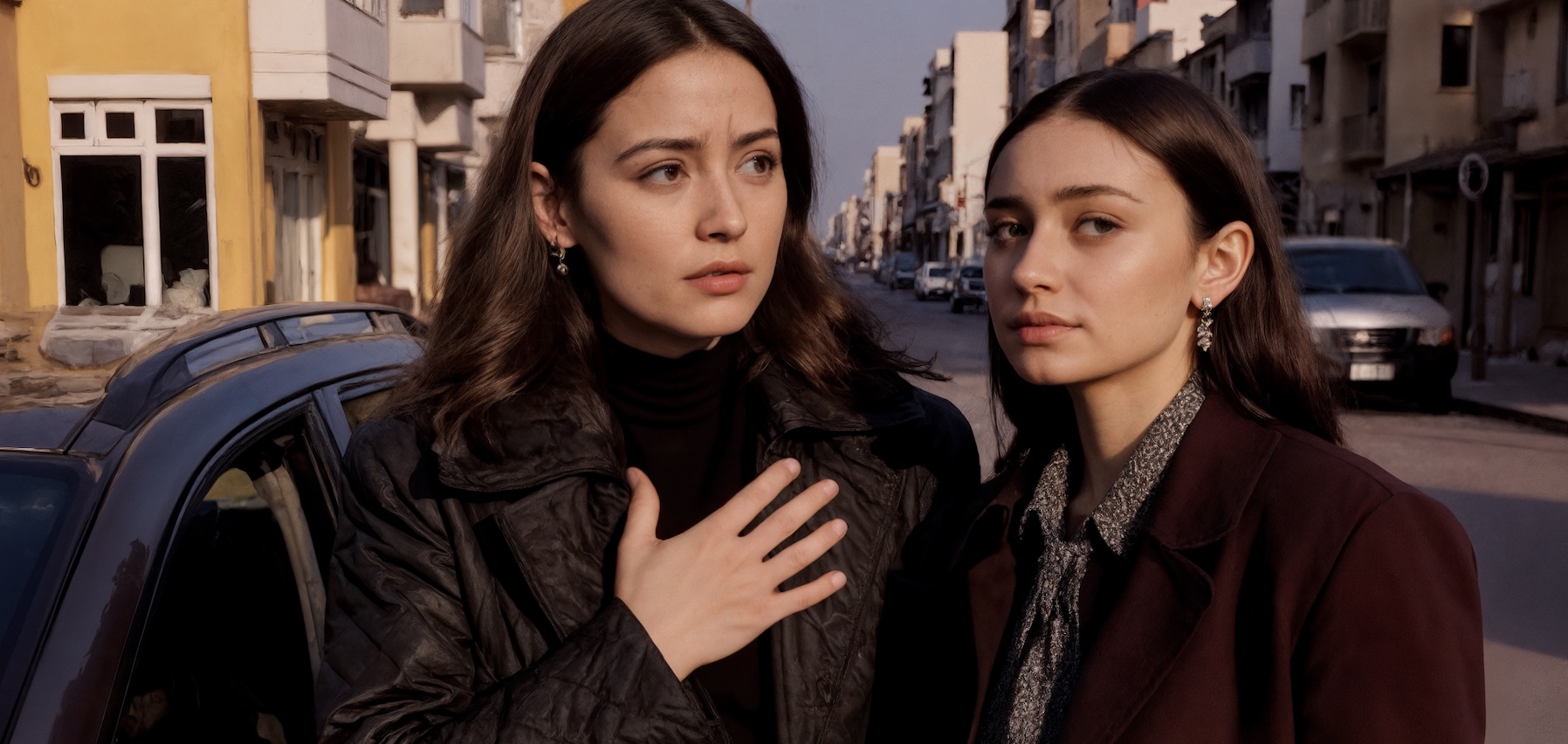
The last client was running late, and Polina had slipped out of her schedule—her own schedule, carefully built for herself. She was already imagining the rest of the evening: stopping by her favorite supermarket near home, picking up fresh salmon for dinner and a bottle of that sauce Artem adored. It was Friday, after all. She was allowed to exhale.
She could almost feel the warmth of the steering wheel under her fingers, already looking forward to a calm drive with her favorite podcast playing. The car—bright red, gleaming even beneath a gray autumn sky—was her little island of freedom and independence. Not just transportation. Her parents’ gift was bigger than a car. It was their faith in her, in her success, their pride in a daughter who stood firmly on her own feet. They had saved for that foreign car for years, denying themselves things along the way, and Polina knew it. To her, it wasn’t a possession. It was love—shaped into metal and glass.
Her key was already in the ignition when the phone rang. Artem flashed on the screen. Polina smiled.
“Hi, love. I’m on my way. Should we buy salmon?”
“Hold off on the salmon,” his voice sounded strange—tight, forced. “Listen, I’ve got a small question for you.”
Polina’s shoulders tensed. He used that voice when he was about to ask for something inconvenient.
“Katya called. She urgently needs to get to the airport to meet some important client. She doesn’t want to pay for a taxi, and the metro with suitcases isn’t an option. Can you give her a lift?”
Something in Polina’s chest dropped. Katya. Artem’s sister. The one for whom “urgent” was a permanent state of being, and other people’s plans were just annoying obstacles in her way.
“To the airport?” Polina repeated, forcing her voice to stay steady. “Artem, that’s the opposite direction from home. I literally just left work, and traffic is awful right now. She’ll get stuck, she’ll be late, and somehow it’ll be my fault. Let her take a taxi—I’ll chip in for half if she needs.”
“Why are you nickel-and-diming?” Artem laughed, but the laugh was fake. “You have a car! What’s the effort? She’s blood, not some stranger. You’re supposed to help family.”
The words rang in Polina’s ears—that phrase. “You have a car.” As if owning a car automatically meant she was obligated to be a personal driver for his entire family.
“Artem, my parents bought that car for me,” she said, and her voice finally hardened. She felt goosebumps prickle up her spine as anger rose. “For my needs. For my work. Not so I can drive your sister around for her sudden whims.”
Heavy silence settled on the line.
“What do you mean, ‘not for that’?” Artem protested, his tone flipping from pleading to accusing. “So now we’re dividing things in the family—yours and mine? Is my sister a stranger to you? It’s awkward, Polina! I practically told her you’d pick her up.”
That was the last push—the argument that finished her off. He had promised. In her name. Without asking.
“No, Artem,” Polina said flatly, staring at the reflection of her decisive eyes in the rearview mirror. “I’m not going. And tell Katya I’m not a taxi she can summon whenever she wants. Let her solve her own problems.”
“Why are you screaming?” his voice cracked into a shout. “It’s one ride! A few pennies of gas! What, you don’t respect yourself?”
“It’s you who don’t respect me!” Polina shot back, gripping the phone so hard her knuckles whitened. “Neither you nor your sister. My parents bought this car for my personal needs—not to drive your sister around. Understand?”
She ended the call without letting him say another word. Her heart hammered up in her throat. Her hands trembled. She looked around at her car—her little cozy space that smelled of a new interior, the soft floor mat, the plush teddy bear on the dashboard her mother had given her “for luck.” And someone outside of it—someone in her own life—was treating this small world of hers like shared property, like a service they could demand.
She took a deep breath and turned the key anyway. The engine started with a quiet, confident purr. She pulled away—but the evening she’d been looking forward to was gone. In its place sat a heavy, sticky anxiety. She knew this was only the beginning. That phone call was just the first warning. And somewhere deep inside she understood: the fight over the steering wheel—and her right to say “no”—had officially started.
The evening was ruined beyond repair. The salmon she bought at the nearest shop, without any enthusiasm, tasted bland. The silence at the table was thick and tar-like. Artem stayed glued to his phone, pretending he was reading something important. Polina could feel his resentment in waves—almost physically. But to back down, to be the first to start a conversation, would mean admitting she was wrong.
And she wasn’t wrong. That thought warmed her from the inside and gave her strength to stay quiet.
She was washing dishes when the intercom buzzed. Not a phone call—an actual, insistent ring at the door system. Artem wandered over lazily, pressed the button—and his face changed instantly.
“Mom?” Surprise and an unspoken question mixed in his voice. “What are you doing here? I’ll open up.”
Polina froze, a plate in her hands. A cold streak slid down her spine. Galina Ivanovna. Her mother-in-law. Eight o’clock on a Friday night. No warning. Nothing about that promised anything good.
A minute later the apartment filled with expensive perfume and cold autumn air. Galina Ivanovna—a woman with a perfect, severe hairstyle and a piercing gaze—took off her coat and, like a hostess in her own home, draped it over a chair. She swept the room with an appraising look, as if checking whether her personal order had been violated.
“I was in the area,” she announced, settling on the sofa and placing her purse neatly on her knees. “I decided to stop by. How are things here?”
Her gaze locked on Polina in the kitchen doorway. The question was clearly meant for her.
“Everything’s fine,” Polina said softly, feeling like a schoolgirl called to the principal’s office.
“Fine?” The mother-in-law lifted perfectly shaped eyebrows. “I don’t think so. Artem told me a few things.”
There it was. It had begun.
Artem stood by the window, pretending he couldn’t hear, studying something outside with exaggerated focus.
“Mom, don’t…” he tried weakly, but she stopped him with a look.
“Quiet, son. This is a women’s conversation.”
She turned back to Polina, wearing the tired expression of a woman who’d seen it all and now had to sort out the foolish quarrels of young people.
“Polina, I don’t understand you. Why are you digging your heels in like a stubborn mule? One ride. Your husband’s sister. Is that really such a tragedy? In a family everything should be shared—joy and hardship alike. Cars too. Otherwise what kind of family is it? A fake one.”
“Galina Ivanovna, it’s not about sharing,” Polina began, trying to keep her voice level. “It’s about respecting my time and my plans. Nobody asked me—somebody ordered me.”
“Oh, what delicate ‘plans’!” her mother-in-law snorted. “Katya has an important matter—clients, business. And you, I see, are already home washing dishes. What difference does it make if you wash them now or in an hour? Helping someone is sacred. You should support your husband, not create problems out of nothing. He’s worried about his sister!”
Polina felt heat rush into her cheeks. They were trying to put her back in her place. Again. Make her the guilty one.
“I’m not creating problems. I’m simply saying I want to manage my property the way I choose.”
“Your property?” Galina Ivanovna’s eyes widened theatrically. “What is this—are you divorcing already? Dividing assets? If your parents gave it to you, that means it’s for the family now—shared. For shared needs. And our family needs are the same… unless you think yours are special?”
That argument—heard for the second time that evening—made Polina feel like she was losing her mind. The logic that something gifted personally to her automatically became property of her husband’s entire family was monstrous.
“It’s my car,” Polina repeated, feeling the last of her composure melting away. “It’s registered in my name. And I decide who rides in it.”
“And what kind of wife does that make you?” her mother-in-law shook her head with practiced pity. “Selfish. Thinking only of yourself. My son works so hard, and you can’t even help his sister. I only want what’s best for you. Peace and harmony in your home. And you’re fighting over some piece of metal.”
Polina looked at Artem. He still stood with his back to her, carefully removed from the conversation. His silence screamed louder than words. He’d allowed his mother to come and attack her. He agreed with it.
“Peace and harmony happen when people respect each other’s boundaries,” Polina said quietly, but clearly. “Not when one person is obligated to everyone, all the time.”
Galina Ivanovna curled her lips in contempt, realizing the frontal attack wasn’t working. She stood, picked up her purse.
“I can see you’re not in the mood and you’re not capable of a reasonable conversation,” she said. “I’ll go. Artem—walk me out.”
She moved toward the door without saying goodbye. Artem, like a puppy on a leash, rushed after her to help with her coat.
The door shut. Polina was left alone in the quiet kitchen, hearing blood pound in her ears. She walked to the table and picked up her car keys. A bright keychain shaped like a red heart—her mother’s gift. She squeezed it so hard the metal bit into her palm.
She wasn’t selfish.
She was under siege.
And the walls of her fortress had just taken their first crack.
A week passed. The tension cooled into a cold truce. Artem tried to be polite, even washed the dishes a couple times without being asked. He seemed to be trying to make up for his mother’s visit—without saying the word “sorry.” Polina, exhausted by the conflict, met him halfway. They even went to the movies on Saturday, and for a moment it felt like maybe things could settle.
On Wednesday Polina had a brutal day. The meeting dragged on, the client was fussy and petty. Her head was splitting. The only bright thing in the evening ahead was the thought of getting home, taking a hot shower, and making mint tea. She could practically feel the warmth of the mug in her hands.
She pulled into her courtyard, toward her usual spot by the crooked birch tree, and pressed the button to shut off the engine. Her hand reached for the seat belt—then her eyes automatically slid to the place she always left her car.
The spot was empty.
Polina blinked. Confusion turned to a thin panic. She scanned the other cars. Maybe she had parked somewhere else? No—this was her place. She drove forward, checked around the corner. Nothing.
Her heart began to hammer. A cold wave of fear ran down her spine.
Stolen.
Right from under her building, in broad daylight.
In her head she saw the whole nightmare: calls to the police, insurance, endless paperwork, the stress. Her parents… How would she look them in the eye?
With trembling fingers she dug through her purse for her phone to call Artem. Could he have taken it? But why—he had a company car.
The phone slipped from her hands and hit the floor. As she bent to pick it up, she heard an irritating, high-pitched noise. She froze.
It was a car alarm.
Her car alarm.
Somewhere very close.
She jumped out and listened. The sound was coming from behind the next entrance. She hurried over—and saw it.
Her bright red car was parked by the garbage bins. The driver’s door was wide open, and that was what kept the alarm screaming. Beside it, flailing her hands and trying to silence the siren, was Katya.
And in that same moment Artem walked out of the entrance carrying a huge cardboard box.
Polina walked toward them, barely feeling her legs. They didn’t see her—didn’t hear her—because of the wailing alarm.
“Artem!” she shouted over the noise.
He turned. First surprise flashed across his face—then an instant, guilty confusion. He fumbled in his pocket for the keys, pressed the button. The siren stopped, and an awful, ringing silence filled the air.
“Polina… you’re already here?” he tried to smile, but it looked pathetic.
“What is happening?” Her voice came out quiet and strangely calm, like it belonged to someone else. “Why is my car here? And why is Katya trying to steal it?”
“I’m not stealing it!” Katya snapped immediately. “I just couldn’t figure out your stupid alarm! Artem, tell her!”
Artem set the box down, exhaled heavily.
“Relax. Everything’s fine. Katya needed to pick up that damned wardrobe from IKEA urgently. It was the last one—they could’ve bought it. You can’t bring that on a taxi. I came earlier, gave her the keys so she could go. She’s careful! She would’ve brought it back in a couple of hours—you wouldn’t have even noticed.”
Polina listened, and the world around her seemed to turn red.
He had taken the keys.
Her keys.
From her home.
From her car.
And handed them to his sister—without asking, without warning—like it was some object he could use however he pleased.
“You… gave her… the keys to my car?” Each word cost her effort.
“Yeah,” he spread his hands, genuinely not seeing the problem. “I told you, it was just for a bit. Are you starting again?”
“What if she’d gotten into an accident?” Polina’s voice finally snapped into a scream. Inside her everything shook with rage and helplessness. “What if the car had been stolen? Who would be responsible? You? Would you have signed something saying you take full responsibility?”
“Are you out of your mind? What kind of paper? What accident?” Katya shrieked. “I’m not some idiot! I’ve been driving for ten years!”
“Shut up!” Polina whipped toward her, and Katya involuntarily stepped back. “You don’t have the right to even touch my car. Ever. Do you understand?”
Polina yanked the keys from Artem’s hand. He stared at her in genuine disbelief, as if she had lost her mind.
“Polina, have you completely lost it? Making a scene over one IKEA trip? You can’t help my sister?”
“No!” she roared so loudly the sound bounced off the buildings. “You can’t—because it’s my car! Do you both hear me? Mine!”
She spun around, got into the car, and slammed the door. Her heart was pounding, tears of fury burning in her eyes. In the rearview mirror she saw them both: Artem, confused and angry, and Katya with her lips pinched in contempt.
Polina started the engine and tore away, leaving them standing by the dumpsters.
This time it wasn’t just the beginning of a fight.
It was a declaration of war.
Polina didn’t go home. She drove through the night city without really seeing the road until she ended up on an empty embankment. She shut off the engine and sat in silence, listening to the metal cool and her own blood thud in her temples. The tears had dried long ago, leaving behind only cold, crystal-clear resolve.
They hadn’t treated her like a wife. Not like a person. They’d treated her like staff—like an attachment to the car.
She couldn’t take it anymore.
When she finally returned, the lights were on. Artem sat in the kitchen pouring himself tea. He looked at her from under his brows, ready for another round. He was prepared for shouting, hysteria, tears. His arguments were lined up. His resentment too.
But Polina was calm.
Deathly calm.
She walked into the kitchen, placed the keys on the table, and looked him straight in the eyes.
“I’m not going to fight with you,” she said evenly, quietly, without a tremor. “There are no more words. Only facts.”
He watched her with cautious confusion.
“Starting tomorrow, nobody but me will use that car. Nobody. Not Katya, not your mother, not you—even if there’s an apocalypse. It’s not up for discussion.”
Artem snorted and took a sip of tea.
“Here we go again. And how exactly are you going to control that? Sleep in the car?”
“No,” Polina shook her head slowly. “I’m going to remove the possibility.”
“First: you will give me all duplicate apartment keys you ever gave Katya. She does not have the right to enter our home whenever she feels like it.”
“Are you serious? This is my home too, and I decide who comes in!”
“This is our home,” Polina corrected him. “And I have the right to feel safe here. After you took my property out of it without my knowledge, I don’t feel safe. The keys. Now.”
He froze, stunned by her tone. No hysteria—only cold steel. In silence he got up, went to the hallway, rummaged in a drawer, and pulled out a spare set. He tossed it on the table.
“Happy?”
“Second,” Polina continued, ignoring his sarcasm, “the car keys. Where is the second set?”
“In the hallway drawer. Where it always is.”
She left, found them, and came back. Two keychains with bright little hearts lay in her palm. She closed her fist around them.
“And what? You’ll hide them somewhere? I’ll find them.”
“You won’t,” she said, her face blank. “Because they’ll always be with me. I’ll take them to work. Into the shower. Into bed. They’re mine. And it’s my right to decide where they are.”
She turned and went to the bedroom. Artem heard no sobbing, no slammed drawers—only her quiet, measured footsteps.
The next morning Polina woke first. She got ready for work in silence, moving mechanically. Artem pretended to sleep, lying with his back to her as she left.
All day she felt stretched tight. Every phone buzz made her flinch. She expected another explosion—another call from Galina Ivanovna, another tantrum from Katya.
But the phone stayed silent.
It was quiet.
Too quiet.
That evening, when Polina came home, Artem was already there, watching TV. The kitchen was tidy. He nodded in greeting. She nodded back.
She changed clothes in the bedroom, then went into her study to work on her laptop. After a while there was a knock.
“Come in.”
Artem stood in the doorway, looking unsettled and oddly lost.
“Can we talk?” he asked, and for once his voice held none of its old certainty.
Polina set the laptop aside and waited.
“I don’t understand what’s happening,” he began, staring at the floor. “Okay, the car. Okay, the keys. Okay, I helped my sister. We’re family. But you’re acting like… like we’re enemies. Like I’m a stranger to you. Why is this such a huge deal?”
Polina watched him—and suddenly felt sorry for him. He truly didn’t understand. He couldn’t see the line between “helping” and “using someone.” He couldn’t see that the betrayal wasn’t that he wanted to help his sister, but that he stepped over his wife—over her right to her own property and boundaries.
“Artem,” she said quietly, “answer me one honest question. Am I your wife—or your sister’s taxi?”
He looked up at her, genuinely confused.
“Of course you’re my wife. What does that have to do with anything?”
“Then why do you protect her interests instead of mine?” Polina asked softly. “Why is her convenience more important to you than my peace of mind—and my right to say ‘no’?”
He opened his mouth, but nothing came. No answer.
For two days there was silence—two days of tense quiet where “what’s for dinner?” and “pass the salt” were the peak of conversation. Polina buried herself in work, stayed late, tried to be home as little as possible. Artem left early and returned when she was already in bed.
She knew it was only the calm before the storm.
And she was right.
On Saturday morning, as Polina finished her coffee, the doorbell rang. Not a warning text, not a call—an actual knock at the door. Artem, pale and frowning, went to open it.
Galina Ivanovna stood on the threshold.
And she wasn’t alone.
Beside her, wearing the classic expression of offended innocence, stood Katya. They entered without invitation, like judges arriving to deliver a verdict.
“Well, hello,” the mother-in-law’s voice rang with fake warmth. “We decided to check how you’re living. In light of recent events.”
Artem backed away helplessly. Polina stayed seated at the kitchen table, unmoving. She’d expected this. She was ready.
Galina Ivanovna sat opposite her without even removing her coat. Katya leaned against the doorframe, arms crossed.
“I spoke with Katya,” the mother-in-law began, snapping each word into place. “And we’ve concluded this situation is absurd. You drove the poor girl to tears. Over a car! Over a piece of metal! A family should have mutual support, not a merchant’s spirit. You’re destroying my son’s family, Polina. Driving a wedge between relatives.”
Katya let out a theatrical sniffle for effect.
“Mom, maybe don’t…” Artem started, but Galina Ivanovna silenced him with a look.
“Be quiet, Artem. This is no longer your business. This is a matter of principle.”
Polina set her cup down slowly on its saucer. The sound was strangely loud in the taut silence. She lifted her eyes to her mother-in-law—calm, almost detached.
“What principle, Galina Ivanovna?” she asked. “The principle that everything should belong to you? That my things are your things?”
“Not yours—shared!” the older woman snapped. “Family property! Or are you saving up for your own separate apartment?”
“Fine,” Polina nodded, as if she’d been waiting for that word. “Let’s talk about ‘shared.’ Legally.”
She paused, letting it sink in. Artem froze near the stove. Katya stopped pretending to be wounded and leaned forward, curious.
“The car is registered in my name. Only mine. The insurance policy is also issued only in my name. Which means, by law, only I have the right to drive it. Nobody else.”
“Some stupid excuses,” Galina Ivanovna scoffed. “Katya is an experienced driver!”
“That doesn’t matter,” Polina said, her voice even, metallic. “If Katya drives my car without my permission and gets into an accident—even a small one—who is responsible? Me. The owner.”
Polina looked from face to face, making sure they were listening.
“Let’s say she scratches someone’s Mercedes. Or God forbid hits a pedestrian. Who do the claims come to? Who pays? Who becomes the defendant if someone is seriously injured? Me. I lose my license. I get sued. And the insurance company can refuse to pay because the driver wasn’t listed on the policy. Every loss comes out of my pocket. Out of my parents’ pocket—the parents who gave me this ‘piece of metal.’”
The kitchen went dead silent. Katya’s contempt evaporated. Artem stared at Polina wide-eyed, as if he were seeing her for the first time.
“Are you willing to take that responsibility?” Polina asked gently, addressing all of them. “You, Galina Ivanovna? You, Katya? Will you sign a written statement right now that in the event of any accident—any damage—you take full financial and legal responsibility? Fines, courts, compensation—everything. Right now. I can bring the printer.”
She shifted as if to stand.
Galina Ivanovna went pale. Her confidence leaked out, revealing confusion and fear.
“This… this is just intimidation…” she tried to protest, but her voice trembled. “No one is going to crash into anyone!”
“And I wasn’t planning on losing my property and peace of mind because of an IKEA trip,” Polina replied. “But it happened. And anything else can happen too. The law doesn’t ask whether you planned it. It records what happened. And the fact is: you want to risk my freedom, my money, and my reputation for your convenience. Isn’t that true?”
No one answered. Katya lowered her gaze and studied the tile pattern. Artem looked down too, and it was clear—only now was he really thinking about it.
Galina Ivanovna rose slowly. Her queenly manners had vanished.
“I can see everything is already decided here,” she said dully, avoiding Polina’s eyes. “And not in favor of family. Come on, Katya.”
She turned and left without saying goodbye. Katya followed, burning with shame and anger.
The door closed. Polina remained at the table, staring into her empty cup. Her hands weren’t shaking anymore.
The silence after Galina Ivanovna and Katya left was different. Not tense—heavy, like lead. It pressed on her ears, thickened the air, made every movement slow.
Polina sat without moving. The adrenaline that had held her up drained away, leaving emptiness and a strange, aching guilt. She did what she had to do. She protected herself. So why did she feel so awful and alone?
Artem stood by the window with his back to her, staring outside. His shoulders were tight, drawn up. He was silent so long she started to wonder if he’d followed them out.
Finally he turned. His face was pale, twisted with internal conflict. His eyes held resentment, anger—and the same stubborn bewilderment.
“So what did you achieve?” His voice sounded hoarse. “Are you happy? You proved you’re right? You almost made my mother cry. You humiliated my sister.”
Polina looked at him, and real fear rose in her chest. He didn’t just not understand—he refused to understand. The wall between them rose to the ceiling.
“I wasn’t proving I was right, Artem,” she said quietly. “I was defending myself. I stated facts you all refused to consider.”
“Facts!” He slammed his palm against the windowsill. Polina flinched. “You always have facts! What about feelings? What about relationships? We’re family! And you talk to us like we’re criminals—quoting criminal codes! Like we’re strangers!”
He came to the table, braced his hands on it, leaned close. His face was inches away.
“You could’ve just said ‘no.’ Once. Twice. We could’ve fought and moved on. But no—you staged a whole performance with legal lectures! You humiliated them on purpose! You put me in an impossible position between my wife and my mother!”
Polina listened, and her heart slowly iced over. He couldn’t see that his mother and sister had staged the performance. He couldn’t see that they were the ones who forced the choice—and he’d chosen them, not her.
“They came here, Artem,” Polina said softly. “They came to humiliate me. And I simply stopped letting them. And yes—I put you in front of a choice, because this couldn’t continue. Answer me honestly, looking me in the eyes. Am I your wife—or your sister’s taxi?”
He straightened and looked away.
“Don’t start that nonsense again.”
“It’s not nonsense. It’s the whole point. You’re supposed to protect me. My interests. My boundaries. And all this time you protected their right to cross them. Why?”
“Because you’ll be fine either way!” he suddenly exploded. “You’re strong! You’ll always find what to say! And they… they’re defenseless. Mom is used to everything going her way. Katya is alone—no husband—life is hard for her. They need help!”
“And what about me?” Polina’s voice shook, betraying the pain. “Am I not alone sometimes? Isn’t it hard for me too? Don’t I need my husband’s support? Or does my strength mean you’re freed from the job of being my husband?”
He had no answer. He stared at her, confusion flickering—like he was finally seeing it from her side. But then his gaze hardened again.
“You just don’t want to share anything. You’re selfish. You blew this up. And now the family is broken. Mom won’t call. Katya won’t come around. Is that what you wanted?”
Polina rose slowly, feeling unbelievably tired.
“I wanted one thing, Artem,” she said. “Respect. That my things are mine. That when I say ‘no,’ it means ‘no.’ Apparently, for your family, that’s an impossible task.”
She didn’t wait for a reply. She went into the bedroom, shut the door, and leaned her back against it. From the kitchen she heard something thrown with a crash—probably his cup. Then the living room door slammed.
They stayed on opposite sides of a barricade. He—with his resentment over wounded family ties. She—with the ache of betrayal by the person closest to her.
The war over the car had been won.
But the battle for their marriage had just entered its hardest phase.
And Polina wasn’t sure there would be any winners.
A week passed in ghostly, unnatural calm. Artem slept on the living-room couch. He left early, came back late. They crossed paths rarely, and their communication shrank to short necessities about bills or groceries. Polina felt like she lived with a shadow—the outline of the man she once loved.
She threw herself into work, buried her head in projects just to avoid the icy silence waiting at home. She almost got used to this new reality—to the emptiness inside her own apartment.
On Friday she stayed late, sorting paperwork. By the time she drove home it was dark. In the courtyard under their kitchen windows, she spotted a familiar figure.
Artem.
He stood with his hands in his pockets, staring upward at a few scattered stars. No car beside him—he must have come by taxi or on foot.
Polina parked, turned off the engine, and sat for a few seconds, gathering herself. She didn’t want another scene, another turn of this quiet war.
She got out and headed for the entrance, pretending she hadn’t noticed him. But he called out.
“Polina. Can we talk?”
She stopped and turned. Under the streetlamp his face looked tired, worn.
“Talk.”
“Let’s go upstairs. It’s cold.”
She nodded, and walked ahead. The elevator ride was a tomb of silence.
Inside, the apartment smelled of food—he’d warmed something for himself. Polina hung up her coat and went to the kitchen for water. He followed.
“I talked to Sergey from work today,” Artem began, leaning against the doorframe. “He had a similar situation. Only it was his nephew taking the car without asking.”
Polina didn’t turn around, listening, glass in her hand.
“And?”
“And he practically stole it. Hit a barrier. The car’s in the shop for half a year. Insurance paid nothing because the nephew wasn’t listed. Sergey’s in court now, paying off debts… His wife almost lost her mind.”
He went quiet. Polina could hear him breathing hard.
“I… I didn’t think about it like that,” he said finally. “Honestly. I thought you were exaggerating. Looking for a reason… But it’s real. It’s dangerous.”
Polina turned slowly. His eyes had no anger now, no accusation. Only exhaustion—and, for the first time in a long time, clear understanding.
“I wasn’t looking for a reason, Artem,” she said. “I was trying to prevent what happened to your colleague.”
“I know,” he lowered his gaze. “I’m sorry. I acted like a complete… like a complete idiot. Mom and Katya… they’ve always been like that. Always decided everything for me. Always ‘knew better.’ And I… I got used to not arguing. It’s easier. And I didn’t see how much it hurt you. How I was choosing them instead of you.”
He stepped closer but didn’t touch her.
“You asked me who you are to me—wife or taxi.” The words were hard for him. “You’re my wife. And I should’ve protected you. Instead I attacked you. I’m sorry. Please.”
Polina looked at him, and the ice around her heart cracked a little. She could see he truly felt ashamed. Not the kind of fear that disappears in a day—but understanding.
“I don’t want us to live like this,” she said quietly.
“Neither do I. But I don’t know what to do. Mom won’t stop. Katya will sulk. They…”
“Artem,” she interrupted gently. “We don’t need to do anything. They do. They need to accept our rules—ours, as a family. And if they can’t…” She exhaled. “Then we’ll have to keep distance.”
He nodded in silence, accepting the weight of it.
“About Katya…” he hesitated. “Her birthday is coming up. I was thinking… let’s buy her a gift—maybe a car-sharing certificate for a year. Or taxi credit. So she can go wherever she wants. Without causing problems for us.”
For the first time in weeks, Polina felt the corner of her mouth twitch into something like a smile. It was ironic, practical, genuinely wise. It was their shared decision. Their first step back toward each other.
“Good idea,” she agreed softly.
He awkwardly reached for her, and she didn’t pull away. He hugged her—no passion, just an unsure, apologetic gesture. Polina rested her head on his shoulder, feeling his heart racing.
They stood in the cold kitchen as the wall between them began to melt, slowly. Not everything was solved. Hard conversations still waited. But the most important step had been taken: he finally saw her not as an enemy—but as his ally. And together they started drawing the boundaries of their fortress.
A few weeks went by. The scars of their recent war were still visible, but they no longer bled. Artem and Polina moved around each other carefully, like people recovering from a severe illness. They relearned how to talk, how to joke, how to share the kitchen in the mornings.
Their relationship with the outside world—his family—shifted too. Galina Ivanovna didn’t call. Sometimes Polina caught herself staring at her phone, half-expecting a new explosion, but it didn’t come. It was quiet.
Katya’s birthday arrived. After discussing it with Polina, Artem sent his sister a birthday message and transferred money for the gift, explaining they were busy. The reply came dry and short: “Thanks.”
A week later the phone rang. Mother-in-law flashed on the screen. Artem glanced at Polina, answered, and put it on speaker.
“Hi, Mom.”
“Hello, son.” Galina Ivanovna’s voice was steady, without its usual commanding edge. “How are you?”
“Fine. Working.”
“That’s good…” A pause. “Katya got your gift. Thank you. Very… practical.”
Artem caught Polina’s gaze and gave the smallest smile.
“No problem. Convenient, isn’t it?”
“Well…” the mother-in-law hesitated. “Listen, I’m calling for a reason. My TV broke. I need to take it to a service center. Can you give me a lift when you have time?”
Artem didn’t answer right away. He looked at Polina, and there was a question in his eyes. Polina nodded once.
“Okay, Mom. I’ll come by Saturday morning and pick it up.”
“Thank you.” Another pause, longer. “Say hello to Polina.”
She said it quickly, almost unintelligibly, and ended the call.
Artem exhaled.
“Well. A TV. No attacks. Progress.”
Polina nodded. It wasn’t warmth—but it was respect. The distance they had set was beginning to work.
One Sunday Polina drove to her parents’ place. She didn’t tell them the whole story, only mentioned a small conflict in general terms. But a mother’s heart seems to know more than words say.
Her mom poured tea and served apple pie, her dad asked about work. And only when Polina was about to leave did her mother lay a hand on the hood of the car, stroking it like a beloved pet.
“The most important thing is that it makes you happy, sweetheart,” her mother said. “That it helps you, not becomes a headache. That’s why we gave it to you.”
Polina hugged her tightly, breathing in the familiar scent of perfume and home baking.
“Thank you, Mom. It’s the best helper. And I did the right thing.”
On the way home she drove slowly. Put on her favorite music. Watched streets and people pass. She didn’t feel triumph or gloating—only a calm, deep certainty. Certainty she was right. Not only legally, but humanly.
At home Artem had set the table. A simple dinner—pasta with sauce. But he’d made it himself.
“How are your parents?” he asked, serving the plates.
“Good. They say hello.”
“I called Katya today,” he added with a small smirk. “Asked how she was, if she was using the gift. Turns out she’s already taken three rides. Says it’s convenient. Doesn’t have to ask anyone.”
They ate quietly, but the silence wasn’t hostile now. It was peaceful.
“You know,” Polina said, setting her fork down, “I realized something simple today.”
“What?”
“Sometimes one firm ‘no’ is worth more than ten forced ‘yeses.’ It saves nerves, time—and even relationships. Because relationships are built on truth, not guilt.”
Artem looked at her carefully and nodded.
“Yeah. I still have a lot to learn from your ‘no.’ But I’m starting to get it.”
He reached across the table and took her hand. His palm was warm.
“I’m sorry again,” he said. “For everything.”
“I can be too harsh sometimes,” Polina admitted. “Let’s make a deal. If we have problems, we talk to each other immediately. No building resentment. And no calling your mom in as heavy artillery.”
“Deal,” he smiled—and the warmth in that smile was the one she’d missed for so long.
They washed the dishes together, shoulder to shoulder. Then they sat down to watch a movie. And when Polina rested her head on his shoulder, Artem wrapped an arm around her and didn’t let go until the credits rolled.
The fight was over. Peace was fragile; it had to be built daily, brick by brick. Sometimes Galina Ivanovna still tested the boundaries, but Artem learned to stop her gently and firmly. Katya kept using taxis and sometimes complained about prices, but she stopped demanding things.
One morning Polina started the car, heading to work. The bright red color no longer felt like a challenge. It was the color of her freedom—of a lesson life had taught her, one she learned with losses but learned all the same.
She understood this: your boundaries must be guarded. Because if you don’t guard them, someone will cross them. And most importantly—those boundaries have to be protected together with the person you love. Otherwise you can end up alone, standing by a broken car.
Polina pulled away and eased out of the courtyard. A new day lay ahead.
And it was entirely hers.