— Honestly, I only ever see stuff like this on cars headed for write-off. Where did you dig up this junk? The cord’s sticking out, the tread is worn down to nothing, and there are cracks all along the sidewall. Driving on this even in summer on dry asphalt is suicide. And in winter… Miss, you’re just lucky you’re alive.”
The words of the elderly mechanic—reeking of diesel and tobacco—pounded in Tatyana’s temples the whole way home. She drove with an unnatural, almost paranoid caution, as if beneath her wheels there wasn’t wet city asphalt but the thinnest ice of Lake Baikal. Her hands clamped the steering wheel until her knuckles turned white. In the rearview mirror she could see two empty child seats, and every time she glanced at them she flinched, replaying the morning episode in her head.
A smooth turn on the ramp off the overpass—one she’d taken a thousand times on autopilot. A light, familiar flick of the wheel, and then the car suddenly drifted. Not a skid with squealing tires, not the scrape of studs—just a quiet, sly, treacherous slide toward the gray concrete barrier. A second that stretched into eternity. An instinctive, barely noticeable correction back the other way. The car rocked, straightened out. From the back seat came the delighted laughter of her younger son, who thought Mom was playing “boat.” And in that moment everything inside her snapped and plunged into an icy abyss.
She made it to work, dropped the kids at daycare, but the sticky, cold horror wouldn’t let go. Something was wrong. Her premium winter “studless” tires—bought just two months ago for insane money—couldn’t behave like that. They were supposed to bite into any ice like a pit bull. That’s why after work she turned into the first tire shop she saw. And now she was driving home knowing the truth—truth filthier than any lie, worse than any affair.
Denis was home. He was in the living room, sprawled on the couch with his feet on the coffee table, enthusiastically chasing cartoon monsters across a huge TV screen. He heard the key turn in the lock and shouted without looking back:
“— Tanyush, hi! Is there anything to eat? I can’t finish this raid—last wave now.”
She didn’t answer. Silently she took off her boots, hung her coat on the hook. Her movements were slow, precise—like a sapper walking up to a mine. She didn’t look his way. Her gaze locked on the balcony door. There, suspended on a special wall mount like a piece of art in a gallery, hung his idol. His pride. A racing bike with a carbon frame, pro components, and a price tag comparable to a used foreign car. His “escape,” his “freedom,” his personal temple.
Tatyana walked into the kitchen. Opened the bottom drawer of tools under the sink. Her fingers found the cold, smooth wooden handle of an old cobbler’s awl—sturdy, with a thick, hardened steel spike. She walked past the living room. Denis was shouting excitedly into his headset mic, unaware of her presence, of the aura of ringing cold around her. She went out onto the balcony, took his treasure off the mount, set it on the concrete floor. Let a little air out of the front tire so the awl would go in easier, without resistance. Then, with force—her full weight—she drove the point into the sidewall of the expensive tubeless tire. A short, angry hiss. She pulled the awl out and did it again. And again. And again. Then she moved to the rear wheel.
She wasn’t hacking the rubber in blind rage. She was making neat, precise punctures—punctures no repair could fix.
When she was done, she walked back in and tossed the awl onto the coffee table right in front of him. Metal clinked against glass. Denis jerked at the sharp sound, yanked off his headphones, and stared at her in confusion, then at the awl.
“— What the hell? What is that…?”
“— A demo version,” she said in an even, emotionless voice that carried a graveyard chill. “Now get up and go look at what happened to your two-wheeled misunderstanding. And then you’re going to explain how my new tires ended up on Avito while I almost ended up in the morgue with our kids. Get out of the house. You’re a danger to life.”
Denis froze for a second, his brain refusing to process it. Demo version? Bike? Awl? He slowly got up from the couch like an old man and, without looking at his wife, trudged onto the balcony. His eyes fell on the wheels. They weren’t just deflated. The expensive, nearly new rubber gaped with neat, lethal wounds—multiple punctures made with methodical cruelty. Like a surgeon cutting out a tumor, leaving no chance of recovery. He touched one hole with a finger, and the cold winter air from the balcony suddenly felt scorching.
He came back into the room. His face was pale, sweat beading on his forehead.
“— You… you’ve lost your mind? Tanya, do you even understand how much that costs? That’s—”
“— How much?” she cut him off without raising her voice. Her calm was more frightening than any scream. “More than twenty thousand rubles? More than that junk from a dump you bolted onto my car? That’s exactly how much you sold my set for—I saw the listing. Twenty thousand. A good price for the lives of two kids and a wife, don’t you think?”
His face went slack. He understood she knew. Everything. And now the countdown had started.
“— Tanyush, it’s not what you think! Listen, I’ll explain everything!” He took a step toward her, hands raised in a placating gesture. “I had problems. Small debts, a couple microloans… I didn’t want to burden you, you’re exhausted as it is. I thought it was a genius plan! Swap them for a week, nobody would even notice! I almost found the money to buy them back! I would’ve put everything back, I swear!”
He spoke fast, rambling, like a schoolboy caught smoking behind the garages. His excuses were so pathetic they didn’t spark sympathy—they sparked disgust. He really believed it was a genius plan.
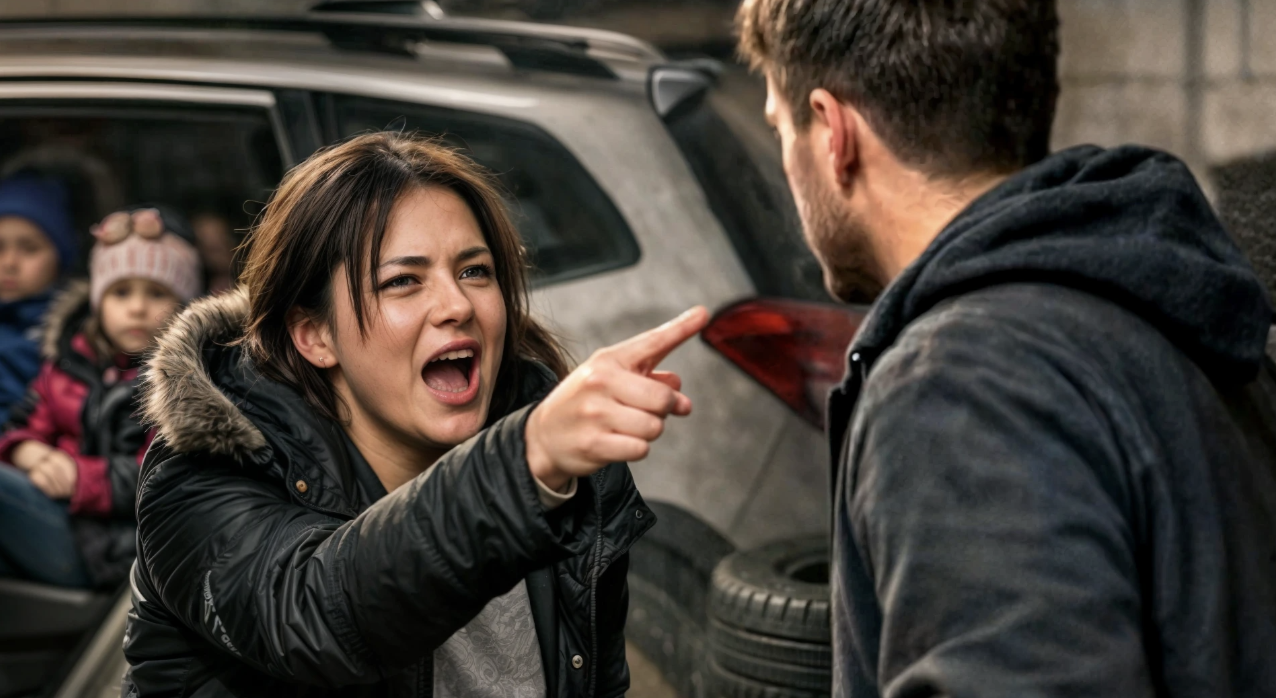
“— I wouldn’t notice?” Tatyana smirked, but there wasn’t a trace of humor in it. “Today I almost didn’t notice a concrete barrier on the overpass. Along with Max and Kirill in the back seat. The car just slid—out of nowhere. At forty kilometers an hour. Do you have any idea what it’s like when a three-ton crossover on bald tires starts gliding on a film of ice? No. You don’t. You were killing monsters on a screen. And I was killing the urge inside me to jerk the wheel the other way and see what happens.”
She paused, letting the words soak into him like poison. Denis opened his mouth to say something—then found nothing.
“— I thought you’d drive carefully…” he finally mumbled the stupidest phrase he could have invented.
“— I did drive carefully. It just doesn’t help when instead of tires you’ve got four polished pieces of crap on your wheels. You didn’t just steal a thing from me, Denis. You planted a bomb with a timer under our car. And you didn’t care when it went off. You just needed money to cover your petty, shameful debts.”
He backed away and collapsed onto the couch, clutching his head. He was crushed. But for her it wasn’t enough. It was only the beginning.
“— We’re… we’re a family, Tanya… We can fix this…”
“— Family?” she slowly picked up her phone from the table. “No. A family doesn’t do this. Family is when you know the person behind you has your back—not when they stick a knife in it. And you didn’t just stick a knife in. You tried to kill all of us.”
Her finger slid across the screen. She found the contact and hit call. Denis looked up at her—terror sloshed in his eyes. He saw the name on the display.
“Viktor Nikolaevich.” His father.
“— Hello, Viktor Nikolaevich,” she said into the phone in that same icy, colorless voice. “It’s Tanya. I have a request. Please come over. Take Denis. He doesn’t live here anymore.”
Viktor Nikolaevich arrived forty minutes later. In that time, not a single word was spoken in the apartment. Denis sat on the couch, curled into himself, staring at one spot on the carpet. He looked like a soaked sparrow waiting for the cat who’d picked it up to finish it off. Tatyana stood by the window with her back to him, watching the lights of the night city. She didn’t move, didn’t make a sound—an ice statue radiating arctic cold. The air in the room was so thick and heavy it felt like you could cut it with a knife.
The doorbell rang like a starter pistol.
Tatyana didn’t turn around.
“— Open it,” she threw into the emptiness. “That’s for you.”
Denis flinched, slowly stood, and trudged into the entryway. Viktor Nikolaevich—a tall, severe man with a hard, stone-carved face—came into the apartment. He gave his son a heavy look, then walked into the living room.
“— So what happened here? Money again? Tanya, Denis, you’re adults,” he began in a conciliatory tone, clearly expecting a story about another stupid quarrel. He sat in an armchair, preparing to act as the wise arbiter.
Tatyana slowly turned. Her face was absolutely calm, almost lifeless.
“— Something happened, Viktor Nikolaevich. But this isn’t a quarrel. This is a sentence,” she said, looking not at him but at Denis, who stood like a pathetic shadow in the doorway. “I want you to hear it. Not from him—he’ll lie and downplay everything—but from me. So you have no illusions about your son.”
Viktor Nikolaevich tensed; his peacekeeping mood began to evaporate.
“— Two months ago,” Tatyana began methodically, as if reading a report, “I bought a new set of winter tires for my car. Michelin X-Ice Snow. Eighty-four thousand rubles. The best on the market. Because I drive children. And for me, safety isn’t an empty word. Your son knew that perfectly well.”
She paused, letting the father digest it.
“— And this morning, when I was taking your grandsons to daycare, on a harmless turn the car suddenly started pulling toward the barrier. Just pulled—like a cow on ice. I barely straightened it out. All day I couldn’t shake the bad feeling, and after work I went to a shop. The mechanic lifted the car and first he stayed silent for a long time. Then he asked what dump I’d found these wheels on. He said the rubber wasn’t just bald—it was cracked all over with cord sticking out. That driving on it is pure suicide.”
Viktor Nikolaevich’s face hardened with every word. He shifted his gaze to his son, and a cold glint appeared in his eyes.
“— And you know what’s the most interesting part?” she continued; her voice gained strength, metal ringing in it. “I found my tires. On Avito. Sold. For twenty thousand rubles. From your son’s account.”
She stepped toward Denis. He hunched his shoulders.
“— You took new winter tires off my car and put bald junk from a dump on it so you could sell my wheels and pay off your loan?! Today I nearly flew into a ditch on black ice with the kids! You almost killed us for twenty thousand! Pack your crap and get out!”
Her voice broke into a shout—not a hysterical screech, but the roar of pure, concentrated rage.
“— That’s why I called you, Viktor Nikolaevich! Let him pack his crap! Take your loser son before I strangle him with my bare hands!”
A deafening silence fell over the room. Viktor Nikolaevich slowly turned his head to his son. There was no anger in his eyes. No disappointment. Only scorched emptiness and cold, limitless contempt. He looked at his forty-year-old son as if he weren’t a man at all, but some small, disgusting insect.
“— Pack,” Viktor Nikolaevich said, his voice dull and lifeless. He didn’t look at Tatyana. He looked at his son, and that look was worse than any blow. An order with no room for discussion.
Denis jerked as if shocked and shuffled into the bedroom. He moved like an automaton whose program had been erased, leaving only one basic action. He opened the closet, pulled out a large duffel bag. His movements were sluggish; his hands wouldn’t obey. He scooped up T-shirts, jeans, sweaters from the shelves, crumpling them and stuffing them inside. For him this wasn’t just packing. It was an exile ritual—humiliating and public.
Tatyana watched silently from the doorway. Denis’s father remained in the living room, petrified like an Easter Island statue. There wasn’t a drop of pity in her. She looked at her husband’s hunched back and understood: puncturing the bicycle and humiliating him in front of his father wasn’t enough. Those were only warning shots. She needed an execution. A demonstrative one. One that would burn out the very thought that something like this could be gotten away with.
Her gaze slid around the room and stopped on the narrow glass-fronted shelving unit by the wall. Inside stood his pride. His shrine. A collection of model sailing ships he’d been building since he was twelve. An entire flotilla—each little ship months of painstaking work. The delicate “Kruzenshtern” with its web of rigging, the formidable “Victoria” warship, Columbus’s tiny caravel. It wasn’t just a hobby. It was his world—his refuge, the place where he was captain and creator.
She walked up to the cabinet and opened the door. Denis froze with an armful of socks in his hands when he saw her move. His eyes widened with horror.
“— Tanya… don’t,” he whispered.
She took the first ship. A small frigate he’d finished just a month earlier. She turned it in her hands, examining the tiny cannons and the thin shroud lines. Then, in front of her husband and his father, she closed her fist. There was a light crunch of dry wood and the tinkling crack of shattered glass—he kept each ship inside a bottle. She opened her fingers, and broken masts and splinters of hull spilled onto the floor.
“— Tanya, please!” Panic crept into Denis’s voice. He stepped toward her.
At that moment Viktor Nikolaevich entered the bedroom and set a heavy hand on his shoulder, stopping him.
“— Don’t interfere,” he said quietly but firmly. “You earned this.”
Denis went limp under his father’s hand, and in his eyes flashed terror at that double betrayal. He watched as Tatyana took the next ship—“Santa Maria.” She didn’t crush it. She simply dropped it onto the parquet floor. The ship exploded into pieces. Then another. And another. She didn’t rush. She worked methodically, like an executioner carrying out a sentence. Every crunch, every chime of broken glass was a hammer blow on the lid of his coffin.
When only one remained on the shelf—the biggest and most beautiful ship, the one his father had once given him for his birthday—Denis howled. Not a scream, but a muffled, animal groan of total despair.
“— Not that one… It’s… a memory…”
Tatyana lifted the flagship of his collection. Raised it to eye level. Looked at it, then looked at Denis. And slowly, with force, crushed it between her palms. She didn’t even flinch when a sharp splinter of mast pierced her skin. She just wiped her hands on her jeans, leaving a bloody streak and wood dust.
“— So you don’t forget,” she said softly, but each word was carved from granite. “So you have nothing left except the memory of today.”
She nodded toward the half-empty bag.
“— That’s enough. I’ll throw out the rest.”
Then she turned to her frozen father-in-law in the doorway.
“— Take him.”
Viktor Nikolaevich silently pushed his son between the shoulder blades, steering him toward the exit. Denis walked without looking at his feet, stumbling over the wreckage of his past life. At her feet on the carpet lay a crumble of wood, thread, and glass—everything that was left of his childhood and his marriage…