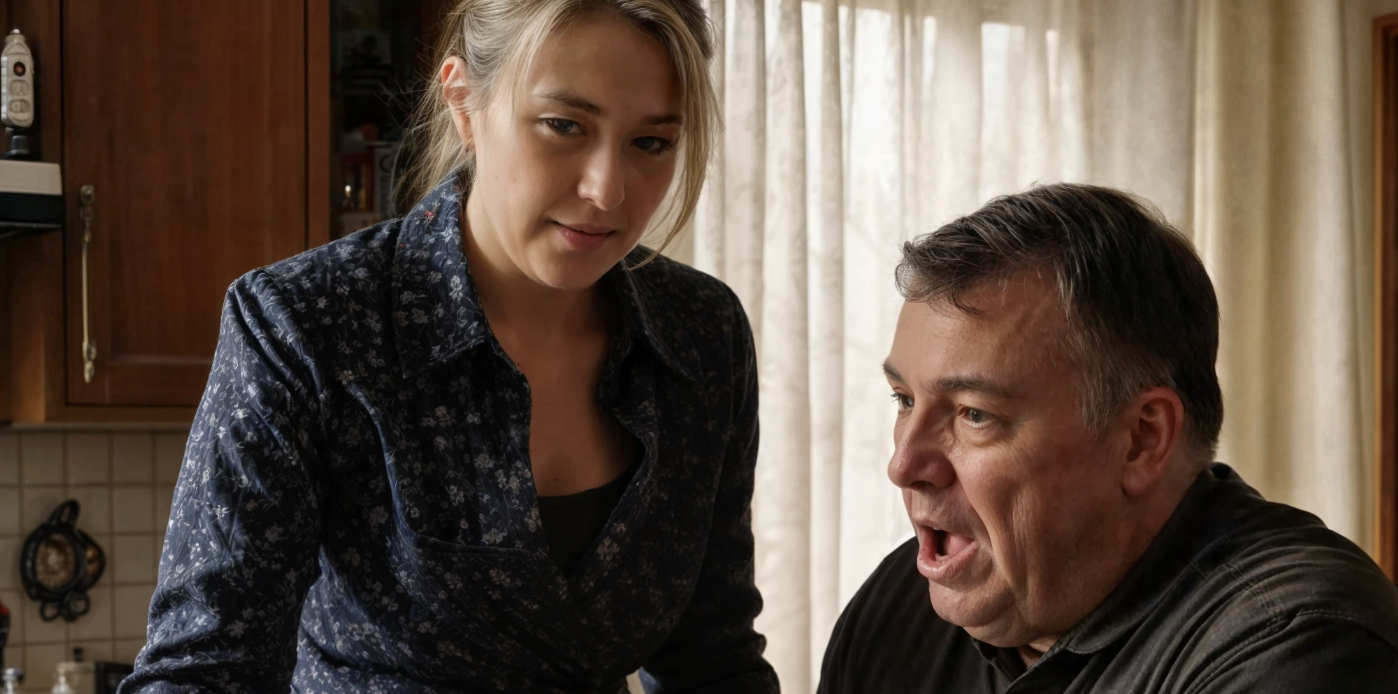
“We need your card,” my husband announced while I, with my heart in my throat, stared at the endless string of zeros on the ATM screen.
The hum of the old machine spitting out stacks of crisp banknotes sounded deafening in the silence of the half-empty branch. I felt like either a lucky robber or a traitor. My hands trembled slightly as I packed the thick bundles into a cloth bag I had set aside for this day—the one I’d sewn myself during long winter evenings while Dmitry watched his never-ending videos about “successful success.”
“Lena, are you even listening?” his voice came right by my ear, insistent and impatient.
I flinched and turned. Dmitry stood there with his hands in the pockets of his expensive jacket—bought on credit—watching me with an expression I had learned to read flawlessly over twenty-five years of marriage. It was the face of a man who’d just had another “brilliant idea,” and in his mind he was already spending money he didn’t have yet.
My money.
“What card, Dima?” I asked, trying to keep my voice steady. I zipped the bag and hugged it closer. That heavy rectangle was the result of twelve years of my quiet, invisible saving—twelve years of evening bookkeeping side jobs, of skipping a new dress, of giving up a trip to the sea, of denying myself hundreds of small, ordinary joys. It was my safety net, my dream of a little dacha outside Yekaterinburg, with geraniums on the windowsill and the scent of apples and currants in the garden.
“Well, yours. The one you’re going to…” He nodded vaguely at the bag, and a greedy spark flashed in his eyes. “…put all that into. We need it. Urgently.”
“We.” That word had always been his strongest weapon. “We” needed a new car because his old one “didn’t match his status.” “We” needed to renovate the living room because his son from his first marriage, Kirill, would be embarrassed to bring friends over. “We” had to pay for Kirill’s next course—one he’d quit a month later, like all the others. And me… in that “we,” I was just a function. A resource. An add-on to Dmitry’s grand plans.
“I want to put it into a different deposit account—one with a better interest rate,” I lied without blinking. Years as chief accountant at a construction firm had trained me to keep a stone face even when everything inside was flipping over with fear.
Dmitry snorted. “Lena, what deposits? What is this, the last century? Money has to work, not sit there dead weight! Come on—let’s go outside. It’s awkward in here.”
He took my elbow like he owned it and tugged me toward the exit. His touch wasn’t warm or familiar—it was possessive, gripping, like he wasn’t leading his wife but dragging along a stubborn, valuable pet.
Outside, cold Ural drizzle hung in the air. The city frowned in gray façades reflected in the wet asphalt. We stopped under the awning of the nearest shop.
“Listen carefully,” Dmitry began, dropping his voice to a conspiratorial whisper. “Remember Semyon—my second cousin from Pervouralsk? He’s got a scheme. Ironclad. Everyone’s taking taxis now, the market’s growing. We buy a few used but solid Korean cars and put them on a rent-to-own plan for drivers. That’s pure passive income, Len! In a year we’ll not only get your… I mean, our money back—we’ll triple it!”
I watched his excited face, his shining eyes, and felt a cold, heavy wave rise inside me. I remembered Semyon. Or rather, I remembered the aftermath of his earlier “ironclad schemes”: the tire shop that folded within six months and left Dmitry in debt. The quail farm that got eaten by a neighbor’s dog. The draft beer kiosk that the health inspectors shut down. Every time, Dmitry came back bruised but unbroken, eyes burning with a new idea that would “definitely work this time.” And every time I silently patched the holes in our budget.
“Dima, that’s really risky,” I started carefully. “We need a business plan, calculations, market analysis…”
He waved me off like a buzzing fly. “Oh, here we go—your accounting again! What calculations? You need instinct, business grit! Semyon’s already thought of everything. He found the cars, he’s practically made the deals with the drivers. We just need money for the down payment. Exactly your amount. Well—ours.”
He reached for my bag. I recoiled instinctively.
“I need to think.”
His face hardened instantly. The smile vanished; his eyes turned cold and sharp. “Think? About what, Elena? I’m offering to secure our old age, and you’re telling me ‘think’? Are we a family or not? Or have you been saving behind my back for some separate life?”
That last line hit like a slap—because it was true. Not for a separate life, no. For a quiet harbor. A place where I could finally exhale. Where I wouldn’t jump at every phone call, expecting news of yet another collapse.
“We’ll talk tonight,” I said firmly, turned, and walked straight into the rain, ignoring him calling after me. The bag of money felt like a life preserver in the murky water of our family life—and I knew that if I let go now, I’d sink immediately.
Evening brought no relief. On the contrary: Dmitry brought in the heavy artillery. On the threshold of our three-room apartment—furnished back in the nineties—stood Semyon himself. Short, stocky, with shifty eyes and a damp handshake he thrust at me in greeting. He smelled of cheap tobacco and stale enthusiasm.
“Lenochka, hello! We’ve come to you with great news!” he boomed, striding into the kitchen as if he owned the place.
Dmitry followed him, carrying a bottle of cognac and a box of chocolates on a tray like a victory banner—my favorite kind. Cheap, but in his mind, foolproof.
They sat at the kitchen table, where the plates from my lonely dinner were still sitting. They spread out crumpled papers covered in hand-scribbled numbers.
“Look here, Elena Viktorovna,” Semyon jabbed a short thick finger at one sheet. “Five Solaris cars. We buy them at three hundred thousand each. That’s one and a half million. Down payment is thirty percent—four hundred and fifty thousand. The rest is leasing. Each driver pays fifteen hundred a day: five hundred goes to leasing, three hundred to upkeep, two hundred goes into our pocket. Five cars—that’s a thousand a day! Thirty thousand a month! And that’s just the beginning!”
I stared at their “math,” and the accountant inside me wanted to weep. No insurance, no taxes, no downtime, no repair costs—which are inevitable with used cars. It wasn’t a business model; it was a child’s fantasy scribbled on a napkin.
“And what if a car breaks down? What if a driver gets sick or just quits? Taxes? You’ll be registering as a sole proprietor, right?” I asked calmly, methodically, the way I would in a work meeting.
“Lena, stop nagging!” Dmitry exploded. “Always with your problems! You deal with them as they come! The main thing is to start! You just don’t want me to succeed! You’re jealous!”
“Jealous of what, Dima? Your talent for stepping on the same rake over and over?” The words slipped out—sharp and cruel.
Silence dropped into the kitchen. Semyon coughed awkwardly and began studying the pattern on the old oilcloth with exaggerated interest. Dmitry looked at me like I’d hit him.
“I… I just want you to support me,” he said suddenly, quieter, switching tactics. “Just once. Believe in me. I’m doing it for us. For Kirill. He’s coming back from the army soon—where will he go? And here it’s a ready-made business. He’ll be our mechanic, our administrator.”
Again he played his trump card: his son. Kirill wasn’t a bad kid, really—just completely unprepared for life, spoiled by his father’s empty promises and my silent indulgence. I’d always felt guilty for never becoming a real mother to him, and Dmitry used that shamelessly.
“Give us a chance, Len,” he finished, almost pleading.
I stayed quiet, shifting my gaze from his face to Semyon’s, then to the crumpled papers on the table. I felt trapped. Refuse—and I’d be the enemy, the shrew, the destroyer of the family. Agree—and I’d betray myself, my dream, my one real hope for peace.
“I’ll think until tomorrow,” I forced out, standing up. “I’m exhausted.”
I went into the bedroom and shut the door, leaving them alone with cognac and their great plans. I lay down on the bed fully dressed and stared at the ceiling. My head buzzed. I replayed all twenty-five years: our wedding, his burning eyes. Kirill’s birth to his first wife, Dmitry’s confusion. My two miscarriages—he barely remembered them because “we have to move on.” His endless projects. And my constant, dull, patient waiting. What had I been waiting for? For him to change? To grow up? To appreciate me?
Then it hit me with horrifying clarity: the money under the bed wasn’t just savings. It was the material price of my endurance. Every ruble was an unspoken word, a swallowed hurt, a life postponed. To hand it over now would mean devaluing everything—crossing out myself.
The next day at work I moved as if in fog. Numbers in reports swam, coworkers spoke to me and I didn’t immediately understand what they wanted. At lunch, Tatyana Petrovna from Planning—wise, tactful, long widowed—came up and sat at my desk with her food container.
“Lenochka, are you okay? You don’t look like yourself,” she asked gently.
And I broke. I didn’t go into details, but I described it in broad strokes: husband, risky scheme, a lot of money. My money.
Tatyana Petrovna listened without interrupting, only nodding now and then. She didn’t rush to give advice. When I finished, she paused, then said while looking out the window:
“You know, my late Kolya was a golden man—hands like gold, heart wide open. But he was impractical, too kind. Always wanted to give away the last shirt off his back. Once he came home and said, ‘Tanya, let’s sell our Volga and invest in MMM—those interest rates!’ Everyone invested back then. And I told him: ‘Kolya, the Volga is the Volga. We drive to the dacha in it, haul potatoes. MMM is just a piece of paper. Let’s do it like this: with your salary, invest wherever you want—even with the devil himself. But the car and the dacha are ours. They’re the fortress.’ He was terribly offended. Didn’t speak to me for a week. And six months later it all collapsed. And he told me, ‘Thank you, Tanyka, for being so… sensible.’ Men are like children, Lenochka. They get carried away by shiny wrappers. Our job is to protect the candy. Not for them—for the family. And for yourself first of all. Because if something happens to you, if you break—there won’t be any family.”
Her words were simple, but they landed perfectly. “Protect the candy.” “For yourself first.” A thought I’d been terrified even to allow suddenly gained weight and legitimacy. I wasn’t selfish. I was the keeper—the keeper of my future, my sanity, my small but vital world.
That evening I came home with a firm decision. But Dmitry got ahead of me. He met me in the hallway, excited and triumphant.
“Lena, I decided everything! I didn’t wait for you—why waste time? Semyon and I drove out and looked at one car. Absolute fire! The owner will give us a discount, but the money has to be there by tomorrow morning. I left a deposit.”
“A deposit?” Everything inside me turned to ice. “What deposit? Where did you get money?”
“Oh, don’t worry!” he waved it off. “I took a little from our credit card. Only ten thousand. But you’re going to agree anyway—I know it! We’re a team!”
He looked at me with such disarming, childlike certainty that for a second I wavered again. Then I saw the notification on my phone: an SMS from the bank. It wasn’t ten thousand. It was fifty thousand rubles. Fifty. He hadn’t just taken money without asking—he’d lied again, looking me straight in the eyes.
That was the last straw. Not a straw—a freezing waterfall that crashed over me and washed away every last doubt, pity, and fear.
I walked into the room in silence, pulled the bag from under the bed, took out one bundle of cash—ten thousand—and went back to the hallway. I held it out to my husband.
“Here,” I said in a flat voice I barely recognized as my own. “This is for your deposit. Consider it my last investment in ‘us.’”
Dmitry stared, stunned, from the money to my face. “What do you mean? What about the rest? Lena, we need four hundred and fifty!”
“You need it, Dima. Not we. You and Semyon.”
“You… what are you doing?” His face started turning purple. “You want to disgrace me? I gave people my word!”
“You gave your word—you’ll answer for it. I’m not participating in your scams anymore.”
It was like an explosion. He screamed—screamed like he never had before: that I was selfish, greedy trash; that I’d ruined his whole life with my pettiness and down-to-earth thinking, never letting him “breathe” or “grow”; that I was nothing but an “accounting rat” who could only count pennies and was terrified of risk. He flung the money back in my face. The bills scattered across the hallway like a fan.
And I stood there, silent. The scariest part was—I felt nothing. No hurt, no tears. Only emptiness and a strange, cold relief, as if a years-old abscess had finally burst.
When he ran out of steam and slammed the door on his way to “friends who understand him,” I didn’t cry. I calmly picked the bills up from the floor, stacked them neatly, and put them back into the bag. Then I went to the kitchen and made myself tea—Earl Grey with bergamot. For the first time in years I drank tea in complete, absolute silence. And that silence was beautiful.
He didn’t come back that night. I didn’t sleep—but not from worry. I was planning. My accountant’s brain, trained for order and logic, laid out a clean action plan.
Step one: find a rental apartment—small, cheap, but mine.
Step two: move my things—the essentials. My books, my sewing machine, my dishes.
Step three: file for divorce and divide property.
I knew we’d have to split our shared apartment, bought early in the marriage. And I was ready. It was a fair price for freedom.
In the morning I called work and took unpaid leave. Then I opened a classifieds site. By lunchtime I was viewing my first apartment: a tiny one-bedroom in a sleeping district far from the center. But clean, bright, with a big kitchen window and a wide windowsill. I imagined pots of violets sitting there and said “yes” to the landlady on the spot.
Dmitry called while I was arranging movers. His voice was hungover and confused.
“Len, where are you? I came home—you’re not here. Don’t sulk. I got carried away yesterday. Let’s talk.”
“There’s nothing left for us to talk about, Dima,” I said, and ended the call. Then I blocked his number.
The move felt like a covert operation. Two strong men carried my boxes out quickly and efficiently. I didn’t take anything we’d bought together—only what was mine. My parents’ old photo album. My mother’s little jewelry box. The porcelain elephant collection I’d started as a teenager. When I took one last look at the emptied room, I didn’t feel nostalgia—only lightness.
The first night in the new apartment was unforgettable. I slept on an inflatable mattress under an old blanket. The city шумed outside, but inside my little fortress it was quiet. I woke to a sunbeam cutting through the bare, curtainless window—and for the first time in years, I smiled for no reason at all.
A week later my lawyer filed the divorce papers. Dmitry, of course, raged. Calls came from his mother, from Kirill, from mutual friends. They accused me of every mortal sin, called me a traitor. I didn’t answer. I just lived.
I bought curtains—white with tiny blue flowers. I bought four flowerpots and planted violet cuttings Tatyana Petrovna gave me. In the evenings I read the books I’d been meaning to read for ages, or simply sat by the window, looking at the lights in other people’s homes, sipping tea.
A few months later the court divided our shared apartment. To pay out my share, Dmitry sold it. I added that money to what had been waiting in my precious bag and began searching for my dream.
And I found it: a small dacha house thirty kilometers from the city. Old, in need of repairs, but with a big overgrown garden where three ancient apple trees grew beside gooseberry bushes. The first time I stepped inside, I smelled dry herbs and wood—and I knew: this was home.
One day, weeding the beds, I heard a car pull up. Dmitry stood by the gate—thinner, worn down.
“I was just passing by,” he said uncertainly. “Found out you were here…”
I looked at him in silence.
“Our project… it crashed. Semyon turned out to be… anyway, it doesn’t matter. I lost everything, Len.”
He waited for me to invite him in. To pity him. The old me would have. But now I simply straightened up, brushed the dirt from my hands, and said:
“I’m very sorry, Dima.”
No triumph. No spite. Just a fact. His life went its way. Mine went its own.
He stood there a moment longer, then got back in the car and drove off. And I returned to my garden beds. The sun warmed my back; the air smelled of soil and future harvest. I picked up the watering can—and inside me there was only quiet, steady peace.
Blessed, hard-won silence.
Mine