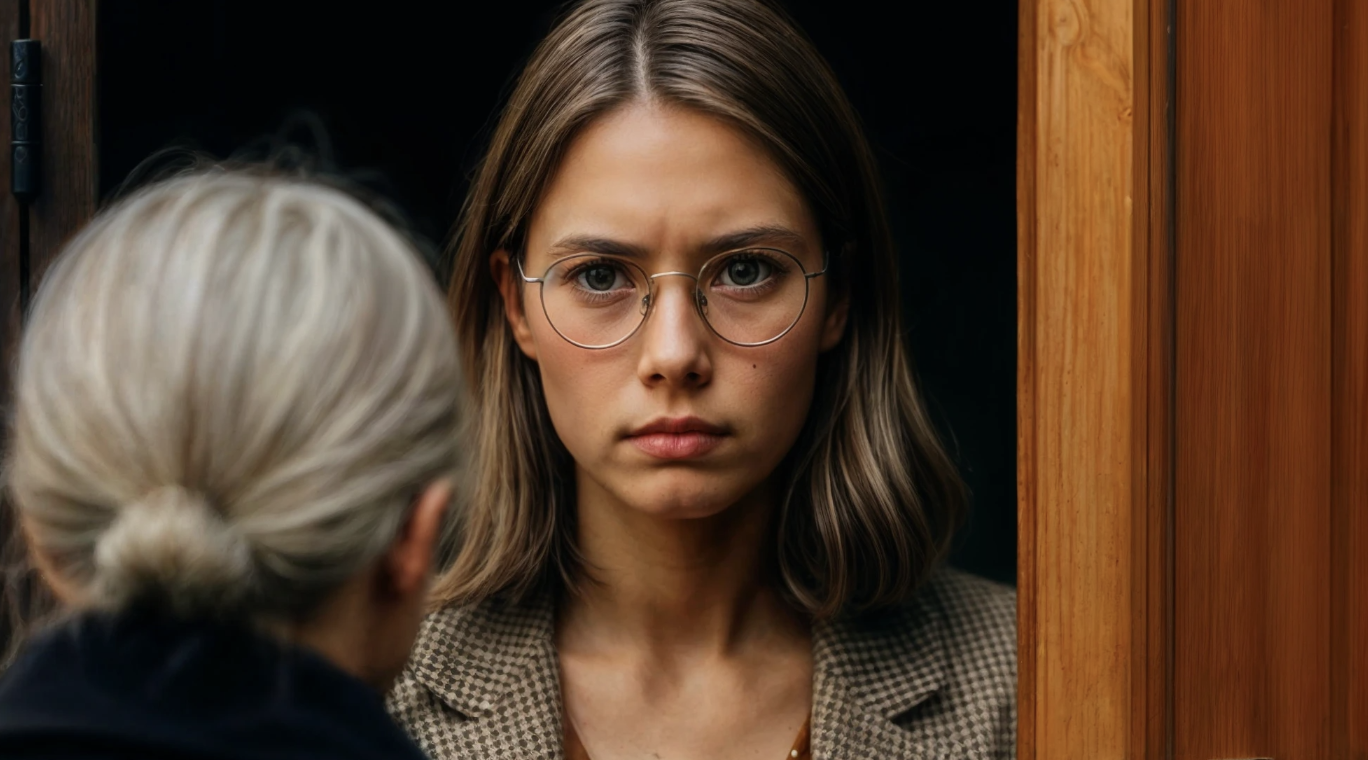
— “I’ll get straight to the point. You’re going to transfer all your savings to me right now, and I’ll tell Tolya you’ve realized you were wrong. Then your husband will come back to you.”
“Sorry… what exactly am I supposed to do?”
“Don’t play dumb,” her mother-in-law smirked. “I know everything. You were saving up for a car. You’ve got money. So here it is: if you want to save your marriage, transfer it to me. Otherwise Tolya will file for divorce, and you’ll have to split it in half anyway.”
Anya had barely managed to take off her coat and set her bag down in the entryway when she heard Lyudmila Andreevna’s familiar tone—dry, accusatory.
“Well then, Tolya, look at how your wife welcomes guests,” her mother-in-law said, taking a sip of tea from a mug that read ‘Best Son.’ “Back in our day, when guests came over, we set the table so full it practically collapsed under the food.”
Anya drew a deep breath and walked into the kitchen.
“Good evening, Lyudmila Andreevna.” She forced a smile, though her face felt stiff with exhaustion. “Sorry I’m late—work ran long. We’ve got an emergency, I barely got out.”
“An emergency, you say?” her mother-in-law drawled, setting her spoon down. “In the old days, even when a woman worked, she managed everything. And she certainly didn’t come home without dinner. And mind you, we didn’t have any dishwashers or washing machines back then.”
Anya placed a cake on the table, trying not to show the irritation she’d already built up during the workday.
“I thought it would be nice for all of us to have tea. It’s pistachio with raspberry confiture—your favorite.”
“Well… yes, I see,” her mother-in-law nodded, inspecting the box with a connoisseur’s gaze. “Pistachio—that’s good. At least you have some taste.”
Tolya, as usual, sat between them, pretending to be his mother’s perfect son. His eyes darted from his cup to his phone to the ceiling—anywhere but his wife’s face.
“Mom, come on,” he finally said without looking up. “Anya tried.”
“Oh, I can see how hard she tries. Every time I come, it’s the same thing!” Lyudmila Andreevna snapped. “At her age, I came home from work, cooked, washed clothes, helped you with homework—and nothing killed me!”
Anya felt a lump rise in her throat, and then, unexpectedly, Tolya said:
“But I lived with Grandma Monday through Friday, didn’t I? You only took me home on weekends. You used to say you didn’t have time to deal with me.”
“You were little and you don’t remember anything!” Lyudmila Andreevna barked, and Anya gave a short, bitter chuckle.
“Lyudmila Andreevna,” Anya said, “I understand you’re used to a different way of life. But the pace is different now. I’m trying. Truly.”
Her mother-in-law sighed and leaned back in her chair.
“Oh, I didn’t say anything like that. I’m just saying a woman should be the mistress of the home. And with you it’s all somehow… not human.”
Tolya cut in:
“Mom, enough. Let’s just have tea.”
Silence. The ticking of the clock. The taste of pistachio cream mixed with the sour aftertaste of resentment. By the time Lyudmila Andreevna finally got ready to leave, it was already getting dark outside.
“Thank you for the hospitality,” she said, giving Anya a heavy look. “Tolya, I’ll call you tomorrow. We need to discuss something.”
The door closed behind her, leaving a trail of cloying perfume.
“Tolya,” Anya said quietly, without turning around, “maybe next time you could at least warn me when your mom is coming over?”
“Oh, come on,” he replied, opening the fridge. “It’s Mom. What’s the big deal?”
“What’s the big deal?..” Anya echoed, clenching her hands. “Everything. Literally everything. I need at least a couple of days to plan and cook something for your mother.”
“Fine,” her husband said, poured himself some water, and walked into the other room.
Anya stayed in the dim kitchen, staring at the half-eaten cake. She exhaled, turned off the light, and thought that tomorrow she’d wear her favorite gray scarf—it would match the cold, damp weather and her mood perfectly.
She pushed that dinner with her mother-in-law out of her head as quickly as she could. There was too much work, and her own mother, Valentina Ivanovna, had fallen ill. For the past couple of weeks Anya had stopped by almost every evening: to buy medicine and simply sit with her so she wouldn’t feel lonely.
Valentina Ivanovna had lived without a husband for over fifteen years. When her spouse died, she had been just over forty, but she never managed to let another man into her life. She would only say:
“Your father was one of a kind. There won’t be another…”
Since childhood, Anya had watched her mother preserve her husband’s memory. Their photo always stood on the dresser. Sometimes Anya would notice her mother quietly talking to the portrait, as if telling her husband news—about their daughter, about life, about work.
It was a blessing they lived close to each other. Just two stops—and Anya was already at her mother’s door. Fate had smiled on them both, too: after Grandma’s death, the apartment went to Valentina Ivanovna, and Anya and Tolya ended up living there.
And because Anya didn’t have to worry about housing, she started saving for a car. The dream felt almost like a symbol of freedom: no more morning crush on the minibus, no freezing at a stop in winter, no dependence on route schedules.
She even stuck a photo on the fridge—a small but beautiful blue car. Every time she managed to set aside even a little, she wrote down the amount in her phone notes. Tolya supported her—at least in words.
“Of course you need a car,” he’d say. “Every day you’re packed into that minibus like sardines. We’ll get you a little car and you’ll live like a normal person—comfortably.”
Anya would smile. Those words felt like genuine care, though somewhere deep down a feeling sometimes stirred that Tolya talked more than he acted. But she chased the thought away—he was trying, after all. He didn’t argue when she put money aside, didn’t spend her savings, didn’t interfere with her plans. That alone seemed worth being grateful for.
Meanwhile, work piled up to her ears. Quarterly reports, inspections, onboarding new clients—everything demanded strength, focus, and time. Anya came home drained. Sometimes she went straight to bed without dinner. On those days, Tolya usually ate alone or ordered delivery.
“Are you staying late again?” he’d ask on the phone.
“Hang on, I’ll be home soon,” Anya would answer without lifting her head from the monitor.
When Valentina Ivanovna learned how tired her daughter was, she sighed every time:
“It’s all on you, Anyushka. Work, home, and us old folks too. But it’s all right, sweetheart—I’ll get better soon. Just don’t run yourself into the ground.”
“Mom, come on,” Anya would smile, pouring her mother warm chicken soup. “It’s not hard for me to come by.”
But it was hard. And not only physically. Sometimes she felt like life was passing her by—gray workdays, with only rare Friday evenings when she could allow herself a glass of wine and a bubble bath. The rest was hustle: numbers, transport, bags, and endless calls.
Anya didn’t yet know that on her last visit, Lyudmila Andreevna had done more than throw barbed remarks—she had carefully examined everything around her. And her gaze had lingered on the photo of the car stuck to the fridge: a blue, shiny little dream.
“So that’s what she’s saving for,” her mother-in-law had thought, frowning. And the very next day she began her usual work—quiet, persistent.
“Tolenka,” she said to her son casually during yet another phone call, “I’ve been thinking… why does your wife need a car? You already have one, you drive her everywhere. What else does she want? Women don’t belong behind the wheel at all—they’re too nervous. She’d be better off spending that money on something useful.”
Tolya waved it off then.
“Mom, it’s her decision. Let her save.”
But Lyudmila Andreevna knew how to choose her words. She didn’t argue or push—she simply added a few drops of doubt into her son’s mind each time.
“And I was thinking, Tolya… how much does that car cost? Six hundred thousand, no less? Just imagine how many good things you could do with that money. My birthday is coming up, for example. Fifty-three is still a date. Maybe I’d like, just once in my life, to fly somewhere—to the sea, to Turkey, for instance. You know I’ve worked my whole life, I never rest. Anya’s a kind girl, maybe she’d support an idea like that…”
Day after day. Week after week. At first Tolya joked, and then he started agreeing:
“Yeah, you’re right, Mom. A trip wouldn’t hurt you.”
And two months later he was already speaking her words:
“Who needs those cars? It’ll just sit in the yard for nothing. And with our traffic jams it’s pointless anyway. She’ll crash into something.”
When Lyudmila Andreevna invited them for a birthday dinner, she was already sure her son would make the “right” choice. She even bragged to her friends:
“My Tolya is a real man! He knows what his mother needs. Just you wait—when you see what he gives me, you’ll be stunned.”
Anya learned about the invitation in the evening, over dinner. Tolya mentioned it offhand:
“Mom’s calling us over tomorrow for dinner. Says she wants a cozy family evening, just us. And, by the way, she hinted she wants to fly on vacation. I think we can give her a really nice gift—a trip, for example.”
Anya, who had just taken a sip of tea, almost choked.
“A trip to Turkey? Tolya, are you out of your mind? Where would we get that kind of money?”
“Well…” Tolya scratched the back of his head. “You had money saved up for the car.”
Anya froze, not believing her ears.
“Wait—are you serious? Those are my savings! And besides, your mom doesn’t even have an anniversary, it’s just a regular birthday. And we have a ton of expenses.”
But Tolya was already on the well-worn track—his voice sounded almost like Lyudmila Andreevna’s:
“Why do you need that car, Any? We already have one. That’s enough. Women don’t have to sit behind the wheel anyway—it’s just nerves. And Mom needs a rest. She’s worked her whole life, she deserves it.”
“Tolya…” Anya said quietly, feeling a surge of anger and hurt rising in her chest. “That’s your mother, and you should know the limits. I’m not against a gift, but not with all my savings!”
He looked away and mumbled something like:
“Do what you want…”
In the end they reached a compromise. Anya insisted they buy a certificate to a jewelry store—for fifteen thousand rubles. Polite, decent, and without unnecessary drama.
The next evening they went to Lyudmila Andreevna’s.
The table was lavish: salads, roasted duck, a cake with pink cream swirls. Besides them, two of her friends were there, along with her husband—Sergey Vladimirovich, a sturdy, silent man around sixty.
“Come in, children,” Lyudmila Andreevna smiled.
Tolya immediately fussed, pulled the gift certificate from his pocket, and handed it to his mother with a radiant grin. Her face twitched almost imperceptibly, but she quickly composed herself and produced a strained smile.
“Oh, how… original. Well, thank you, of course.”
The friends exchanged glances. Sergey Vladimirovich cleared his throat to break the tension.
Anya pretended not to notice the awkwardness. She knew that with this dinner her mother-in-law had hoped to demonstrate her power—especially over her son. But instead of a trip to Turkey, she received something entirely different. And for two whole weeks she’d been telling her friends her son would give her a vacation by the sea.
Anya sat quietly, avoiding everyone’s eyes. The friends laughed, clinked glasses, talked about TV shows and grocery prices, while Lyudmila Andreevna kept tossing sharp looks at her daughter-in-law.
“Why are you so gloomy?” she finally snapped. “Don’t you like it here? Maybe the cake isn’t to your taste? Or the duck is too salty?”
Anya forced a smile.
“Everything is delicious, thank you. I’m just a bit tired…”
“Tired?” her mother-in-law snorted. “She’s always tired. Poor thing, works in an office, shuffles papers, and then spends the whole evening resting from her rest. No wonder you do nothing around the house.”
The friends laughed, and Tolya scratched his head, embarrassed, and muttered:
“Mom, don’t start…”
“And what did I say?” Lyudmila Andreevna raised her brows in feigned surprise. “I’m merely stating a fact. A woman should be a homemaker. And here… it doesn’t even smell like that.”
Anya gripped her fork. The first time, she stayed silent.
“She isn’t eating anything,” her mother-in-law went on. “Sits there picking at the food. Tolya, look—your wife doesn’t respect me. Everyone’s eating, and she’s just pretending.”
By the middle of the evening, after the women had had a bit to drink, Lyudmila Andreevna’s tone turned rougher and more intrusive. She leaned back with a glass of wine and spoke louder than necessary.
“I’ll tell it like it is,” she began, not looking at Anya. “This girl is rude. No respect for elders.”
“Mom…” Tolya said softly, but she didn’t listen.
“And greedy, too!” she continued with drunken bluntness. “Saving, saving… She wants a car. Ha! What car?! She can’t even cook borscht properly. Tell me, girls,” she turned to her friends, “what kind of wife hides money from her husband?”
Anya felt tears rising. But to show weakness in front of Lyudmila Andreevna meant to lose. She turned to her husband and whispered with a fragile hope:
“Tolya… say something…”
But Tolya only shrugged and gave a stupid little smile.
“See!” her mother-in-law cried triumphantly. “He’s silent because he knows his mother is right! You’re not a wife—you’re a punishment. I don’t understand how my Tolenka puts up with you. And anyway…” She snorted, took another sip, and added with an icy smirk, “You’ve needed to divorce for a long time.”
Silence fell over the room. Even the TV playing in the background suddenly seemed too loud. Anya stood up and said:
“Thank you for dinner… and happy birthday.”
No one managed to answer—she slammed the door, and for a moment cold air rushed into the apartment. Tolya stayed seated, staring blankly at the empty place where his wife had been sitting.
“Tolya, what’s wrong with you?” his mother said, pursing her lips. “Don’t go after her. A woman should know her place. Let her think about her behavior.”
And he didn’t go.
Outside it was cold; the wind pushed dry leaves across the asphalt. Wrapped in her coat and scarf, Anya walked fast, not really seeing where she was going. Her chest boiled with resentment—at the humiliation, at her husband’s silence, at the way her life was starting to feel like someone else’s.
She reached the bus stop, sat on the bench, and stared ahead. The streetlamp above flickered, casting a dull light on the wet pavement. On the bus she sat by the window, pressing her forehead to the cold glass and watching the city lights drift past.
When she walked into the apartment, it was dark. Tolya still hadn’t come home. Anya plugged in her phone, lay down on the bed without taking off her clothes, and couldn’t fall asleep for a long time. In the morning, looking into the mirror at her exhausted face and deadened eyes, she told herself: If he doesn’t come today, that’s it. I’ll pack his things and put them out.
But at lunchtime, the doorbell rang. Anya thought it was Tolya, and her heart gave an involuntary stab. But when she opened the door, she froze. Lyudmila Andreevna stood on the threshold, stern-faced.
“We need to talk,” she said, stepping inside without waiting to be invited.
Anya slowly closed the door behind her and felt everything inside go cold. Lyudmila Andreevna stopped in the hallway, set her bag on a shelf, and narrowed her eyes.
“I’ll get straight to the point,” she said, folding her arms. “Tolya isn’t coming back to you. At least not before I allow it.”
“What do you mean, allow?” Anya asked evenly.
“I mean exactly that,” her mother-in-law snapped. “I explained to him that he can’t go back to a woman who doesn’t respect her husband’s mother. But”—she paused, squinting slyly—“there’s one way to fix everything.”
Anya stayed silent, waiting.
“You’ll transfer all your savings to me right now,” Lyudmila Andreevna said. “And I’ll tell Tolya you’ve realized your guilt. Then he’ll come back to you.”
Silence. The clock ticked in the hallway, suddenly deafening. Anya frowned, feeling distrust and outrage rising.
“Sorry… one more time—what exactly am I supposed to do?”
“Don’t play dumb,” her mother-in-law smirked. “I know everything. You were saving for a car. You’ve got money. So—if you want to keep your marriage, transfer it to me. Otherwise Tolya will file for divorce, and you’ll have to split it in half anyway.”
Anya suddenly laughed—quietly, but sincerely, at the absurdity.
“Are you serious?” she asked, taking a step back. “You came to my home to extort money from me?”
“Don’t be dramatic,” Lyudmila Andreevna shrugged. “Just decide: either your marriage, or your pathetic little savings.”
“You know what,” Anya straightened and looked her in the eye. “Let it be the second one. Let Tolya pick up his things today, or I’ll put them outside.”
“What?!” her mother-in-law shrieked. “You… do you even understand who you’re talking to?!”
“Oh, I understand perfectly,” Anya said calmly, opening the door.
She took Lyudmila Andreevna by the hand and, gently but firmly, guided her out into the stairwell.
“Don’t come here again,” she said clearly. “Ever.”
And she closed the door right in her face.
A second—and complete silence. Then Anya laughed again. “What stupidity.”
She went to the kitchen, poured herself a glass of water, and suddenly felt a strange sense of freedom—as if she’d shrugged off a heavy, invisible load. Tolya didn’t come home that evening. So Anya sat down at her laptop and filed for divorce.
Then, in a rush, she gathered all of her husband’s things—shirts, sneakers, even his favorite mug that read “Best Son”—and put the bags outside the door, on the landing.
A month later, the divorce was finalized. Anya knew Tolya’s car—the brand-new foreign-made one he was so proud of—had been purchased during the marriage. Which meant it was to be split in half.
In the end, Anya had to share her savings, but Tolya was forced to sell the car and give her half of the proceeds. With that money Anya finally bought herself that very blue car—the one that had once hung on the fridge.
The first time she got behind the wheel, she smiled at her reflection in the rearview mirror and thought: Now I decide where to go.
Tolya moved in with his mother. Lyudmila Andreevna was furious to the point of shaking—she’d been sure she’d strip Anya bare. But it turned out the other way around.
Anya gradually settled into a new life: work, caring for her mother, evening drives around the city—now with favorite music and a feeling of freedom. And a year later she met Dmitry—a calm, confident, intelligent man.
With him, Anya understood that marriage isn’t about control, or bargaining, or favors. It’s about respect, warmth, and feeling safe beside someone.
And Lyudmila Andreevna remained in the past—like a reminder that sometimes, to become happy, all you need is to say once: “Don’t come here again