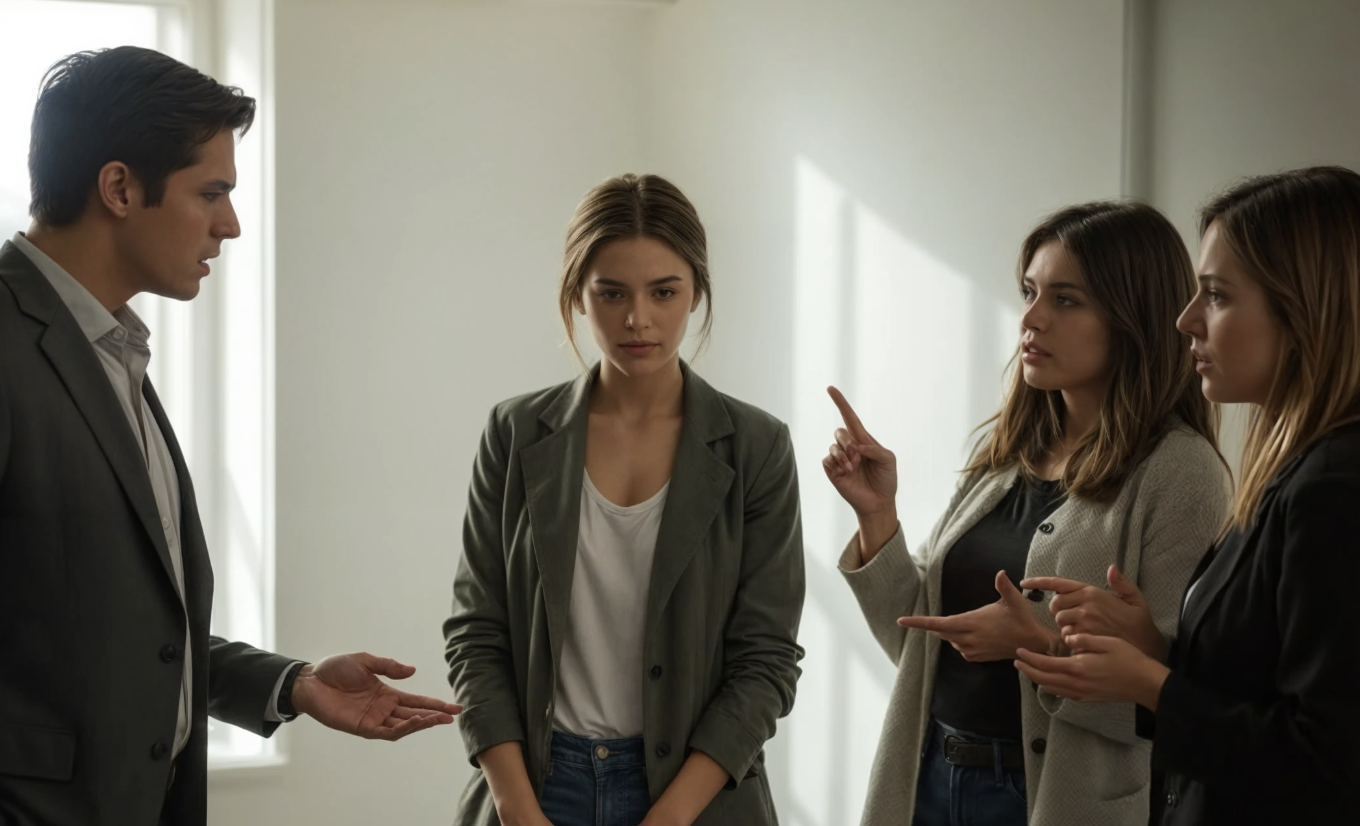
Get out of here while you’re still in one piece!” Tanya shouted, and her phone flew into the wall.
The screen went dead, spraying shards across the linoleum. Good. Let that snake stop calling. Let her shut up with her orders, her poisonous voice, those endless: “Where is it?” “Why isn’t it like this?” “Denis’s mom always…”
Denis’s mom. Her beloved mother-in-law at least said it to your face when she was unhappy. But this one—Larisa—was like a spider: weaving webs behind your back, then snap—and suddenly you’re to blame. Always to blame.
Tanya pressed her forehead to the refrigerator. The metal burned her skin with a pleasant cold. Ten o’clock on a Saturday morning. Outside the window, November drizzle turned the city into a gray watercolor—blurred the outlines of the buildings across the street, extinguished the last colors of autumn.
And the apartment smelled of burnt potatoes.
She yanked the oven door open—heat and smoke hit her face. The duck breast was blackened at the edges, a lump of charcoal. Denis loved duck. Loved it when the skin was crisp and the meat inside was rosy, juicy. She’d cooked it for him so many times, checking the temperature, timing everything. Today she’d forgotten the timer.
Today she’d forgotten everything except that call.
“And I don’t understand where the праздничный lunch is. Get everything ready—now—or you’ll be out on the street!”
Larisa had called at seven in the morning. Woke her up with that line, hissed into the receiver as if Tanya were her servant. Denis was coming back from his trip today—so the table had to be groaning with food. So Tanya had to run to the market, buy half the stalls, fry, steam, braise. Because “that’s how it’s done.” Because “in our family, we always welcomed men like heroes.”
Like heroes.
Denis had been away for a week—business for the company, to Yekaterinburg. Tanya stayed alone in this three-room cage in Uralmash, where every corner screamed that she was a stranger. The furniture was chosen by her mother-in-law. The wallpaper had been put up by Larisa and Denis before the wedding. Even the kitchen curtains—the beige ones with tiny little flowers—weren’t Tanya’s choice.
Five years of marriage, and it felt like living in a museum of someone else’s life.
Tanya pulled out the baking tray and hurled it into the sink. The duck sizzled under the cold tap, and the steam fogged the windows. She stood there, staring at that charred piece of meat, and everything inside her tightened into a hard knot.
No. Enough for today.
She untied her apron—a gift from that same Larisa, pink, with the idiotic words “Best Little Homemaker”—crumpled it and shoved it into the trash. Then she yanked off her house dress, pulled on jeans and an old leather jacket Denis couldn’t stand. “You look like some biker chick in that,” he used to say.
Perfect. Let her be a biker chick.
She grabbed her bag, her car keys, and stormed out. The elevator, as always, wasn’t working. Tanya ran down the stairs—past scratched walls, past the stink of cat urine and damp, past the neighbor from the third floor who was always gossiping with Larisa.
“Tanechka, where are you off to?” the neighbor tried to stop her.
“Errands, Nina Fyodorovna,” Tanya threw over her shoulder without slowing down.
Outside, the wind shook the bare branches, pushed last year’s leaves along the sidewalks. Tanya got into her old Lada Kalina and started the engine. Her hands were trembling—not from cold, but from the rage that had been building for months. For years, if she was honest.
She drove out of the courtyard and headed toward the center. She didn’t know where exactly. Just away. Away from that apartment, Larisa’s calls, the need to be convenient.
The traffic light at the intersection turned red. Tanya stopped and looked in the rearview mirror. Pale face. Dark circles under her eyes. She was thirty-two, but looked forty. When was the last time she looked at herself not as a maid? Not as Denis’s wife, Natalya Pavlovna’s daughter-in-law, Larisa’s sister-in-law—but simply as Tanya?
Her phone buzzed again on the passenger seat. Tanya glanced at the screen—Larisa. Of course.
She declined the call. A message appeared immediately: “Denis and I will be there at three. If there isn’t lunch, you know what will happen.”
Tanya smirked. She knew. A scandal. Denis would defend his sister, like always. He’d say Tanya was exaggerating, that Larisa was just worried, that Tanya should understand her situation. Larisa had divorced two years ago, lived alone, worked as a cashier at a supermarket. And now it was Tanya’s problem—to be a punching bag so Larisa could dump her anger on someone…
Green light. Tanya hit the gas and drove on without answering. Let them wait. Let them get nervous. Let them feel it for once—what it’s like when you’re not kept in the loop, when you’re not the main character, when your time means nothing.
She turned onto Cosmonauts Avenue and twenty minutes later pulled up at Megapolis—an enormous shopping mall that turned into a human anthill on weekends. The parking lot was packed; she had to circle between rows looking for a spot. Tanya squeezed in between two SUVs and killed the engine.
She sat for five minutes, just staring at the gray sky through the windshield. The rain intensified, drumming on the roof in a steady, soothing rhythm. Inside her, everything still boiled—a mix of anger, hurt, and some strange emptiness. When was the last time she did something for herself? Not for Denis, not for his family, not because “that’s how it should be,” but simply because she wanted to?
She couldn’t remember.
Tanya got out and hurried toward the entrance, shielding her head with her bag. Inside the mall it smelled of popcorn, new clothes, and perfume from the first-floor stores. There weren’t many people yet—Saturday hadn’t fully woken up; the main wave would hit after lunch.
She went up to the third floor where the food court was. Colorful café signs blinked in neon: “Shokoladnitsa,” “Teremok,” “Kroshka-Kartoshka.” Tanya chose a small café in the corner—called “Happiness Exists.” A cozy place with wooden tables and soft booth seating by the window.
She sat at the panoramic window and ordered a cappuccino and a slice of cheesecake. Not because she was hungry—just to have something to do with her hands. Her phone came alive again—Denis this time.
“Larisa says you snapped. What happened? I’ll be home soon.”
Tanya turned the phone face down. Not now. Right now she would just sit here in this warm cocoon of other people’s voices and the smell of coffee—and not think.
“Is this table free?”
She looked up. A man of about thirty-five stood in front of her, wearing a dark blue sweater and jeans. Slightly wavy hair with gray at the temples. A pleasant, open face—with crinkles by the eyes that suggested he smiled often.
“All the other tables are taken,” he added apologetically, gesturing around the crowded space.
Tanya glanced back. True—everything was full.
“Go ahead,” she nodded.
He sat across from her, set down a cup of espresso and a croissant. He took out his phone but didn’t bury himself in it like most people did. He just placed it beside his cup.
“I hate rain,” he said suddenly, looking out the window. “In weather like this you either want to crawl into bed or fly somewhere far away. Thailand, for example.”
Tanya smirked.
“Then what are you doing in a shopping mall?”
“Hiding from reality, I guess.” He looked at her carefully. “You are too, by the look of it.”
Strangely, his words didn’t feel rude. Maybe because he spoke calmly, without that fake cheerfulness people use when they’re pushing advice on a stranger.
“Something like that,” Tanya admitted.
They fell silent. He drank his coffee; she picked at the cheesecake with her fork. Then he started talking again—about the weather, the city, how the neighborhood had changed in recent years. Light small talk about nothing, that somehow didn’t irritate her.
“Bogdan,” he introduced himself when the waitress brought him a second espresso.
“Tanya.”
“Nice to meet you, Tanya. Do you often run away to shopping malls from reality?”
She laughed—for the first time that morning.
“No. First time, honestly.”
“Then the reason must be serious.”
Tanya shrugged. She didn’t want to tell a stranger about Larisa, the family battles, how she felt like a servant in her own home. But Bogdan didn’t push. He just sat there, and something about him felt calm—calm she’d been starving for.
“I work not far from here,” he said. “I have a small business repairing computers and office equipment. Office on Bebel Street. A client canceled today, so I decided not to go straight home.”
“You live alone?”
“Alone. Divorced three years now. My daughter stayed with my ex—see her on weekends.” He didn’t look crushed, more like someone who’d made peace with it. “And you—are you married?”
Tanya absentmindedly turned her wedding ring.
“Yes. Five years.”
“And you ran away from your husband to a shopping mall?” There was no judgment in his voice—just mild curiosity.
“From his family, more like,” Tanya blurted.
And then she broke. She started talking—about Larisa, the constant calls, how her opinion never mattered, about Denis always taking his sister’s side. The words poured out on their own, and Bogdan listened without interrupting, only nodding now and then.
When she finally stopped, he finished his coffee and said:
“You know what the hardest thing is in a relationship? Not learning to love another person. But learning not to lose yourself beside them.”
Tanya looked at him, startled. The phrase landed dead center.
“Speaking from experience?”
“From very painful experience,” Bogdan nodded. “My ex-wife was a wonderful person. But I tried so hard to meet her expectations that at some point I stopped understanding what I wanted myself. And she felt it. Said she was living with a ghost, not a man.”
They stayed in the café another hour. Bogdan talked about his work, about his daughter Nastya who went to an art school. Tanya talked about her abandoned dream of becoming an interior designer. Once she’d taken courses, even did a few projects for friends. Then she got married, and Denis said she didn’t need to work—family mattered more than career.
“And what do you think?” Bogdan asked.
Tanya paused. What did she think? Strange—no one had asked her that in a long time. Not whether she was doing things “right,” but what she wanted.
“I don’t know,” she admitted. “I’ve lived by other people’s rules for so long, I forgot my own.”
When they left the café, Bogdan took out his phone.
“Can I have your number? Just to talk sometimes. I enjoyed this.”
Tanya hesitated for a second, then recited the digits. What was wrong with just talking?
They went downstairs and split up at the exit, heading in different directions. Tanya walked to her car and felt something shift inside. Not dramatically—no—but as if a door had cracked open onto another world. A world where someone listened to her. Where she mattered. Where she didn’t have to meet other people’s expectations.
Her phone buzzed—Denis again.
“I’m already in the city. Where are you? Larisa’s hysterical.”
Tanya typed back: “I’ll be there soon.”
But she didn’t start the car right away. She sat there, staring at the screen, thinking about what was waiting at home: Larisa’s sour face, her mother-in-law Natalya Pavlovna—no doubt already pulled into the attack—Denis with his eternal “Come on, they didn’t mean it.” A “holiday” lunch that didn’t exist. A scandal that was inevitable.
And then Tanya realized—she didn’t want to. She simply didn’t want to go back. Not today.
She started the engine and drove home on autopilot. The rain had almost stopped, just a fine mist hanging in the air. The city drifted past the windows in gray smears—shops, bus stops, little parks with bare trees.
When she reached her floor, voices were already coming from behind the apartment door—loud, indignant.
“Where is she even running around?” Larisa. “We’ve been waiting an hour! Denis is back from the road, he’s hungry!”
“Tanechka was always strange,” Natalya Pavlovna chimed in. “I could tell even at the wedding—she’s not our kind of girl. Not domestic.”
Tanya opened the door. All three were crowded in the entryway—Denis in his travel jacket with a bag in hand, Larisa in a bright red blouse that made her face look even angrier, and her mother-in-law in her usual dark blue suit.
“Oh, here she is,” Larisa lunged first. “Out strolling while we’re waiting? Denis is home from a trip and she’s off shopping!”
“I wasn’t shopping,” Tanya said calmly, taking off her jacket.
“And where’s lunch?” Natalya Pavlovna marched into the kitchen and stared at the empty table. “Good Lord, Tanya—how can you do this? Nothing to welcome your husband home with!”
“I didn’t have time,” Tanya followed her, opened the refrigerator. “I’ll make something quick.”
“Quick!” Larisa shrieked. “There’s nothing to even cook! What is this? Kefir, eggs, sausages? Are you kidding me?”
Denis stood in the doorway in silence. Tired face, dull eyes. He looked at Tanya with a kind of bewilderment—like, what’s wrong now?
“Mom, Lar—let me go to the store,” he tried to soothe them. “I’ll buy a rotisserie chicken, some salads…”
“And what does this have to do with you?” Larisa snapped at him. “It’s her responsibility! She’s the wife, isn’t she? She sits at home all day and can’t even greet her husband properly!”
“I don’t sit at home all day,” Tanya’s voice came out quieter than she wanted. “I run the house, I cook, I clean…”
“Oh, please,” Natalya Pavlovna waved her hand. “Runs the house. My neighbor Zhanna has three kids, works two jobs, and her place is always spotless and lunch is always ready. And you…”
“And me what?” Tanya felt that wave rising again—the one she’d barely held back all morning. “I’m a bad wife? A bad homemaker?”
“You’re nothing,” Larisa cut in. “Absolutely nothing! Denis could’ve found someone better, but you must’ve bewitched him or something!”
“Lar, why are you talking like that,” Denis tried to intervene, but his sister cut him off:
“Shut up! You always defend her! She laughs at you and you don’t even see it!”
Tanya stood in the middle of the kitchen, and suddenly none of it mattered. The yelling, the accusations, those faces twisted with anger—everything drifted away, as if she were watching from the outside. And in that quiet inside herself she heard a question: why do you need this?
“You know what,” she said softly, and all three instantly went silent. “Go to hell. All of you.”
Natalya Pavlovna gasped. Larisa turned crimson. Denis took a step forward.
“What do you think you’re doing? That’s my mother. My sister!”
“And this is my life,” Tanya walked past him into the bedroom. “And I’m not spending it anymore trying to justify other people’s expectations.”
She pulled a sports bag out of the closet and started packing. Her hands moved on their own—jeans, sweaters, underwear, makeup bag. Denis burst into the room.
“Where are you going? What are you doing?”
“Leaving,” Tanya zipped the bag. “For a while. Maybe forever. I don’t know yet.”
“You’ve lost your mind!” He tried to grab her arm, but she slipped away. “Destroying a family over one argument?”
“Not over one,” Tanya looked him straight in the eyes. “Over hundreds. Over thousands of small humiliations you didn’t notice. Or didn’t want to notice.”
“Tanya, wait,” his voice cracked with confusion. “Let’s talk calmly. We’ll figure something out…”
“I already did.”
She took the bag, her phone, her documents. In the bedroom doorway stood Larisa and Natalya Pavlovna—both with the same shocked faces.
“There you go,” Larisa hissed. “See what you chose? First problem and she runs!”
Tanya stopped next to her.
“The first problem, Larisa, was when I walked into this family five years ago. Since then I’ve been trying to solve all of your problems. But mine never interested anyone.”
She left the apartment without looking back. The elevator was working—some kind of miracle. Tanya went down, got into the car, and only then allowed herself to exhale. Her hands were shaking, her heart was pounding, and her head rang with emptiness.
She pulled out her phone and dialed Bogdan. He answered after the second ring.
“Tanya?”
“Can I come to you?” her voice trembled. “I just… I need somewhere to sleep. I’ll pay, of course…”
“Come,” he said, not even asking what happened. “I’ll text you the address. And you don’t need to pay.”
Forty minutes later Tanya stood at the door of his apartment on Bebel Street. Bogdan opened immediately—wearing lounge pants and a wrinkled T-shirt, a mug of tea in his hand.
“Come in,” he stepped aside. “Ignore the mess—I wasn’t expecting guests.”
The apartment was unexpectedly cozy—a one-room studio with big windows, shelves crammed with books and computer equipment. Photos on the walls: a girl about ten with braids; Bogdan with the same girl on a swing; sunsets; mountains.
“Sit,” he pointed to the couch. “Tea? Coffee?”
“Tea,” Tanya sank into the soft pillows and suddenly felt all the tension release at once. Tears rose on their own.
Bogdan silently handed her a box of tissues and poured tea. He sat beside her and rested a hand on her shoulder—carefully, not insistently.
“Tell me when you’re ready,” he said. “Or don’t. Whatever you want.”
And Tanya told him everything—from the morning call to walking out of the house. He listened, nodded now and then, asked a few short questions.
By the time she finished, it was already dark outside. The city lights had come on—yellow squares of windows across the street, red streetlamps along the avenue.
“You know what’s scariest?” Tanya finished her cold tea. “I don’t regret it. Not at all. I’m supposed to, right? But I just… feel relieved.”
“That’s normal,” Bogdan got up and took a blanket and pillow from the closet. “Sleep on the couch for now. Tomorrow you’ll decide what’s next. Maybe you’ll go back, maybe you won’t. The main thing is—don’t make decisions in this state.”
Tanya lay down on the couch and pulled the blanket up—smelling of detergent and something else: masculine, homey. Bogdan turned off the overhead light, leaving only the floor lamp glowing in the corner.
“Good night, Tanya.”
“Good night.”
She lay in the dark listening to something humming softly behind the wall—the fridge or the washing machine. Her phone lay on the floor beside the bag, and one message after another popped up from Denis on the screen. She didn’t read them.
And for the first time in five years, she felt free.