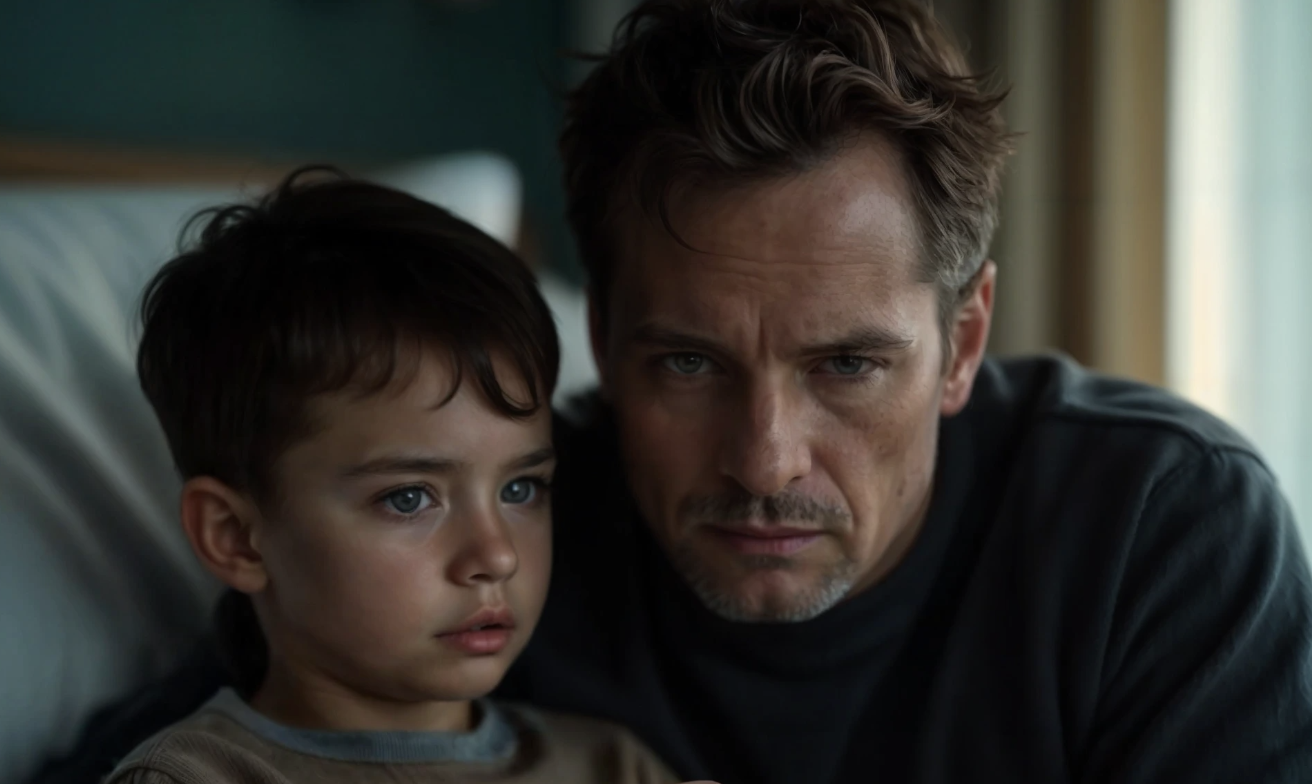
The sterile whiteness of the hospital room made his eyes ache. The sharp smell of bleach and medicine—the constant companion of any state-run clinic—seemed to have soaked into his very soul. Dmitry sat on the edge of the bed beside his ten-year-old son, Kirill, forcing the most carefree smile he could. This year the spring allergies had hit hard, and for a week now the boy had been stuck here, under IV drips and doctors’ watchful eyes. The room was shared—four beds—and during quiet hour it was filled with sleepy snoring. Dmitry had offered to move his son to a private VIP room, but Kirill had flat-out refused.
“Dad, what’s wrong with you?” Kirill whispered so he wouldn’t wake the others. “It’s deathly boring in there, and here I’ve got friends. Denis and I were playing ‘tanks’ on the tablet till late last night, until the nurse confiscated it. What time are you coming tomorrow? Try to come earlier, okay?”
He looked at his father with a seriousness beyond his years, but deep in his eyes swirled the usual boyish longing for home—and for his dad. Dmitry ruffled his light hair.
“I’ll try, buddy. As soon as I sort out work, I’ll come straight to you. Want me to bring you anything?”
“Bring something. Just…” Kirill hesitated; his gaze hardened. “Just don’t bring Olga with you. I don’t want to see her.”
Dmitry let out a heavy sigh. It was their constant problem. His relationship with Olga, which had been going on for almost two years, still hadn’t won his son’s approval. Olga tried—she bought Kirill expensive gifts, she tried to ingratiate herself—but the boy wouldn’t budge.
Deep down, Dmitry understood him. Olga talked more and more about getting married, about a shared future, but he kept stalling. Something held him back, and it wasn’t only Kirill’s dislike. Kirill firmly believed his mother, Anna—who had vanished eight years earlier—would return one day. That childlike faith was a fragile shield Dmitry didn’t dare shatter. He couldn’t betray the memory of his wife, whom he had loved more than life itself, and he couldn’t take away his son’s last hope.
“Alright,” he said gently. “Deal.”
Kirill’s face lit up at once. His neighbor in the next bed, Denis, was already awake and waving a homemade sign for a game of Battleship.
“Hit!” Denis whispered triumphantly.
“Miss!” Kirill whispered back and stared at his paper with renewed азарт.
Dmitry stood quietly and stepped out. His son truly needed the company of other kids. Maybe it was for the best he’d refused a single room.
The next day Dmitry arrived earlier than usual. Kirill met him at the doorway with shining eyes.
“Dad, hi! We went outside today! Aunt Nina, the nurse, took us into the courtyard for half an hour. It turns out it can be pretty great here!”
Dmitry smiled, seeing his son’s genuine joy. The hospital stay almost seemed to be helping, pulling the boy out of his usual lonely routine at home.
“Well, I’m happy for you, champ. How are you feeling?”
“Fine. They put me on a drip and that’s it. What’s new at home? Does Aunt Vera miss me?”
Dmitry chuckled. Aunt Vera—their housekeeper—adored Kirill and called him nothing but “my little chick.”
“Of course she misses you. Says the house feels empty without you. And also…” Dmitry hesitated, but decided to say it. “Olga stopped by. Asked me to tell you hi.”
Kirill’s face clouded instantly.
“I knew it. She took all Mom’s photos off the table, didn’t she? I told you not to let her touch anything! She wants everything to look like Mom never existed!”
His voice trembled. Dmitry felt a stab of guilt. He really hadn’t noticed when the framed photo of Anna disappeared from his desk.
“Son, I’m sorry. I didn’t notice. I promise tonight we’ll put the big portrait of Mom back up—the one that used to hang in the living room. Okay?”
Kirill nodded, calming down a little. Then Dmitry suddenly slapped his forehead.
“I’m completely spun out! I brought you and the boys treats—a whole bag—and I left it in the car. Come with me, help me carry it.”
They went downstairs. While Dmitry pulled bags of juice and cookies from the trunk, Kirill wandered over to an old gazebo at the edge of the hospital courtyard. There, curled up on a bench, sat a small, very thin girl in a worn-out little dress.
“Dad, look—that’s the same girl,” Kirill said quietly when Dmitry came over. “During our walk today, the older boys started teasing her, and she got scared and ran off.”
Dmitry looked at the child’s frightened, dirty face. His heart tightened with pity.
“Then go up to her,” he advised his son. “Give her something.”
Without hesitation, Kirill pulled out a chocolate bar and a pack of wafers and walked straight to the girl. She shrank into her shoulders as he approached, but Kirill held out the sweets.
“These are for you. Don’t be scared.”
The girl looked at him distrustfully, then at the treats, and with a tiny hand snatched the chocolate.
“Thank you,” she whispered, and jumping off the bench, disappeared around the corner of the hospital building.
Dmitry watched his son with pride. Despite everything, he was raising a kind, sensitive person.
When Dmitry came the next day, he found his son not in the ward but outside, on that same bench where the unknown girl had sat. Kirill looked thoughtful and upset; he didn’t even notice his father right away.
“Did something happen?” Dmitry asked anxiously, sitting down beside him.
Kirill lifted serious, older-looking eyes. There was no childish naivety left in them—only a heavy, sober thought.
“Dad, we need to talk. Like adults.”
They walked to the farthest corner of the courtyard where no one could overhear them. Dmitry braced himself for another talk about Olga or going home, but the question his son asked caught him completely off guard.
“Dad… how did Mom disappear?”
Dmitry froze. All these years he’d shielded Kirill from the terrible truth, saying only that Mom had gone away and would come back one day. He’d kept up that story to protect the child’s mind. But now, looking into his ten-year-old son’s eyes, he understood Kirill had grown up. He was ready. Hiding the truth any longer was pointless—and even cruel.
“It’s a hard story, buddy,” he began, choosing his words. “I didn’t want to tell you when you were little. Your mom didn’t just leave. And she didn’t just vanish.”
He paused, gathering courage. Memories he’d buried deep in the darkest corner of his mind surged up, causing almost physical pain.
“She was kidnapped.”
Kirill flinched, but didn’t interrupt. He waited.
“It was eight years ago. I got a call… from unknown people. They said they had Anna, and if I wanted to see her alive, I had to pay a ransom. A huge amount. They forbade me from going to the police and threatened to kill her if I did. I was out of my mind with fear. I gathered every ruble I had, borrowed from friends, sold my first jewelry workshop… I did everything they told me. I left a bag of money in the place they named. They took the ransom and… disappeared. Just vanished. And Anna… Anna never came back.”
Dmitry spoke quietly, staring into the distance, reliving the nightmare.
“After that, the police searched. For a long time. But they found nothing. Not a single trace. Not of the kidnappers, not of your mom.”
He fell silent. In the quiet it was easy to hear Kirill breathing hard. The boy stayed quiet, processing it. Finally he raised his head. There were no tears—only bitter understanding.
“So she’s… not alive?” he asked softly. “It’s been eight years. There’s no chance, right?”
Dmitry couldn’t answer. He only wrapped an arm around his son’s shoulders—silent agreement.
“Kirill,” he said at last. “Why are you asking about this now? What happened?”
Kirill pulled away and looked at his father with a new, strange expression.
“Dad, do you remember that big portrait of Mom—the one that hung in the living room? In it she’s wearing this really beautiful pendant on her neck.”
Dmitry nodded. How could he forget? That pendant had been one of his first creations when he’d just opened his jewelry workshop: delicate work, a silver rose with petals folded into the initials “A” and “D.” He’d made it for Anna for their first wedding anniversary.
“Of course I remember,” he said. “I made it myself. There isn’t another one like it in the world.”
Kirill took a deep breath, as if about to jump into icy water. His voice came out quiet but clear, and every word hit Dmitry like an electric shock.
“Dad… I saw that pendant today.”
Dmitry stared at his son, stunned. For a second he thought the boy was delirious—still in shock from what he’d heard.
“Buddy, you must’ve imagined—”
“No!” Kirill cut him off firmly. “I couldn’t be wrong! It was on her. On that girl.”
Skepticism and a wild, rising hope wrestled inside Dmitry.
“I talked to her again today,” Kirill rushed on, seeing doubt on his father’s face. “Her name is Masha. I asked her about the pendant. She said it was a gift from her mom. Her mom told her never to take it off because it’s their talisman. She said it protects them.”
Hope swelled in Dmitry’s chest, pushing aside common sense. He knew how Kirill loved studying his mother’s photos—how he could spend hours with the family album, noticing every detail. He couldn’t—he simply couldn’t—confuse that unique piece of jewelry, the symbol of Dmitry and Anna’s love. It was impossible.
“Dad, I know where they live!” Kirill pulled a sheet of paper folded into quarters from his pocket. “Masha told me, and I drew it. It’s somewhere on the outskirts—she explained how to get there from the tram stop.”
He handed his father a homemade map. In a child’s hand, crooked little houses, trees, and arrows marched across the page.
“Just… please don’t scare them,” Kirill added pleadingly. “Her mom is really afraid of strangers. They barely talk to anyone. Promise you won’t frighten them.”
Dmitry took the paper with trembling hands and stared at the clumsy drawing that could either lead to the greatest miracle of his life—or to the final, irreversible collapse of every hope he’d ever held.
Dmitry stared at the plan his son had drawn and couldn’t believe his eyes. He was shocked not so much by the map itself as by the fact that his sheltered, homebody boy even knew this neighborhood. It was the farthest edge of the city—a notorious area people called “the rotten corner.” A place respectable people avoided even in daylight. A place ruled by poverty, hopelessness, and crime. Apparently his new hospital friends had enlightened him.
He got into his expensive car, and its polished, respectable look felt almost indecent against the backdrop of where he was headed. His heart hammered a warning rhythm. A sharp, cold premonition—like a blade—pierced him. He drove slowly along a broken, pothole-riddled road. Outside the window flashed half-collapsed barracks, crooked fences, trash-choked courtyards. Poverty and abandonment seeped from every detail of the miserable landscape.
As the car crawled over the bumps, ghosts of the past rose in Dmitry’s mind. He remembered the dreadful weeks after Anna disappeared. He barely slept, barely ate—just drank water and smoked ceaselessly. In two weeks, a healthy thirty-year-old man, he turned gray.
He’d felt like he was dying of grief, like his heart would tear itself apart. Only one thought saved him: little Kirill, left in his care. For his son, he forced himself to keep living, burying his pain deep inside. And now, eight years later, the old wound ripped open again and bled with new force.
He turned into a narrow alley, checking Kirill’s map. There was the right turn; there was the old dead tree that served as a landmark. Finally he saw the structure his son had marked as “the house with the red roof.” It was a shabby little place sunk into the ground—barely a house at all. The slate roof sagged, paint peeled from the walls, and the windows were covered with cloudy film.
Dmitry killed the engine. The silence—broken only by the squeak of rusty gates in the wind—pressed on his ears. For several minutes he sat in the car, steadying himself, trying to stop his hands from shaking. Then he got out, walked to the flimsy, battered door, and knocked lightly. Behind it came soft shuffling footsteps.
The door creaked open. A young woman stood on the threshold. Her face was exhausted and pale, dark circles lay under her eyes, and gray strands showed in her once-thick blonde hair. But they were her eyes.
Anna’s eyes.
Dmitry stared at her and the world began to sway, losing all shape. The concrete courtyard, the gray house, his own car—everything blurred into a single smear. The air vanished. He tried to inhale, but his lungs refused to work. His legs buckled, and without a sound he collapsed to the ground, sinking into merciful darkness.
He woke to a quiet child’s voice: “Mom, the man is waking up,” and the touch of a cool damp cloth on his forehead. Dmitry opened his eyes. Two faces hovered over him. One was a child’s—frightened—belonging to little Masha. The other was an adult’s—anxious—belonging to her mother. He heard her voice, the same voice that had haunted his dreams for eight years.
“Are you alright? Are you feeling sick? Do you want some water?”
Dmitry sat up abruptly. He stared at her, searching that worn, battered face for the features of the bright, blooming Anna he remembered. She looked back with concern and sympathy—but without the slightest recognition. She didn’t know him.
“Sorry, did I scare you?” she asked, stepping back. “My name is Irina. Are you looking for someone?”
Irina. She called herself Irina. Dmitry couldn’t speak. He only shifted his gaze to her daughter—where, on a thin chain, hung the familiar silver pendant.
“The pendant…” he rasped. “Where did your daughter get that pendant?”
The woman glanced at it, surprised.
“It’s mine. I gave it to Masha when she was born. Why?”
“I… I made it. For my wife. Eight years ago.”
Irina—Anna—looked at him like he was insane. She pulled her daughter close, bracing to protect her.
“I don’t understand what you’re talking about. I don’t know you. I don’t remember my past life at all. Eight years ago, Baba Polya—a local old woman—found me in bushes by the roadside. I was beaten, covered in blood… and pregnant. I didn’t remember anything—my name, where I was from. Total amnesia. Doctors said it was from a traumatic brain injury.”
She spoke quietly, detached, as if telling someone else’s story.
“Baba Polya nursed me back to health. She was lonely, and when I gave birth to Masha, she helped me get documents in her name—as her supposedly ‘found’ granddaughter, Irina. She became a real grandmother to us. Two years ago she died. Since then we’ve lived alone—on my disability pension, which they arranged for me…”
Dmitry listened as the mosaic assembled into a horrifying picture. Kidnapping. Beating. Amnesia. They thought she was dead, and she’d been here—just a few kilometers from home—raising their daughter.
His daughter.
With a trembling hand, he pulled out his phone, opened his gallery, and found that very photo from the portrait. He held it out to the woman. In the picture, a young, happy Anna smiled—and the same pendant shone on her neck.
Irina stared at the photo, her face twisting with painful effort, trying to remember. But the silence was broken by little Masha. She leaned toward the screen and cried out happily:
“Mom, that’s you! Just prettier!”
Dmitry couldn’t hold it back anymore. He covered his face with his hands and wept. For the first time in eight years, he cried not from grief, but from scorching, impossible happiness. He had found his wife. And gained a daughter.
The next morning Dmitry was back at the shabby little house. He told Anna-Irina and Masha not to take anything from that old, чужая life. He sat them in the car and drove straight to the hospital, where Kirill was already waiting—having not slept all night, praying for news. The reunion of brother and sister, who had never known the other existed, was touching and a little awkward. Kirill, as the older one, immediately took Masha under his wing, showing her games on his tablet.
When they pulled up to Dmitry’s big, beautiful home, Olga was already waiting on the porch. She was furious.
“Dmitry, where have you been all night? I called you a hundred times! I was going crazy with worry! You owe me an explanation!”
Her demanding voice cut off mid-sentence. The car door opened, and Anna stepped out, holding a little girl’s hand. She looked at the huge house with cautious curiosity, as if it felt faintly familiar.
Olga recoiled, her face turning white as a sheet. She stared at Anna, and in her eyes there wasn’t shock so much as animal terror. She stumbled back and let out one sentence—just one—that explained everything:
“You?.. But you were supposed to die!”
In that moment, Dmitry saw everything with brutal clarity. Olga—Anna’s “best friend.” The one who had comforted him all those years. The one who wanted so desperately to take his wife’s place. It was her.
A flash of blind, searing rage flooded his mind. He didn’t remember crossing the distance. He grabbed Olga by the throat and slammed her against the wall.
“It was you… You did this…”
Anna screamed—and that scream seemed to punch through the armor of her amnesia. A sharp headache tore through her skull. Later, after examinations and surgery, doctors would say the shock had triggered the restoration of neural connections.
Memories began to return—at first in fragments, in terrifying flashes. Anna getting into Olga’s car, invited to see an “amazing house for rent.” Olga screaming about injustice, about how Anna always had everything—beauty, money, Dmitry’s love. And then a blow to the back of the head, and pain, pain, pain…
Olga and the accomplices she had hired for the kidnapping were arrested that same day. She confessed to everything, seeing no point in denying it.
And for Dmitry, Anna, Kirill, and little Masha, a new life began—difficult, full of discoveries and adjustments. They learned to live again as one big, reunited family. Anna got to know her husband anew, her grown son, and the life she’d lost.
And Dmitry thanked fate every day that his son’s allergy—and his kind heart—had led them to a miracle no one believed in anymore. Their new life began with a long trip to the sea, where the salty waves washed away the bitterness of past years, leaving only hope for a happy future.