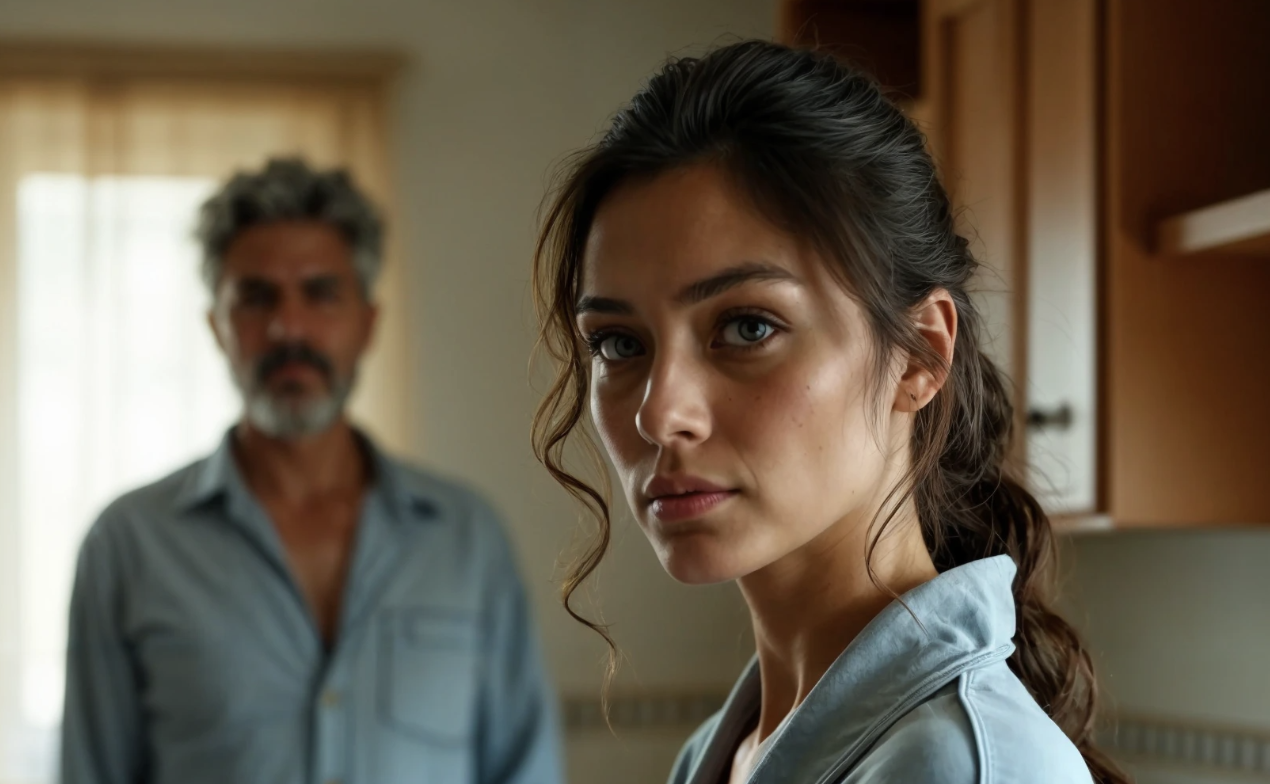
— “Are you seriously saying this right now?” Raisa set down the comb she’d been threading pearls into and slowly turned toward her husband. Her voice was quiet, but there was steel trembling inside it. “Sell my apartment to pay off your mother’s debt?”
— “Well what else are we supposed to do?” Andrey stood by the window, pale as the wall. His eyes darted over the curtains, the sill—anywhere but her face. “The bank will start proceedings. They’ll evict Mom!”
— “And who’s going to save me?” Raisa stood up. She wore her house robe—the very one she sewed bridal jewelry in, patterned with tiny daisies, the elbows already worn thin. In it she felt like she was wearing armor. “I’ve been saving myself my whole life, Andryusha. On my own. Without anyone else’s apartments.”
He exhaled and said nothing. And in that silence was that particular male helplessness women can feel in their spine.
Outside the kitchen door, the apartment was quiet. A pot of pasta boiled on the stove, and the smell of fried onions braided itself into the air, as if the scene demanded a set—peaceful, domestic, but cracked.
— “You don’t understand,” Andrey said at last. “It’s my mom. She’s desperate.”
— “Your mother is an adult woman,” Raisa cut in dryly. “And it’s long past time she understood that desperation isn’t a discount on responsibility.”
— “You’re heartless,” he breathed.
Raisa smirked. “And you’re naive.”
Five years ago she would’ve stayed quiet—back when she was just starting out, when beads rolled across the table and varnish stuck to her fingers like a reminder of her foolish stubbornness. But now she had an apartment—tiny, but hers. Her own income. Her own last name, which she’d never changed after the wedding—“just in case.” And apparently the “just in case” had arrived.
The pearls scattered on the table glowed like little moons. Raisa gathered them into her palm and poured them back into their jar, as if she were putting her patience back into a container.
— “I’m not refusing to help,” she said at last, a little softer. “But not with my apartment.”
— “Then how?” Andrey asked, hope flaring.
— “With advice.”
He gave a dull laugh.
— “Mom has heard plenty of advice. Now she’s putting the house up as collateral.”
— “Then let her listen to how to live without it.”
Andrey spun around sharply.
— “You… you’re serious?”
— “One hundred percent.”
And she walked out of the kitchen.
Raisa didn’t cry. Tears, in her view, were a useless investment. Better to brew tea. Or, worst case, wash the floors.
She put the kettle on and opened the window. October air rushed in—cold, damp, smelling of wet asphalt after rain. Somewhere behind the building boys were shouting, a ball thudding against a wall.
While the kettle heated, she remembered the first time she’d met Andrey.
He’d come to fix her hair dryer—so confident, with his tools, his drill-driver, and the face of a person who always knew where plus was and where minus was.
— “Your wire’s burned out,” he’d said, peering into the dryer like a surgeon into a patient’s heart. “But we’ll sort it out.”
A week later he asked her to the movies. A month later he brought tulips—“just because it’s spring.” A year later he proposed.
And now he was standing in front of her, offering to sell her apartment.
Not for a life. Not for an illness. Not for a child.
For his mother’s debts—debts she’d racked up because she couldn’t tell the difference between a business and a scam.
Raisa stared at the kettle and felt everything inside her going cold.
Once, Lyudmila Pavlovna had seemed likable—not “a sweet woman,” but strong, confident, capable. The kind who, over lunch, would say:
— “The main thing is to keep everything under control.”
And back then Raisa had thought, So that’s why Andrey is so reliable.
Only later did it become clear: control was Lyudmila Pavlovna’s way to survive. And to command. And to interfere.
— “Rayečka,” her mother-in-law would say with a smile that hid a blade, “a woman should be grateful. You’re lucky to have Andrey.”
— “Yes,” Raisa would answer. “And he’s lucky to have me.”
They would both smile—but between them always hung a thin thread of rivalry.
Now that thread had snapped.
After their argument, Raisa sat at the table and opened her notebook. Inside was her list of orders—wedding sets, combs, tiaras.
Everything planned through the end of the month. She had a plan.
Andrey had chaos.
The phone rang. On the screen: “Lyudmila Pavlovna.”
Raisa sighed, but picked up.
— “Rayečka…” Her mother-in-law’s voice sounded as if she’d just drunk tears. “Don’t be angry. Andrey flared up—he’s only like that because of me…”
— “I’m not angry,” Raisa said evenly. “I’m just tired.”
— “You understand that without that apartment I’ll be ruined, don’t you?”
— “I do. But without my apartment, I’ll be ruined too.”
— “Oh come on,” her mother-in-law sounded almost offended. “You’re young, you’re pretty—you’ll earn more!”
Raisa gave a small, sharp laugh. “And you’ve already spent everything, I take it.”
Silence. Only breathing on the line.
— “I didn’t know it was a scam,” Lyudmila Pavlovna whispered at last. “I wanted to prove I could do it—no worse than you…”
That sentence hit Raisa in her most painful place. Competition. Always competition. Even here. Even now.
— “Well, you proved it,” Raisa said quietly—and hung up.
That evening Andrey came back. He looked exhausted, dark circles under his eyes. A suitcase stood by the door.
— “You really packed?” he asked.
— “I did,” she said.
— “And that’s it? Four years—and a suitcase?”
— “The suitcase is a symbol,” she said. “So you remember: you can’t walk into someone else’s life with calculations.”
He was silent. Then, suddenly, he laughed.
— “You know, you’re like stainless steel. Not a drop of compassion.”
— “At least I don’t rust.”
He looked at her for a long time—the kind of look people have right before they leave: not at the person, but at the ghost of the past.
— “Then that’s it,” he said, and walked out.
The door slammed.
Raisa stood still for another minute, then went to the window. Outside, a fine rain was falling. The courtyard lamp flickered.
She brewed tea, turned on the old record player—the vinyl hissed, and an old song sang about a life where “everything will pass—both sorrow and joy.”
Raisa sank into the armchair and, for the first time in a long while, allowed herself to be tired. Not from orders, not from clients, but from a life where a woman is expected to be a seamstress, a therapist, and a rescuer of other people’s disasters.
And in the morning, when she woke, she didn’t feel emptiness.
Only silence—real, steady, like silk you could cut a new life from.
A week later, a mutual acquaintance told her Lyudmila Pavlovna was going around to lawyers, trying to “win something from the daughter-in-law in court.”
Raisa wasn’t even surprised. She simply finished her coffee and wrote in her notebook: “Order new beads.”
From that moment on, she decided she wouldn’t let anyone climb into her home, her life, or her wallet.
And she never saw Andrey again.
Not yet.
— “Raisa Nikolaevna? It’s you, right?” The voice was young, slightly hoarse, like someone who’d argued with life for too long and lost. “I… I’m calling about the ad.”
Raisa opened the door and saw a thin guy with a backpack and a tired gaze. Sleeplessness had left marks on his cheeks, shadows under his eyes. About twenty-eight, no more. In his hands—a folder and a thermos, like he’d come back from a war, but on a schedule.
— “What ad?” Raisa asked cautiously.
— “You wrote you were looking for an assistant for your workshop. I… I came.”
She blinked. Yes—she really had posted an ad online a week earlier: “Assistant needed for assembling jewelry. Work from home, neatness, attention to detail, responsibility.”
But she’d forgotten. After the divorce she’d forgotten how she’d even posted anything.
— “Well… come in,” she said, stepping aside.
The guy took off his backpack and crossed the threshold.
— “My name’s Vlad,” he said. “I used to work at a plant, but they shut the shop down. And I’m… good with my hands, I guess.”
Raisa narrowed her eyes. The hands really did look competent—long, deft, clean nails. Not a drunk. That was already a plus.
— “Sit down, Vlad,” she said. “Tea?”
— “If I can.”
He sat and looked around. In the corner—a work table: beads, wire, glue guns. On the wall—neatly hung combs, tiaras, barrettes, glittering like pieces of light.
— “Your work is beautiful,” Vlad said. “But painstaking, yeah?”
— “Painstaking,” Raisa smirked, “like life.”
— “Yeah,” he nodded. “Only life doesn’t pay by the hour.”
After a week, Vlad was already sitting confidently at the table. He worked quietly, focused, asked almost no questions. Raisa watched him out of the corner of her eye—there was something odd about him. Not stupid, not lost—more like he was deliberately weighed down by something invisible.
Sometimes he looked like everything around him was temporary. The way people sit in train stations—not living, just waiting for their train to be announced.
— “Vlad,” she said one evening, “your eyes look like they’re from another life.”
He smiled.
— “They are. From the last one.”
— “And what was in it?”
— “Everything. Work, family. Then I guess I took the wrong direction.”
Raisa didn’t press. People with eyes like that usually don’t want details.
Two weeks later Andrey called.
She recognized the number—blocked, but persistent.
— “Raya,” his voice trembled, “Mom died.”
Raisa sat on the edge of the table.
— “What? When?”
— “Last night. Heart.”
She said nothing.
Not because she was happy. Just because her head suddenly went empty, like a church after the service ends.
— “I need to talk to you,” Andrey said. “I… I can’t handle it.”
— “Andrey,” she said softly, “I’m not a psychologist.”
— “I know. But I’m not coming to a psychologist. I’m coming to you.”
He came that evening. The same Andrey—only as if he’d aged ten years. Gray at the temples, dull eyes. In his hands—a bag of chocolate and a bottle of wine, like he was trying to bring an apology in material form.
— “Can I?” he asked.
Raisa nodded without a word.
— “You look good,” he said, stepping into the kitchen. “Lost weight.”
— “The stress diet,” she smirked. “Works flawlessly.”
He nodded and set down the bottle.
— “I didn’t know who else to go to. After the funeral… it’s like everything cut off. Mom… she drove me crazy with her advice, but without her… it’s empty.”
Raisa looked at him—at the man who used to bring her tulips. She felt sorry for him. Humanly. Without the old feelings.
— “Andrey,” she said calmly, “you don’t need to come to me. You need to go to yourself.”
He lowered his eyes.
— “I understand. It’s just… it’s warm here.”
Raisa didn’t have time to answer—Vlad walked into the kitchen. In a sports hoodie, holding a mug of tea.
— “Oh, you must be Andrey,” he said calmly, like it was the most ordinary introduction in the world. “I work for Raisa Nikolaevna.”
Andrey froze.
— “Work? Here?”
— “Yeah.” Vlad shrugged. “I help out.”
Silence. Something heavy and sticky hung in it. Andrey looked at Raisa with the expression men get when they’re looking at a woman they can’t get back anymore—but they want to bite her for being alive without them.
— “You found a replacement fast,” he said hoarsely.
Raisa set down her cup.
— “Vlad is my assistant. Period.”
Andrey smirked.
— “Sure. Assistant. That’s what everyone says.”
Vlad calmly put his cup on the table.
— “You’re probably leaving?” he said. “Raisa Nikolaevna is busy. We’ve got an order due tomorrow morning.”
— “Good job,” Andrey said with poison. “Already ‘we.’”
Raisa stood up and looked him straight in the eyes.
— “Andrey, go. Tonight isn’t your night.”
He wanted to say something, but couldn’t. He just turned and left.
The door slammed; dishes clinked.
Later, Vlad silently put away the tools.
— “Sorry,” Raisa said. “I didn’t want you dragged into that.”
— “It’s fine,” he answered. “I had a night like that once too. When the past comes over and acts like it owns the place.”
She smiled—for the first time that day.
— “You’re a philosopher, Vlad.”
— “No,” he said. “Just tired.”
After that, the apartment felt different. A hush settled between them—not awkward, but alive. Vlad started staying late. Sometimes he brought food, sometimes he just sat nearby while she worked.
And then, somehow, it simply happened that one morning he didn’t leave.
Raisa woke to the smell of coffee and saw him—barefoot, in her old T-shirt, in the kitchen.
— “Morning,” he said. “I decided we don’t have to rush today.”
She looked at him and didn’t feel fear. No regret, no doubt.
Just calm.
But life, as everyone knows, loves to kick the chair out from under people who’ve only just learned to sit straight.
Three weeks later, a letter arrived.
From the bank.
“Notice of seizure of property. In connection with the overdue loan of Lyudmila Pavlovna K., for which you are listed as guarantor…”
Raisa reread it twice. Then again. Her heart dropped.
She had never signed as a guarantor. Never.
She called the bank.
The answer:
— “There’s a signature, there are documents. Challenge it in court.”
She hung up and sat down on the floor.
— “What happened?” Vlad crouched beside her.
— “Looks like they made me a guarantor on her loan.”
— “Who did?”
— “Who, who… Saint Lyudmila Pavlovna.”
The trial lasted three months. The documents really were there. The signature looked like hers. The forensic examination proved it was forged.
But while the checks were happening, the bank froze her account. Payments stopped. Clients got nervous.
Raisa didn’t sleep at night. Vlad tried to keep her afloat—cooked, joked, sat in silence when that was what she needed.
— “You know,” she said once, “I used to think rock bottom was just a metaphor. Turns out it has a very specific address and a case number.”
Vlad smirked.
— “The main thing is not to register there permanently.”
They won. The freeze was lifted.
The bank officially recognized her as the injured party.
Raisa cried for the first time that entire year—from relief.
And then she went to the cemetery. To Lyudmila Pavlovna.
She brought white chrysanthemums.
— “Well,” she said, standing at the gravestone, “it worked out for you, Lyudmila Pavlovna. You still managed to make me worry. Right to the end.”
Wind chased leaves along the path. Raisa smiled—tiredly, humanly.
— “Only here’s the thing,” she added. “I still climbed out.”
And she walked away without looking back.
In spring, she reopened the workshop. Vlad became her full partner—not only in work. They rented a space and expanded production.
Work went on. Life went on.
Sometimes in the evenings, sitting with a cup of tea, Raisa would think:
That’s how it is. Some people drown in debt, others in feelings. The main thing is learning to swim in time.
And somewhere deep inside, she still held a kind of gratitude—for Andrey, for his mother, for that strange, heavy experience. Because it tempered in her the most important thing of all: the ability to survive without someone else’s props.
And when Vlad asked one day—already in summer:
— “Could you start over if you’d known it would be like this?”
Raisa smiled and said:
— “Of course. But this time—no guarantees. Not for loans, and not for people.”
And their laughter spread through the workshop—light, clean, like the chime of new pearls she’d just threaded into her life