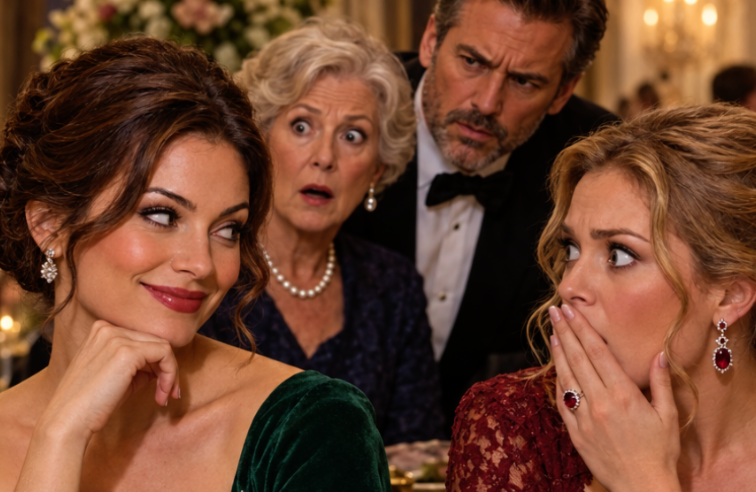
“Really pulling out all the stops, aren’t we?” my sister-in-law announced as she paused at the entrance of the banquet hall, casting a critical eye over the tables as if she’d suddenly been appointed chief inspector of the bargain bin section.
I was adjusting a bouquet of white peonies in a crystal vase— a gift from my colleagues— and froze for a moment with the scissors in my hand. Nearly all the guests had already arrived: my boss Olga Sergeyevna, two fellow general practitioners I’d long worked with at the city clinic, old university friends, and my husband Arkady. In the corner, a hired musician was quietly tuning his violin, while the air was filled with the scent of fresh pastries, lemon, and spiced appetizers.
Zhanna walked in as though she wasn’t attending a family celebration, but rather a court hearing on illegal enrichment. Right behind her, with pursed lips and the dignified air of a retired empress, swept in my mother-in-law, Raisa Mikhailovna. Rounding out the procession was an unfamiliar, distinguished-looking man of about forty-eight, impeccably dressed in a sharply pressed dark gray suit.
“No one throws this kind of spread on a general practitioner’s salary,” Zhanna loudly declared to the whole room, not even bothering with a greeting. Her voice was bright and piercing, fine-tuned by years of shouting over the drone of supermarket refrigerators and sales announcements. “So, Vika, how many poor pensioners did you have to send to private clinics to afford red caviar and live music? Does your conscience not bother you?”
A few guests coughed awkwardly. Olga Sergeyevna slowly set her glass of mineral water down on the tablecloth and fixed my sister-in-law with the kind of professional scrutiny that suggested she was mentally deciding whether to refer her to a neurologist or simply prescribe a calming herbal remedy.
I set the scissors down on a napkin and smiled with my gentlest, most reassuring doctor’s smile—the same one reserved for patients convinced they’re suffering from the plague, gout, and the evil eye, all at once—then walked over to welcome the guests.
“Hello, Zhanna,” I said smoothly and cheerfully. “Come in, don’t block the doorway—let’s not have the draft blow away all your concern for pensioners. And hello to you too, Raisa Mikhailovna. Nice to see you.”
“Hello, Viktoria,” my mother-in-law replied curtly, giving the table setting a quick, critical glance. “You’ve really gone all out. I thought we’d be celebrating quietly, as a family, but this looks like a wedding palace.”
“Well, these occasions don’t come around every year, Mom,” Arkady calmly interjected, walking over and shaking hands with the man in the gray suit. “It’s been twenty-five years since the day Vika first put on her white coat. Her silver professional anniversary. And may I ask—who are you? You haven’t introduced yourself.”
Zhanna instantly transformed. Her face, which a moment before resembled a bitter lemon, suddenly broke into a sugary, almost syrupy smile. She took her companion by the arm, cozied up to his shoulder, and announced proudly:
— Meet Vadim Igorevich! He’s the owner of a logistics company, a serious man who moves in cultured circles. I thought he might find it interesting to see what our free healthcare system looks like these days. Take a seat, Vadim Igorevich, don’t be shy — since we’ve been invited here, we might as well see where the honest taxpayers’ money goes!
Vadim Igorevich looked a bit embarrassed, adjusted his shirt cuff, and with a polite little bow handed me a box of Belgian chocolates and an elegant bouquet of creamy roses.
— Sorry for the sudden arrival, Victoria. Zhanna said you’d be happy to have an extra guest. Congratulations on such a wonderful milestone. Being a doctor is such a noble profession.
— Thank you, Vadim Igorevich, — I replied as I accepted the flowers. — There’s always room at our table and an extra setting for a good person. Waiter, could you please bring another chair next to Zhanna Nikolaevna?
My sister-in-law was clearly hoping I’d get flustered, try to justify myself, insist I never took a penny from any elderly ladies, or at the very least cause a scene about the uninvited gentleman. But I knew Zhanna inside and out: any attempt to defend myself she would consider a confession of guilt, and any argument would turn into a marketplace shouting match — a competition she would easily win, hardened as she is after years behind the counter.
So I decided not to argue. I simply chose to observe. After all, the evening was just getting started, and people like Zhanna rarely know when to stop if they feel the audience is at their feet.
The first half hour at the table went by surprisingly peacefully — if you ignore the fact that my sister-in-law acted like a stern restaurant critic who hadn’t been paid for a good review. She conspicuously sniffed the jellied pike-perch before putting it on her plate, loudly whispered to Vadim Igorevich that the mayonnaise in the salad ‘definitely contains palm oil, I can always tell these blends with my eyes closed,’ and asked the waiter twice if the mineral water in the glass bottles truly wasn’t just tap water.
Vadim Igorevich listened to her with the polite but slightly tense half-smile of a man who’s brought a lady to a respectable place, only for her to start poking the tablecloth with a fork, testing the thread count.
When it was time for the speeches, our supervisor Olga Sergeevna took the floor. She said a few warm, heartfelt words about all the people I’d helped recover from serious illness over the past twenty-five years and presented me, on behalf of the whole staff, with a watercolor landscape of our old city park and a gift certificate to a bookstore. Then Arkady pulled a velvet box from his pocket and pinned a delicate silver brooch in the shape of an antique clock balance onto my jacket lapel — a piece he’d crafted himself in his workshop during the evenings.
Zhanna looked at all these gifts with such contemptuous condescension, as if someone had shown her kids’ crafts made out of pinecones and acorns. As soon as the applause died down, she stood up, adjusted her voluminous hairstyle, and swept her gaze triumphantly over the guests.
“Well, since everyone has had their say, now it’s my turn,” my sister-in-law announced loudly, leaning over the chair to pull out a big cardboard box wrapped with a somewhat crooked gold ribbon. “Vadim Igorevich and I, we’re simple people, we don’t splurge at expensive restaurants or try to impress anyone. But I never skimp when it comes to family. Vika, you are, after all, my brother’s wife, and it pains me to see that you don’t even have decent dishes at home—all those mismatched mugs from discount shops. So I decided to give you something real, something with status. Hand-painted Imperial porcelain, limited edition! I spent half my salary on this set and got it through some antique dealer friends!”
With these words, Zhanna placed the box in front of me with a triumphant look, glancing at Vadim Igorevich, clearly expecting him to gasp in admiration. He nodded politely, though I saw a hint of confusion in his eyes—the “antique” box suspiciously looked like something from a hardware superstore, and it seemed like someone had hastily ripped off a yellow price sticker from one corner.
But the biggest shock came from the very last place Zhanna had expected.
Raissa Mikhailovna, who was sitting to the right of her daughter, perked up at the mention of “Imperial porcelain.” After all, my mother-in-law had spent forty years working as a quality control inspector at the porcelain factory, and her professional instincts were sharper than a sniffer dog’s.
“Let me take a look, Zhanna,” Raissa Mikhailovna said briskly, putting on her thin, horn-rimmed glasses and pulling the box closer. “I do love good craftsmanship. What series is this?”
“Mom, please don’t touch it, you might get it dirty,” Zhanna blurted suddenly, but it was already too late.
With a practiced, almost mechanical motion, my mother-in-law pulled out a teacup, lifted it to the chandelier’s light, tapped the rim gently with her fingernail, and turned it upside down. The room fell into a hush. The violinist in the corner had just finished his piece, and in the sudden silence, Raissa Mikhailovna’s voice rang out as clear as a factory loudspeaker:
“Zhanna, where did you get this disgrace?!”
Zhanna blinked and let out a nervous little laugh:
“Mom, come on… It’s an antique…”
“What antique?!” Raissa Mikhailovna exclaimed, genuinely offended in her most professional feelings. “Who are you trying to fool? I spent forty years in Quality Control! First of all, this isn’t bone china, it’s cheap earthenware—it doesn’t even ring, it clunks like a flowerpot! Second, look at the rim—there’s a glaze drip a millimeter thick, total third-grade rejects! And the stamp on the bottom is slapped on crooked—back at the factory, the whole shift would lose their bonuses for that! The going price for this box is three hundred rubles at a year-end clearance sale! Why are you telling such a lie in front of everyone?!”
You should have seen Zhanna’s face at that moment. She started changing colors rapidly—going from pale pink to the deep shade of boiled beetroot. A few of my coworkers hurriedly buried their faces in their napkins, Olga Sergeyevna’s shoulders started shaking suspiciously, and Vadim Igorevich reached so quickly for his glass of water, he almost knocked over the salt shaker.
“Mom, you just… don’t get modern technology!” hissed Zhanna, snatching the cup from her mother-in-law’s hands and shoving it back into the box. “It’s an artistic style made to look vintage! That’s actually super trendy right now!”
“Trendy to drink out of cups with glaze stains?” snorted Raisa Mikhailovna, pursing her lips in annoyance. “Don’t embarrass me, Zhanna. If there’s one thing I know better than you, it’s pottery.”
I held back a smile and gently steered the conversation toward the main courses, hoping to give my mother-in-law time to cool off. But judging by the furious glint in Zhanna’s eyes, I could see she would not forgive this humiliation. She was clearly desperate to get back at someone—to regain her superiority in front of Vadim Igorevich, and even more importantly, to take a pointed jab at me.
She spotted what she thought was her chance about twenty minutes later.
First, Zhanna called the waiter over and, without lowering her voice, demanded a separate drinks and food menu. Flipping through the pages with the air of a bored duchess, she jabbed her finger at two items and declared loudly:
“I’ll have two glasses of fifteen-year-old Armenian brandy and a grilled wild salmon steak, please. The pike you have here is a bit too bland. And put it all on the birthday girl’s tab—she’s living like royalty today and can afford it!”
The waiter looked at me questioningly. I simply nodded, signaling him to fulfill the guest’s wishes. Zhanna gave a triumphant smirk and shot Vadim Igorevich a smug look as if to say, ‘Look how easily I can order delicacies for myself, while this quiet one doesn’t even dare to protest.’
But the show didn’t end there. While the waiter was fetching the order, I caught an interesting detail in the mirror across from our table. Zhanna, seizing the moment when Vadim Igorevich got caught up in a conversation with a neighbor, pulled three clear plastic containers—just like the ones her supermarket uses for deli salads—out of her oversized bag. She quickly started loading meat platters, cheese, pastries, and even an unopened box of chocolates from the edge of the table into them.
Watching this, I didn’t feel angry or grossed out—just a quiet, almost scientific admiration for human greed. Classic, really: the loudest person about honesty is usually the one stuffing other people’s sandwiches into their own pockets.
I excused myself to the guests, stepped away from the table for a couple of minutes, walked over to the administrator’s desk, and quietly gave a brief instruction. When I returned, I found Zhanna in the middle of another impassioned speech.
“Now don’t get me wrong, Vadim Igorevich, I’m a person of principle,” my sister-in-law announced, waving her fork dangerously close to the neighbor. “I never take what isn’t mine and I don’t live off anyone else—I’ve always worked hard for what I have. Only Vika here knows how to land on her feet. She spends the mornings at the clinic complaining about how poor healthcare is, then throws lavish parties in the evenings. My brother Arkady, he’s lucky too: sits in his cozy workshop fixing cheap alarm clocks and swapping batteries, while his wife throws celebrations like this! Tell us, Vika, how do you manage such luxury on a therapist’s salary? Maybe I should get a job at reception and save up for a night out at a restaurant too!
continued in the comments.
The table fell silent. Olga Sergeyevna frowned—she clearly didn’t appreciate those public suggestions about taking bribes in her department. Raisa Mikhailovna tugged at her daughter’s sleeve, but Zhanna just brushed her off, clearly relishing her own boldness.
continued in the comments.
Arkady, who’d been the picture of calm all evening, slowly set his napkin down on the table and gave his sister the same intense look he reserves for examining a broken anchor escapement under a magnifying glass.
continued in the comments.
“You see, Zhanna,” my husband said quietly but so clearly his words carried to every corner of the room, “‘gears’ and ‘batteries’ aren’t all that simple. Take, for example, the chronograph on Vadim Igorevich’s wrist: it’s a rare Swiss caliber from the late seventies, with a hand-wound movement and a complicated calendar. In this whole city, only two watchmakers know how to service and adjust it properly. And as it happens, Vadim Igorevich picked up his watch from my workshop on Tverskaya just two days ago—I’d just finished restoring the mechanism after a bad fall. Correct, Vadim Igorevich?”
continued in the comments.
The man in the gray suit froze, glass in hand. He turned to look at Arkady’s face, as if imagining a watchmaker’s white coat and head magnifier on him, then suddenly slapped his palm on his knee.
continued in the comments.
“Wait… Arkady Nikolaevich?! You’re the famous master from Tverskaya with a month-long waitlist?! I didn’t recognize you out of your work clothes and without your magnifier! Forgive me, Zhanna told me her brother was just a guy working a strap kiosk, but you saved my family chronograph—the one that would’ve cost me as much as a used import car to repair in the capital!”
continued in the comments.
Vadim Igorevich shifted his slow, weighty gaze to Zhanna. My sister-in-law’s mouth fell open, but all that came out was a faint, awkward squeak. Turned out, lying about her brother to someone who had personally paid him for restoring antique watches wasn’t such a winning move.
continued in the comments.
“I… I just didn’t want to brag about family…” Zhanna stammered, nervously fidgeting with the edge of the tablecloth.
continued in the comments.
“Of course,” I gently picked up her thought, rising from my seat with my glass of mineral water. “Zhanna has always been the model of humility and financial honesty. And since she herself brought up the transparency of my family budget tonight, it would only be polite not to leave her curiosity unanswered.”
continued in the comments.
I turned to Olga Sergeyevna and my colleagues, smiled, and continued in a clear, calm voice:
Dear friends and colleagues, let me put your minds at ease: not a single grandma in my care was harmed, and I don’t run any private clinics during work hours. This anniversary evening is paid for from two very official sources: first, from the city prize I won as “Best District Therapist of the Year,” and second, from those Saturday shifts I’ve been working at the diagnostic center for the past two years. In fact, from this same prize, just last week, I paid for a three-week stay in a cardiology health resort for my dear mother-in-law, Raisa Mikhailovna—something that, it seems, Zhanna simply forgot to mention while picking out ‘imperial’ porcelain for me.
Raisa Mikhailovna blushed so fiercely it was as if someone had pressed two hot water bottles to her cheeks. She lowered her eyes to her plate and mumbled barely audibly:
Vika, why did you have to say it in front of everyone…
Because, Mama, a good deed doesn’t have to hide in the shadows, I replied warmly and turned my gaze back to my sister-in-law. Now, to the main point. Zhanna just rightly announced in front of Vadim Igorevich that she is proud, principled, never takes what isn’t hers, and never lives at others’ expense. Respecting her high moral standards, I didn’t dare to offend her with my hospitality. Everything on the banquet table—from me, with a pure heart. But those two portions of fifteen-year-old cognac and the wild salmon steak you ordered separately, Zhanna, I asked the manager to put on a separate bill in your name. Waiter, please bring Zhanna Nikolaevna her personal check!
At that moment, a waiter silently approached our table and, with a perfect bow, set a leather folder with the bill in front of my sister-in-law.
Eight thousand four hundred rubles, he said quietly and politely. Will you be paying by card or cash?
That was the moment of total clarity—there was nowhere to run, nothing to say, and no way to pretend it was a joke. If Zhanna refused to pay, she’d admit—right in front of everyone, including Vadim Igorevich—that she’d tried to eat and drink at the expense of the very woman she’d spent the evening accusing of crooked earnings. If she paid, she’d have to fork over a good part of her monthly salary for cognac she’d only ordered out of spite.
Zhanna gasped, furious and flustered. Her hands trembled as she fumbled for her wallet in that huge black bag hanging on her chair—right at that moment, the flimsy faux leather strap snapped.
The bag landed on the parquet floor with a dull thud. The zipper burst open and three clear plastic containers spilled out right at Vadim Igorevich’s perfectly polished shoes: one filled to the top with slices of cured sausage and tongue, another piled high with hard cheese and olives, and a third with pastries. Next to them landed that very box of candies that had been on the edge of the table.
No one in the hall laughed out loud—my guests are all well-mannered people. But the silence was so expressive, it felt like you could hear the antique Swiss watch ticking on Vadim Igorevich’s wrist.
He slowly lowered his gaze to the containers of sausage, then glanced at the slightly crooked third-rate cup, next at the leather folder with the bill, and finally at his companion’s flushed, blotchy face.
“You know, Zhanna…” Vadim Igorevich said quietly and very politely as he stood up from the table, buttoning his jacket. “I suppose I really am a simple man and don’t know much about high manners. I’ll head home now. By taxi. Alone. My apologies for any inconvenience, Victoria, Arkady Nikolaevich. All the best.”
He gave a brief bow to the guests and walked quickly and confidently out of the hall.
Zhanna sat motionless, staring at one spot. It seemed like she was ready to sink right through the parquet floor along with her chair and the ill-fated cognac. Raisa Mikhailovna was the first to recover. My mother-in-law silently opened her small purse, took out a thick white envelope—the very one she’d saved after her daughter persuaded her not to spend money on her “wealthy” daughter-in-law—and quietly placed it next to my plate.
“Sorry, Vika,” she said softly, without looking up. “Happy birthday. Health and patience to you. And you, Zhanna, get ready right now. And pick up your containers—don’t disgrace my gray hair.”
My mother-in-law took her stunned daughter by the elbow, and within a minute both of them had disappeared behind the doors of the banquet hall. The waiter discreetly collected the bill folder and the untouched glasses of cognac, whispering to me that the restaurant would cover all the extra orders on the house in honor of the birthday. But I still insisted the amount be included in our overall check—I don’t like leaving someone else’s debt behind.
The sound of a violin once again filled the hall. Olga Sergeevna raised her glass with a smile, colleagues started chatting loudly about their plans for spring, and Arkady leaned over to quietly ask me:
“Well, doctor, how are you feeling? Did your blood pressure go up?”
I looked at the now-quiet door, behind which all of my dear sister-in-law’s arrogance had just disappeared, took a sip of cold water, and smirked:
“You know, Arkasha, I’ve been treating people for all kinds of ailments for twenty-five years, but today I’m absolutely convinced: the best cure for someone else’s envy is a well-timed bill and a sturdy zipper on your purse.”