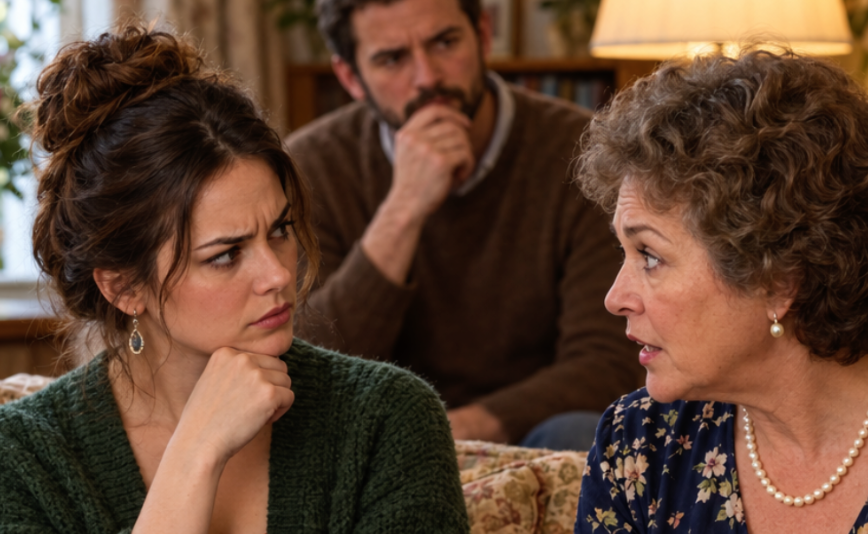
“That’s how we do it,” Adeline Valeryevna dabbed her lips with a napkin, leaving a streak of cheap “Wild Fuchsia” lipstick on the pristine white fabric. “In our family, the younger ones always organize the milestone birthdays for the elders. That’s the rule—out of respect.”
I looked over at my husband. Slavik calmly cut his steak, eyes glued to his plate. He recognized that tone in his mother’s voice. It was the classic, “I want all of you—preferably right now” tone.
“I’d like to clarify,” I said, putting down my fork. “Who exactly is included in this ‘we,’ and more importantly, who’s footing the bill for this banquet of respect?”
My mother-in-law let out a theatrical sigh. Somehow, in that sigh, you could hear the world’s grief for lost nobility—a quality, by the way, never observed in her biography. Adeline Valeryevna had worked her whole life in the HR department of a district clinic, yet acted as if she’d lost a family estate in Nice playing cards.
“Marina, you’re making it all about the money again. That’s so… vulgar,” she grimaced, eyeing my new manicure. “This is about the soul. Family legacy. I’m turning sixty. That’s a milestone. I want to gather everyone. Aunt Lucy from Lebedyan, the nephews from Tver, my old colleagues… About thirty people.”
“Thirty guests,” Slavik finally swallowed his bite. “Mom, our bathroom is mid-renovation—we’ve got tiles off and discovered mold. How are we supposed to host a birthday party for thirty?”
“That’s exactly what I mean!” Adeline Valeryevna slammed her hand on the table, her ring—cubic zirconia the size of a quail egg—sparkling. “You’re buried in chores! A celebration is sacred. I’ve already chosen the restaurant. ‘Tsarsky Dom.’ Gorgeous stucco, perfect for my complexion.”
My husband and I exchanged glances. ‘Tsarsky Dom’ was the kind of place where the price of water made you rethink how thirsty you really were.
“Whose name is the reservation under?” I asked, feeling my professional auditor instincts kicking in.
“Yours, of course,” my mother-in-law smiled, revealing a row of metal-ceramic teeth. “You sound more important on the phone. Plus, I think your boss has a discount card there. I’ve already called everyone. Guests will arrive Friday. And naturally, they’ll be staying with you. Can’t put family in a hotel, it’s just not done.”
In a split second, our peaceful evening vanished. Slavik quietly set down his utensils. He didn’t blush or start yelling. He just suddenly looked like a man about to fire a troublesome employee.
“No,” he said.
“No what?” Adeline Valeryevna froze mid-sip, her teacup raised.
“No ‘Tsarsky Dom.’ No thirty guests in our apartment. And no funding your birthday bash out of our budget.”
My mother-in-law slowly put her teacup down. The porcelain clinked against the saucer like a gunshot.
“You’re refusing your own mother?” Her voice dropped to a dramatic low. “Your own mother, on her birthday? Marina, is this your doing? You turned him against me? Of course, you’ll only spend your money on clothes for yourself…”
“Adelina Valeryevna,” I said quietly but firmly. “Let’s look at the facts. Last month, as part of our ‘family tradition,’ we paid for your spa trip because your ‘nerves were acting up.’ The day before yesterday, you asked for five thousand rubles ‘for medicine,’ but came back with a brand new purse. Now you want a party that would cost us three whole salaries. This isn’t tradition. This is financial freeloading.”
“How rude!” she gasped. “Slavik, do you hear this? She’s actually keeping track of what I spend on medicine!”
“I see the purse, Mom,” Slavik nodded at the new faux leather clutch hanging on the chair. “And I see the budget. We can take you out to a cafe. Just the three of us. Or you cook at home and we’ll buy the groceries. That’s it.”
Adelina Valeryevna stood up. She had a knack for making an exit—with her back straight, looking dignified.
“You’ll regret this,” she said as she reached the door. “Greed is a sin. And family… Family won’t understand. I’ve already invited people.”
The door slammed behind her.
“She’s bluffing,” Slavik said, returning to his now-cold steak. “She didn’t invite anyone. Aunt Lucy doesn’t even have the money for train tickets, and the nephews from Tver are working out of town.”
I turned on the dishwasher. My gut told me we were underestimating the disaster about to unfold. Adelina Valeryevna was the kind of woman who once made a bus conductor apologize for asking her to pay the fare.
Three days later, all hell broke loose.
First, Aunt Lucy called me.
“Marinochka, sweetheart, we’re on train 045, car seven. Be there to meet us! There are four of us, I even brought my grandson—he needs to see the capital. Adelina told me you have a fold-out couch in the living room?”
I pressed decline in silence.
Next, I was added to the group chat “THE QUEEN’S JUBILEE.” There were 28 participants. Adelina Valeryevna posted photos of the restaurant menu with captions: “Sturgeon à la royale is a must,” “Only French wine, Slavik’s allergic to the cheap stuff.”
The only thing Slavik was actually allergic to was audacity, but that didn’t bother his mom.
I showed my phone to my husband.
“She really went and did it. She actually invited people.”
Slavik rubbed the bridge of his nose.
“If we don’t pay, she’ll cause a scene in front of everyone. She’ll cry, clutch her heart, claim we turned her out on the street. She’s counting on us being ashamed in front of the guests.”
“That’s called social blackmail,” I said. “Classic move. If we cave now, the next ‘it’s our custom’ will be about signing over our apartment.”
“I have an idea,” Slavik grinned wickedly. “She wants tradition? We’ll give her tradition.”
The big day arrived.
We didn’t go to meet anyone at the train station. Our phones blew up all day, but we set them to Do Not Disturb. Somehow, Adelina Valeryevna managed—maybe she called a taxi or convinced one of her ‘girls’ to meet the caravan.
That evening, we pulled up to the ‘Tsarsky Dom.’ I put on my best dress—a black, serious number, as somber as a sentence. Slavik wore a suit.
The banquet hall glittered with chandeliers. Adelina Valeryevna sat at the head of the table in a sequin dress that looked like golden fish scales. Relatives bustled around her. Aunt Lucy was already spooning out caviar, and the nephews were pouring vodka (which wasn’t even on the menu, but they must have brought it themselves, sneaking it under the table).
Silence fell as soon as we walked in.
“Here come the sponsors of our happiness!” my mother-in-law declared, throwing her arms wide. “My children! You’re late! Penalty for them!”
“Hello, Mom,” Slava approached her, but didn’t hug her. He reached into his pocket and pulled out an envelope. “Congratulations.”
“Oh, don’t be so formal! Sit down, sit down!” she waved to the waiter. “Young man! Bring the main course! Everything just as I ordered. Marble beef steaks for everyone! And Veuve Clicquot champagne!”
The waiter, a young guy with nervous eyes, looked at us.
“Excuse me, is the order confirmed? The total for the banquet…”
“Of course it is!” my mother-in-law interrupted. “My son is paying. He has a gold card, right Slava?”
All the relatives grew quiet, anticipating a stunning show of generosity. Aunt Lucy froze with a sandwich halfway to her mouth.
I stepped forward. Calmly opened my clutch and took out a small, neat notebook.
“Adelina Valeryevna,” my voice rang out in the silent hall, echoing off the ornate ceiling. “Vyacheslav and I looked into the family archives. Studied our roots, you could say.”
“What? What archives? Sit down and eat!”
“You’re the one who always says, ‘That’s how things are done in our family.’ Honoring the traditions of our ancestors. Well,” I opened the notebook, “on your father’s side, the merchant of the second guild you love to talk about, the rule was: the parent’s jubilee is paid for by whichever child received an inheritance or a dowry.”
The silence in the hall was so complete that you could hear the champagne bubbles fizzing in Aunt Lucy’s glass.
“Slava,” I turned to my husband, “did your mom give you an apartment?”
“No, we bought our own,” he answered loudly.
“A car?”
“I’m still paying off the loan.”
“Maybe she paid for your education?”
“I studied on a state scholarship and worked part-time as a mover.”
I turned to my mother-in-law.
“Adelina Valeryevna, maybe you passed down the family diamonds to us? Oh right, you sold them when Slava was ten to buy yourself a fur coat.”
“How dare you…” she hissed. “In front of everyone!”
“There’s another tradition,” Slava continued, looking his mother straight in the eye. “The noble one: whoever invites the guests is responsible for their entertainment. That’s a matter of honor. Isn’t that right?”
“You’re shaming me!” my mother-in-law shrieked. “I’m your mother!”
“We respect you,” Slava nodded. “That’s why here is our gift.”
He placed the envelope on the table.
“Here is twenty thousand rubles. That’s the price of a good dinner for two with wine. That’s our contribution. We congratulate you, Mom. But we’re not paying for Veuve Clicquot for thirty people you invited just to show off. That’s not the way we do things.”
Slava took my arm.
“Enjoy your meal, dear relatives. By the way, the bill will arrive in two hours. I suggest you all pitch in.”
We turned and headed for the exit. I could feel the growing panic in the room behind me.
“Slava! Wait!” called out Adelina Valeryevna, forgetting all her airs. “I don’t have that kind of money! You can’t leave me!”
We stopped at the door. Slava turned around.
— Mom, you have your rainy day fund. The one you keep in your special ‘under the pillow’ savings account. Three hundred thousand, right? I saw the statement when I set up your online banking. That should be just enough for your getaway. Go enjoy yourself now, Mom. Traditions, you know—they always demand sacrifices.
We had dinner at home, eating dumplings. Slavik’s phone was turned off. So was mine.
Later, we learned the details from Aunt Lucy herself, the one who called to apologize (and to ask for money for her return ticket, which she was refused).
Adelina Valeryevna had to pull out her precious card. The sturgeon stuck in her throat—literally. The ‘girls’ from work were whispering, relatives gloomily finished the salads, realizing the party was officially over. What started as a triumph ended up being a wake for my mother-in-law’s bank account.
The next day, Adelina Valeryevna sent a message: “Traitors. I’ll never set foot in your house again.”
— Well, there you go, Slavik smiled as he read the text. — And she said she didn’t want any gifts. She’s given us the best one.
I looked at him and thought: it’s such a blessing when your husband understands that a real family isn’t about tolerating freeloaders for the sake of appearances, but about standing up for each other—no matter how absurd the situation. Even if the absurdity is named Mom.
A summary for my wise readers:
Manipulators love the word ‘tradition’ because it’s the perfect cover for their greed and desire for control. But remember: every tradition is an agreement between two sides. If one side only delivers, while the other just rides along and prods—this isn’t family, it’s draft work. Don’t be afraid to ask the awkward question: ‘Who’s paying for this feast?’ And if you don’t like the answer—close your wallet. Respect can’t be bought, and audacity is best cured with a strict financial diet.