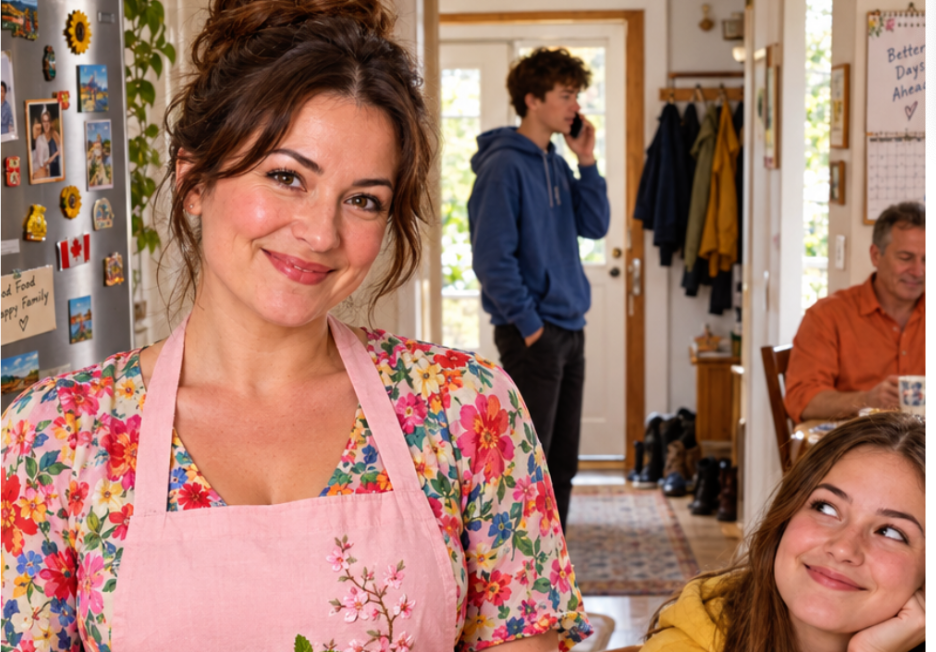
“Aunt Lena, are we having syrniki today?” Grisha poked his head into the kitchen, ducking as he came through the door, even though he still had about five centimeters to spare.
“I bought four packs of cottage cheese, 189 each. But only after soup.”
“Does the soup have floating onions?”
“No onions floating. Go wash your hands.”
Grisha left, and Elena scooped a whole onion out of the pot with a slotted spoon and tossed it in the trash. The onion had given everything it could to the soup, and Grisha never knew it was there. He hadn’t eaten boiled onions since he was eight, and he could always spot them on his very first spoonful.
While the soup was cooking, she pressed cottage cheese through a sieve. The sieve was large, its wooden rim darkened with age, and she had to work for a long time, moving the spoon in circles. But thanks to that, the syrniki turned out tender and lump-free. Grisha always noticed when they weren’t sieved, and then he’d eat them half-heartedly.
Elena was forty-seven and worked as a school librarian on Kompros. She had been married to Konstantin since 2017, and though they never had children of their own, Konstantin’s kids visited every weekend: Saturday lunch and dinner, Sunday breakfast and lunch. Afterward, Kostya would drive them back to their mother’s place in Gayva. Elena never called them her own or pretended to be their mom. She simply remembered little things: that Grisha wouldn’t touch boiled onions, and Liza loved raisin casserole—but always picked out the raisins and stacked them in a neat pile at the edge of her plate.
They ate together in the kitchen. Seventeen-year-old, lanky Grisha sat sideways because his legs wouldn’t fit under the table, quickly downing two bowls of soup. Liza ate slowly, telling everyone about the new English teacher in her ninth-grade class, who said ‘good’ as though she was giving a failing grade.
‘And what did you say to her?’
‘I told her ‘thank you’. With exactly the same expression.’
‘That’s right,’ Konstantin approved. ‘Grisha, what about you? When’s your practice test?’
‘In December. For the specialized subject.’
‘And how’s it going?’
‘It’s fine,’ Grisha replied and held out his empty bowl to Elena. ‘Aunt Lena, could I have half a bowl more? Just the thick part, please.’
‘You can’t have half a bowl of the thick stuff. You get a full bowl.’
‘Okay, give me a whole bowl, then.’
‘Dad, are we leaving at six or earlier today?’ Liza asked.
‘At six, like always. Why earlier?’
‘No reason. I just have a math test tomorrow.’
‘Well, you can always open your textbook here if you want.’
Konstantin, a factory foreman at Motovilicha, looked on Saturdays like he’d managed to catch up on sleep for the entire week. He didn’t get involved in the women’s routines and believed everything at home was fine as long as no one complained.
After lunch, the kids went off to their room and Elena headed to the stove. She fried syrniki on two pans at once, stacked the first batch on a big plate, and brought them into the room while they were still hot.
Grisha was standing in the hallway by the coat rack, his back to the kitchen, phone pressed to his ear.
‘It’s fine, Mom. Aunt Lena’s cooking isn’t tasty, but we get by. No, we’re not full.’
He listened to whatever she told him, shifting from foot to foot.
‘Okay. Yeah. Dad will bring us tomorrow.’
Elena turned back and returned to the kitchen. She set the plate on the table and sat down on the stool by the stove. The syrniki in the other pan started to burn, so she flipped them. The strainer with leftover cottage cheese still lay in the sink.
Five minutes later, Grisha came in.
‘Oh, syrniki! Why didn’t you bring them in?’
‘I didn’t have time.’
He sat down, grabbed one with his hands, burned his fingers, blew on it, and ate it. Then had a second. Elena didn’t intend to count, but did anyway. The third Grisha dipped in sour cream. The fifth—into jam. When he got to the sixth, Liza came in.
‘Grisha, have you lost your mind? Leave some for me.’
‘There’s another pan coming.’
He polished off the seventh while Liza was taking her seat, and took the eighth with him to his room, eating as he went.
‘Thank you, Aunt Lena,’ he called from the hallway.
Konstantin poked his head in, drawn by the smell, and immediately noticed the nearly empty plate.
‘Wow, Grishka’s really going for it! Lena, next time you’d better get five packs. He’s growing like a weed.’
‘I will.’
Dinner tonight was navy-style pasta—everyone’s favorite, especially Konstantin, who loves anything with ground meat. Elena served up the dishes and took a seat at the edge of the table. In the past, she never paid attention to how everyone ate, but now she watched closely. Grisha finished his own portion and then half of his father’s, while Konstantin was distracted by his phone. Liza picked all the meat out of her pasta first, then changed her mind and ate the noodles too.
“Aunt Lena, are we having pudding tomorrow?” Liza asked.
“I’ll bake it in the morning.”
“With raisins?”
“Of course.”
All the plates ended up in the sink completely empty, and Elena thought that maybe this is what it means to endure—silently, until the very last bite.
Later, while the kids watched a movie in the other room and Elena was clearing the table, Konstantin came up behind her and gave her a quick kiss on the top of her head.
“What’s wrong? Are you tired?”
“A little bit, yeah.”
“Come on now. The kids are happy, Grisha wolfed down eight portions. They adore you.”
Elena nodded and didn’t say a word.
***
Sunday went on as usual. French toast for breakfast, pilaf for lunch. Elena served up the plates and then suddenly asked a question she had never asked before:
“Did I make it too salty?”
“Nah, it’s fine,” Grisha replied, without looking up.
Elena had heard him say “fine” a hundred times without thinking much of it, but now she wondered what it really meant. Grisha finished his meal, glanced into the pot, and asked for seconds. Liza ate a piece of casserole and stacked a neat pile of raisins at the edge of her plate.
At six, Konstantin drove them to Gaiva. The kids were putting on their shoes in the hallway, and as usual, Grisha was hunting for his second sneaker, which he always found under the coat rack.
“Aunt Lena, the pudding was delicious,” Liza said, already in her jacket.
“Thank you.”
Liza waved her sleeve at her and went downstairs to join her father. Before, Elena would have simply felt happy. Now, she stood in the hallway, wondering if it was just politeness or if Liza really meant it.
Elena spent the whole week thinking.
On Monday at the library, between lending textbooks to the 9th grade B class and doing a dictionary inventory, she did the math. There are fifty-two weekends in a year. Subtracting holidays, summer camp, and a couple of times someone was sick—let’s say forty-eight. Four meals each weekend, over nine years. That added up to one thousand seven hundred and twenty-eight lunches, dinners, and breakfasts. And one phrase spoken in the corridor, which, for some reason, felt heavier than all of those meals combined.
“Lena, what’s up with you? You look like the whole seventh grade just turned in their books at once, all with underlines,” someone remarked.
Farida Rashitovna, the chemistry teacher, would come into the library during the big break when she didn’t have the strength for the staffroom. She’d sit in the reading room with her thermos and say that at least here, nothing was about to blow up.
A sixth grader peeked in through the door, his backpack almost bigger than he was.
“Hi, do you have ‘Timur and His Team’? We need it for school.”
“Yes, it’s on the second shelf from the bottom, Gaidar. You can find it yourself.”
The sixth grader found the book, signed for it, and left hugging it to his chest.
“Timur,” Farida said. “I have a Timur too. But mine doesn’t gather a team, he just plays PlayStation. So, tell me what’s going on.”
Elena told her. Briefly, without expression, the way you retell someone else’s story.
“Not tasty,” Farida said, putting down her mug. “But your cheesecakes are. You used to bring them to parent meetings—they were amazing. I still dream about them.”
“He said ‘we’re managing’.”
— Hey, try an experiment this Saturday. Boil some pasta. No butter, no cheese, nothing extra. Then watch and see how much they can actually tolerate it.
— Farida, they’re just children.
— Mine’s a child too, twenty-two years old. Every night he complains I’ve over-salted the food, and every night he asks for seconds. Have you ever seen them leave anything on their plates?
— Not once.
— Exactly. If it’s not tasty, they’ll leave it behind, believe me, I’m a chemist. If the plate is empty, the food was good. Everything else is just talk.
Elena didn’t end up boiling any pasta. But that line about empty plates stuck with her until Wednesday, like a bookmark in a novel.
On Tuesday evening, Elena made syrniki for the two of them, just because—even though she never made them on weekdays. She went through the usual routine: passed the cottage cheese, did everything as always. She tasted the first one herself, carefully, like you’d try someone else’s cooking as a guest. It tasted exactly like a syrnik should.
— What’s with syrniki on a weekday? — Konstantin asked, drawn in by the smell. — Is it a special occasion?
— Just testing.
— Testing what?
— Myself. To see if I’ve lost the knack.
Konstantin ate six syrniki and said that if she ever does forget how to make them, he hopes she keeps forgetting just like that.
On Wednesday evening, Konstantin was at the kitchen table with buckwheat and a cutlet, checking the weekend weather forecast on his phone.
— Kostya, do the kids like it here? I mean, the way I cook?
— They’re fine with it. Why?
— Just wondering.
— They adore you, come on. Grishka eats eight at a time. — He set his phone down. — Listen, I need to head to the garage after lunch on Saturday, gotta check the battery before the freeze sets in. You’ll be okay without me?
— I think I’ll manage.
— There you go then.
On Friday, Farida Rashitovna popped into the library, already in her coat on her way home.
— So, pasta experiment?
— Ended up making syrniki.
— Good call, — Farida said, not the least bit upset. — Experiments on kids are banned anyway. I just wanted to see what you’d do.
— On Saturday, I’ll just ask them.
— Directly?
— How else? I’ve been teaching all my life, Farida. Kids answer direct questions better than adults.
— Depends on the kid, — Farida replied. — Mine still answers ‘fine’ to everything, even now.
That Friday evening, Svetlana called Konstantin. He talked in the hallway, so Elena could only hear his side of the conversation.
— Yes, Sveta. I’ll pick him up at eleven, like always. Of course we’ll feed him. Yeah, sure. I’ll tell Grishka to wear his hat. No, everything’s fine here. See you.
He returned to the kitchen and sat back down to finish his meal.
— She said to remind Grishka to wear his hat. He keeps it in his pocket—I’ve seen it.
— Let him carry it around. As long as he has it with him, that’s what matters.
That same night Elena bought cottage cheese. Five packs, just like Kostya asked.
***
On Saturday, she did her usual cooking. Meatball soup with a whole onion that got tossed in the trash on time. Potatoes with cutlets. A raisin casserole for Liza was cooling in its dish on the stove. The kids arrived at noon. Grisha poked his head into the kitchen without even taking his shoes off.
— Aunt Lena, are you making syrniki?
— After lunch.
— He asked me three times in the car, — Konstantin announced from the hallway. — I almost turned around and went out for more cottage cheese.
Elena didn’t answer, she just took a sieve from the shelf and set it on the edge of the table. They sat down for lunch at one, and by two Konstantin had put on his old jacket and headed to the garage.
Grisha was finishing his second bowl of soup while Liza picked at her cutlet. Elena poured herself some compote, sat down across from them, and waited until the door closed behind Konstantin.
“Guys, I want to ask you something, and please be honest with me. I promise, I won’t get upset. A week ago, I was bringing you syrniki, and I overheard Grisha talking to your mom in the hallway. He was saying that my cooking isn’t tasty, and that you just put up with it. I really just want to know—what exactly don’t you like? I can make things differently.”
Grisha blushed all the way to his ears and stared down into his soup.
Liza answered, quick and sharp as always.
“It’s all good, Aunt Lena. Seriously. That’s just something we say.”
“To whom?”
“To Mom. Every Sunday night she asks what we ate. If we say ‘it was tasty,’ she goes quiet for the whole evening and slams the cupboard doors in the kitchen. Once, she even cried,” Liza pushed her cutlet away. “We’ve been saying that since we were about ten. ‘It wasn’t tasty,’ that’s it, and she calms down.”
“She’s not mean,” Grisha said quietly to his bowl. “She’s just alone all Saturday.”
Elena listened without saying a word.
“Last time she asked if we were full,” Liza went on. “But what would Grisha say? That he ate eight syrniki?”
Grisha lifted his head.
“Aunt Lena, I eat eight of your syrniki. You don’t eat that many if they’re not tasty.”
Elena didn’t say anything about their mom. She asked something else instead.
“Why didn’t you tell me this before?”
Liza looked at her brother, then at Elena.
“How could we say something like that?”
They were quiet for a moment. Grisha rolled a bread crust in his fingers.
“Mom’s solyanka is actually really good,” said Liza. “She makes it for New Year’s. And manty too.”
Elena nodded.
“The first time I told Mom your cutlets were better, she went to the bathroom and let the water run for a long time,” Liza said, still looking at her plate. “Then Grisha told me in our room that you just can’t say things like that.”
“I didn’t explain,” Grisha grumbled. “I just said: keep quiet.”
“Well, that was an explanation.”
The hum of the fridge filled the kitchen. Grisha finished his soup, took his bowl to the sink, and came back, standing by the table and staring at the sieve lying on the edge.
“Aunt Lena. Will you teach me how to make syrniki? So I can do it at home myself.”
“Right now?”
“Why not? Dad’s in the garage till the evening.”
Elena took two packs of cottage cheese, eggs, and flour from the fridge and set the sieve in front of Grisha.
“First, you have to strain it. Through the sieve, with a spoon, in a circle.”
“Is that really necessary? It takes so long.”
“Can’t skip it. The whole trick is in the sieve. Without it, you’ll get cottage cheese in flour, not syrniki.”
Grisha strained the cheese with effort and a bit of frustration. The cottage cheese was stubborn, pushing through the mesh slowly, the spoon scraping against the rim. Liza sat on the stool with her legs tucked under her, offering commentary.
“Don’t press, smooth it out. Aunt Lena, tell him!”
“Listen to your sister,” Elena said.
“You two are ganging up on me.”
Grisha’s first syrniki were a flop. Literally: one fell apart into three pieces on the pan, another stuck, the third was too thick and raw in the middle. He ate all three, standing at the stove with the spatula in hand.
“It’s fine,” he said with his mouth full. “It’s edible.”
“Is it tasty?” Liza asked.
“Not really,” Grisha replied. “But I can stand it.”
Liza snorted so hard she nearly toppled off the stool. Elena laughed too, for the first time all week, surprised at how easy it felt.
The second batch turned out better. The third one was almost perfect. While Grisha was frying, Liza climbed down from the stool, picked up a knife, and started slicing apples into thin wedges.
“What are those for?” Elena asked.
“For a casserole. Next time. You don’t even have to add raisins at all.”
“But you love them.”
“I always pick them out. Since first grade. Not the same thing.”
“I thought you liked picking them out.”
“Well, that too,” Liza admitted, after thinking for a moment. “But it’s better with apples.”
Konstantin came back from the garage around seven, his hands black with grease, and sniffed the air as soon as he walked in.
“What’s going on in here? Syrniki again?”
“It’s not me.”
“Who then?”
“Me,” Grisha called from the stove.
Konstantin looked at his son, at the frying pan, then at Elena, and headed off to wash his hands.
“Well, well,” he called out from the bathroom. “Soon you’ll be feeding me.”
“Not soon,” Grisha replied. “We’ve got to get a sieve first.”
At dinner, Konstantin took one of Grisha’s syrniki from the third batch and ate it. Grisha watched his father like he would an examiner.
“Well?” Grisha couldn’t hold back.
“It’s fine.”
“What do you mean? Tasty or just okay?”
“‘Fine’ means tasty,” Konstantin replied, surprised. “What else would it mean? I’m eating it, aren’t I?”
Across the table, Liza raised her eyebrows at Elena, as if to say, Did you hear that?
***
On Sunday, Grisha woke up earlier than anyone else—which had never happened before—and by 9 a.m. there was a plate of syrniki on the table. Half neat, half lopsided, and one was burnt on one side, which Grisha put aside for himself.
“Way too much sugar,” Liza said after taking a bite.
“At least they held together.”
“Two of them fell apart. I saw you eat them.”
Elena ate breakfast in silence. The syrniki were sweet as jam and fully edible.
Konstantin ate four, thought for a moment, then took a fifth.
“They’re really sweet.”
“They’re my signature ones,” Liza said.
By lunchtime, Elena was making soup. Grisha stood by, watching how she put a whole peeled onion into the pot.
“What’s that for?”
“For flavor. I’ll take it out later.”
“Wait,” Grisha glanced at the pot, then at her. “Has it always been in there?”
“Since the very beginning.”
“And I ate it?”
“You ate soup. The bucket ate the onion.”
Grisha thought for a moment and made a note in his phone: ‘onion whole, throw out later.’
After lunch, she sat down at the kitchen table and wrote out the recipe on the back of a clean library card. Large handwriting, no abbreviations, and notes like: ‘cottage cheese MUST be strained,’ ‘don’t press, smooth,’ and ‘sugar—two spoons, not four.’ Grisha read it twice, folded the paper in quarters, and tucked it into his backpack’s inside pocket where he kept his headphones.
“Just don’t tell Mom this recipe is yours.”
“Tell her you learned it yourself,” Elena said. “That’ll be true.”
“What about the sieve?”
“You’ll buy one. They have them at Fix Price for about two hundred rubles. Not the best, but it’ll work.”
“Can you write out the casserole recipe for me?” Liza reached out her hand. “With apples.”
“And why do you need it?”
“Just because. Grisha hides his, I’ll put mine in my algebra textbook. Nobody looks there. Not even me.”
Elena took a second card and wrote out the casserole recipe. Raisins didn’t make the ingredient list.
Konstantin was in the hallway, zipping up his coat and jingling his car keys.
“What secrets are you two up to?”
“Men’s business,” Liza replied.
“Then why are you involved?”
“I’m on the apple team.”
Konstantin shrugged and opened the door.
“Lena, you see? I told you, they absolutely adore you,” he said.
“Bye, Aunt Lena,” Grisha called from the landing, ducking under the doorframe even though he really didn’t have to.
The door closed behind them, and Elena went back to the kitchen. The sieve was drying at the edge of the sink. Grisha had washed it himself in the morning, and there were still curd bits stuck in the mesh—he’d scrubbed it so hard, as if the cottage cheese had done something to offend him.