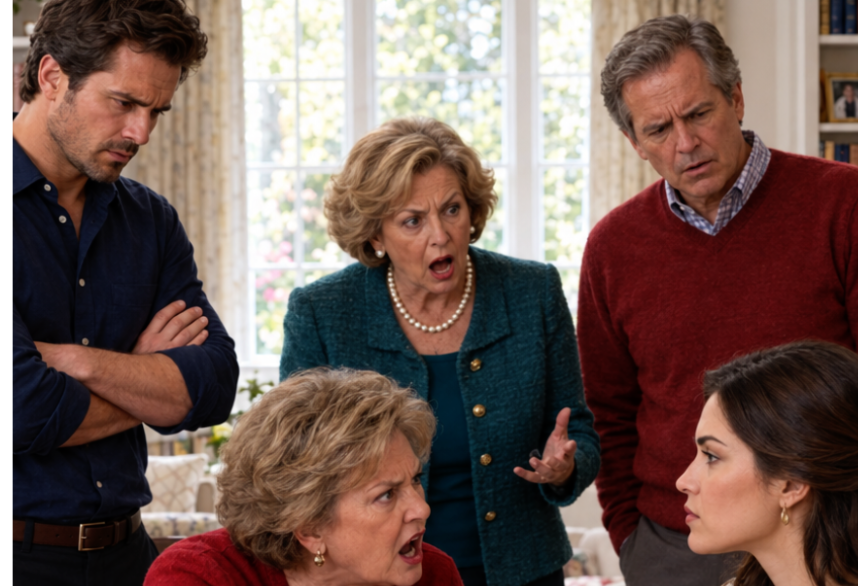
Get out of my house!
The way it was said—so calm, almost gentle—made it even scarier. Zinaida Borisovna had a talent for this: not yelling, but letting her words drip out, bit by bit, like venom from a dropper straight into a wound.
Vera stood in the hallway, holding a bag of groceries. She had just returned from the store and hadn’t even managed to take off her coat yet.
“I don’t understand you,” she said evenly.
“You will,” the mother-in-law replied, settling into her armchair as if she had just won a chess tournament. “My darling son has already transferred everything. The apartment is his. You’re nobody here, understand? No one. Not even worthy of a name.”
Vera quietly put the shopping bag on the floor. She took off her coat in silence, hung it on the hook, and headed for the kitchen.
She heard a disgruntled huff from behind her.
Zinaida Borisovna had come into their lives—or more truthfully, had never left. She was the kind of mother who never let go of her son—not at twenty, not at thirty-five. Maxim was her only child, her “sunshine,” her “smart boy”—even though at forty he couldn’t make his own doctor’s appointment and called his mother to ask how long potatoes should be boiled.
Vera thought she knew what she was getting into. Or at least, she thought she did.
For the first two years, she endured her mother-in-law’s visits with that polite smile that eventually starts to ache—in your cheeks. Zinaida Borisovna would arrive and immediately inspect the apartment like a health inspector: running her finger across the shelves, peering into the fridge, and shaking her head over the soup pot.
“Maxenka, just look at how she feeds you,” she’d say to her son, using the tone people reserve for discussing someone gravely ill.
Maxim would stare at his phone and nod. Or sometimes not even bother to nod—it made no difference.
He basically existed somewhere between his mother and the couch. He went to work—that was true. But everything else: the repairs, paperwork, decisions—it all somehow ended up as Vera’s responsibility, or Zinaida Borisovna’s. His mom would come, take charge, leave satisfied. Maxim would say, “Mom knows best,” and go back to his phone.
For a long time, Vera wondered: maybe it’s just his personality? Maybe it’ll get better?
It didn’t get better.
Three months ago, Maxim told her over dinner, casually between courses, that he had changed the registration for the apartment. He just said it—as if talking about a new cell phone plan.
“Mom says it’s safer that way,” he added, reaching for the bread.
Vera set down her spoon.
“Safer for whom?”
Maxim shrugged. You know how it is, he seemed to imply. Mom worries. Anything could happen.
“Anything could happen” apparently meant Vera. Who knows what she might do. Who knows what she might try to take to court. Vera looked at her husband and thought: here he sits, eating the soup she made, in the apartment she helped furnish, and he’s explaining to her that she’s a risk here. An insurance case. Something to be protected against.
She didn’t say anything then. She got up and cleared the dishes. Maxim seemed to think everything was fine.
But Vera did do something. Quietly, without any drama—she never liked drama anyway. She signed up for an appointment.
Today, Zinaida Borisovna arrived early in the morning—Maxim had just left for work, and his mother showed up at the door almost immediately after, as if she’d been waiting around the corner. She walked in with such an air of victory that Vera knew right away: something had happened. Something Zinaida Borisovna already knew about, but Vera did not.
“Maksik told me everything,” her mother-in-law announced, settling into an armchair and looking around with open satisfaction. “You thought he’d just leave it all to you? No, dear. He transferred everything last month. The apartment, the summer house—everything—it’s his now. And you? Who are you? A wife?” She gave a short, nasty laugh. “These days, being a wife means nothing. Just a piece of paper.”
Vera stayed quiet. She watched a pigeon marching along the windowsill outside—confident, businesslike.
“So think about it,” Zinaida Borisovna continued. “Maksik is kind, he means no harm. If you part ways quietly, that’s that. There’s nothing to divide here.”
“There’s nothing,” Vera agreed.
Her mother-in-law seemed to be expecting tears. Or arguments. Or at least trembling lips. Vera gave her none of that—and it clearly irritated her.
“Did you hear what I said?” Zinaida Borisovna repeated, louder now.
“I heard you,” Vera finally turned to her. “You said I’m nothing here.”
“Exactly!”
“That’s odd,” Vera said calmly. “The notary seems to think otherwise.”
Zinaida Borisovna fell silent. For the first time that morning.
Vera picked up her bag and left the apartment. The air outside was crisp – October was just beginning. The trees were still clinging to their leaves, but not with much hope. As she walked along the sidewalk, she remembered how three months ago, when Maxim had so casually told her about the paperwork transfer, she had done one simple thing: called a friend who worked as a notary’s assistant.
Just to ask. Just to understand.
Then she went for a consultation. And then – once more. And it turned out that despite Maxim’s mom’s cunning, he had missed a few things. Actually, more than a few – and they mattered.
Vera stopped at a small café on the next street over, picked a table by the window, and ordered a coffee. She took out her phone and reread the message that had arrived last night:
“Everything is ready. You can come by tomorrow to sign the final version.”
She took a sip of coffee. Outside the window, a woman with a dog strolled by, a teenager rushed past with a backpack, and a cyclist rolled down the street. Just an ordinary city, an ordinary day.
But for Vera, today was anything but ordinary.
What Zinaida Borisovna didn’t know was this: while she was teaching her son how to ‘protect himself’ from his wife, Vera hadn’t just sat idly by. And the notary—the one Vera found on her own, without hints or mother-in-law advice—knew much more about Vera’s situation than Zinaida could ever imagine.
Vera finished her coffee, left money on the table, and got up.
It was a twenty-minute walk to the notary office. She enjoyed walking—the fresh air always seemed to clear her mind.
No one
, then.
Well. Let’s see what happens.
The notary office was in an old building with tall ceilings and creaky parquet floors—one of those places where even the air felt official. Vera pushed open the heavy door and stepped inside.
Pavel Sergeevich—a short, neat man with his trademark glasses slipping down his nose—greeted her with a nod and gestured to the chair across from him.
“Have you read through everything?” he asked, opening the folder.
“Yes, everything,” Vera replied.
He gave a barely noticeable smile—the kind people give when they’ve seen it all and nothing truly surprises them anymore.
“Then let’s sign.”
Vera picked up the pen. Her hand was steady.
Maxim found out that very evening. Vera didn’t hide anything—there was no point. She simply put a copy of the document on the table and said:
“Take a look when you have a moment.”
Maxim read for a long time. Then he read it again. Then he called his mother.
The conversation lasted forty minutes. From the bedroom, Vera could only catch snippets—”but how,” “she had no right,” “you promised.” Maxim’s voice sounded lost, almost childlike. That’s always how he spoke to his mother—a bit softer, a bit more helpless, as if he were ten again and had just broken a window with a ball.
Zinaida Borisovna showed up the next morning. By that time, Vera had already had her coffee, sorted the mail, and even watered the plants on the windowsill.
Her mother-in-law walked in—and from the doorway it was clear it had been a rough night. Dark shadows sat under her eyes, her hair was even more unkempt than usual, and that lazy confidence she usually carried when moving through someone else’s apartment had completely disappeared.
“What have you done this time?” she said—not gently, but seriously.
“I was just standing up for myself—just like you taught me,” Vera replied.
Zinaida Borisovna opened her mouth, but just then the phone rang. She glanced at the screen, and her expression changed completely—she almost looked frightened.
“It’s Tamara,” she muttered, heading out to the hallway.
Vera only knew Tamara by reputation—and that was more than enough.
Zinaida Borisovna’s older sister lived in Tula. She rarely visited, but when she did, she always made quite an entrance—usually when, as she liked to say, it was “time to set things straight.” Maxim was always a little intimidated by his aunt. Even their mom, tough as she was, seemed to shrink a bit in Tamara’s presence.
Vera didn’t know much about this woman, but what she did know wasn’t exactly inspiring. Tamara owned a small hardware store in Tula, had been married three times—all unsuccessfully, by her own admission—and saw herself as the ultimate life expert within a 500-kilometer radius. She had an adult son, Boris, who tagged along everywhere like a personal lawyer—though he wasn’t one, he worked at a car service station and had a real knack for butting into other people’s business.
And now, by the looks of it, the ‘Tula brigade’ was preparing for landing.
Zinaida Borisovna was talking in a low voice in the hallway, but Vera caught enough: “Yes, come,” “No, I can’t handle this alone,” “She signed some papers.” A long pause. Then: “Good, bring Boris with you.”
Vera set her cup in the sink and thought: now things are really starting.
They arrived two days later—Thursday evening, just as Maxim was home. Vera was coming back from work and spotted an unfamiliar car with Tula license plates outside the building: old but well-kept, with a pine tree air freshener dangling from the mirror.
She headed upstairs, opened the door—and found herself right in the middle of everything.
There were four people in the living room: Maxim, looking guilty like he’d been caught red-handed; Zinaida Borisovna, lips tightly pressed; and two strangers—a large woman in her mid-sixties wearing a maroon jacket and a young man with a buzzcut lounging on the sofa as if he owned the place.
The woman in maroon looked at Vera without a smile.
“So, this is who you are,” she said.
“Hello,” Vera replied.
“Tamara Borisovna,” the woman introduced herself in a tone usually reserved for announcing job titles. “I’ve heard about your tricks.”
Boris gave a little chuckle from the sofa. He looked just like his mother—broad, confident, but younger. He glanced at Vera with lazy curiosity, the way you look at something not very interesting but still worth a bit of attention.
“What tricks?” Vera asked as she took off her coat.
“Don’t play innocent,” Tamara Borisovna leaned forward a bit. “Zina told me everything. You secretly signed something over to yourself. Think we won’t figure it out?”
“Go ahead and figure it out,” Vera said calmly, and headed for the kitchen.
There was a sudden commotion behind her. Boris said something quietly to Maxim, but Vera didn’t catch it. Maxim replied. Then Zinaida Borisovna raised her voice—she could never stand silence, always had to fill it.
Vera poured herself a glass of water and drank it. She gazed out the window at the evening city—the streetlights were already glowing, and people walked along the streets, having no idea about what was happening in the apartment on the fourth floor.
Then she went back to the living room.
“I’m ready to talk,” Vera said as she sat down on a chair by the window. “Calmly, and to the point. But if anyone speaks to me in the same tone Tamara Borisovna used—there will be no conversation.”
Tamara Borisovna squinted at her.
“Well, look at that,” she drawled, almost with respect. “Brave.”
“Just tired,” Vera replied.
Boris gave a little grunt again—but this time it was different. Not mocking. More thoughtful.
Maksim stared at the floor.
Zinaida Borisovna, sensing the conversation wasn’t going as she hoped, jumped in again—talking fast, cutting everyone off. She explained, she complained, she told stories. The words spilled out of her like beans from a torn sack—messy and endless.
Vera listened. She remembered everything.
Because hidden in all that noise was something important—a small detail, casually dropped by Zinaida Borisovna in the stream of words. A detail she might not have intended to say aloud.
But she said it.
And Vera caught it.
The detail was simple—but sometimes it’s the simplest things that change everything.
Gasping on her own words, Zinaida Borisovna mentioned a notary. Not the one Vera had been to—a different one. Her own. And she let slip a name—Korostylev. Said it almost by accident, in between complaints about her daughter-in-law and remarks like, “decent people don’t act like this.”
Vera didn’t show any reaction. She nodded, poured everyone some tea—no one had asked for it, but it eased the tension in the room for a few minutes—and quietly slipped away to the bedroom, saying she had a headache.
There she got out her phone and sent a short message to Pavel Sergeyevich:
“Korostylev. Does that name mean anything to you?”
The reply came twenty minutes later:
“It does. Call me tomorrow, better not on the messenger.”
Vera put her phone on the bedside table and stared at the ceiling. Through the wall, the conversation continued—Tamara Borisovna was talking about how to “get everything back on track,” Boris occasionally threw in a comment, Maksim stayed silent. He was always quiet when his mother was there. He just existed nearby—warm, passive, like bread without a crust.
In the morning, the guests from Tula were in the kitchen before anyone else. Tamara Borisovna was making herself coffee with the authority of someone who had lived there for twenty years. Boris sat at the table, looking at his phone and chewing something from time to time.
“Maksim and I are going to see a lawyer,” Tamara Borisovna announced, not turning around.
“Alright,” Vera replied.
That seemed to throw her mother-in-law’s sister off balance again. She clearly expected some pushback—or at least some worry. Instead, Vera grabbed an apple, rinsed it under the tap, and went into the hallway to get dressed.
“Where are you going?” Zinaida Borisovna asked, appearing in the doorway in her robe.
“I have things to do.”
“What things?!”
“My own business,” Vera said and closed the door behind her.
Pavel Sergeevich saw her at 10:30. His office was small, just two chairs, a desk crowded with folders, and a window that looked out onto the yard, where a janitor was slowly raking leaves. He listened to Vera, folded his hands on the table, and said:
“Korostylev—now that’s interesting. Three years ago, he got mixed up in a case. Nothing criminal, but his reputation isn’t great. He works with clients who need things done fast, without too many questions.”
“What do you mean?”
“I mean, your husband could have arranged it so everything looks clean on the surface— but in reality, a few rules were bent.” He paused for a moment. “I want to request copies. If what I suspect turns out to be true, you’ll have a strong case.”
Vera looked at him.
“Will it take long?”
“A week. Maybe ten days.”
She nodded. Ten days was no time at all. She had already waited three years.
While Pavel Sergeevich was working on the requests, life in the apartment carried a special tension, like before a storm. Tamara Borisovna and Boris hadn’t left, claiming, “the matter isn’t finished yet.” Boris slept on a fold-out bed in the living room, leaving behind a mug with dried tea and crumbs on the table every morning. Tamara Borisovna handed out advice to everyone, on any topic, without asking if anyone wanted it.
Maxim moved between his mother and aunt like a ball in a children’s game. In the morning, he agreed with Tamara Borisovna; in the evening, he nodded at his mom; at night, he stared at his phone. He barely spoke to Vera—only once, running into her in the hallway, did he quietly say:
“You really shouldn’t get involved in all this.”
“You mean in my own business?” Vera clarified.
He didn’t answer. Just walked past her.
She watched him go and thought: this was the man she loved. Or thought she did. Now, looking at him, she saw something else—maybe exhaustion. Or clarity. When you live in shadow for so long and suddenly the lights turn on, at first it hurts, then you just see things for what they are.
The call from Pavel Sergeevich came on the ninth day.
“Come by,” he said simply. “We have something to discuss.”
Vera arrived at one in the afternoon. He met her with a folder—thicker than last time.
“Here’s the situation,” he started, opening the documents. “The apartment transfer was done with a violation. A small one—but significant. Your notarized consent as a spouse wasn’t obtained. Korostylev, to put it lightly, skipped that step. Technically, the deal can be challenged.”
Vera was silent. She listened.
“The dacha is more complicated; it’s registered differently. But the apartment—this is already something serious.” He took off his glasses and wiped the lenses. “Do you understand what this means?”
“Yes,” Vera said.
She left the office and stepped onto the street. It was already November-cold, the wind pushing dry leaves along the sidewalk. She stopped at the corner, took out her phone—and called someone other than Maxim. She called her friend.
“Are you okay?” her friend asked right away.
“Better than okay,” Vera replied.
That evening, she came home to find everyone gathered together. Tamara Borisovna was in the midst of telling a story, gesturing animatedly. Boris was having a sandwich. Zinaida Borisovna was endlessly straightening the tablecloth—over and over, like it was some nervous habit. Maxim sat there looking like he’d do anything to be somewhere else.
Vera took off her coat, walked into the room, and sat down at the table.
“I need to tell you all something,” she said calmly.
Tamara Borisovna fell silent. Boris looked up from his sandwich. Zinaida Borisovna stopped fussing with the tablecloth.
“The transfer of the apartment was done illegally,” Vera said. “You needed my consent, and you didn’t get it. I have the documents to prove it. I have grounds to challenge the deal.”
The silence was so intense, you could hear the tram passing outside.
“You’re bluffing,” said Tamara Borisovna—but she didn’t sound as sure as before.
“The documents are on the table,” Vera replied. “Take a look for yourself.”
Maxim picked up the papers. He read them for a long time before handing them to his mother. As Zinaida Borisovna read, her expression changed—slowly, like a sky darkening before a storm.
Boris stood up, walked over, and read over her shoulder. Suddenly, to everyone’s surprise—including his own, it seemed—he said:
“Mom, you’re the one who always said Korostylyov was shady.”
Tamara Borisovna whipped around to look at her son. He just shrugged, like he was simply stating the obvious.
Zinaida Borisovna lowered the documents onto the table. Maxim stared out the window. There were five people in the room, and each was silently lost in their own thoughts.
Vera stood up, poured herself a glass of water, and thought: this is what it looks like when everything changes. Not with an explosion, not with a fight—just a piece of paper on the table and a silence no one can answer.
“I don’t want a war,” she finally said. “I never did. But I’m not leaving empty-handed just because that’s easier for you.”
Tamara Borisovna looked at her for a long moment. Then—totally unexpectedly—she gave the slightest of nods. As if she’d made some private decision.
Maxim never took his eyes off the window.
And for the first time through all of this, Zinaida Borisovna didn’t say a word.
And that silence said more than words ever could.
The divorce was finalized in February. There were no arguments—by then, it seemed Maxim was just tired of everything. He signed what was needed and left for his mother’s place, taking only a bag that held some sweaters, his phone charger, and the mug with the blue stripe he’d randomly taken from the kitchen.
Vera watched the door close and didn’t feel pain—more like a deep, long-held exhale.
She kept the apartment—the court acknowledged the violations with the paperwork, and Pavel Sergeyevich did everything perfectly. Rumor had it, Korostylyov received a reprimand from the notary chamber. Zinaida Borisovna called her once in March, said something about “you’ll regret this”—and never called again.
Tamara Borisovna never called at all. She disappeared with her Boris to Tula, leaving no trace behind. Vera would think about this woman sometimes—not with anger, just out of curiosity. That night, Boris said the only honest thing he ever did during those days. Maybe there was a bit of humanity in him after all—just buried very deep.
In the spring, Vera did a little remodeling in her apartment. Nothing major—just repainted the hallway walls, changed the curtains, and rearranged the furniture. Suddenly, the whole place felt different. Or maybe she was the one who had changed—and that’s why she saw the same rooms in a new light.
In the mornings, she would drink coffee by the window, gazing out at the street and letting her thoughts wander. Sometimes she thought about how many years it took to finally feel like someone in her own life, instead of a nobody. Other times, she just watched the pigeon on the windowsill—it seemed to live there all the time.
She brought Pavel Sergeyevich a box of good tea. He was a little embarrassed, but accepted it.
Life went on—ordinary and quiet.