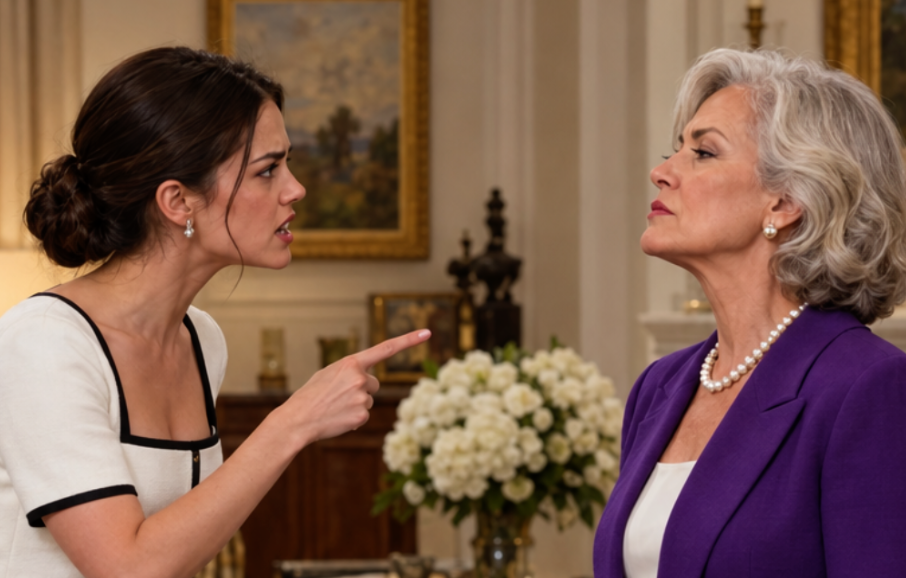
Masha balanced her phone between her shoulder and ear as she stirred a boiling pot of soup. Her mother’s voice rang out on the line, as demanding as ever:
“Masha dear, this Saturday we’re gathering at Lyudmila Sergeyevna’s place. Remember, my friend from the faculty? You should come alone, alright? Don’t drag your country husband to our parties! Let him come for my birthday, that’s enough.” Her mother’s tone made it sound as if she was granting an enormous favor.
Masha felt a wave of irritation rising in her chest. It was the third time lately her mom insisted she come without Dima. First there were just the “girls’ nights,” then an “academic evening” at a university colleague’s, and now this.
“Mom, please stop calling him ‘country.’ Dima is from Ryazan, which is a regional center, not a village. And he’s been my husband for two years,” Masha tried to speak calmly, though she was simmering inside.
“Masha, you know what I mean,” her mother, Elena Viktorovna, switched to a pleading note in her voice, “He’s a good guy, hard-working, but… but he’s not from our circle. You’re a PhD in philology, a professor’s daughter, and he’s… what? An electrician. No university education.”
Masha switched off the stove abruptly. She’d heard this all before.
“Mom, listen. Dima isn’t just an electrician. He has his own crew, he manages serious projects.”
“Yes, yes, of course,” her mother interrupted, “But admit it, when everyone’s sitting around discussing the latest books and theater premieres, your Dima just sits there like a fish.”
“He’s just shy!” Masha blurted out.
“Exactly! So that’s why I’m saying—come by yourself. Why torture the guy? Let him get a break from our ‘intellectual’ conversations.”
Masha sighed. There was some truth in her mother’s words—Dima did feel uncomfortable among her academic family and friends. But all these “come by yourself” requests were starting to feel suspiciously regular.
“Okay, Mom. I’ll come alone,” Masha gave in, feeling a bitter sting inside.
Three years ago, Masha never would’ve imagined falling for someone like Dima. She was a refined, well-read grad student in philology, daughter of a renowned professor. Her entire circle was made up of other “bookish” types—professors, scholars, intellectuals.
Then one day, the old wiring in her apartment started to smoke. Panicked, Masha dialed the first number she could find, and an hour later he showed up—a tall, broad-shouldered guy with an open smile and a slightly shy look in his eyes.
“Dmitry,” he introduced himself, offering a firm handshake. “Show me where the problem is?”
She led him to the room where a charred socket gaped like a black hole in the wall.
“You really need to replace all the wiring here,” Dima shook his head as he checked the walls. “These wires are from the Soviet days—it’s a wonder they didn’t catch fire sooner.”
Masha looked around the apartment anxiously:
“But that’s probably super expensive, right?”
Dima studied the worried girl’s face and smiled unexpectedly:
“Tell you what—let’s do this the right way. I can come in the evenings after my main job and replace everything piece by piece. That’ll be way cheaper than hiring a whole crew.”
For a whole month, Dima came by almost every evening. At first, they barely talked—he worked, she worked on her dissertation. Then, they started having dinner together. Masha was surprised to find that this simple guy from Ryazan, with no college degree, had a certain life wisdom and an honest sincerity she found captivating.
When the job was done, Dima shuffled his feet in the hallway.
“Well, that’s it,” he said, glancing aside. “The wiring’s all fixed now.”
“Would you like some tea before you leave?” Masha asked, realizing for the first time that she’d miss his nightly visits.
Over tea, he surprised her:
“Would you… maybe like to go to a movie with me?”
She said yes, though a nagging inner voice—sounding suspiciously like her mother—whispered: “Where will you go with him? What could you possibly talk about?”
But conversation was easy. Dima spoke about his job with such enthusiasm that Masha found herself hanging on his every word. He talked about his plans to start his own business, about new technologies in electrical work. And when Masha talked about her research in Russian literature, he listened with an honest interest she hadn’t even found among her own colleagues.
Three months later, when Masha decided Dima should meet her parents, her mother just pursed her lips:
“Darling, you’re from completely different worlds.”
“Mom, give him a chance,” Masha pleaded.
The dinner was excruciating. Her father asked Dima about his job in a patronizing way, while her mother kept making barbed remarks disguised as small talk. Dima responded politely but became quieter and quieter, and by the end of the evening he barely spoke.
“See?” her mother proclaimed as soon as the door closed behind Dima. “He can’t even hold a conversation!”
“That’s because you overwhelmed him!” Masha exploded. “You didn’t give him a single chance!”
Elena Viktorovna shook her head:
“Masha, I only want the best for you. You’re a smart girl, you need an equal partner. That boy… what can he offer you, besides fixing sockets?”
“Did your mom ask you to come without me again?” Dima stood at the window, staring into the darkness.
“I’m sorry,” Masha came over and hugged him from behind. “She says it’s some important academic get-together…”
Dima turned and gave her a weak smile:………read more at the link in the comments
Masha held the phone to her ear with her shoulder, trying to stir the boiling soup at the same time. Her mother’s voice rang out sharply, as demanding as ever:
“Mashenka, darling, this Saturday we’re all gathering at Lyudmila Sergeyevna’s. Remember my friend from the university department? You should come by yourself, okay? There’s no need to bring your country husband to our parties! Let him come only for my birthday,” her mother ended the sentence with a tone that made it sound like she was doing Masha a big favor.
Masha felt a rising wave of irritation. This was already the third time lately her mother had insisted Masha come without Dima. First it was a ‘girls’ night,’ then an ‘academic evening’ at a university colleague’s, and now this.
“Mom, please stop calling him ‘country.’ Dima is from Ryazan—it’s a regional capital, not a village. And he’s been my husband for two years,” Masha tried to keep her voice calm, even though she was boiling inside.
“Mashenka, you know what I mean. He’s a good guy, hardworking, but…”—Elena Viktorovna’s voice suddenly became more pleading—“he’s just not from our circle. You’re a candidate of philological sciences, a professor’s daughter, and he’s what? An electrician. No university degree.”
Masha turned off the stove with a sharp motion. She’d heard all this more than once before.
“Mom, listen. Dima’s not just an electrician. He has his own team, he leads major projects.”
“Yeah, yeah, of course,” her mother interrupted, “but let’s be honest—when everyone’s sitting around discussing the latest literary releases or theater premieres, your Dima just sits there silent as a fish.”
“He’s just shy!” Masha burst out.
“Exactly! That’s why I’m saying—come by yourself. Why make him suffer? Let him take a break from our intellectual conversations.”
Masha sighed. There was some truth in her mother’s words—Dima really did feel out of place among her academic friends and family. But all these ‘come alone’ invitations were starting to become an uncomfortable pattern.
“Alright, Mom. I’ll come alone,” Masha gave in, feeling a bitter taste linger.
Three years ago, Masha would never have guessed she’d fall for someone like Dima. She was a refined, well-read grad student in philology, the daughter of a famous professor. Her whole circle consisted of fellow bookish people—teachers, scholars, intellectuals.
Then one day an electrical short smoked up their old apartment. Panicking, Masha called the first repair service she could find, and an hour later he showed up—a tall, broad-shouldered guy with an open smile and a slightly shy look in his eyes.
“Dmitry,” he introduced himself, offering a strong hand. “Show me where you’re having trouble with the wiring?”
She led him to the room, where a scorched outlet gaped like a black hole in the wall.
“You need to replace all this wiring,” Dima said, shaking his head as he examined the walls. “These wires are from Soviet times—honestly, it’s a miracle there hasn’t been a fire before.”
Masha glanced around the apartment in confusion:
“But that must be really expensive, right?”
Dima looked carefully at the upset girl and then, suddenly, smiled:
“You know what? Let’s do this the right way. I can come by in the evenings after my main job and replace everything bit by bit. That’ll be cheaper than hiring a whole crew.”
For a whole month, Dima showed up almost every evening. At first, they barely spoke—he worked while she focused on her dissertation. Then they started having dinner together. Masha was surprised to discover that this simple guy from Ryazan, who didn’t have a college degree, possessed an amazing wisdom about life and a disarming sincerity.
When the job was finally finished, Dima awkwardly shuffled his feet in the hallway.
“Well, that’s it,” he said, looking off to the side. “The wiring’s all good now.”
“Maybe some tea before you go?” Masha suggested, realizing for the first time that she’d miss these evenings.
Over tea, he unexpectedly asked:
“Would you… like to go to the movies with me?”
She said yes, even though an inner voice—sounding suspiciously like her mother—whispered, “Where are you going with him? What will you even talk about?”
But conversation came easily. Dima spoke about his work with such passion that Masha couldn’t help but be captivated. He shared his plans to start his own business and talked about new electrical technologies. When Masha began telling him about her research into Russian literature, he listened with a genuine interest she hadn’t even seen among her colleagues.
Three months later, when Masha decided to introduce Dima to her parents, her mother just pursed her lips:
“Sweetie, you two live in completely different worlds.”
“Mom, give him a chance,” Masha pleaded.
Dinner was excruciating. Her father asked Dima about his work, but in a condescending way, while her mother kept making subtle digs disguised as polite conversation. Dima responded politely but grew increasingly withdrawn, and by the end of the evening he had almost stopped talking.
“See?” her mother declared triumphantly as the door closed behind Dima. “He can’t even hold a conversation!”
“That’s because you two overwhelmed him!” Masha burst out. “You didn’t give him a single chance!”
Elena Viktorovna shook her head:
“Masha, I only want what’s best for you. You’re a smart girl, you need an equal partner. And this boy… what can he offer you besides replacing outlets?”
“Did your mom ask you to come alone again?” Dima stood by the window, staring out into the darkness.
“Sorry,” Masha said, walking over and hugging him from behind. “She says it’s some important academic gathering…”
Dima turned and gave her a faint smile:
“It’s okay. I get it. Really.”
But there was sadness in his eyes. After two years of marriage, Masha could read every nuance of his mood.
“You know,” he went on, “I really do feel out of place around your relatives. They’re all so… educated. Sometimes I don’t even understand what they’re talking about.”
“Dima…”
“No, really. Like last time, when your uncle started talking about postmodernism—I just sat there feeling like an idiot. I was even too embarrassed to ask what it meant.”
Masha gently cupped his face in her hands:
“That doesn’t matter to me. I don’t love you because you know about postmodernism.”
Dima covered her hands with his own:
“Then why do you love me?”
— Here’s to your honesty. To the fact that you’re genuine. That you never pretend or play a part.
That evening, they didn’t speak about it any further, but Masha noticed something odd: her mother started inviting Dima whenever help was needed at the dacha or with apartment repairs, yet she always found reasons not to ask him to family celebrations.
— Dima, dear, could you take a look at our plumbing? The tap seems to be leaking, Elena Viktorovna would call.
Or sometimes:
— Son-in-law, we need your help! The wiring at the dacha is sparking!
And Dima never refused to help. Reliable, patient, he never complained. Only once, after a full day working at his mother-in-law’s dacha, did he quietly say on the way home:
— It’s strange. I’m good enough for the rough work, but not for the celebrations.
Masha said nothing, feeling a rising wave of resentment for her husband.
Time passed, and their lives changed. Dima actually started his own business—a small electrical installation company. At first, he had one assistant, then three, and a year later an entire team. They began taking on bigger projects—restaurants, office buildings, country houses.
Masha completed her dissertation and began teaching at the university. They bought a bright, spacious apartment and decorated it together, arguing over every detail and laughing at their disagreements. Not once did Masha regret her choice.
But the relationship with her parents, especially her mother, remained strained. Elena Viktorovna no longer openly criticized Dima, but she still kept him at a distance from “her circle.”
— Mashenka, it’s better if you come alone to Antonina Pavlovna’s anniversary. The whole department will be there, and the conversation will be strictly professional—your Dima would just be bored, she would say with fake concern.
One day, while going through an old planner, Masha noticed a pattern she hadn’t realized before. For New Year’s and March 8th, her mother invited both her and Dima. But for Defender of the Fatherland Day, May holidays, and relatives’ birthdays—it was just her, without her husband.
She double-checked her theory by paging through two years of entries. The pattern was clear: Dima was only invited to celebrations where he would be expected to bring a gift. Elena Viktorovna, knowing her son-in-law was doing well financially, was clearly counting on his generosity. But whenever it was their turn to give gifts, Dima was “spared” and not invited to the “boring academic gatherings.”
Masha felt fury and hurt boiling inside her. She never thought her own mother—an educated person, a university professor—could be so… mercenary.
— Mom, I’ll come alone this Saturday, just like you asked, Masha said into the phone in an especially calm voice.
— That’s good, sweetheart. Everyone will be there, we’ll have a nice cultured evening. Your Dima would only get bored.
— Of course, Mom. See you soon.
Saturday evening was cool. In her parents’ apartment, “all their own people” had gathered—her mother’s colleagues from the department, a few distant relatives, and old family friends. All educated, cultured people with academic degrees and titles.
Masha sat at the table, absently poking her salad with a fork while listening to the conversations swirling around her. Professor Klimov was discussing the latest theatre production, Aunt Sveta argued with Uncle Boris about recent political news, and her mother was proudly sharing the story of her father’s new scientific article.
“And where is your husband, Mashenka?” asked her mother’s friend, Nina Petrovna. “Such a handsome man— I remember he visited for New Year’s.”
“Dima is busy today,” Masha replied, feeling her cheeks start to flush.
“Busy with his wires,” someone at the table muttered, sparking quiet laughter.
Masha quickly looked up and saw her mother give a warning gesture to the one who’d spoken. That gesture was the last straw.
Masha slowly stood up from the table. Somehow, the room suddenly seemed very quiet, even though everyone was still talking.
“I have something I want to say,” she announced, her voice sounding louder than she’d expected.
The conversations stopped. Everyone turned toward her.
“Masha, what’s wrong?” her mother asked anxiously.
“I want to apologize to everyone,” Masha said, feeling her heart pounding in her throat. “I’m sorry for coming without my husband. But I need to explain the reason for his absence.”
“Mashenka, it’s not necessary…” her mother began.
“No, it is,” Masha said firmly. “Dima didn’t come today not because he was busy. He didn’t come because he was asked not to. Or rather, I was asked not to bring him.”
A surprised whisper swept through the room.
“You see,” Masha continued, looking her mother straight in the eyes, “my husband isn’t considered good enough for certain celebrations. He doesn’t have a university degree, he can’t join in on discussions about postmodernism or the new theatre production. So he tends not to be invited when the so-called ‘intellectual crowd’ gathers.”
“Masha!” Elena Viktorovna exclaimed. “How can you say such a thing!”
“It’s the truth, Mom. Only the truth. Dima isn’t good enough for your cultured conversations. But he’s perfectly suitable when someone needs to fix a faucet, rewire something, or repair the dacha. Then, everyone forgets about his supposed ‘lack of refinement.’ And another thing—
The silence in the room became absolute. Her mother’s face had turned pale, her eyes narrowing with anger.
“Do you realize what you’ve just done?” her mother asked quietly, her voice trembling.
“I do,” Masha nodded. “I just wanted everyone to know: It isn’t lacking a diploma or an inability to discuss fine art that’s shameful. What’s truly shameful is hypocrisy and a materialistic attitude toward the people closest to us.”
She turned to the guests:
“I’m sorry for this scene. I didn’t want to spoil the evening. I just can’t keep quiet anymore.”
Masha grabbed her purse and headed for the door. Behind her, worried voices called her name, but she didn’t look back.
The air outside was cool and quiet. Masha slowly walked toward the metro, feeling a strange mix of lightness and emptiness. Her phone vibrated in her pocket—most likely her mother. But Masha didn’t answer.
When she entered the apartment, Dima was sitting in an armchair with a book. He looked up, and to Masha’s surprise, she saw that it was a collection of Brodsky’s poems—the same one she had given him as a gift some time ago.
“You’re back early,” he said, putting the book aside. “Did something happen?”
Masha looked at this man—her husband, the one she loved more than anyone in the world. So simple, honest, hardworking. No pretentious gloss or intellectual airs. He never pretended to be someone he wasn’t.
“You know,” she said, sitting down beside him, “I think I only truly understood today what it means to be a genuinely cultured person.”
Dima looked at her in surprise:
“And what is it?”
“It’s not about how many books you’ve read or how well you can quote them. It’s about respect for others, sincerity, and the absence of snobbery.”
Dima was silent for a moment, then unexpectedly asked:
“Did you have an argument with your mother?”
Masha nodded. Her eyes stung with tears she tried to hold back.
“Was it because of me?”
“Because of her,” Masha answered firmly. “Because she can’t see the good in people if they don’t have the right diplomas or connections.”
Dima pulled her closer and hugged her:
“Maybe she just needs some time?”
Masha buried her face in his shoulder:
“I don’t know. Maybe.”
Her phone vibrated again. Masha reluctantly took it out of her pocket. Her mother’s name lit up on the screen. After a moment’s hesitation, she answered:
“Yes, mom.”
“Mashenka,” Elena Viktorovna’s voice didn’t sound as confident as usual. “What you said today… Is it true? Do you really feel that way?”
Masha took a deep breath:
“Yes, mom. It’s true.”
There was silence on the other end of the line.
“I… I need some time to think,” Elena Viktorovna finally said. “But tell your husband… tell Dima that next Sunday we’re expecting you both for lunch. And I promise—no chores or repair errands this time.”
The phone beeped—her mother had hung up. Masha stared at the darkened screen, barely believing what she’d just heard.
“What did she say?” Dima asked, noticing the change in Masha’s expression.
“She invited us for lunch. You, too.”
Dima smiled:
“See? I told you—she just needed time.”
Masha shook her head:
“I’m not sure it’s that simple. But… it’s a start.”
That evening, they talked for a long time. About family, about work, about books. Dima admitted that he secretly read Russian classics to better understand Masha’s world. And Masha shared how proud she was of everything he had built from scratch.
Later, they lay in the dark, holding hands, and Masha thought about how real education has nothing to do with diplomas on the wall. True education is the ability to grow as a person. And in that sense, her ‘uneducated’ husband was often wiser than many professors.
“You know what’s the funniest thing?” she mumbled sleepily.
“What?”
“I always thought I would help you fit into my world. But it turned out you were the one who taught me the most important lesson.”
“And what did you learn?” In the darkness, she couldn’t see his face, but she could hear the smile in his voice.
“That it’s not about how many books you’ve read, but the kind of person those books have helped you become.”
Outside, dawn was breaking. A new day lay ahead, full of uncertainty—would she and her mother finally reconcile for good, would Elena Viktorovna accept her choice at last? But Masha knew one thing for sure: no matter how “cultured” her family considered themselves, she would never again let anyone belittle the person she loved. Because being educated and cultured isn’t just about knowing literature and the arts. It’s also about having the wisdom to see what truly matters.