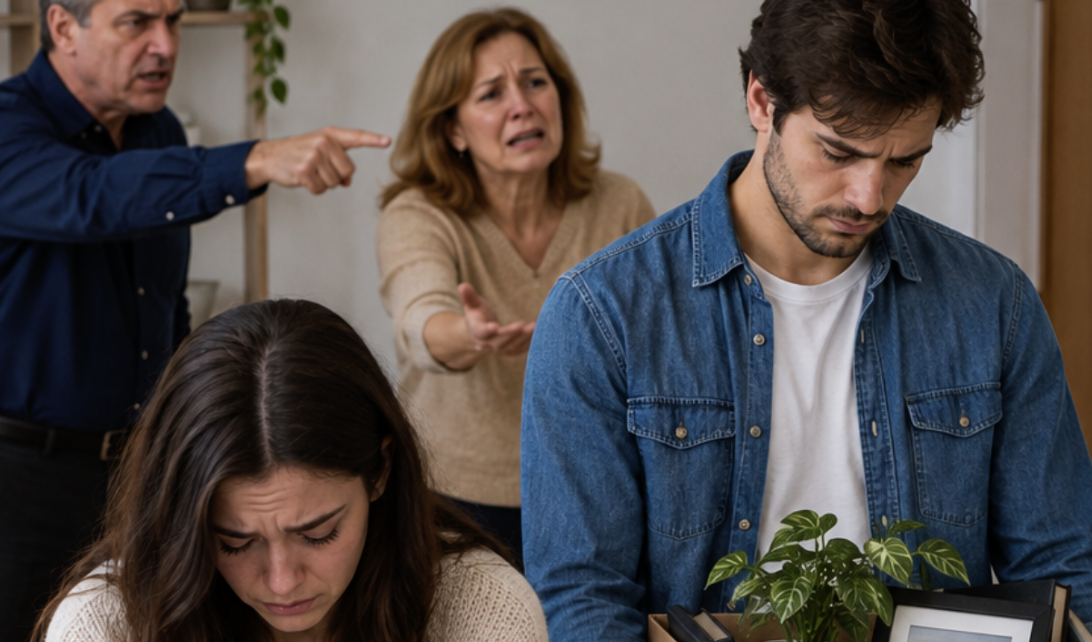
On Thursday evening, Ksenia stayed late at the clinic until almost 9:30. The last patient showed up with severe pain without an appointment, so the doctor decided to stay—and she stayed too. The head administrator always leaves last.
On her way to the bus stop, she stopped by a shoe store at the shopping center. The same boots were still in their spot, on the second shelf near the counter. Dark brown, with a low sturdy heel and a soft shaft. Eleven thousand nine hundred.
“Want to try them on?” asked the saleswoman. She already recognized Ksenia.
“Maybe next time.”
She’d been wearing her old boots for the fifth winter. The left sole had cracked, and Ksenia had glued it with “Moment” and colored over it with a black marker.
At home, Dmitri was lying on the couch with his phone. An empty pot from the pasta was sitting on the stove.
“Ksenia, Mom called,” he said, not looking up. “She’s inviting us for the weekend. Says Dad will heat up the sauna, we’ll have some shashlik. Let’s go? You said yourself you’re dog-tired.”
“I did say that.”
“Exactly. You won’t have to do anything for two days. Mom said, ‘Let Ksyusha rest—she already works herself to the bone.’ You’ll get to sleep in, I promise.”
Ksenia looked at her husband. He was smiling that same smile he’d had eight years ago when they’d met at a mutual friend’s birthday party.
“Let’s go,” she said.
Ksenia could practically count their eight years of marriage by the weekends they’d spent at Dmitri’s parents’ place in Lugovoye. Their honeymoon to Sochi was canceled because Grigory Pavlovich needed to fix the shed. Dmitri skipped Ksenia’s mother’s 60th birthday in Kostroma because his dad had a delivery of firewood and couldn’t chop it alone. May holidays were for planting potatoes, August weekends for cucumbers and preserves, November breaks for winterizing the house.
“They’re getting old, Ksyusha,” Dmitri would say. “Who else will help them? I’m their only child.”
Ksenia always agreed. Her in-laws really weren’t young anymore. Tamara Ivanovna had spent thirty years as a cook in a school cafeteria, now complaining of back pain. Grigory Pavlovich, a retired bus driver, was always rebuilding something in the yard. Ksenia thought if she was patient enough, one day Dmitri would appreciate it and take her side when she needed him to.
They kept putting off having kids. First, they needed to get on their feet, then buy a place of their own. For years, they rented a one-bedroom in a nine-story panel building, third floor, twenty-eight thousand a month. They saved for four years. The bank account was in Ksenia’s name, because she knew how to leave the money untouched—Dmitri didn’t. By spring, two years ago, they’d managed to save one million one hundred fifty thousand. They visited a new two-bedroom on Zarechnaya, got pre-approved for a mortgage. Ksenia could already picture where the crib would go.
In April, Tamara Ivanovna called. She was crying on the phone. Their old boiler had broken down twice during the winter, and they had to sleep in their coats. The roof over the porch started leaking in the fall, and now, after the snow, it was leaking over the bedroom too. The windows were wooden, forty years old, with rotting frames, and drafts so strong that water in a glass on the windowsill froze.
After that call, Dmitry spent two evenings pacing around the apartment. On the third night, he sat across from Ksenia in the kitchen.
“Ksenia, I get it. The apartment, the mortgage. But they can’t make it through another winter like that. I’m serious. Dad’s sixty-three, and Mom has high blood pressure. Let’s build them a proper house—new roof, windows, heating. We can wait to buy our apartment for another year, save up more.”
“Dmitry, that’s all our money.”
“I know. But they’re my parents. And besides, you understand—the house will end up being ours too. It’s like we’re investing in ourselves.”
Ksenia thought about it for a week. Then she agreed. She felt sad about giving up the two-room apartment on Zarechnaya, but she couldn’t stop picturing her mother-in-law bundled up in a coat under her blanket.
Ksenia handled everything. Dmitry said he didn’t understand paperwork and was swamped at work. Ksenia found the roofers, went herself to the window company to pick out the profiles, and called the gas technicians. She signed all the contracts herself and paid from her own account. The metal-tile insulated roof cost four hundred and ten thousand. Nine windows, plus sills and trim, were two hundred ninety thousand. The new gas boiler, pipes, and radiators throughout the house were three hundred sixty thousand. In total, one million and sixty thousand. The ninety thousand left over went, six months later, to repairing the transmission in Dima’s car.
In the summer, when the roofers left, Tamara Ivanovna hugged Ksenia on the porch and didn’t let go for a long time.
“Ksyusha, you’re like a daughter to us now. Truly one of our own. I will never forget this.”
Grigory Pavlovich stood nearby, looking at the new roof—dark cherry red, perfectly even.
“You invested in your own future,” he said. “The house will be Dima’s, after all.”
Two years passed.
They were still living in their one-room apartment on the third floor. Mortgage rates had risen during that time, and the two-room place on Zarechnaya had long since been sold to someone else. Dmitry never brought up the money they’d spent. He never said “thank you” apart from when his mom did, and never talked about how they’d need to save up all over again. He worked as a repairman at a service center, fixing washing machines and refrigerators, earning about fifty thousand and thinking it was enough.
Ksenia took extra shifts. Two Sundays a month, sometimes three. Evening hours when one of the girls on staff got sick. In two years, she managed to save up two hundred forty thousand again. Every thousand was hard-won. She stopped going out to cafes with friends, gave up her pool membership, and only bought clothes on sale.
In June, her in-laws celebrated their fortieth wedding anniversary. Dmitry bought them a TV—fifty-five inches, fifty-four thousand nine hundred ninety. Ksenia found out about it when she saw the box in the trunk.
“Dmitry, we agreed not to spend large amounts without talking about it first.”
“It’s from my salary,” he said. “Can’t I get my parents a gift? Forty years, Ksyusha. That’s once in a lifetime.”
Ksenia stayed silent. That month, she postponed buying boots for the second time.
On Friday, they left for Lugovoye after work. The drive took an hour and a half. The house stood at the end of the street, behind a green fence, and the new roof was visible even from the turn. The windows glowed. Light steam rose from the boiler’s chimney.
Tamara Ivanovna met them on the porch wearing an apron.
“You’re here, my dears! Come in, I baked pies. With cabbage and with apples.”
Dinner was warm and cozy. Grigory Pavlovich boasted that in winter, they keep it at twenty-three degrees in the house, and the gas bills are lower than with the old boiler. Tamara Ivanovna kept passing around the pies.
“Ksenia, what time are you getting up tomorrow?” her mother-in-law asked as they cleared the table.
“I don’t know. Dima promised I’d get to sleep in.”
“We’ll see,” Tamara Ivanovna said with a smile.
On Saturday, at ten minutes to eight, someone knocked on the bedroom door. Ksenia opened her eyes. Dmitry wasn’t next to her.
“Ksenia, time to get up,” her mother-in-law called from the hallway. “Breakfast is on the table.”
Ksenia went downstairs. In the kitchen by the door were two buckets, a pile of rags, a bottle of glass cleaner, stove cleaner, rubber gloves, and a step ladder leaning against the fridge.
“What’s all this?” Ksenia asked.
“That’s for today,” Tamara Ivanovna said, pouring her tea. “Grisha’s sixty-fifth birthday is next Saturday. My sister from Tver will come with her husband, our godparents, the neighbors. The house needs to shine. All the windows washed, floors, kitchen. The cabinets need to be wiped inside—they haven’t been sorted since spring. Take down the curtains too, I’ll wash them.”
“Tamara Ivanovna,” Ksenia set her cup down. “Dima promised I’d get to rest.”
“You’ll rest later. We’ll have the sauna in the evening. Is it so hard for you? You’re young. But my back—you know it hurts. I can’t bend over.”
Ksenia stepped into the big living room. Dmitry and Grigory Pavlovich were sitting on the sofa in front of the new TV. A fishing show was on. Her father-in-law held a bowl of sunflower seeds in his lap.
“Dmitry,” Ksenia said. “Can I talk to you?”
“Ksyusha, just help mom out,” Dmitry said without getting up. “It’s no big deal. Her back hurts. Dad and I will barbecue later.”
“You promised me.”
“I did, but how could I know about Dad’s birthday? Really, Ksyusha. Just a couple of hours.”
She could’ve refused right away. Ksenia didn’t. Eight years of habit acted faster. She put on the gloves and grabbed a bucket.
She started with the kitchen. The stove, the oven, the tiles above the sink, the extractor hood with caked-on grease. Then the windows. Nine white, plastic windows with wide sills. Ksenia remembered picking out the hardware for them and arguing with the manager about whether they needed mosquito screens. Now she stood on the ladder, washing these windows inside and out, while in the living room, the TV hummed behind the glass.
By one in the afternoon, she had cleaned six. Her back ached, her hands red from the cleaner. Tamara Ivanovna came in, checked the glass against the light.
“Ksenia, there are streaks here. And here. Wash them again, please. We can’t have the guests seeing that. It would be embarrassing.”
Ksenia got down from the ladder. She took off the gloves and set them on the windowsill.
“No,” she said.
— What do you mean, “no”?
— I’m not cleaning anymore. I came here to relax. That’s what I was promised. I work six days a week just to save up again for our apartment. All the money we saved for four years went into this place. On these windows, the roof, the boiler. One million sixty thousand. For two years, I’ve been wearing boots with taped-up soles. I am not ready to spend my weekends mopping the floor here either.
Tamara Ivanovna straightened up. Her face turned red.
— Oh, is that so. You’re throwing our help back in our faces? Bragging about the money? I knew it. I told Grisha: just wait, she’ll bring it up one day. Did we ask you? You offered yourself!
— Dima asked me. You were crying to him on the phone.
— I was crying because we were freezing! And you, you were counting every penny. We welcomed you into this family like our own, and now you’re presenting us with a bill. So ungrateful.
Dmitry appeared in the doorway. Grigory Pavlovich followed him.
— What’s going on here? — Dmitry asked.
— Your wife is rubbing money in my face, — Tamara Ivanovna said. — For the roof. For the windows. Saying she bought them, and now I owe her.
Dmitry looked at Ksenia.
— Ksenia, are you out of your mind? Apologize to my mother. Right now.
He said it the way he always did—calm, a little tired, certain she’d obey. For eight years, after such words, she always apologized. To her mother-in-law for oversalting the salad. To her father-in-law for parking the car in the wrong spot. To Dmitry for upsetting his mother.
— No, — Ksenia said.
Everything went quiet. In the big room, the TV was playing a show where someone was pulling a pike out of the water.
Grigory Pavlovich walked into the room, took the remote, and turned off the television. Then he came back and stood beside his wife.
— Pack your things and get out of this house! — he said.
— Ungrateful relatives like you don’t deserve anything good, — added Tamara Ivanovna. — You come here and act like you run this place. In our home.
Ksenia looked at her husband. He was standing in the doorway, his hands in the pockets of his sweatpants. He looked at the floor, then at his father, then back at her.
— Ksenia, — he finally said. — Listen. Maybe you should go by yourself. Cool off. Think about your behavior. I’ll stay here. Dad needs my help with the fence tomorrow. I’ll come back Sunday evening, and we’ll talk properly.
— Are you sending me away?
— I’m not sending you away. I’m saying you need to think about this. You hurt my mom.
Ksenia nodded. She turned and went upstairs.
She packed her bag slowly, even though she didn’t have many things. Her hands wouldn’t cooperate. From downstairs, through the floor, she could hear Tamara Ivanovna speaking quickly and loudly, Grigory Pavlovich responding in a deep, short tone. Then Dmitry’s voice:
— Mom, please calm down. I told you, she’s got a temper.
What stung the most was that: “I told you.” So he had said this before. Somewhere in that kitchen, over pies, without her.
Ksenia zipped up her bag. She looked around the room. The new window with the white windowsill, the warm radiator beneath it. She had chosen radiators with side connections back then, because it was eight thousand cheaper that way.
She went downstairs and put on her jacket. Dmitry was sitting in the kitchen with his mother. He looked up as she walked past.
“Do you know where the bus stop is?” he asked.
“I do.”
He didn’t walk her to the gate. He didn’t offer to drive her to the main road, even though the car keys were right there on the shelf by the door. Ksenia closed the gate behind herself.
It was a kilometer and a half to the stop by the store. The city bus came twice a day—once in the morning and again at 6:10 in the evening. It was just after two. Ksenia sat down on the bench under the shelter and set her bag beside her.
Half an hour later, an elderly woman came out of the store carrying a bag. She stopped for a moment and looked over.
“Are you Tamara’s daughter-in-law? I saw you when they were fixing the roof. I’m Valentina Semyonovna, two houses down.”
“Hello.”
“Waiting for the bus? It doesn’t come until evening. Come to my house, have some tea, no need to sit out in the wind.”
Ksenia wanted to say no, but it was cold. She went along.
Valentina Semyonovna had a small house with a stove and a cat sitting on a stool. The hostess put the kettle on and brought out some jam.
“You did a great job on their roof,” she said. “Tamara’s so proud of it. She says Dima is golden—paid for everything himself, the windows, the heater. Gave over a million, she says. What a son she raised.”
Ksenia set her cup down on the saucer.
“So, he did it all himself?”
“Of course. Why, wasn’t it him?”
“It doesn’t matter,” Ksenia said. “Thank you for the tea.”
The bus was warm and almost empty. Ksenia sat by the window, watching dusk settle over the fields. She thought about how many times in eight years Dmitry had said, “We’ll buy this,” “We’ll have a kid,” “We’ll go to the sea later.” She remembered lying in the hospital after her surgery—he’d visited only once because they were planting potatoes in Lugovoye. On her mother’s sixtieth birthday in Kostroma, there was an empty chair at the table with a card that said “Dima. ”
Eight years. Not once had he chosen her.
And even today, when choosing should have been the simplest thing—when he only needed to say “Mom, that’s enough”—he still chose to have peace on his parents’ couch.
The bus arrived at the terminal at eight-thirty. Ksenia took a minibus home, climbed up to the third floor, and opened the door. The apartment was dark. On the stove sat the same empty pot from the pasta.
She didn’t cry, and that surprised her. She changed, put the kettle on, and took out the folder from the cupboard where she kept the renovation papers. The contract with the roofers. The window contract. The heating installation contract. The statements. Bank records for all the payments, printed out then—just in case. Receipts for the radiators. The guarantee card for the heater, all in her name.
She didn’t sleep that night. In the morning, she called her colleague Oksana.
“Oksana, is your aunt’s room on Gagarin still available?”
“I think so. Why, what’s up?”
“I’ll tell you later. Can you check if I could move in today?”
The room was in a three-bedroom apartment, ten minutes’ walk from the clinic. Twelve meters, an old wardrobe, a sofa bed, and a window looking out to a courtyard with a poplar tree. Oksana’s aunt Nina Arkadyevna lived in another room, the third was occupied by a medical college student. Fifteen thousand a month.
By Sunday evening, Ksenia had moved everything out using a cargo taxi. She left the keys to the one-bedroom apartment on the hallway table. The apartment was a rental under Dmitry’s name—he paid for it with his card, and Ksenia would transfer him half, but she had no intention of continuing the arrangement.
Dmitry called her shortly before ten in the evening.
“Ksenia, where are you? The closets are empty. What’s going on?”
“I moved out.”
“What do you mean, moved out? Where did you go?”
“I rented a room. Dmitry, I’m filing for divorce.”
He paused, then laughed—a short, nervous laugh.
“Are you serious? Over what? The windows? Ksenia, my mom overreacted, and so did my dad. You pushed them to this point. You could’ve just cleaned those windows, and none of this would’ve happened. But instead, you started a fight. Do you even realize how much you hurt them? My mom’s been lying down all evening with high blood pressure.”
“Dmitry. You told me to go alone and think about my behavior. Well, I’ve thought about it.”
“Ksenia, this is ungrateful. They treat you like their own…”
“They’re telling Valentina Semyonovna that you paid for the roof.”
He didn’t answer.
“So what,” he finally said. “What difference does it make who paid? We’re family.”
“Exactly,” Ksenia replied, and hung up the phone.
He kept calling for a week. At first he was angry, then he started pleading. Then, he showed up at her clinic during her lunch break, holding a bouquet of chrysanthemums he’d bought at a metro kiosk.
“Ksenia, can you come out for a minute?”
She stepped out onto the porch.
“Listen,” Dmitry said. “I talked to my mom. She’s willing to forgive you. If you come to her birthday party and apologize in front of everyone—just say you were wrong, that you were tired, it was nerves. That’s it. They don’t hold grudges.”
Ksenia looked at the chrysanthemums. They were yellow, with dried-up edges.
“Dmitry. I’m not coming.”
“Well, that’s your loss. Where will you go? My mom says you’ll come back on your own in a month. You’re thirty-four, you don’t have your own apartment, you have nothing.”
“Your mom says,” Ksenia echoed. “Go, Dmitry. I have patients to see.”
Dmitry refused to go through with a simple registry office divorce. He said he wouldn’t sign anything and that Ksenia would change her mind. So Ksenia filed a petition with the magistrate. They didn’t have kids and, aside from an old Logan car, there was almost nothing to divide—she didn’t even want to argue about the car. Three weeks later, Dmitry received a summons. He called her that evening.
“Did you really file in court?”
“I did.”
“Have you lost your mind? Fine. We’ll see.”
Even before the first hearing, Ksenia went to a consultation with a lawyer that Oksana had recommended. Irina Olegovna leafed through the folder for a long time, rereading statements and making pencil notes.
“Your documents are solid,” she said. “You paid, the contracts are in your name, it’s all clear. But let me be honest with you—there are complications. First, the money was saved during the marriage, so technically it’s considered joint marital property and half belonged to your husband. With his consent, it went toward his parents’ house. From what I understand, he didn’t object to that.”
“He didn’t.”
Second, you can try to get the money back from the parents as unjust enrichment. But they’ll almost certainly say it was a gift. Legally, you can’t reclaim money that was given voluntarily with the understanding that it didn’t have to be returned. The court would look into whether there was any agreement to return the money or to exchange it for something. Do you have anything in writing? Any receipts? Messages where they promise to return it?
No. All they said was, ‘You’re investing, the house will be Dima’s.’
Did anyone else hear that being said?
My husband heard it. He was standing right there.
Then he’s your key witness. If he confirms that the money was given on the condition that the house would go to your family—not as a gift—then you’ve got a chance. Without him, your case is weak. Even with him, it could take a long time. A year, maybe more. I don’t want to promise you anything I can’t guarantee.
That evening, Ksenia called Dmitry. She spoke calmly, not blaming anyone. She explained what she needed: just for him to confirm in court what he’d heard and what he himself had told her in the kitchen back then: ‘The house will still be ours.’
‘You want to sue my parents?’ he asked slowly. ‘My mother and father? Are you out of your mind?’
‘I want to get my half back. Five hundred and thirty thousand. That’s my money, Dmitry. I spent four years saving it.’
‘It was my money, too,’ he replied. ‘And I gave it to my parents. And I don’t want anything back. I’m not going against my own parents. Not in any court. Don’t even think about it.’
‘But you said yourself the house would be ours.’
‘Well, I’ve said a lot of things. There’s no more “ours.” That was your decision.’
She hung up. Then she sat in her twelve-square-meter room, looking at the poplar outside the window. Strangely, she felt lighter. Everything she’d been afraid to confront for years, he had just said out loud himself, without any prompting.
In the middle of October, she got a call from an unknown number.
‘Ksenia Andreevna? This is the service department of Teplogazservice. You have a contract for annual gas boiler maintenance at Luhovoe, Sadovaya Street, number twelve. The service is due. When would it be convenient for our technician to come?’
At first, Ksenia didn’t even know what they were talking about. Then she remembered: when the boiler was installed, the workers had offered to sign a maintenance contract, and she had just signed it, the same as she’d signed everything else.
‘I want to terminate this contract,’ she said. ‘What do I need to do?’
‘You’ll need to submit a statement. You can do it at the office or send it by mail. But then the homeowners will have to sign a new contract themselves.’
‘I’ll let them know,’ Ksenia replied.
She sent the statement that same day. Then she thought for a moment and wrote a short message to Grigory Pavlovich. She decided not to write to her mother-in-law.
‘Grigory Pavlovich, the maintenance contract for the boiler was in my name. I have terminated it. You’ll need to set up your own contract with Teplogazservice, I’ve included their phone number. The warranty card and manual for the boiler are in the top drawer of the hallway dresser. Ksenia.’
An hour later, Tamara Ivanovna called. Ksenia didn’t pick up. Her mother-in-law called three more times, then sent a two-minute voice message. Ksenia didn’t listen to it. In the evening, she received a message from Grigory Pavlovich. Just one word: “Understood.”
The first hearing with the magistrate judge took place in early December. Dmitry showed up and sat down on the bench across from her. He looked thinner and somehow older. When the judge asked if he agreed to the divorce, he said he didn’t and requested time for reconciliation. The judge postponed the case for a month.
The month passed quietly. For New Year’s, she went to visit her mother in Kostroma and, for the first time in eight years, stayed up with her in the kitchen until three in the morning, sorting through old photographs. Her mother didn’t ask her anything. Only before bed did she say:
“I never did put his chair away after the anniversary. It stayed there the whole evening.”
In January, the judge asked Ksenia if she had changed her mind. Ksenia said she hadn’t. This time, Dmitry sat in silence, gazing out the window. The marriage was dissolved.
As she left the courthouse, he caught up with her on the steps.
“Ksenia. One last thing. Are you going to sue my parents or not? My mother hasn’t been able to sleep over this.”
Ksenia stopped. She’d been thinking about it all month. Without Dmitry, her chances were slim. She imagined another year, maybe two, of court sessions. Tamara Ivanovna in the courthouse corridor. Grigory Pavlovich telling the judge that his daughter-in-law invited herself to do the renovation. Dmitry sitting next to them. And every morning she’d wake up thinking about Lugovoy.
“No,” she said. “I’m not suing. You can tell them. Let them sleep easy.”
“Well, there you go,” Dmitry said. His face looked relieved and almost pleased. “That’s the right choice. I knew you were reasonable.”
He decided that she gave in, just as she always had.
“Goodbye, Dmitry,” she said, and walked to the bus stop.
They never spoke again.
She didn’t throw the folder away. She put it on the top shelf of the closet, under the box with winter hats.
She worked just as hard all year, only now she knew what for. The room on Gagarina cost fifteen thousand, no one asked her for money for gifts or gas to Lugovoy, and for the first time, she had money left at the end of the month. Nina Arkadyevna turned out to be quiet and would invite Ksenia over for pancakes in the evenings. By the next fall, there were six hundred eighty thousand in her account. The mortgage manager at the bank said that with her salary and such a down payment, she could easily afford a one-bedroom in a new building. Ksenia booked a viewing.
At the end of October, on a Saturday, she woke up at half past nine. No alarm clock. She lay there, watching a poplar branch sway outside her window. She hadn’t signed up for any shifts that weekend. There was nowhere she needed to go. No one knocked on the door.
She brewed coffee, had a leisurely breakfast, and headed to the shopping mall.
The boots were still on the same shelf by the register. Over the year, the style had changed a little: the heel was a bit higher, the shaft a little narrower. Now they cost thirteen thousand four hundred.
“Would you like to try them on?” the sales assistant asked. It was a different girl now.
“Yes. Size thirty-seven.”
The boots fit perfectly. Ksenia walked over to the mirror and back. She glanced at her old boots, their soles covered in black marker, standing next to the fitting room bench.
“There will probably be discounts on this model by January,” said the saleswoman. “If you want, I can write down your phone number and give you a call.”
“No need,” Ksenia replied. “I’ll wear them out. And if it’s possible, please throw the old ones away.”
She walked out of the shopping center in her new boots. It was a dry, sunny day. There was a whole day ahead of her until evening, and it belonged to her.