“Irisha, did you remember about the chocolate? Zhenya has an allergy, you know.”
I pinched the phone between my shoulder and ear as I kept rolling out the dough. Olga Semyonovna was calling me for the third time today.
“Olga Semyonovna, I’m not using chocolate in a single dish.”
“Well, I just wanted to make sure. You never know. You know how sensitive he is.”
I know. I’ve known for ten years. I also know that Evgeny eats chocolate candies in the car when he thinks I’m not watching.
“I’ve got it all covered, don’t worry.”
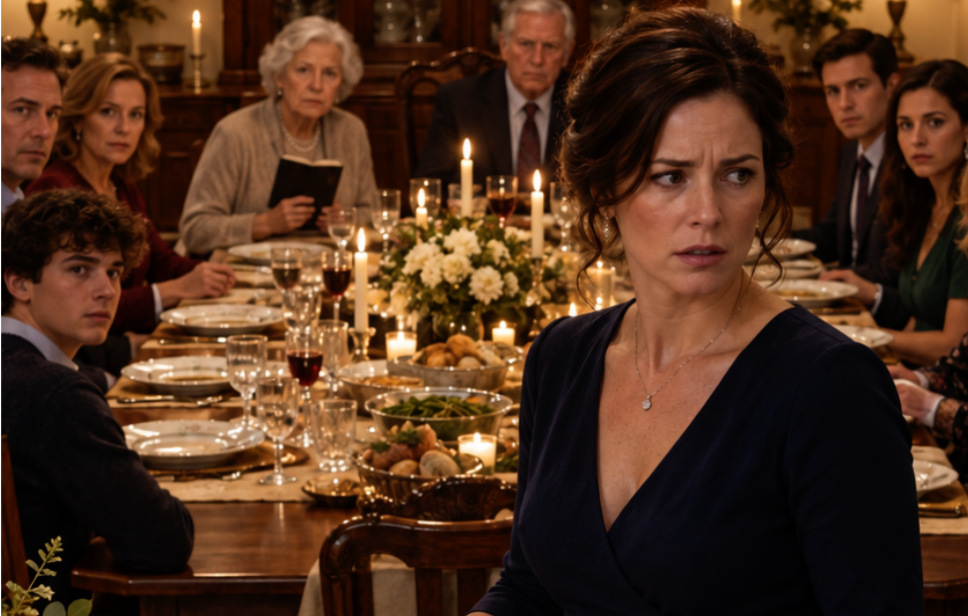
I put the phone down and looked at the table overflowing with ingredients. Three kinds of meat, fish, four salads, appetizers, pastries. Twenty people. Ten years of marriage. I wanted this evening to be perfect. For once, I wanted Olga Semyonovna to see me not as a girl from the dorm, but as a true hostess.
Guests started arriving at seven. I put on my new dress—a dark blue, strict style. Olga Semyonovna didn’t like flashy outfits. Evgeny wrapped his arm around my waist.
“You look beautiful. You’ve really outdone yourself tonight.”
The table really did look magnificent. A white tablecloth, crystal glasses, candles. Viktor Nikolaevich poured himself some sparkling wine and raised his glass.
“To the happy couple! May the next ten years be even stronger!”
Everyone joined in. Olga Semyonovna sat next to her husband, smiling, but her eyes kept scanning the table with a critical look. The dinner went smoothly. People complimented the duck and asked about the salad recipe. I almost managed to relax.
“Attention, everyone!” Olga Semyonovna stood up with a glass in her hand. “I want to give gifts to my girls.”
I froze.
“Vera, my dear,” she said, handing her daughter an elegant velvet box. “This is the family sapphire necklace. It belonged to my grandmother. Wear it in good health.”
Vera opened the box, and everyone gasped. The necklace was stunning—deep blue stones set in gold, crafted in an old-fashioned style. Everyone congratulated her and admired the piece.
“And for Irochka,” my mother-in-law leaned forward and pulled a large box out of her bag, wrapped carelessly in old newspaper, “I have something too.”
I took the box. Everyone watched. Evgeny leaned in, smiling. I unwrapped the paper and opened the lid.
Inside was a book. Old, worn, with yellowed pages and greasy stains on the cover. ‘Home Cooking.’ A 1970s edition.
“This is a very practical thing,” Olga Semyonovna said with a smile. “For the household. I think you’ll find it useful. The recipes are simple, understandable. Just right for everyday cooking.”
A hush fell around the table. Someone coughed. Vera stared into her plate. Evgeny opened his mouth to speak, but said nothing. And I just sat there, staring at that book. At the stains. At the faded letters. At the way Olga Semyonovna had presented it to me—in front of everyone, right next to the family sapphire. So everyone could see: here’s your place, Irochka. The kitchen. Simple recipes.
I slowly stood up, set the book down on the table, and walked over to the stove to turn off all the burners. The main dish—roasted veal—was still slow-cooking in the oven, but I switched that off too. Then I opened the cupboard, grabbed some containers, and calmly started packing up the food from the table—salads, appetizers, cold cuts. Everything that was in front of the guests. My hands moved precisely, without any rush.
“Irina, what are you doing?” Evgeniy’s voice grew louder. “The guests are still at the table!”
I lifted my gaze to him.
“Answer me, Evgeniy. Right now, in front of everyone. Do you really think what your mother did was okay?”
He looked at his mother, then at me, uncertain.
“Well… it’s just a book. Mom meant well…”
“Meant well,” I repeated, continuing to put the food into containers. “The family necklace goes to Vera, and I get an old Soviet cookbook with stains. Right in front of twenty guests. On our anniversary. Is this what you call ‘meant well’?”
“Irina, you’re exaggerating,” Olga Semyonovna interjected. “I honestly thought you’d appreciate it. It’s something useful, after all.”
“Useful,” I nodded, sealing another container. “I see. Vera gets the diamonds because she’s the daughter. And I get a reminder that my place is in the kitchen. For ten years, you’ve shown me that.”
Suddenly, Viktor Nikolaevich set his glass down sharply on the table. The sound was so loud that everyone flinched.
“Olya, that’s enough.”
My mother-in-law turned to him.
“What?”
“I said, that’s enough,” he looked at his wife in a way I’d never seen before. “For ten years, you’ve been wearing this woman down. I stayed quiet, hoping you’d come to your senses. But you just can’t stop.”
“Vitya, what are you talking about?”
“I’m talking about how you can’t accept that your son grew up and made his own choices. You always wanted to control his life. And when that didn’t work, you started humiliating Irina at every opportunity.”
Olga Semyonovna turned pale.
“How dare you say that in front of the guests!”
“And how did you dare to give her that junk in front of everyone?” Viktor Nikolaevich’s voice was firm. “Did you really think no one would notice? Everyone noticed. They’re sitting here quietly because it’s awkward. But I’m not embarrassed. I’m ashamed of you.”
A few guests stood up and awkwardly said their goodbyes. I kept clearing away the food. Vera looked at me with guilty eyes.
“Irina, take the necklace. Please.”
“No,” I shook my head. “It’s not about the necklace. It’s about respect.”
Evgeniy was still standing in the middle of the room. I stopped and looked him in the eyes.
“So you’re just not going to answer? You’ll stay silent again?”
He clenched his fists. I saw something shift in his expression.
“Mom,” he turned to Olga Semyonovna. “Apologize to Irina. Now.”
“What?!”
“I said apologize. Right now.”
Olga Semyonovna jumped up from her seat.
“Zhenya, are you out of your mind? I’m your mother! I gave you life, raised you, educated you!”
“And now you’re taking her side…”
“Go ahead, say it,” Evgeniy’s tone turned sharp. “Taking whose side? My wife’s? The woman who’s put up with your jabs for ten years?”
My mother-in-law was standing there, breathing heavily. Her face was blotched with red spots.
“You’re choosing between me and her?”
“I’m just asking you to apologize. Is that so hard?”
“I won’t apologize,” she grabbed her bag. “I did nothing wrong. She’s the one who caused this scene.”
Evgeny stepped towards the door and opened it.
“Then leave.”
A heavy silence filled the room. Olga Semyonovna looked at her son as if he had struck her.
“You wouldn’t dare throw me out!”
“Leave, Mom. And don’t come back until you realize you were wrong.”
Viktor Nikolaevich slowly stood up.
“Let’s go, Olya.”
“Vitya!”
“Let’s go, I said. Before we embarrass ourselves any further.”
They left. The door shut with a dull click. The remaining guests quickly departed. Ten minutes later, we were alone. Evgeny stood by the door, leaning against the frame.
“I’m sorry,” he said softly. “I’ve been a coward for so many years.”
I stayed silent.
“I thought if I just ignored it, everything would go away on its own. That you’d get used to it. That Mom would stop. But I was just closing my eyes because I was afraid of conflict.”
“But today you made a choice.”
“Yes. Late, but I made one.”
He came over and knelt down beside my chair.
“Give me a chance. I’ll make it right. I’ll protect you, I promise.”
I looked at him. At this man I’d spent ten years with. The man who really was a coward. But today, for the first time, he stood by my side.
“We’ll see.”
Olga Semyonovna didn’t call for a month. Then Viktor Nikolaevich phoned. He said his wife barely spoke and had closed herself off. That she hadn’t expected this reaction from her son.
“Viktor Nikolaevich, I respect you,” I replied. “But unless she realizes she was wrong, meeting doesn’t make sense.”
He sighed.
“I understand. I’ll talk to her.”
Two months later, he called again. Said he had convinced Olga Semyonovna to see a psychologist. He had given her an ultimatum: either she works on herself, or he moves out and lives separately. For the first time in forty years of marriage.
“She agreed,” he said, his voice tired. “She’s been going for a month now.”
I didn’t answer. I didn’t care anymore. I no longer sought my mother-in-law’s approval. I was just living my life. The bakery was expanding, I hired an assistant. Evgeny changed—he became more attentive, defended me even in little things.
Almost two years passed. We celebrated our twelfth anniversary quietly, just the two of us. Suddenly, the doorbell rang. I opened it and saw Olga Semyonovna. She had lost weight, looked older. She was holding a small bundle in her hands.
“May I come in?”
I looked at Evgeny. He nodded. I stepped aside.
Olga Semyonovna sat down on the edge of the couch. Her hands were trembling.
“I need to tell you something. It’s long overdue.”
I waited.
“Forgive me,” she swallowed. “For everything. For these ten years. For the gift. For trying to make you small, so I wouldn’t feel like I was losing my son.”
I didn’t expect to hear those words.
“The psychologist helped me understand,” she continued, staring at the floor. “I was afraid Zhenya would drift away. That you would take him from me. Instead of accepting you, I attacked you. I thought if I showed you weren’t good enough, he would stay closer to me. But I achieved the opposite. I almost lost him and Vitya too.”
She fell silent. Wiped her eyes with a handkerchief.
“I’m not asking you to forgive me right away. I just want you to know: I realize I was wrong. And if you give me a chance, I’ll try to make things right. Not with words. With actions.”
Evgeny sat beside me, tense. But the decision was mine to make.
“Olga Semenovna,” I began slowly. “I can’t just take everything and forget. It doesn’t work that way. Two years ago, you chose pride over an apology. Two years have passed before you finally came.”
“I know. I’m stubborn. I didn’t want to admit that I was wrong. It took me time to… break myself down.”
“Then here’s what I’ll tell you,” I looked her in the eyes. “I’m willing to try. Gradually. But the very first sharp remark or any hint of the old attitude—and it’s over. For good. Do you understand?”
She nodded, repeatedly and gratefully.
“Yes. Thank you. I won’t let you down.”
She handed me a package.
“This is for you. For the anniversary.”
I unwrapped the paper. Inside was a box, and in it—a professional-grade pastry thermometer. An expensive, precise one I had dreamed of.
“Viktor Nikolaevich said you’ve wanted one for a long time,” Olga Semenovna looked at me with shy hope. “I thought, since you love to bake so much… this would be the right thing to do.”
I ran my fingers over the smooth case. This wasn’t just a gesture. This was a gift chosen thoughtfully. With respect for what I do.
“Thank you,” I said. “I really need it.”
She stood up, took an uncertain step toward me. I got up too. We hugged. Cautiously, genuinely. This was a beginning.
Another half a year passed. Olga Semenovna visited every two weeks, no more often. She didn’t meddle with advice. Didn’t make remarks. Asked about the bakery, showed interest in recipes. I saw how much effort she made. How she held back when she wanted to say something from the past.
One day she noticed that very book on the shelf. The old cookbook with stains. I hadn’t thrown it out. I kept it as a reminder.
“You… kept it?” Olga Semenovna’s voice trembled.
“Yes,” I nodded. “It’s my reminder that I stood up for myself. That I wasn’t afraid to turn off the stove and clear away the festive dinner right in front of the guests. And that people are capable of changing if they want to.”
She looked at me a long time. Then nodded.
“You’re strong, Irina. Much stronger than me. Zhenya is lucky. And I’m lucky too—that you gave me a second chance.”
I covered her hand with mine. We sat in silence. And in that quiet, there was more understanding than in all the previous years combined.
That book still stands on my shelf. Next to new editions, glossy albums, professional manuals. Sometimes I take it in my hands and remember that evening. How I turned off the stove. How my husband took my side for the first time. How I realized that respect can’t be earned by pleasing others—you get it only by defending your boundaries.
Olga Semenovna now comes to family dinners and thanks me for the meal. Sincerely. Without any sharpness. Sometimes I catch her gaze—in it, I see acknowledgement. Something she hadn’t given me in ten years. She lost two years of her son’s life, her husband’s respect, and her place in the family. She had to see a psychologist, break herself down, confess mistakes publicly. That was her karma for years of humiliation.
And you know what? That recognition was worth it—just to once turn off the stove and say: enough.