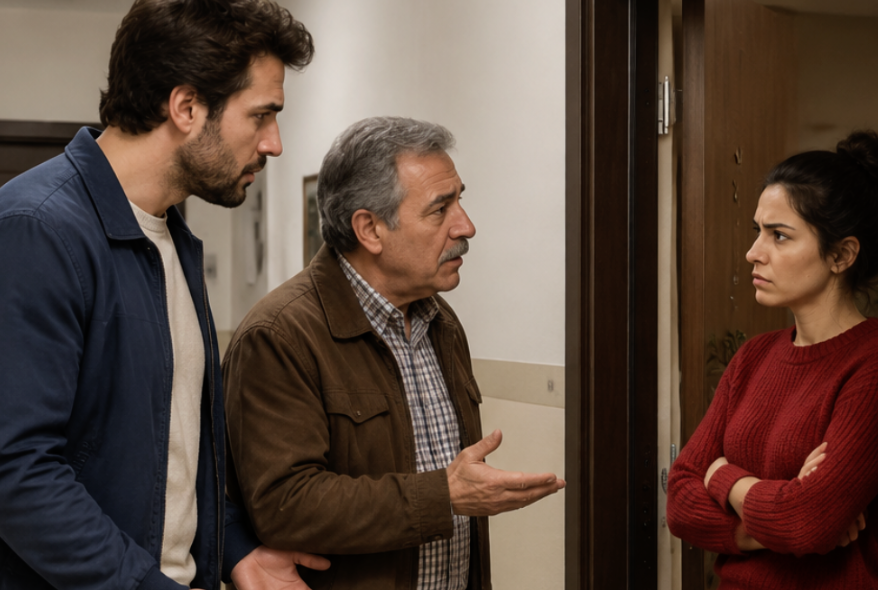
On Saturday morning, someone knocked so hard on my door it felt like there was an emergency outside.
I was just pouring cocoa for my kids. Sonya, my twelve-year-old, was laughing at something on her tablet. Vanya, seven, was poking at his oatmeal and making a mountain out of it.
“Mom, who is it?” Sonya asked.
“I don’t know,” I replied, and went to answer the door.
Two men were standing on the doorstep. One was tall and heavyset, wearing a leather jacket, with a face that reminded me of a soft bun. The other was short, balding, fidgety, constantly fiddling with keys in his pocket. I recognized them both instantly. Ruslan and Gennady. My ex-husband Oleg’s best friends. The same guys who used to come over for barbecues, drink in our kitchen, and then loudly proclaim how “lucky Oleg was to have me as his wife.”
“Hello, Tanya,” Ruslan said, not stepping inside. “Can we come in? We need to talk.”
“Hello. I’m having breakfast with the kids.”
“We won’t take long,” Gennady was already squeezing into the hallway. “It’s important.”
I sighed and stepped aside. It’s not that I wanted to let them in, but loud conversations in the stairwell never led to anything good.
They walked into the kitchen without removing their shoes. Ruslan sat down on a chair as if he owned the place, Gennady stood by the window with his arms crossed. The kids glanced at each other and quietly went to their room. I closed the door behind them.
“I’m listening.”
“Do you know that Oleg is in the hospital?” Ruslan started right away without any introduction.
I froze for a second.
“No. I didn’t know.”
“He fell off some scaffolding at a job site. Three weeks ago. Broken thigh, two ribs, and a concussion. He had surgery, but the doctors say recovery will take a long time. At least six months. He’ll have to use crutches, needs care.”
I stood by the stove, looking at the chipped edge of the kettle. Strangely, my heart didn’t skip a beat. No pity, worry, or panic. Just a light, cold surprise.
“I’m sorry,” I said at last. “Really. I hope he gets better soon.”
“We think he will recover too,” Gennady chimed in. “But he has nowhere to go.”
“How can that be? He has an apartment.”
“It was rented,” Ruslan waved his hand. “The landlady kicked him out as soon as she found out about his injury. Said she didn’t want any problems. And his… Aline… she left the same day he had surgery. Took her things and told him she wasn’t going to be a caregiver.”
“I see.”
“So we decided,” Ruslan cleared his throat. “Listen, Tanya, you lived together for ten years. You have kids. You’re his children’s mother, after all. Let him stay with you until he can get back on his feet. You can take care of him, cook, help with his dressings. It’s your duty, as a person.”
It took me a moment to understand what I’d heard. I asked again:
“He’d live with us? Here?”
“Yeah. This is a two-bedroom, kids in one room, you in the other. We’ll set up a cot for Oleg in the living room.”
“We’ve been divorced for three years,” I said quietly.
“So what!” Gennady protested. “Divorce is just a piece of paper. Family is forever. Are you really going to abandon someone in trouble? You’re a woman!”
“What does being a woman have to do with it?”
They exchanged glances, and in that look I saw the same condescension reserved for clueless little girls.
“Tanya,” Ruslan said softly, almost gently. “You’re strong. You always have been. You can handle this. If not you, then who?”
There it is. That phrase. “You’re strong.” “You can handle this.” “If not you, then who?”
I smiled. Not because it was funny, but because I suddenly felt incredibly calm.
I met Oleg twelve years ago at a mutual friend’s birthday party. He was handsome, cheerful, and had a booming voice. He knew how to tell jokes, played the guitar, and whenever he looked at me, I felt like I was the only woman in the world.
We got married after six months. A year later, Sonya was born. Five years after that, Vanya arrived.
All the good times in our marriage probably lasted about three years. Then the everyday routine set in.
Oleg worked as a foreman at a construction site. It was tough, stressful work, and after a hard day he liked to unwind: first a beer, then vodka, then a crisis. These crises happened regularly—sometimes his boss would nitpick, sometimes colleagues would betray him, sometimes clients wouldn’t pay. Each time, he came home looking gloomy, sat in the kitchen, and said:
“Tanya, I can’t do this anymore.”
And I listened. I nodded. I’d pat his shoulder and tell him everything would be okay.
When Vanya turned one, Oleg quit his job. He said he wanted to “find himself.” That he wasn’t going to work for someone else anymore. That he had an idea to start his own business.
His “idea” lasted eight months. He went to various meetings, drank coffee with “partners,” invested our savings into “promising projects.” Meanwhile, I was working double: in an accounting office by day, freelancing in the evenings, and rocking our son to sleep at night.
When our savings ran out and the project never took off, Oleg found a new job. But by then, I had stopped believing that things would just work out on their own.
During our last year of marriage, we barely spoke. He came home late, smelling of beer and someone else’s perfume, and I pretended to be asleep. In the mornings, he’d disappear—without breakfast, without kissing the kids.
Then he told me he was leaving.
“You see, Tanya,” he explained, shifting awkwardly in the hallway. “It’s hard with you. You’re always asking for things—money, attention, help. I just want life to be easy.”
“Easy for who?” I asked.
“Just easy. No demands.”
He moved in with Alina, a twenty-five-year-old fitness club administrator who, according to him, “doesn’t ask for anything and knows how to enjoy life.”
I was left alone with two kids, a mortgage, and the feeling of being thrown onto the sidelines.
The first year was a nightmare. Oleg paid child support irregularly—sometimes half, sometimes not at all. He’d say it was a “difficult period.” He took the kids only when he felt like it. Sonya would wait for him at the window on weekends, but he’d message, “Sorry, bunny, urgent things came up.” After that, Vanya would wake up crying for several nights.
I worked insanely hard. I took side jobs, handled accounting for three small businesses, drove to clients from morning till night. Still, I paid the mortgage, bought clothes for the kids, and took them to their clubs.
Little by little, life got back on track. I finally had an evening to myself—could light a candle and take a bath. I got used to waking up without that weight in my chest. A small joy appeared: the quiet, where no one demands that I “get it together.”
I learned how to live for myself and my kids. And now here I was, with two grown men at my doorstep telling me that I “owed” something.
***
“No,” I said.
Ruslan and Gennady froze.
“No, what?” Ruslan asked, confused.
“I’m not going to take care of him. And he won’t be living here.”
“Tanya…” Gennady’s voice grew more serious. “Do you realize what you’re saying? The man is in trouble!”
“I do realize. I feel sorry that he’s hurt. But, let me remind you, we’ve been divorced for three years. We no longer share a household or any duties except for the kids. And I’ve never refused anything when it comes to the children: he can come over, call, see them if he wants.”
“But he’s in the hospital!”
“I know. I can take the kids to visit him, if they want. But I won’t live with him.”
“You’re so cold,” Ruslan said reproachfully. “What is he to you now? Just some stranger?”
“He’s my ex-husband. A person who left his family when things got ‘too hard.’ He didn’t help raise the kids, didn’t pay child support, and now that his mistress has dumped him, he remembers he has a wife with a ‘sense of duty.'”
“Don’t talk like that!” Gennady snapped. “Oleg regrets it!”
“Really?” I asked calmly. “Did he tell you himself that he regrets it? Or did you just assume for him?”
They fell silent. Ruslan looked away.
“He hasn’t said anything,” Gennady admitted. “We came ourselves. We didn’t know who else to turn to.”
“I see. But that doesn’t mean I should take on something that’s not my responsibility.”
“Tanya,” Ruslan tried again, his tone softer. “You have to understand, he’s alone. No money, nowhere to live. No one else wants him.”
“He has his mother.”
“Nina Pavlovna?” Ruslan made a face. “She’s old, sick, living out in the village.”
“Then he should go to her.”
“There aren’t any doctors or proper conditions there…”
“Then there’s social services, rehab centers, private care homes. Let him get insurance, apply for disability pension. That’s what your friendship should help with: paying, organizing, finding a place. Not me.”
“We’d love to,” Gennady sighed, spreading his hands. “But we have our own families, our own problems.”
“And I don’t have any family or problems?” I smiled. “I’ve got two kids, a mortgage, and four side jobs. No, guys. Sorry.”
Ruslan stood up, slowly, like a weight had been dumped on his shoulders.
“You’re so cruel,” he said. “We always thought you were a good person. Turns out you’re just a selfish, cold-hearted woman.”
“Thanks for being honest,” I nodded.
“A real woman would never do this!”
“A real woman, Ruslan, doesn’t owe anyone anything,” I replied. “She decides who to help, and who not to. And when she does help, it’s out of love or kindness. Not because she’s pressured, and not because of guilt.”
They left, slamming the door loudly. One of them—probably Gennady—muttered something about a “witch and man-hater” on the stairs.
I stood in the hallway, staring at the closed door, then returned to the kitchen and sat down on a stool. My hands were shaking—not from fear, but from the stress that was finally starting to fade.
I heard footsteps in the hallway. Sonya peeked out of her room, came over quietly, and hugged me by the shoulders.
“Mom, are you okay?”
“I’m fine, sweetie.”
“Was that about Dad?”
I was caught off guard. I thought the kids hadn’t heard. But the thin walls in our apartment kept no secrets.
“Yes,” I admitted. “Dad’s in the hospital. He had a fall at work.”
“Is he in pain?”
“Probably. The doctors said he’s going to need a long time to recover.”
Sonya was silent for a moment.
“Why don’t you want him to live with us?”
I looked at my daughter. Twelve years old, long light brown hair, watchful gray eyes. She noticed everything, felt everything. I knew I couldn’t lie to her.
“Because your dad and I aren’t a family anymore,” I said gently. “And because I’m not ready to take care of another adult like a child again. I did that for ten years. That’s enough for me.”
“But he’s still our dad.”
“Yes, he is. And I won’t stop you or Vanya from seeing him. If you want to visit him at the hospital, I’ll drive you. If you want to call him, go ahead. But he’s not going to live here.”
Sonya thought about this.
“What if he gets really sick?”
“Then we’ll find another way to help,” I said. “For example, we could look for a good rehab center. But not in a way where you and Vanya are left without your mom, and I have nothing left.”
My daughter nodded and pressed her cheek against me.
“I understand,” she whispered. “You’re just tired.”
Tears welled up in my eyes. I hugged her tighter, and we just sat like that for several minutes. Then Vanya came running in with a mug of cold cocoa.
“Mom, can I have another candy?”
“You can,” I laughed through my tears. “But just one.”
***
The next day, I went to the hospital.
Not because I had changed my mind, but because I decided to help in the way I thought was right, not how others demanded.
Oleg was lying in a six-bed ward by the window. He looked skinny, unshaven, his face gray. His leg was in a cast, suspended in some complicated contraption. On the bedside table sat a half-empty bag of kefir and a dried-up bun.
When he saw me, he blinked in surprise.
“Tanya?”
“Hi, Oleg.”
“You… came?”
“I did. I brought you something.”
I set a bag of fruit, mineral water, and some good chicken broth in a thermos on his table. He stared at it in disbelief.
“I didn’t know you would come,” he mumbled. “Ruslan said you didn’t want to…”
“I didn’t want you to live with us. That’s true.”
Oleg lowered his eyes.
“I understand,” he said quietly. “I wouldn’t want that if I were you either.”
I didn’t expect that answer. I sat down on the edge of the chair.
“I’m not here to argue. I just wanted to know how you are.”
“I’m surviving,” he said with a bitter smile. “Alina left. The landlady kicked me out. My things are in Ruslan’s garage. I have no money. No insurance, since I was working off the books. The doctors say I can’t put weight on my leg for at least two months, then a month on crutches. And after that, I have no idea where to go.”
“And your mom?”
“She’s in the country. She has high blood pressure and arthritis, she can barely walk herself. I don’t want to burden her.”
“But there aren’t any other options.”
“I know,” he clenched the sheet. “Tanya, I never asked my friends to come to you. They did that on their own. I’m ashamed.”
“Really?”
“Really. I don’t have the right to ask for anything. I broke everything myself.”
We sat in silence. Someone was snoring loudly in the ward, and a light rain was falling outside the window.
“Oleg,” I finally said, “I’m not going to take care of you. But I can help in other ways. I’ve found three rehabilitation centers in the region. One is public, free, and based on a quota. You’ll need a doctor’s note and to apply through social services. I wrote down the numbers—here.”
I handed him a piece of paper.
“Call them, find out. If you need help with the paperwork, let me know and I’ll tell you what to do. But I’m not going to do everything for you.”
Oleg took the sheet of paper, his hands trembling.
“Thank you,” he managed to say.
“And another thing,” I added. “You haven’t paid child support for three months. That’s twenty-four thousand. I’m not asking for it now, please understand. But when you’re back on your feet, you’ll need to pay it back.”
He looked up at me.
“I’ll pay it back.”
“Okay.”
I stood up.
“The kids want to visit you. If you’re okay with it, I’ll bring them on Saturday.”
“Of course,” he said quickly. “I really want to see them. But… maybe not in this condition…”
“Any condition. They’re your kids.”
Suddenly, he turned toward the window. His shoulders shook, and I realized he was crying. Quietly, soundlessly, the way men do when they’re not used to showing weakness.
I stood by him for a moment, then placed my hand on his shoulder.
“Get well soon,” I said.
And I walked out of the hospital room.
***
On Saturday, I brought Sonya and Vanya.
Oleg looked a bit better, freshly shaven and wearing a clean t-shirt. When he saw the kids, his face lit up so much it made my heart ache.
“Dad!” Vanya rushed over to the bed.
“Careful, his leg!” Sonya cried out.
“It’s fine, it’s fine,” Oleg smiled. “Come here.”
They sat with him for a whole hour. Vanya talked about school and his new Legos, Sonya showed photos from her dance competition. Oleg listened, nodded, laughed, and asked questions. I stood by the door and saw something long forgotten appear on his face: real interest, warmth, tenderness.
When we stepped out into the corridor, Sonya quietly asked:
“Mom, has he really changed?”
“I don’t know,” I replied honestly. “Time will tell.”
“He looks like he’s afraid of losing us.”
“Maybe.”
“Did you forgive him?”
I thought for a moment.
“You know, honey, forgiveness and letting someone back into your life aren’t the same thing. I can forgive a person and still not let them in again. That’s not anger or resentment. It’s just boundaries.”
“Boundaries,” Sonya repeated, tasting the word. “I like that.”
***
Ruslan and Gennady didn’t show up again.
But a week later, I got a call from Nina Pavlovna, Oleg’s mother.
“Tanyusha, hello,” her voice was weak and shaky. “It’s me, Nina.”
“Hello, Nina Pavlovna. How is your health?”
“Oh, what health… I heard Oleg is in the hospital. I want to bring him home with me. But I’m afraid I won’t manage alone.”
I sighed.
“Nina Pavlovna, I’ll help you. Not with money, but with arrangements. Here’s what we can do: through social services, you can get a caregiver for three hours a day with a subsidy. I’ll find out how to arrange it and help get the paperwork together.”
“Oh, Tanechka, thank you… I know we’re not in a position to ask for help. There’s just no one else to turn to.”
“It’s okay. There’s nothing wrong with asking for help. The important thing is not to demand it.”
We talked for almost an hour. I wrote down phone numbers, office numbers, lists of documents. The next week, I went with Nina Pavlovna to social services, helped her fill out applications, and made sure she got on the waiting list for a caregiver.
Then I visited Oleg in the hospital again and brought him the documents he needed to be discharged.
“You don’t have to do this,” he said.
“I know,” I replied. “That’s exactly why I’m doing it. When you don’t have to help, it means so much more.”
***
A month later, Oleg was discharged from the hospital. His mother took him to their village, set him up in a small room overlooking the vegetable garden, and even hired a caregiver for three hours a day. Ruslan and Gennady brought his things from the garage and helped arrange the furniture.
The kids called their dad every evening. He would tell them funny stories about the neighbors’ goats and show them on video how he was learning to walk with crutches. One day, Sonya said:
“Mom, Dad seems kind of different now.”
“Different how?”
“He’s calmer. Not so nervous. And he doesn’t promise things he can’t do anymore.”
I just smiled. I didn’t know what was going on in Oleg’s mind. Maybe pain and loneliness really did make him rethink his life. Or maybe it was just time for him to finally grow up.
Five months passed. At the end of autumn, Oleg came back to the city.
He wasn’t visiting the hospital or dropping by for a chat. He was just sitting on a bench by our building, resting on his crutches, waiting for the kids to get home from school. I spotted his silhouette from the window. At first I thought about just walking by, but then I went downstairs anyway.
“Hey,” I said.
“Hi, Tanya. Sorry for showing up unannounced. I really wanted to talk to you myself.”
We sat down together on the bench. He looked better—his face was tan, his shoulders were strong, and his gaze was level and calm. The only difference was he had more gray in his hair now.
“I got a job,” he began. “I’m working as a dispatcher at a construction company. It’s a desk job while my leg heals. The pay’s not great, but it’s steady. Everything’s official.”
“I’m glad to hear that.”
“So,” he said, pulling an envelope from his pocket, “here’s three months of child support—twenty-four thousand, just like you asked. And this is for the current month too.”
I took the envelope, hardly able to believe what I was seeing.
“Thank you.”
“This isn’t charity,” he added quickly. “It’s my responsibility. I should have been paying all along.”
We sat in silence.
“Tanya, I wanted to thank you,” he said softly. “Not just for helping with the paperwork, though I’m grateful for that too. But thank you for not letting me move back in.”
I looked at him, surprised.
“If you’d let me stay with you,” Oleg went on, “I would’ve ended up relying on you all over again—lying on your cot, waiting for you to feed me, to take care of everything, to fix my world. And I wouldn’t have learned a thing. I had to make it on my own. It was scary, it was painful, and it was hard. But for the first time in years, I realized I could actually do things myself.”
“Do you really mean that?” I asked carefully.
“I do. I realized I’d spent my whole life taking advantage of your strength. I always said you’d handle things, while I hid behind your back. That wasn’t fair.”
A lump formed in my throat.
“You know,” I said, “I figured something out, too. Weakness isn’t necessarily bad if you’re willing to admit it. And strength isn’t just about enduring everything—it’s about knowing when to say ‘no.'”
He smiled.
“You’ve always been strong.”
“I was,” I nodded. “But I never liked when people used it against me.”
From around the corner, Sonya and Vanya appeared with their backpacks. When they saw their dad, they ran up to him and the three of them sat together, and then all four of us, until it started to get dark.
***
I told this story to my friend Lena once, over a cup of tea.
“And you don’t regret it?” she asked. “Not letting him come back? Not helping him the way most people would?”
“I did help him,” I replied. “Just not the way everyone expected.”
“But everyone always says: a woman should be wise, patient, forgiving…”
“You know, Lena,” I stirred my spoon in the cup, “I lived with that belief for a long time. ‘You must,’ ‘you have to,’ ‘you’re a woman.’ And every time I forced myself to do something because of it, I felt smaller. Like little pieces of me were being cut away, one by one.”
“And now?”
“Now I feel whole,” I smiled. “And I really like it.”
Lena stayed quiet for a moment, then softly said:
“I don’t think I could ever do that.”
“You will,” I replied. “Once you realize that saying no isn’t betrayal. It’s respect for yourself.”
She nodded thoughtfully.
That evening, once the kids had fallen asleep, I stepped out onto the balcony with a cup of hot tea. A few lonely stars shone over the city, somewhere below a dog barked, and the air smelled of wet asphalt.
I found myself reflecting on how strange life can be. People call you heartless, and then it turns out that your very “no” helped someone stand on their own two feet. They tell you what you “should” do, only for you to later realize nobody owes anyone anything except honesty.
My phone vibrated on the table. A message from Oleg:
“Thank you for tonight. The kids were happy. And so was I. Goodnight.”
I smiled and put my phone away. I didn’t want to reply right then. I just wanted to stand there, breathing deeply, feeling the night air fill my lungs.
I wasn’t strong or weak anymore. I was free. And as it turns out, that’s enough to be happy.