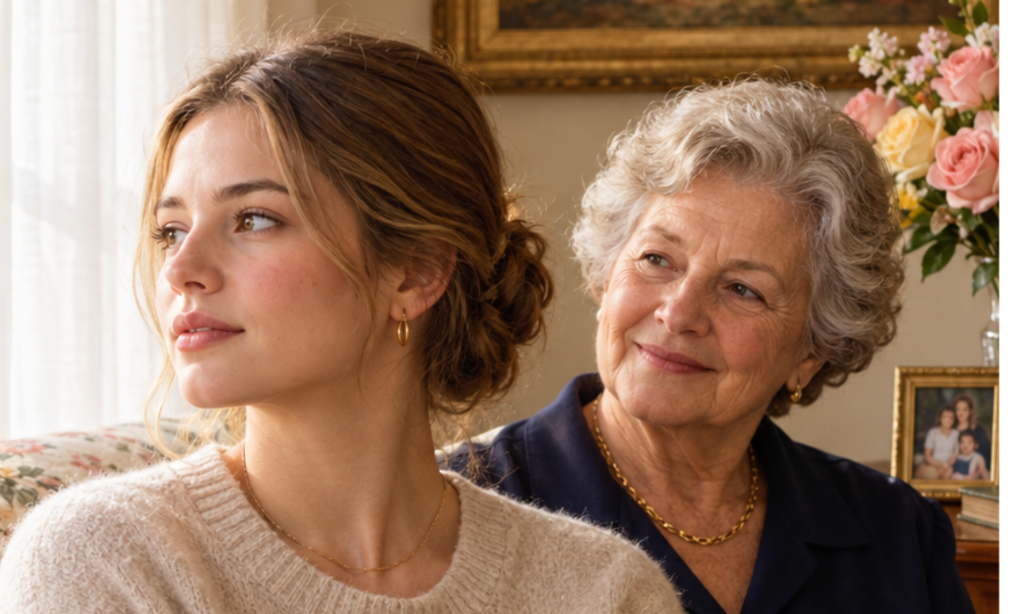
The lock clicked at half past nine in the morning—two confident turns, like it belonged there. Nina was standing in the middle of the kitchen in her robe, holding a cezve, listening to the unfamiliar squeak of boots in the hallway. She already knew who it was, even before the rustling of a plastic bag drifted in from the corridor.
“Nina, are you home?” Tamara Igorevna appeared in the doorway, still wearing her coat. “I saw the lights were on. I thought you both were at work.”
“Actually, I’m on sick leave,” Nina replied. “Second day.”
“Oh, why didn’t you tell me? I would have brought you some broth.”
The coffee began to bubble. Nina took the cezve off the stove and set it on a trivet, avoiding her mother-in-law’s eyes and holding back everything she wanted to say.
“Tamara Igorevna, why didn’t you call first?”
“What for?” Her mother-in-law was already untying the bag and setting it on the table. “I’m just here for a minute. Brought socks for Sergey, he said they’re all full of holes. And I picked up cottage cheese at the dairy store—there’s only one shop near you, but that so-called cottage cheese you get here is nothing.”
“You walked into an apartment where someone was sleeping.”
“But I was quiet.”
Nina looked at her hands—short, strong, with one nail stained yellow from turmeric. Those hands had already rearranged jars on Nina’s shelves. Last month, those hands had thrown away Nina’s seedlings from the balcony: “The soil’s dry, they won’t grow anyway.”
“You weren’t quiet,” Nina said. “You barged in. You stomped around someone else’s apartment.”
Tamara Igorevna straightened. She held the bag in front of her like an official document.
“Someone else’s?” she repeated. “My son lives here. How is it someone else’s?”
“This is my apartment.”
“Well, that’s what you say.”
She said it calmly, without malice, the way an adult explains to a child that the moon isn’t really hanging from a string. Then she stepped into the corridor—to check if there was dust on the dresser.
Sergey came home around seven, bringing with him the chill and smell of gasoline from outside. Nina waited for him in the kitchen, already dressed, a cold mug in front of her—a detail that alone should have caught his attention.
“Your mother was here today,” she said.
“I know, she texted me. Brought me socks.”
“She let herself in with her own key. I’d just gotten up.”
Sergey pulled off his jacket and hung it over the back of the chair—as he always did, every single time, for four years straight.
“So what?” he sat down. “She’s my mother, not a burglar.”
“Sergey, I’m sick. I woke up to someone walking around my hallway.”
“Our hallway.”
“My apartment,” Nina said. “Let’s finally say it out loud, since we’ve started.”
He grimaced as if he’d felt a pang in his tooth. She knew that gesture by heart—it was how he reacted to anything that couldn’t be turned into a joke.
“Here we go again.”
“Nothing’s starting again. I’m just asking you to get the key back.”
“She’s had it for about five years.”
“She’s had it for three,” Nina clarified. “Ever since we went to the sea and asked her to water the ficus. The ficus died. The vacation ended. The key stayed.”
Sergey poured himself some tea without offering her any and sat across from her.
“So what, she’s supposed to just stand outside the door now?”
“She can call. Like everyone else.”
“She’s not ‘everyone else.’ She’s my mother.”
“She’s a stranger with the keys to my home,” Nina said. “Right now, as we speak, she could open the door and come in. And she will.”
“She won’t.”
No one opened the door that night, and Sergey considered that he had won the argument.
Part two
Continued in the comments
A week later, Nina came home from work and noticed something missing—the heavy glass jar with the ground lid, the one her grandmother had brought from Gomel, was gone from the shelf. In its place stood a plastic container from Fix Price, neatly labeled “BUCKWHEAT.”
“Sergey,” she called out, “where’s the jar?”
“What jar?”
“The glass one. With the lid.”
He walked out of the room, eyes glued to his phone screen.
“Oh, Mom mentioned it. She threw it out—it had a chip on the rim.”
“That chip’s been there for twenty years.”
“Well, guess it finally met its fate.”
Nina opened the container and looked at the buckwheat. It was perfectly fine—and, oddly, that infuriated her the most.
“Your mother was here again when we weren’t.”
“She mopped the floors too,” Sergey replied. “You could at least say thank you.”
“I didn’t ask anyone to mop my floors. I asked not to come in.”
“Nina, come on, don’t be like that. She’s just lonely, she’s retired, she wants to feel needed.”
“Let her feel needed at her own place.”
“There’s no one to need her there.”
He said it with such reproach, as if Nina personally arranged for his mother’s loneliness. As if she’d been the one who sent his father packing, and afterward everyone else who overstayed their welcome for more than just tea.
“Alright then,” Nina said, closing the container. “On Saturday, I’m changing the lock cylinder.”
Sergey finally raised his eyes from his phone.
“Are you serious?”
“Absolutely.”
“You know this is going to start a scandal?”
“What I know is, it’s a lock.”
But the scandal started even before Saturday—it began on Thursday, with a call from Marina. Sergey’s sister called rarely and only on business, which always boiled down to the same thing: explaining to Nina how a family should work.
“Hey, Nina,” came her no-nonsense greeting, jumping right in. “Hope I’m not interrupting? Sergey told me. Are you really planning to change the locks?”
“I am.”
“Because of Mom?”
“Because of anyone who has keys and doesn’t feel the need to call first.”
There was a pause on the line. In the background, a hairdryer buzzed, someone laughed—Marina was speaking straight from the salon, in between clients.
“Nina, don’t take this the wrong way, but this is really harsh,” she said. “Mom does your laundry, irons everything, brings you soups. And now you’re shutting the door in her face.”
“Marina, I don’t need anyone to do my laundry. I’m thirty-four years old.”
“But that’s just how she loves you.”
“Then maybe she doesn’t need to love me,” Nina replied. “I’ll manage.”
The hairdryer on the other end shut off, and Marina’s voice came through more clearly—closer, and somehow more unpleasant.
“Do you even realize what this looks like from the outside? Clinging to your square meters, guarding them like a watchdog. Some wife, huh.”
“And where is this outside perspective from? My own kitchen?”
“From the family.”
“Marina,” Nina said as she sat on the windowsill, “do you have an apartment?”
“Yeah, a rented one.”
“Give me a key to it, then.”
Marina huffed and hung up—and from that huff, Nina knew she’d won the argument, but lost something bigger.
Part Three
On Saturday, the locksmith didn’t show—he pushed things to Monday, then to Wednesday, and then stopped picking up the phone altogether. So on Friday, Sergey brought over his friend Artyom—along with some beer, dried fish, and that classic peacemaker look on his face.
Artyom had been Sergey’s friend since university, a car mechanic, generally a good-natured guy. He always sat in the kitchen the same way: half-turned to the table, elbow on the chair back, legs stretched across the walkway—making it just about impossible for anyone to pass by.
“Nina, here’s why I’m here,” he began as he broke off a piece of fish. “Sergey says you’re at war over there.”
“We’re not fighting. I’m changing the lock.”
“Come on. Is this all because of the old lady?”
“Because of the door.”
Sergey made a noise and opened a second bottle, despite not finishing the first. He always did that when he felt supported.
“Look, you have to understand,” Artyom spoke softly, as if to a frightened dog. “A mother is a mother. Today you don’t give her a key, and what if tomorrow she feels sick? What then? Will the ambulance have to break down the door?”
“She has her own apartment,” Nina replied. “Two metro stops away. And over there, no one’s breaking down anything.”
“Why are you acting like you’re not family?”
“Artyom, tell me honestly: do you visit your mother-in-law without calling first?”
He laughed, pleased, as if she’d made a joke.
“You couldn’t drag me there even with a sweet bun.”
“There you go.”
“That’s different,” said Artyom. “I’m the son-in-law. Here, it’s the son. Being a son is sacred.”
Nina silently stood up and turned on the kettle. There was so much she wanted to say, but none of it would make this evening any better.
“Nina, sit down,” Sergey said in a conciliatory tone. “Let’s be reasonable.”
“I’m listening.”
“How about this: my mother gives a heads-up in advance. She messages on WhatsApp. But the key stays with her, just in case. You never know – maybe there’s a busted pipe when we’re on vacation and she’s nearby.”
“She’s not nearby. She’s twenty minutes away.”
“That’s still close.”
Nina looked at him—at his relaxed face, the bottle, and his friend nodding in agreement—and realized they’d already made up their minds. Without her. Sometime between the second and third bottle.
“Sergey,” she said evenly. “This is my apartment. Bought before our marriage. Paid for by my grandmother, who counted every penny her whole life, and by me, who spent seven years paying off the rest.”
“I know.”
“No, you don’t. You just repeat it like some boring fact from the weather report. But it isn’t just a fact. It’s a wall you’re banging your head against and wondering why it hurts.”
Artyom stopped chewing.
“That’s harsh,” he said.
“It’s fine,” Nina replied. “The door is mine. The lock is mine. The key is mine.”
Sergey set the bottle on the table—carefully, quietly, but still loud enough to be heard.
“Alright,” he said. “Then let me say this. If you change the lock, I’ll take it as you kicking me out.”
“What does this have to do with you?”
“It means I live here. And if my own mother can’t get in, then I’m not the man of the house, either.”
“You were never the man of the house,” Nina said. “You’re my husband. Which, honestly, is more.”
He didn’t answer. He poured a drink for Artyom, then himself, and the conversation shifted to winter tires.
Part Four
At the end of November, Nina was sent to a work site in Cherepovets—for nine days, with hotel nights and daily measurements in a half-built workshop. She left angry and sleep-deprived, and before leaving she said only:
“Give the key back. While I’m gone.”
“Yeah,” Sergey replied, not looking up from his phone.
She called on the third, fifth, and seventh days. He answered shortly, said everything was fine, the house was quiet, and that he was eating.
On the tenth day, Nina unlocked her own door—with her own key, just before midnight, suitcase in hand—and ran into a stroller.
The stroller was standing right in the hallway. Next to it—two children’s snowsuits on the radiator, unfamiliar sneakers, a pink unicorn backpack. Light from the next room, the sound of a cartoon playing.
“Oh,” Marina said as she walked out of the kitchen with a towel on her shoulder. “Why are you here so early?”
“I’m right on time.”
“Seryozha told us you were coming on Friday.”
Nina set down her suitcase. A boy of about six peeked out from the living room, glanced at her without any interest, and disappeared back inside.
“Marina, what is going on here?”
“Oh, we’re just here for a week,” Marina said, waving her towel. “Our landlord is selling the apartment—can you believe it, in December! Some people have no shame. Seryozha said it was fine.”
“Seryozha.”
“Yes, and Mom says—why let the place sit empty?”
Tamara Igorevna shuffled out of the kitchen—wearing Nina’s apron and holding Nina’s spatula.
“Nina, just don’t start shouting,” she said right away. “The kids are going to sleep.”
“I haven’t started shouting yet.”
“Then don’t start.”
Nina walked into her room. Her wardrobe was empty—coats, dresses, and sweaters were stuffed into three construction garbage bags by the balcony door. The shelves held other people’s boxes. A string of lights was hung above the bed.
“Where are my things?”
“Right there,” Marina pointed with the towel. “We packed everything carefully, nothing got wrinkled. The kids need somewhere to hang up their stuff, you know.”
“Where’s Grandma’s china set?”
There was that certain pause that told Nina everything right away.
“Nina, it was just two cups,” Marina said quickly. “Roma climbed on the table. He’s just a kid.”
“Three,” corrected Tamara Igorevna. “And a saucer.”
“And the box,” Nina said. “The blue one. From shoes. It was in the closet, on the top left shelf.”
Her mother-in-law was the first to look away.
“Oh, that box was just full of old paper,” she said. “Letters, postcards, old notebooks. I cleaned out the closet, you could hardly breathe in there. I took it all out.”
“Where did you take it?”
“To the trash, where else.”
“When?”
“Last Sunday.”
Nina stood in her own hallway, between the stroller and the bags, breathing very slowly. In that box were her grandmother’s letters from the war—not hers, her mother’s, written in pencil. And a wedding ring Nina didn’t wear because she was afraid to lose it.
“What were you doing in the bathroom?” she suddenly asked.
“What do you mean?”
“There’s a puddle on my floor.”
Marina turned around. Tamara Igorevna, for some reason, took a step back.
A minute later it became clear: the washer hose had been leaking for three days. They were putting a basin under the machine and dumping it out. For two evenings now, someone downstairs had been banging on their ceiling with a mop.
At 1 a.m., Igor Lvovich from apartment seventy-four rang the doorbell—in his bathrobe, phone in hand, showing photos of his stretch ceiling ballooned above the new laminate floor.
“I’ve called you for three days!” he said at the door. “Your husband told me, ‘Everything’s under control’!”
“He has no idea what control means,” Nina replied. “Come in. Record it on video. I’ll sign anything.”
Sergey came home at half past one—from the garage, from Artyom’s place. He came in, saw the lights on, the neighbor, the bags, his wife—and put on that smile people wear when they hope to get away with something.
“Oh, you’re back!”
“I’m back.”
“So, you see, for now we have some guests…”
“I’ve already met them,” Nina said. “The stroller, the bags, Igor Lvovich’s ceiling. The china set isn’t broken all at once—there’s a waiting list, apparently. Very convenient.”
“Nina, not in front of people.”
— Only in front of people now. Only when there are people around. — She took out her phone. — Igor Lvovich, could you please repeat once more, from what date does it leak?
Sergey stepped toward her and took her by the elbow — not roughly, but it was the first time in four years that he’d touched her elbow at all.
— Enough with the theatrics, — he said quietly. — This is my sister. These are her children. Where am I supposed to put them in December?
— In your own apartment.
— I don’t have an apartment.
— Exactly, — Nina said. — Exactly, Seryozha.
He let go of her elbow. Tamara Igorevna left the room — without her apron now, already in her coat, her face wearing the look of someone leaving another person’s life, refusing to admit any guilt.
— You were a good girl, Nina, — she said. — But in the end, you turned out to be petty.
— Leave the key on the nightstand, — Nina replied. — You seem to be leaving already.
The key clinked against the glass. That was the only sound that brought her joy that night.
Part Five
In the morning, Nina called the local officer — not because she believed in him, but because she wanted someone from the outside to see the stroller in her hallway and put it in an official report. Then she took out documents from the drawer that she hadn’t touched in four years: the sales contract, the statement, receipts, and the loan payoff certificate. Everything was perfectly arranged, just as she’d left it — for a rainy day that had finally come.
Marina left by lunchtime, loudly and with complaints, explaining to the boy in the elevator that “Aunt Nina is stingy.” The locksmith arrived at five and replaced the lock cylinder in forty minutes.
— How many sets should I make? — he asked.
— One, — Nina replied.
— Usually people ask for three. For spares.
— I don’t need any spares.
He shrugged and made just one.
Sergey showed up at nine in the evening. She could hear him coming up, jangling his keys, trying the lock — and realizing the key didn’t fit.
He tried again. A second time. Then a third. Finally, he called.
— Nin, — he said through the door. — Open up. The lock is stuck.
— The lock is new.
A pause.
— You changed it.
— I changed it.
— Open the door.
— No.
She could hear him shifting behind the door. The stairwell echoed, every sound booming like it was inside a barrel.
— Nina, this is my apartment too, — he said. — I’ve lived here for four years.
— You lived here for four years.
— I’m registered here!
— You’re not registered here, — she said. — You didn’t want to, remember? “It’s more convenient for work this way.”
He slapped his palm against the metal.
— Open up! I’m not a stranger to you!
— Then you open up for me, — responded Nina. — Right now. Tell me the address where I can open your door with my own key.
Silence.
— I can’t hear you, Seryozha.
— You’re just being spiteful now, — he said in a low voice. — Over those cups.
— Over the cups, — she agreed. — Over the box. Over Igor Lvovich’s ceiling that cost fifty-six thousand. Over the trash bags where they stuffed my coat. Over the ten days you told me, “the house is quiet.”
— I was only trying to do the right thing.
— That’s a lie! You just didn’t want to argue with your mother. That’s a different word — just longer.
He pushed at the door again — hopelessly, just out of habit.
— So what now? — he asked. — Where should I go?
— Go to your mother, — said Nina. — You’ve been with your mother this whole time. You were just sleeping over at my place.
He came by three more times. The first time, he brought Artyom, who tried talking through the door, saying, “That’s not how problems get solved” and that “a woman ought to be wiser.” Nina listened for about two minutes, then turned on the TV so the announcer’s voice drowned out Artyom. The second time, he came alone, sober, apologizing—though every apology started with the word “but.” The third visit, he brought Marina, who yelled about greed loud enough for the whole building to hear, until Igor Lvovich from apartment seventy-four came out and asked where to file an official complaint.
continued in the comments
Nina filed for divorce on Wednesday. She paid the neighbor back for the ceiling damage herself—bit by bit, never asking Sergey for a single ruble, because she knew if she had, she’d be asking Tamara Igorevna instead.
She packed his things into four bags: shirts, razor, charger, a mug with ‘Best Salesman’ written on it, winter boots, and other random stuff. His passport was in the desk drawer. The key to his mother’s place stayed on the nightstand by the mirror—small, brass, worn at the teeth.
He called on Saturday at eleven. Nina opened the door and tossed the four bags out onto the landing, one by one.
“Everything’s here,” she said. “Check the landing.”
Sergey stood there unshaven, wearing the same jacket. He picked up the bags but didn’t leave.
“Nina,” he said. “Can we talk?”
“We’ve been talking for six months.”
“I understand everything now.”
“What exactly do you understand?”
He thought for a moment.
“That I should have taken her key back.”
Nina looked at him—at part of his face, his shoulder, his sleeve. Even now, standing on the stairs with all his stuff in his arms, he was still bargaining.
“Wait,” she said.
She went back into the hallway, grabbed the brass key from the nightstand, sealed it in an envelope, and slipped it through the crack.
“What’s this?” Sergey asked.
“Give it to your mom,” Nina said. “Tell her it’s a keepsake.”
And she closed the door—locked it twice, as always. Then thought for a second and turned the lock a third time.