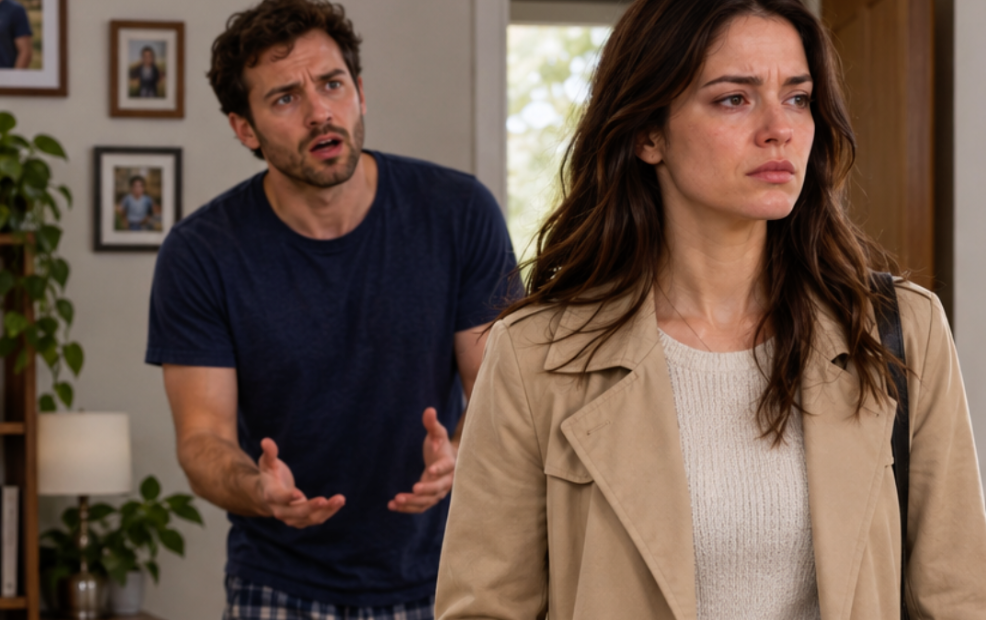
“Tim, come here. Open the box and tell me what you see.”
My son entered the room sideways, the way people walk into a dentist’s office. The box from his new wireless headphones was on the table, its lid open. Inside, nestled in the foam insert, were his old headphones—the worn, scratched ones with the cracked right ear.
“Headphones,” Timofey said.
“What kind?”
“Mine.”
“I bought you new ones just two days ago. Eleven thousand two hundred rubles. These are the headphones you ‘lost’ on Wednesday, then spent half the evening mourning. Now they’ve come back to life—just to turn up in someone else’s box. What should I call this?”
He stayed silent and stared at his sneakers with such intensity, you’d think he was watching a game’s final score appear there. I counted to five. Then to eight, because five just wasn’t enough.
“Mom, I gave them away.”
“To whom?”
“To Milana.”
“To Milana,” I repeated. “Wonderful. She gets headphones that cost eleven thousand two hundred, and you get the cracked ones. What are you, a charity with really bad accounting?”
“You don’t understand.”
“So explain it to me. I catch on quick—it’s my job to build whole cities out of scraps and cardboard.”
“She doesn’t have a dad,” he said. “But I do.”
I sat down. There it was, word for word, letter for letter. My thirteen-year-old had paid someone else’s debt out of his own pocket and thought he’d done something good.
“This is the third time this month,” I said. “Games from your account. The gaming mouse. Now the headphones. You’re acting like someone who’s trying to buy someone off. Tell me, what are you paying for?”
“Nothing. I just wanted to give her something.”
“People give gifts when they have more than enough, Tim. You’re giving away your last things, and you’re looking your mom in the eye while you lie. That’s not kindness anymore, that’s a tribute.”
***
Ruslan came home at nine, set his bag of tools by the wall, and immediately rummaged in the fridge. He’s a vibration diagnostician—he travels to bridges and tower cranes, listens to metal, and tells them where it’s grown tired. He hears metal perfectly, but when it comes to people—nothing at all.
“Look,” I pushed the box toward him.
“So, headphones. And?”
“Inside are the old ones. The new ones went to Milana. So did the mouse. And the money for the game.”
“Kids share,” he shrugged and took a bite of his sandwich. “Timka’s kind, not stingy. That’s good, isn’t it?”
“It’s good when they share an apple. But when a kid gives something away, lies about losing it, then hides the evidence in a box—that’s called a scheme.”
“You’re making this dramatic. He’s a boy, she’s a girl, he’s trying to impress her.”
“She’s his sister, Ruslan. Stepsister. Are you sure you haven’t mixed up your script?”
He set down his sandwich and chewed for a long time.
“Ksyusha, don’t start.”
“I’m not starting. Honestly, I’ve been silent for eight years. If there were a medal for keeping quiet, I’d win it.”
“Then keep being quiet.”
“I can’t anymore. The things are gone—now it’s the money.”
***
I know this story by heart, like the multiplication table, and I hate it just as much. Ruslan and Zhanna dated in school, in a small town where the evenings lasted forever and there was only one movie theater. He left for college and broke up with her over the phone, between classes. No one told him she was pregnant.
Six months later, he married me, his classmate. We were both young, happy, and broke. In our first year, he had two children—my Timofey and her Milana, just five weeks apart.
I found out about it when Tima was a year and a half old. I didn’t scream. I took a pause, thought it through, and decided to keep living—with this fact like a nail in the wall: hammered in, not in the way, not touching the wallpaper.
Zhanna never tried to claim our family. She calmly and efficiently arranged for child support—through the courts, without drama. For seven years, our two sides never crossed paths, and I almost believed it would stay that way forever.
Everything changed when the kids started school. Zhanna moved to our town, rented an apartment in the next yard, and Milana ended up in the same class as my son. In the same room, sitting right next to him.
The kids met on their own. Timofey came to me and asked if it was true that Milana’s dad was his dad, too. I sat down opposite him and told him everything honestly, no sugarcoating. Even now, I believe I did the right thing.
But Milana turned out to be smarter than all of us. In just three weeks, she figured out my son completely: naive, kind, loved, and already guilty before anything even happened. And she began working with what she had.
***
‘Ksenia, you’re making things complicated,’ said my mother-in-law, Tamara Igorevna, the first time I brought up the topic of gifts. ‘Milana is my granddaughter too. Why would I treat them differently?’
‘You don’t have to divide anything. But you do have to be fair. You knit one hat for Timofey, but for her—a hat, a scarf, and mittens.’
‘Her mother is raising her alone.’
‘Her mother has been receiving child support from my husband for eight years. On time, every single month—I’ve seen the receipts myself.’
‘You’ve become petty,’ my mother-in-law said. ‘You used to be easier going.’
‘Math was easier back then. Now the numbers just don’t add up like they used to.’
She pursed her lips and started up the old tune: the boy was born, no one asked him; the girl was born, no one asked her. And she’s right—Milana isn’t to blame for any of this. It’s the adults, who don’t know how to calculate money, or consequences, who are at fault.
I understood that. That’s exactly why I never took it out on someone else’s child. Another person’s child is territory where I have no right to step, and I never once crossed that line.
***
I happened to see the messages by accident. Timofey left his tablet on the armrest, a notification popped up, and I read it.
“Those sneakers cost six. Your mom’s rich, tell her it’s for the school trip and new workbooks.”
“She checks everything.”
“Why, are you not a real man? Don’t want to help your sister out?”
I sat there with the tablet on my lap for about ten minutes. Inside, everything clattered like a box full of nails dropped from the top shelf.
I didn’t react impulsively. If I lashed out, my boy, not wanting to upset his ‘sister,’ might actually start reaching for my wallet for real. I didn’t want a thief in my house—I wanted a son who could think for himself.
I chose to just watch. Six months of watching—honestly, it’s its own kind of sport, where you lose a point every single day.
***
For Ruslan’s birthday, I bought him an electric scooter. I saved up, gave up a trip to the sea, read every review, argued with the salesperson. Tamara Igorevna knit a handlebar cover—a purple one with a yellow stripe, slanted stitch, the kind you can’t buy in any store.
Three days later, I was picking up a mock-up from the warehouse and passed by the school. There, at the school gates, on my scooter, with my purple handlebar cover, stood Milana. A beautiful girl, back straight, chin held high.
I paused for ten seconds. Then I kept going—because arguing with a teenager in public isn’t a grown-up move, it’s just having a meltdown with an audience.
“Where’s the scooter?” I asked when I got home.
“In the hallway,” Ruslan replied without turning around.
“Which hallway?”
“Ours.”
“That’s odd. I saw it at the school. With Milana. Your mom crocheted that handlebar wrap, there’s no other one like it in town.”
He turned around slowly, like a crane swiveling.
“Let her ride it for a bit.”
“For three days?”
“Well, a week. It makes the kid happy.”
“Ruslan, I saved up for that present for eight months. I counted every thousand, I worked on models late at night. And you just gave it away without even telling me.”
“It’s my gift. I do what I want with it.”
“Wonderful. Then next time I’ll give you a card. You can regift that too, and it won’t hurt as much.”
***
Fifty thousand was sitting in a separate account. It was for the kid’s room: wallpaper, a desk, a wardrobe, proper lighting instead of a bare bulb. Timofey had already picked out the color—a blue-grey, ‘like a submarine.’
I checked the app on Wednesday. The account was empty.
“Where’s the money?” I asked that evening, getting straight to the point.
“I transferred it,” Ruslan said. “To Zhanna.”
“Why?”
“Milana’s going to a language camp. A full language program, three weeks, native speakers. It’s a once-in-a-lifetime chance. Zhanna didn’t have enough.”
“But we did. That was for our son’s room.”
“The renovation can wait. The walls aren’t going anywhere.”
“The walls aren’t going anywhere,” I repeated. “But the kid is growing. He does his homework on a kitchen stool, his back is all crooked. But sure, Milana needs native speakers. After all, it’s harder for her, her dad’s far away. Right, Ruslan? Her dad is sooo far away—just the next building over, wallet at the ready.”
“Don’t be sarcastic.”
“I’m not being sarcastic, I’m summing up. Tell me honestly: do you even remember you have a son living under your roof?”
“I remember.”
“Not very well. When was the last time you bought him something yourself, without me reminding you?”
He didn’t answer. The real answer was uncomfortable, so he chose silence—his go-to tool, like a crowbar.
***
Tamara Igorevna came to the rescue with the furniture. I hadn’t asked—I would rather bite off my own hand than go to her with an open palm. She called on her own and said, in her usual dry way:
“Kseniya, I’ll send you money for the desk and wardrobe. Don’t thank me, I’m not doing it for you, but for my grandson.”
“Thank you. I’m going to say thank you anyway, I can’t help myself—it’s how I was raised.”
“You’re too hard on Ruslan. He’s a man, he’s carrying two families.”
“He only supports one adult woman, Tamara Igorevna. The kids are just extras here.”
“You’ve become so bitter.”
“I’ve just become more observant. There’s a difference, but it’s not easy to see right away.”
The furniture was delivered on Saturday. Timofey helped me put the desk together, holding the level and muttering that we were doing a better job than the store. I watched his hands and thought how his grandma, not his father, paid for this desk—and that the boy would remember that, too.
***
A week later, I went into the supermarket for cottage cheese and spotted Milana by the soda shelf. Tanned, cheerful, new sneakers. In her hand—a flagship smartphone in a clear case.
“Hello,” I said. “Aren’t you supposed to be at camp?”
“Hi. I didn’t go.”
“Why not?”
“My mom said it was too expensive.”
— And the phone?
— Dad gave it to me, — she lifted her hand a bit so I could get a better look. — He’s really nice.
— Who is, the phone?
— Dad.
— I don’t doubt it, — I said. — Have a good day, Milana.
I walked to the checkout, placed the cottage cheese on the conveyor belt, and realized I was shaking, small and nasty, like a cheaply built structure coming loose. Fifty thousand. A summer camp that never existed. A phone that very much did.
***
By then, we had been seeing the psychologist for two months. Daria Sergeyevna worked with Timofey: the boy started sleeping worse, began telling little lies, and once he told her something that still makes my jaw clench.
— He sees himself as a debtor, — she explained to me after the fourth meeting. — In his mind, it’s simple: the father left the girl, so someone has to make up for it. The father isn’t making up for it emotionally, only with money. And your son has taken that debt onto himself.
— He’s thirteen.
— At thirteen, kids take on debts especially eagerly. They think having a debt is a kind of valor.
— What should we do?
— We need to break down this scheme. But adults have to do it. While the father keeps paying his guilt with money, your son will keep paying with things. He’s just copying him.
— So the treatment isn’t for the child.
— The child needs help too. But you can’t start with him.
I left her office and typed that phrase into my phone, word for word. I needed something solid to hold onto, because my husband was as soft as overcooked noodles.
***
This conversation happened at night, on a Thursday. I waited until Timofey was asleep and sat down across from Ruslan.
— There was no camp.
— What?
— There was no language camp. Milana spent the whole summer in the city. But she has a phone worth ninety thousand. ‘Dad gave it to me.’
He stayed silent. For a long time, heavy and burdened, as if shifting something massive inside.
— I wanted to do my best.
— You wanted to do what’s easiest. Tell me the number. How much have you given her over the past year—on top of the child support?
— I haven’t counted.
— Then count. You’re holding your phone, the transfer history is four taps away.
— Ksyusha, please don’t.
— Yes, I insist. You know, I could also stop counting. I could quit my job and take up crochet. But then, in a month, we’d be eating buckwheat from the same pot, all of us—including Milana, with her private tutors.
He opened the app. He calculated for about three minutes. Then he placed the phone face up on the table so I could see.
— About three hundred.
— Thousand?
— Yes.
— In one year.
— In one year.
I nodded. Three hundred thousand. That’s my son without swimming lessons, that’s my back without a proper chair, that’s our vacation that’s never happened since Milana moved to the next building.
— Why? — I asked. — Just don’t tell me it’s your fatherly duty. The duty is child support, which you’re paying. Three hundred thousand extra is not your duty.
— I feel guilty towards her, — he said quietly. — Guilty to Zhanna. I left her when she was pregnant.
— You didn’t know.
— I didn’t. But it looks the same.
— So for eight years you haven’t been paying your daughter—you’ve been paying your conscience, which, it turns out, has quite the appetite.
— You could say that.
— And I’m the one footing the bill for this feast. Out of our shared money. Out of my son’s future bedroom.
— Our son’s.
“Ours,” I agreed. “But I was the one who assembled his wardrobe, and your mother paid for his desk. The only place you showed up in this story was in the ‘expenses’ column.”
***
“So what are you suggesting?” he asked.
“Boundaries. Alimony — of course, by the law, every penny, I’m even ready to add more. Birthday gifts — sure. But that’s it. No more transfers to Zhanna. No more ‘loans.’ No more expensive scooters and 90,000-ruble phones for your son while he’s doing his homework on a stool.”
“I can’t do that.”
“Why not?”
“She’ll be upset.”
I looked at him and suddenly realized how simple everything really was. Not difficult, not tragic, not complicated — just simple.
“Ruslan, repeat what you just said. Out loud.”
“Zhanna will be upset.”
“Your wife has been living in a flat with peeling walls for three years, and you’re afraid of upsetting a woman you broke up with nine years ago. You know, this is usually the moment when the entire structure starts to crack.”
“You’re twisting things.”
“I’m measuring. My profession demands it: if the foundation is crooked, the roof will collapse no matter how well you paint it.”
“Give me some time.”
“Haven’t these years been enough?”
“Ksyusha…”
“Choose,” I told him. “Either you set boundaries with your ex and we keep living together, or it’s a divorce. I’m not rushing you. You have until Sunday.”
***
By Sunday, he still hadn’t made a decision. On Saturday night he said, “You can’t just cut off something that’s alive.” On Sunday morning — “We need to think all this through calmly.”
That Sunday afternoon, I packed two bags and a school backpack.
“Are you serious?” he asked, standing in the doorway, blocking the way with his shoulder.
“Absolutely.”
“And where are you going?”
“To Aunt Zina’s. She’s seventy-nine, she’s alone, two rooms and a weak heart. At least someone’s waiting for me there.”
“Tim, what about you?” he turned to our son.
Timofey stood with his backpack, staring at the floor — just like that time with the headphone box.
“Dad,” he said, “you bought Milana a phone. You didn’t even call me for my birthday, you were at work.”
“I was working!”
“Yeah. You’re always working.”
I picked up the bags and told my husband the phrase I’d been repeating silently to myself for three weeks:
“I found out where our money goes, and that’s why I’m leaving you.”
He remained standing in the doorway, stunned, mouth half-open, like someone who’s just received the results of his bridge inspection: closed for use.
“This isn’t fair,” he managed to say.
“Fair is when everyone pays their own bills. You’ve been paying someone else’s for years and decided I’d co-sign for you. I refuse.”
***
Aunt Zina opened the door in her robe and slippers, looked at my bags and said:
“Finally. I thought you’d last another couple of years.”
“Aunt Zina, you knew?”
“Ksyusha, I’ve known you since you were in diapers. You always put up with things as long as the numbers add up. But as soon as they don’t — you’re done with anyone who was riding on your back.”
“We’ll only stay a little while.”
“Stay as long as you want. I’ll be happier. Timka, come here, you’re going to help me fix the TV remote, it’s been acting up for three years.”
Her apartment was old, with heavy doors and a narrow hallway. We lived there for four days before Ruslan started calling.
***
“Ksyusha, I’ve been thinking,” he said over the phone. “Let’s meet up.”
“Say what you need on the phone.”
“I agree to boundaries.”
“Too late.”
“Why so late? You set this condition yourself!”
“The condition was till Sunday. You didn’t do it, and now you want to bargain. That’s not how it works.”
“I removed access from the card. I told her I won’t be giving anything anymore.”
“Don’t tell me that, tell Timofey. You owe him, not me.”
He kept calling. Then he stopped—because something more interesting came up for him.
We rented our apartment. He never bought his own—eight years of saying ‘it’s not the right time, the rates are too high.’ Now the whole payment falls on him alone, and the ‘right time’ has definitely passed.
***
I found out about Zhanna from a mutual friend, and it was the best news I’d heard all year.
“She’s met someone,” the friend said. “It’s serious. She works as a pastry chef, makes handmade caramel, lollipops on sticks, does fairs. They met at one. He has a daughter from his previous marriage, same age as Milana. They’ve filed for marriage.”
“What about Milana?”
“Milana’s happy. She says that finally there’s a real man at home—someone who actually fixed the cabinet door.”
Ruslan came to Zhanna with flowers. He truly believed everything was ‘fine’ between them—eight years of transfers, morning greetings, and ‘how are you’s, and to him, that felt like a relationship.
Zhanna didn’t accept the flowers.
“Ruslan, did you really think you could buy your place back?” she told him right there in the hallway, with the neighbor listening. “You left me while I was pregnant. I gave birth alone, worked two jobs starting at six in the morning, borrowed money for milk. And now, years later, you show up with a bouquet.”
“I paid.”
“You paid. And that was right, it’s the law, not some heroic act. That doesn’t stop me from despising you.”
“I want to see my daughter.”
“Through the court, according to the schedule. You’re not coming to my house anymore. I have a family now and I won’t let you ruin it.”
“You’re forbidding me to see Milana?!”
“I’m forbidding you from coming here and trying to tell her what a great dad you are for your ninety thousand. If you want to connect, do it how real fathers do—not with money.”
***
Aunt Zina fell ill in early October. I took her to medical appointments, waited in lines, argued at the registration desk, taught Timofey how to use the kettle and heat up soup. I wasn’t in any state to take calls from my ex-husband.
He still called anyway.
“Ksyusha, I’m not doing well.”
“Ruslan, I have a woman hooked up to an IV.”
“I’ve lost everything.”
“You’ve lost nothing. You gave it all away, willingly, with a smile. A loss is when something’s taken from you.”
“Let’s try again.”
“No.”
“But you loved me.”
“I did. But then I had to spend all that love just to keep from losing my mind, while you were out buying another girl a phone. The love’s all used up, Ruslan. Just like the child support payments.”
***
Aunt Zina passed away in November, quietly in her sleep. My mom, Larisa Petrovna, and I arranged the funeral. Uncle Valery, Aunt Zina’s brother, showed up at the memorial lunch and got right to talking about the apartment.
“Well, I am her own brother,” he said, pouring the compote.
“You’re her brother, but you didn’t come once in the last six months,” my mother replied. “Not a single time, Valera. Ksyusha was giving her shots, buying her diapers, staying up at night. You only called on New Year’s—and that was when you were hungover.”
“I live far away.”
“You live forty minutes away by train. That isn’t far.”
While sorting through my aunt’s room, I found an old jewelry box with a piece of paper inside: a will, notarized a year and a half ago. The apartment—left to me. Clear as day, stamped and sealed.
Uncle Valery was shouting in the hallway, saying he’d challenge it. My mom grabbed him by the collar, dragged him to the landing, and came back five minutes later—alone.
“What did you say to him?” I asked.
“The truth. That the court would ask who was caring for her. And that I’d testify—not on his side.”
He never showed up again.
***
By spring, the inheritance was officially in my name. The apartment was old, but it was ours—two rooms, solid walls, high ceilings. Timofey got the bigger one. We painted the walls gray-blue, “like in a submarine.”
News about the apartment reached my former mother-in-law suspiciously quickly.
“Ksenia, hello,” her voice on the phone was as sweet as old-fashioned caramel. “How are you? How is my grandson?”
“We’re good. He’s studying, goes to swimming lessons.”
“Here’s the thing. Ruslan is completely alone. Rent’s killing him, he’s lost weight, things are tough. And now you have more space…”
“Tamara Igorevna, are you suggesting I take your son in to live in the apartment my aunt left me?”
“You were family.”
“We were. Until he decided family was a cash register.”
“He’s sorry!”
“Wonderful. Regret is healthy, but it doesn’t replace a home. Tell him to return all he spent over the limit on another woman first.”
“Ksenia, you are a cruel woman.”
“I’m practical, as you always said. Only now I do the math in my own favor—and you don’t like that.”
She took Ruslan back to her place. He lives in the room where his old school desk used to be, goes to work with his cranes, listens to tired machinery, and from what I hear, has become very quiet.
***
Tamara Igorevna calls me every two months. Every call is the same.
“Timofey doesn’t come to visit.”
“He does. Once a month, I drive him to your building.”
“He sits for twenty minutes and then leaves.”
“That means everything that needed saying was said in twenty minutes.”
“And Milana doesn’t visit at all.”
“You’re not welcome at Milana’s. Her mother decided that, and honestly, I understand her.”
“I have two grandchildren, Ksenia! Two! And nobody visits!”
“Two,” I agreed. “And both of them grew up while you were explaining how a boy should be generous and a daughter-in-law shouldn’t be stingy.”
“It’s all because of you. You started this. You left, abandoned my son…”
“No, Tamara Igorevna. This began many years before me.”
She hung up. She always hangs up at that point, and honestly, I’ve started respecting her consistency.
***
Timofey is fifteen now. He goes to swimming, saves up for a bike, and just last month, refused to lend money to a classmate who promised to “pay him back later.”
“Did I do the right thing?” he asked me that evening, looking a little guilty.
“You did. You’re not a bank.”
“Mom, and Milana… she wrote to me. Wished me a happy birthday. It was normal, no requests.”
“And?”
“I replied. I think we’re okay now. She said her stepdad’s nice, they put together a kitchen together.”
“Good. She’s not your enemy, Tim. She was just a kid who learned how to take from someone who couldn’t say no.”
“And Dad?”
“Dad was an adult.”
He nodded and went to his room, painted in submarine colors—the same room where I put together the desk, thanks to money from my grandmother. The walls are sturdy, the corners sharp—I checked with a level, after all, I’m a model maker, and I have an eye for anything crooked.
Ruslan called yesterday, congratulating me on something and asking, ‘Maybe we should give it another try?’ I listened to him for a minute and then finally said what I’d been thinking all along:
‘You’re a generous man, Ruslan. You gave away everything—your son, your wife, your daughter, your apartment, even your scooter. The only time you were truly rich was when you had me.’
I hang up. Dinner is getting cold, and my son calls me to fix the remote—the same old aunt’s remote, acting up again.