Mark was sitting on my lap, laughing so hard his eyelashes, dusted with cream, trembled. The three candles on the cake had already gone out, balloons were bouncing off the chandelier, and in that moment, I felt truly, absolutely happy. I held my son, breathed in the scent at the top of his head, and thought that life had finally settled into a neat, warm square.
Standing behind me were two people. My mother-in-law, Regina Pavlovna, in a new blouse the color of dried clay, and my husband Kirill—thirty-four years old, both hands in his pockets, eyes fixed on the floor.
“Friends, may I have your attention!” Regina Pavlovna tapped her knife against her glass. “Quiet, quiet. Today is a truly special day.”
The guests fell silent. My mom set the kettle on the stand and straightened up. I could feel, with my back, how the air in the room grew heavier.
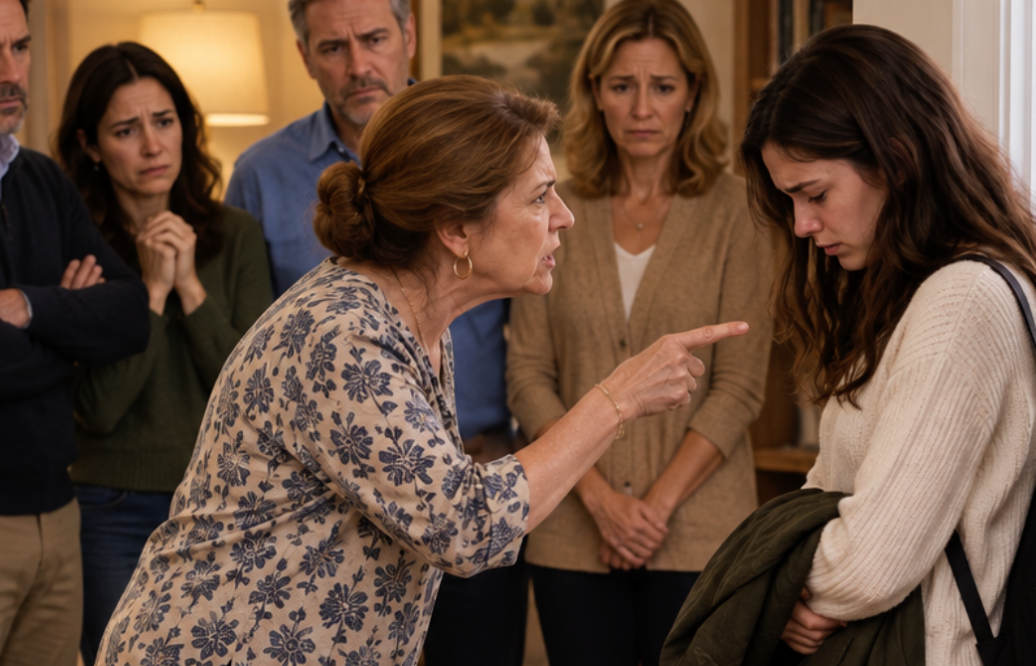
“Three years ago, I became a grandmother,” my mother-in-law began. “And for three years, I’ve watched my son live in an apartment where he’s nobody. Just registered there, that’s all. Is that really right?”
“Regina Pavlovna,” I said quietly. “Let’s talk about this later.”
“No, let’s discuss this in front of everyone!” She raised her glass higher. “Anya, you’re a smart woman. You understand: a man should be the master of the house. Not just someone staying over. Sign the apartment over to Kirill—and I’ll be the first to thank you.”
The room grew so quiet, we could hear the drill from the neighbors next door. Mark tugged on a lock of my hair and whispered, “Mom, more cake.”
“Mom, why now,” Kirill grumbled, still not looking up.
“And when, then?” She turned her whole body toward him. “When you’re thrown out of here with a suitcase? Is that when we’ll discuss it?”
I carefully set my son down on a chair next to my mom. I wiped his cheek with a napkin and adjusted his paper crown. My hands felt calm, almost as if they weren’t my own.
“Regina Pavlovna,” I said evenly. “I bought this apartment before we got married. With the money from selling my grandmother’s apartment, which I inherited. This is my personal property. Article thirty-six of the Family Code.”
“Oh, here she goes again,” my mother-in-law drawled. “Found her inner lawyer.”
“I am a lawyer,” I agreed. “Corporate, with eight years’ experience. I’m on maternity leave now, but my diploma didn’t just disappear.”
“Look at her diploma,” she smirked to the guests, inviting them to laugh along. “But what about her conscience? The child is shared, the family is shared, but the square meters are just yours?”
“The square meters are mine,” I confirmed. “Yes, the child is ours. Those are different columns, and they don’t add up together.”
Someone among the guests coughed. My friend Larisa slowly set her glass down and looked at me the way people do right before standing up to leave together.
“Mom, that’s enough,” Kirill finally forced out.
“I haven’t even started,” Regina Pavlovna replied, finishing her wine in one gulp. “I’m just giving you a warning.”
Part 2. Kitchen After the Guests
The guests left by nine. My mom took Mark to the nursery to read about the mole, and the three of us remained in the kitchen—me, my husband, and his mother, who clearly wasn’t planning to leave.
I was washing the dishes, listening to the stool creak behind me. Regina Pavlovna was making herself comfortable, like someone arriving at negotiations with a clear agenda.
“Anya, sit down,” she said. “This is a serious conversation.”
“I’ll stand. My hands are covered in soap.”
“Have you brought even a single ruble into this family in the last three years?” she started. “Kirill is working, and you’re just living off everything that’s already here.”
I turned off the faucet. Then I turned around and dried my hands with a towel—slowly, finger by finger.
“Kirill,” I said to my husband. “Tell your mom where you work.”
He looked up. Something flashed across his face—quick and frightened, like a student caught at the blackboard.
“What do you mean? At ‘Axiom.'”
“You haven’t worked at ‘Axiom’ since February,” I said. “You were laid off. You leave the house at eight-thirty and sit in the library on Sokolova until six. I’ve known for four months.”
Regina Pavlovna slowly turned her head toward her son, and for the first time, I saw her looking lost.
“Kiryush?” she said.
“I’m looking,” he replied, his voice dull. “The job market right now… Mom, you have to understand.”
“I understand,” I said. “But there’s something I don’t understand. In these four months, not once have I heard, ‘Anya, I’m sorry, I couldn’t do it.’ Instead, I keep hearing ‘sign the apartment over.'”
“Those are separate things!” my mother-in-law cut in. “It’s exactly because a man is going through a rough patch that he needs support! Property gives a man status!”
“Property gives the owner the right to decide,” I said. “Status is about telling your wife the truth.”
“Don’t get smart,” she snapped. “Here’s what I’ll say. Vika and the kids are renting, paying forty thousand. You have a three-bedroom. One room is empty.”
“It’s not empty. It’s my office and the second kid’s room.”
“Second kid’s room?” She smirked. “Are you planning to have another child? With your diploma?”
I looked at my husband. Kirill sat with his head down, picking at a cherry juice stain on the table with his fingernail.
“Kirill. Do you agree with your mom?”
“I agree that it’s hard for Vika,” he said. “And, really… Anya, what difference does it make to you?”
“We’re family,” I nodded. “So I’m asking you directly, in front of your mom. Do you want me to sign the apartment over to you, even though you haven’t put in a single ruble?”
“That’s not the point…”
“It is the point. Yes or no?”
He was silent for about five seconds. Then he said:
“Well… yes. That would be more fair.”
“Thank you,” I said. “It mattered to me to hear it from you, not your mom.”
Regina Pavlovna leaned back in her chair, satisfied.
“Well, that’s great. On Monday, we’ll go to the notary. I know someone, Eduard Borisovich—he’ll handle it for us like family, won’t cost much.”
“Mark has swimming on Monday,” I said. “And I only go to the notary for my own business.”
“You’ll regret this,” she said. And it didn’t sound like a feeling—it sounded like a plan.
Part 3. The Folder
That night, I didn’t sleep. Not because I was hurt—hurt comes later.
I sat in my office and opened the old blue folder I’d started eleven months ago. Back then, in July last year, I had accidentally found a property appraisal form in our car’s glove compartment. They had appraised our apartment. The client was Kirill Dmitrievich Voronov.
I didn’t say anything at the time. I just went to the notary—not Eduard Borisovich, but my classmate Larisa Ilinichna—and set up a donation agreement. The giver: me, Anna Vitalyevna. The recipient: Mark Kirillovich Voronov, three years old. I accepted the gift myself, as his legal representative.
It took me an hour and a half and cost less than a set of pots. And no one knew about it—neither my husband, nor his mother, nor my own mom.
In the morning, I went to the bank branch on Pervomayskaya. Behind the window sat a young woman, and I placed my passport in front of her.
“I need information on any applications submitted under my name,” I said. “And any applications where I’m listed as the borrower’s spouse.”
“Just a moment…” She clicked her mouse a few times. Then she looked up at me, and I understood everything before she even spoke. “We have a rejection from May 19. The application was for a consumer loan secured by real estate. The borrower is Voronov Kirill Dmitrievich.”
“What was the reason for the rejection?”
“Mismatch of the property owner’s data. And…” She hesitated, “there was a notarized spouse consent attached. It didn’t pass verification in the registry.”
“So it doesn’t exist,” I said.
“Formally—yes. No notary has notarized such a document.”
I thanked her and stepped outside. I stood for a minute by the glass door, watching the wind chase someone’s receipt across the asphalt. Then I took out my phone and made a note: “Article 327 CC RF—forgery of documents. Article 159.1—attempted loan fraud. Certificate from the bank. Copy of the application.”
That evening, I went to the outskirts, to the one-bedroom apartment at 14 Druzhby. The very same one, my grandmother’s second apartment, which I never sold. For five years, Regina Pavlovna had been living there rent-free—by a gratuitous use agreement she had personally signed.
The door was opened by a guy around twenty years old, wearing headphones.
“Who are you here to see?”
“I’m the owner of this apartment,” I said. “And who are you?”
He took off his headphones.
“I’m renting a room. From Regina Pavlovna. Twelve thousand a month, since June.”
I stood on the landing, quietly laughing to myself. The woman who would tell me, in front of guests, that I lived off everything prepared for me, had lived in my apartment rent-free for five years—and even rented out a room to a student.
“Do you have a contract?” I asked.
“Well… a receipt.”
“Keep it,” I told him. “It might come in handy for you. And please, don’t pay any more. Not a single ruble. Here’s my phone number.”
Part 4. Family Council
They all gathered on Saturday in my living room. Regina Pavlovna, Kirill, my sister-in-law Vika with her two kids, and that very Eduard Borisovich—a smooth man in a blazer, with a leather folder and the smile of someone who charges twice for the same service.
“Anna Vitalyevna, good afternoon,” he said. “I’ve been briefed about the situation. I’ve prepared a draft donation agreement.”
“Who briefed you?” I asked.
“I did,” my mother-in-law interjected. “Sit down, Anya. Once you sign, this circus will be over.”
I sat down in the armchair opposite them. I placed several papers on the coffee table. Mark was playing with blocks on the carpet, and I pulled him a little closer—not for protection, but because it made me feel calmer.
“Before I sign anything,” I said, “let me tell my side, too. Eduard Borisovich, did you request an excerpt from the Unified State Register of Real Estate?”
“I was provided with a copy of the certificate…”
“A two-year-old copy,” I nodded, pulling out the first page. “Here’s the latest extract. Notice the date—it’s from the day before yesterday. Please read this part aloud—the ‘rights holder’ section.”
He picked up the paper and glanced over it. The smile faded from his face, vanishing like paint running down a damp wall.
“Voronov Mark Kirillovich, born in 2022,” he read out loud. “Ownership share – sole property.”
Vika stopped chewing her cookie. Kirill stood up.
“What?” he exclaimed. “Anya, what does this mean?”
“It means the apartment belongs to your son,” I replied. “For eleven months now. Since last July.”
“You had no right!” Regina Pavlovna shrieked.
“I did. It was my personal property, and I handled it as I saw fit. A spouse’s consent isn’t required for gifting personal property.”
“We’ll challenge this!”
“Oh, go ahead and challenge it,” I said. “But first, explain to the court what your interest is. The child is the sole owner. And you, Regina Pavlovna, who are you to him? Grandmother. You have no rights to his property.”
Eduard Borisovich gently placed the statement on the table and pushed himself and his chair away.
“Moreover,” I continued, “any deal involving a minor’s housing requires permission from child protection authorities. And only if the child receives an equivalent apartment in return. So, are you ready to give Mark a three-room apartment in this neighborhood? No? Then this topic is closed forever.”
“You raised a snake,” my mother-in-law told her son. “You brought a snake into the house.”
“I’m not finished,” I said, pulling out a second sheet. “Kirill. On May nineteenth, you applied for a loan using this apartment as collateral. The application included a notarized consent from your spouse. Mine. Which I never gave.”
He turned pale. He sat back down on the sofa, very slowly, as if his knees had buckled beneath him.
“Anya…”
“The notary never certified it. So the document is a forgery. Which means that’s article 327. Plus attempted credit fraud.”
“It’s my mom!” he burst out. “She found someone for it! She told me that’s how everyone does it!”
The room went completely silent. Regina Pavlovna opened her mouth and then closed it again.
“Thank you,” I said. “Now I know exactly what to write in my statement.”
“You won’t dare,” she hissed.
“I will. The draft of the complaint is already written. It’s right here, in the third file,” I said, patting the stack of papers. “I haven’t filed it yet. And here’s why: if Kirill ends up with a criminal record, Mark will grow up with a father who has been convicted. I don’t want that. I want both of you to understand where the line is drawn.”
Kirill covered his face with his hands. Vika quietly led the children down the hallway.
“And one last thing,” I said, pulling out a fourth piece of paper. “Regina Pavlovna, you’ve been living in my one-room apartment on Druzhby for five years. For free. Under a loan-for-use agreement you signed. Clause seven states: the lender may terminate the agreement with one month’s notice. Here’s the notice. Sign to acknowledge receipt or get it by registered mail – whichever you prefer.”
“You… you’re putting me out on the street?!” Her voice broke.
“You have one month,” I said. “And by the way, you rented out the room to a student for twelve thousand rubles a month. Five months. That’s sixty thousand gained from someone else’s property. That’s called unjust enrichment, article one thousand one hundred and two of the Civil Code. But I won’t sue. Consider this my parting gift to you.”
She looked at me, and for the first time in three years, there was no contempt in her eyes. There was something else—simple arithmetic.
“And one more thing,” I added, “you called me a freeloader three times in front of guests. I have a video from the birthday party. Eight guests were there. I won’t take you to court for insult, Regina Pavlovna. I just want you to know: you weren’t the only one with witnesses.”
Part 5. One Month Later
The divorce went through quickly. There were no children to divide—Mark stayed with me, the apartment was already his, and Kirill didn’t make any demands. Honestly, I would have thrown him out myself anyway. He signed a notarized child support agreement for a fixed amount, and in the “additional” section, he personally added a provision about paying for half the after-school clubs.
He came by on Saturdays. He’d take our son for a walk for two hours, bring him back rosy-cheeked and tired, and each time he’d linger at the door.
“Anya. I got a job. At ‘Telmar,’ as a logistics manager. It’s less money, but it’s a legal position.”
“That’s good,” I replied. “Mark, say goodbye to your dad.”
“Anya, what if I… you know…”
“No,” I said. “Not because I’m cruel, but because you’re cunning. And because that evening, you didn’t say ‘Mom, stop.’ You said, ‘That would be more honest.'”
He nodded and left. And honestly, I didn’t feel sorry for him. I felt sorry for myself three years ago—the one holding a child and thinking she was in the center of a warm family square, when really she was standing with her back to both of them.
Then on June 28th, there was a knock at the door.
Standing on the landing was Regina Pavlovna. She had a rolling suitcase, two shopping bags, and that same clay-colored blouse.
“Anya,” she said. “I have nowhere to go.”
“What about your apartment on Komsomolskaya?” I asked.
She was silent for a moment, then spoke very evenly, like giving an address at an information desk:
“I transferred it to Vika. Twelve years ago. So Kirill wouldn’t lay claim to it, just in case. I meant well.”
“And?”
“Vika said she has two kids and no spare room.”
I stood in the doorway of my—not mine, my son’s—apartment and listened as Mark built a tower in his room, murmuring to himself: “And another block. And another.”
“Regina Pavlovna,” I said. “Do you remember what you told me at the birthday party? ‘The apartment should belong to whoever is head of the family.’ You were right. It’s just that in your family, Vika turned out to be the head.”
She didn’t cry. She just seemed to crumble a little, and her suitcase tilted in her hand.
I handed her an envelope. Inside was thirty thousand rubles and a printout: three addresses for rooms available by the day, the phone number for the social assistance center, and contacts for a real estate lawyer.
“This should last a month. The lawyer can see if anything can be done about the Komsomolskaya apartment—you gifted it with the condition of care, sometimes that helps.”
“Why are you doing this?” she asked hoarsely.
“Because you are my son’s grandmother,” I said. “And because I want Mark to one day know this whole story and never find a single spot where his mother was wrong.”
She took the envelope. She looked like she wanted to say something, but I closed the door.
Then I went back to the room, sat down on the carpet, and lifted my son into my arms. He was heavy, warm, and smelled like waffles.
“Mom,” he said. “Is this our house?”
“It’s yours,” I told him. “It’s in your name. And I live here because you let me.”
“I let you,” Mark agreed solemnly, placing a toy block on my shoulder. “Forever.”
And that’s when I finally felt truly happy. No shadow of someone else’s presence behind me.