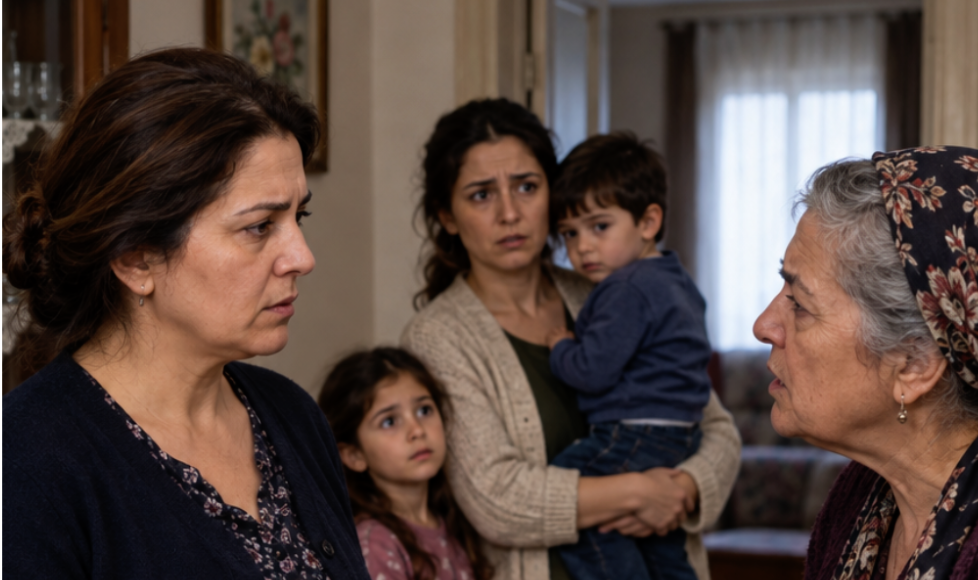
— Olyushka, did I put tomorrow’s pills in the blue box or the green one?
It was 9:40 PM. Grandma always called around this time. She spent her whole evening sitting over her pill organizer, double-checking each compartment, second-guessing herself, and by 10 o’clock she was completely confused.
— The blue one, Grandma. Blue is for the morning, green is for the evening. I even labeled them.
— You did, yes. But the letters are tiny, and I left my glasses in the living room. Oh well. Did I take my diuretic today?
Olga closed her eyes. Grandma took her diuretic on Mondays and Thursdays. Today was Tuesday. But last time she asked, “Did I take it?” it turned out she’d had it twice and spent all night running to the bathroom—and woke up dizzy the next morning.
— Grandma, I’ll come over now. I’ll check myself.
— Oh, you don’t have to, Olya, it’s the middle of the night…
— I’m coming.
Sergey was sitting on the couch in front of the TV and, without turning his head, he asked:
— Again?
— Again. An hour round trip.
— Aren’t you tired of it?
Olga put on her jacket and didn’t answer. Tired was an understatement; she was exhausted, sometimes to tears, so much so that she would doze off on the bus and miss her stop. But she could never be tired *of* it, just like you can’t get tired of your own hand.
Grandma’s apartment was on Pervomayskaya Street, fifth floor, no elevator. A two-room place with high ceilings and a narrow hallway that always smelled of book dust and Corvalol.
Olga grew up in that apartment. Her parents divorced when she was seven, and it was a messy split, with shouting and broken dishes. A year later, her mom remarried and moved to another city with her new husband. At first, Olga was left with her grandma ‘until the end of the school year,’ then ‘until we get settled.’ They got settled for good, but Olga stayed with her grandma for good, too.
Grandma, Antonina Pavlovna, worked her whole life in the local library. At home, books lined the shelves from floor to ceiling, two rows deep on each shelf. Olga did her homework at her grandma’s desk by the window and slept on the couch in the tiny room with the deer rug hanging over it. As a kid, she used to trace the running deer with her finger, imagining where they were going. Grandma never raised her voice. Even when Olga came home at 3 AM in the ninth grade, Grandma just sat quietly in the kitchen by the lamp and then simply said:
— I almost called the police. Sit down, the tea’s hot.
Even after Olga grew up and moved out, she still came back. After her first heartbreak. When she got laid off from her first job. Grandma would open the door, put the kettle on and never ask questions until Olga was ready to talk.
— Everyone should have a place they can go without having to explain themselves, — Grandma said once. — I had such a place. My mom’s room in the communal apartment. When I left your grandfather with your mom as a baby, I had nowhere else to go. I slept on a cot in her room for half a year. No one kicked me out.
Four years ago, Grandma fell in the bathroom and broke her hip. The surgery went well, but afterward, Antonina Pavlovna seemed to suddenly age ten years. She started using a walker, mixed up her medications, and would forget to turn off the stove. Diabetes, high blood pressure, heart issues. Living alone was out of the question, but she absolutely refused to move anywhere else.
“I was born in this apartment, and I’ll die in this apartment. I’m not going anywhere.”
So Olga started visiting her every single day.
After work, it was either two buses or forty minutes in traffic by car. Groceries, cooking meals for two days in advance, filling up pill organizers for the week: blue for mornings, green for evenings. She handled the utility bills that Grandma kept forgetting about in a breadbox. Doctor visits—clinic, endocrinologist, cardiologist, eye doctor. Hospital stays twice a year. Washing Grandma’s hair every Saturday. Pedicures, because trimming nails is risky with diabetes, so Olga learned how to do it herself.
At first, Sergey was patient. But then he started getting annoyed.
“Are you ever home? I come back and you’re not here. Do I have to reheat dinner again?”
“Dinner’s in the fridge, Seryozha.”
“I’m not talking about dinner.”
Once, right at the start, he even drove Grandma to the clinic himself when Olga had an urgent job at work. He came back moody and said that Antonina Pavlovna asked him three times who he was, and that he would never do this again.
His mother, Oksana Grigoryevna, would shake her head every time they met.
“You should really put her in a nursing home, Olya. They have good ones now, private places. Nurses, doctors, five meals a day. It’d be easier for you, and better for her. You’re running yourself ragged with all this hassle. Just look at yourself—dark circles under your eyes.”
“Hassle.” Olga remembered that word. It wasn’t said out of malice, more out of pity. But that pity just made her feel cold inside.
No one from Sergey’s family ever offered to help out, not even for one evening. Not Oksana Grigoryevna, who had every Tuesday free. Not Lera, her sister-in-law, who lived just fifteen minutes from Pervomayskaya. They didn’t even offer help with groceries. The “hassle” was all hers, and everyone seemed to accept that without question.
Grandma passed away in March, peacefully, in her sleep. That morning, Olga came by with groceries, unlocked the door with her own key, and called out: “Granny, it’s me.” There was no answer.
At the funeral, Sergey stood beside her, holding her arm. Oksana Grigoryevna brought a big wreath and dabbed her eyes with a handkerchief three times. Lera didn’t come—she said the youngest had a fever.
A week later, Olga went to the notary and learned that Grandma had left her the apartment. The will was written two years before her death, and Olga had no idea. Grandma had never mentioned it.
In the envelope the notary handed her with a copy of the will, there was a note, written in Grandma’s neat librarian handwriting:
“For Olyushka. So you’ll always have a place to come. Your own. So you never have to ask anyone for it.”
Olga read it right there in the notary’s office, and broke down sobbing, so much that the notary silently slid over a box of tissues.
“It’s yours,” Sergey said that evening. “You decide what to do with it. Sell it, rent it out, whatever you want.”
They lived in their two-bedroom apartment on Zarechnaya, which they bought with a mortgage right after getting married. There were still eleven years left to pay it off. Olga could rent out her grandmother’s apartment and use the money for early repayment. Sergey gently brought this up, but quickly added:
“Well, that can wait. It’s up to you.”
“I just can’t yet, Sergey,” Olga replied. “Her things are all there. Everything is hers. I need to sort it all out. On my own.”
“Of course. Take all the time you need.”
They agreed: for now, they wouldn’t rent out the apartment. Olga would go there on weekends and slowly start sorting through things.
She took her time. She would take each book off the shelf, flip through it, put it aside. In her grandmother’s books she found old bookmarks—tram tickets from the 60s, pressed maple leaves, postcards. Each bookmark felt like a voice from the past. Sometimes Olga would spend the whole Saturday sitting on the floor surrounded by books and not get any sorting done at all.
The inheritance paperwork was finalized in September, as required, six months later. That month, the notary gave Olga the certificate of inheritance, and soon the title was officially registered in her name. Olga tucked the documents into her grandmother’s own file folder, a blue one with ribbons.
From that moment, something changed in her husband’s family.
Lera, Sergey’s younger sister, lived with her husband Dima and their two children in a rented one-room apartment on the outskirts of town. The kids were six and three. Dima worked as a driver, and Lera was on maternity leave with the younger one. According to her, they never had enough money.
Before September, Lera mostly complained about prices. Starting in September, her complaints shifted to the apartment.
“You can’t imagine how we live,” she would say at Sunday lunch at Oksana Grigorievna’s house, always looking at Olga for some reason. “Four of us in one room. The kids share a sofa, and Mitka kicks Sonya at night. The landlord charges thirty-five thousand, and she’s threatening to raise it. Meanwhile, some people have empty apartments just sitting there.”
Olga knew where this was going. She genuinely felt for Lera—four people in a one-room apartment was tough. But her sympathy ended the evening Sergey said over dinner:
“Listen, Olya. Maybe Lera and her family could stay at your grandmother’s place for a while? Just temporarily. The apartment is empty anyway. It would give them a year to breathe, to save up a bit.”
Olga set down her fork.
“No, Sergey.”
“Why not? You’re not living there right now anyway.”
“Because I’m still going through her things. Because we agreed. And because I know how ‘temporary’ turns out with Lera.”
Everyone knew exactly what ‘temporary’ meant with Lera.
Seven years ago, when Lera married Dima, they had nowhere to live. Oksana Grigorievna let them stay at her dacha in Malinovka “just for the summer, until you find something.” The dacha was insulated and had a stove, so the young couple stayed for the fall. Then the winter. Then Mitka was born. Then Sonya.
In all those years, Oksana Grigorievna never spent a single night at her own dacha. She wanted to sell it: she needed the money, and traveling was getting too hard as she got older. But every time she’d mention it, Lera would start crying. “You want to put us out on the street? With kids? Your own daughter?” Dima would stay silent, staring out the window. And Oksana Grigorievna would give in again.
They only moved out of the summer house last autumn. And even then, it wasn’t really their decision: Mitya needed to start kindergarten, and the nearest one from Malinovka was a forty-minute drive away. They ended up in a tiny one-bedroom apartment, and since then, Lera has longed for the country house at every opportunity, as if she’d been cast out.
Olga saw all this with her own eyes. She watched as Oksana Grigoryevna tucked a real estate agent’s flyer into her bag and said, ‘Well, I can’t just kick them out.’ And Olga understood all too well that no one would ever kick Lera and her two kids out of their grandmother’s apartment either—not in a year, not in five.
Two days later, Oksana Grigoryevna showed up at their place. She didn’t call ahead; it was Wednesday evening.
She walked straight to the kitchen, sat down on a stool, placed her bag on her lap, and without any small talk, said to Olga,
‘Olya, make a duplicate key to grandma’s apartment for Lera. And better do it by Friday.’
Olga was standing by the sink, with a wet plate in her hand.
‘Why does Lera need a key?’
‘Why? To live there, of course. They’re moving in on Saturday. Dima’s already booked a truck for nine in the morning.’
Olga carefully placed the plate in the drying rack.
‘They’re moving? Into my apartment? This Saturday?’
‘Well, where else would they go?’ her mother-in-law replied, surprised. ‘Seryozha said you don’t even live there anyway.’
Olga turned to her husband. Sergey sat at the table, eyes glued to his phone, scrolling with his finger, not even glancing at the screen.
‘Seryozha. We talked about this on Monday. I said no.’
He didn’t answer.
‘Oksana Grigoryevna,’ Olga said, trying to keep her voice steady. ‘Did anyone ask me? Who actually decided that Lera would live in my apartment?’
Her mother-in-law looked at her with genuine, almost childlike confusion.
‘What’s there to ask about? You have your own apartment, this one. There are two of you, no kids. She has two kids, she needs it more!’
She said it simply and confidently, like talking about the weather. For Oksana Grigoryevna, it really was that obvious: whoever has more kids deserves the apartment. It didn’t matter to her who the grandmother left the place to, or who spent four years visiting the old lady every night on the fifth floor with no elevator.
Sergey finally put his phone down.
‘Olya, seriously,’ he said. ‘Mom’s right. They’re really cramped where they are. And the apartment is just sitting empty. Let them stay there for a year or two—until they get back on their feet. What’s the big deal? Does it really matter to you?’
Olga looked at her husband, feeling like she was seeing him for the first time. Tall, fair-haired, wearing a faded T-shirt with a ketchup stain on his chest. Eight years ago, she’d married him. He used to bring her coffee in a thermos to her university and once spent half the night hunting the city for her favorite tangerines.
And now here he was, sitting next to his mother, saying, ‘Does it really matter to you?’
Suddenly, Olga remembered so many things at once. How he used to get annoyed when she ran off to grandma’s again. ‘Are you ever home?’ How Oksana Grigoryevna always called it ‘fussing.’ How Lera didn’t even come to the funeral because her youngest had a fever. And how, in four years, none of them ever once offered to help—not for a single evening, not with errands, not with the clinic, not with washing grandma’s hair on Saturdays.
Continued in the comments.
For four years, it was Olga’s problem—her hassle, her sleepless nights, her dark circles under her eyes. But now, with the hassle gone and only the apartment left, suddenly the place became a shared family resource—something everyone expected to benefit from.
“It’s not that I mind, Seryozha,” she said. “I’m just hurt. My grandmother didn’t leave it to me for this.”
She walked out to the hallway. Hanging by the door were two sets of keys to the apartment on Pervomayskaya: hers and the spare. Olga had left the spare there after a trip to the clinic, just in case Sergey needed to take her grandmother anywhere. Ever since, they’d stayed on that hook. Olga took both sets down and put them in her jacket pocket.
She went back to the kitchen.
“Oksana Grigoryevna, please tell Lera: there will be no move on Saturday. She can cancel the moving van. The apartment is mine, and I’m not giving it to anyone.”
“What are you saying…” Her mother-in-law stood up, her face blotchy with anger. “Seryozha! Do you hear what your wife is saying?”
“I hear her,” Sergey answered grimly. He gave Olga a long, heavy look. “You’re being selfish, Olya. I never expected this from you.”
For the next few days, Sergey barely spoke to her.
He didn’t yell or slam doors—just stayed silent. He’d come home from work, eat dinner, then go watch TV. He answered with short phrases: “yes,” “no,” “don’t know.” Olga knew what this was. It was a siege—he was waiting for her to break the silence and give in, like she always had before, over things like where to spend New Year’s, where to vacation, or whether to buy his mother a new microwave.
She didn’t give in.
On Friday evening, while sorting laundry, Olga pulled a crumpled receipt from the pocket of his work jacket. “Shoe Repair. Key Duplication.” Date: Tuesday. Total: three hundred forty rubles. Tuesday, the day before Oksana Grigoryevna’s visit. Two days after Olga told him “no.”
She stood by the washing machine for a long time, holding that receipt. So, on Tuesday, he’d taken the spare key from the hallway, made a copy, and returned the original. He gave the copy to Lera. Then, on Wednesday, Oksana Grigoryevna showed up to ask Olga for the keys—just for appearances.
Early on Saturday morning, Olga headed to Pervomayskaya. There was no moving van outside—Lera must have really canceled it. Olga wasn’t going to wait for her to change her mind.
She gathered up her grandmother’s papers: a blue folder with ribbons, savings books, old certificates. A jewelry box with her grandmother’s earrings and her grandfather’s medals. Photo albums. A note marked “For Olyushka,” tucked between the pages of her grandmother’s favorite book, “Anna Karenina” with the ripped spine. She packed it all into two big bags and took them to work, locking them up in her locker in the dressing room.
Afterwards, she called a locksmith. He was elderly and quiet, and in forty minutes, he had changed the lock on the front door. He handed her three new keys.
“The old ones won’t work anymore,” he said. “None of them.”
“Thank you,” said Olga. “That’s exactly what I wanted.”
She never mentioned the shoe repair receipt to her husband. There was no need. She understood everything already.
Sergey’s silence went on for almost a month.
During this time, Olga did a lot of thinking. Not about the apartment—that issue was already settled. She reflected on her relationship with Sergey, their eight years of marriage, and how she always felt like she was on his side. Yet when it came to choosing between her boundaries and his family’s wishes, he almost always sided with them.
She kept asking herself where Sergey got this calm sense that he could make decisions about her apartment. An apartment that wasn’t given to him, one he didn’t acquire or pay for, and a place he’d only visited once in four years—after which he’d said, “Never again.” To him, it seemed, this wasn’t Olga’s apartment at all. It was just an apartment. No one’s in particular. Simply a space he could offer to his sister.
His silence didn’t scare her. Each day of it only confirmed what she had already realized that Wednesday in the kitchen.
In the middle of October, Sergey was the first to speak.
Olga was washing dishes after dinner when he walked into the kitchen and stopped in the doorway, arms crossed over his chest.
“Listen, Olya. I can’t do this anymore. Let’s be honest. Give Lera the apartment for at least a year. Just one year, that’s all. Let them stay there, save some money, get a mortgage, and move out. One year.”
Olga turned off the water.
“Seryozha. Your mom couldn’t get Lera off her own dacha for years. What makes you think it’ll just be a year?”
“That’s different. I’ll make sure things are handled here.”
“You couldn’t even keep track of your own key. I saw the receipt—you made a duplicate on Tuesday.”
He faltered and blushed, then his face grew hard.
“Fine. I’ll put it differently. If you won’t give Lera the apartment for at least a year, I’ll have to reconsider whether I need a family like this. One where a wife can’t help her husband’s own sister.”
Olga dried her hands on a towel. She folded it in half and hung it on the oven handle.
She realized this was an ultimatum: the apartment or the marriage. Her grandmother’s ‘own place’ or Sergey. It felt like two heavy weights on a scale, and she had to choose which one to set down.
“Seryozha,” she said. “I’m not choosing between myself and your family. That’s not a fair choice. If family to you means I have to give my grandmother’s apartment to your sister while you make copies of the key behind my back, then we don’t have a family. We don’t have one anymore.”
He looked at her for a long time. Probably waiting for her to cry or start begging. She didn’t cry.
“You really are…” he started, but didn’t finish. He turned around and left.
Three days later, Sergey packed his things and moved in with his mother. Olga didn’t try to stop him.
In November, she filed for divorce. They decided to sell the mortgage apartment on Zarechnaya through the bank: pay off the remaining loan, then split whatever was left from the sale. That’s what the lawyer recommended, said it was the simplest. Surprisingly, Sergey didn’t argue. It seemed he just wanted it all to end as quickly as possible.
Lera stayed in her rented one-bedroom apartment on the outskirts of town. Through mutual acquaintances, Olga heard that the landlord had finally raised their rent to forty thousand, and Dima started working double shifts. Later, she heard that Oksana Grigoryevna had finally sold the dacha in Malinovka and gave part of the money to Lera for the down payment on a mortgage. Olga hadn’t really expected that. Maybe her mother-in-law finally understood something. Or maybe she just found another way to help her daughter when this one didn’t work out.
continued in the comments
This didn’t concern Olga anymore.
She started renovations on Pervomayskaya in the spring, almost exactly a year after her grandmother passed away.
She took her time with the renovations, doing things bit by bit, just like her grandmother used to. First, the windows: the old wooden frames let the cold in so badly that in winter, even tea would get cold on the windowsill. Then the bathroom, where her grandmother had fallen four years ago. Olga put in new tiles, light and non-slippery, and placed a handrail by the wall. She wasn’t really sure why—her grandmother didn’t need it anymore.
She kept all the books. Every single one. A cabinetmaker recommended to her restored the bookshelves, and they shone with dark wood again, just like in her childhood. She took down the deer-patterned rug, had it cleaned, and hung it back up in the small room. Her friends laughed: who has a rug on the wall in the twenty-first century? Olga just shrugged.
She moved in June, at the very start of summer.
That first evening, she sat in her grandmother’s kitchen at her grandmother’s table—which she also kept. She drank tea from her grandmother’s cup, the one with the chipped edge. Outside, the poplar trees rustled, and somewhere below, cats were yowling.
At 9:40 p.m., Olga automatically glanced at her phone. It was as if she was waiting for a call: “Olyushka, where did I put my pills this time—in the blue box or the green one?”
The phone stayed silent.
Olga finished her tea. She went to the room and took down “Anna Karenina” from the shelf, the one with the torn spine. She took out a note, reread it, even though she knew it by heart. “So you always have somewhere to come home to. Your own. So you won’t have to ask anyone.”
She used to think her grandmother wrote that in case Olga ever had nowhere else to go. If something broke down, or if she was left alone. For some rainy day that might never even come.
Now Olga understood it differently. Her grandmother hadn’t left her a refuge. She’d given her a right. The right not to explain, not to prove to anyone that she was entitled to her own space. Not to stand in the kitchen listening to someone say they needed it more because they had two kids. Just to live in her own place. And to decide for herself.
She tucked the note back into the book and set it on the shelf, in its rightful spot on the second row, next to the other volumes of Tolstoy, right before Turgenev. Then she turned off the light in the kitchen and went to sleep in the little room, underneath the rug with the deer.