She tied the key onto a red satin ribbon, like the ones they use for gifts at stores. Then she put it in my jacket pocket herself and patted it with her hand.
“So you don’t lose it, Svetochka. You’re always misplacing things.”
It was on a Sunday, early October. I had brought her groceries as I had been doing since late summer: kefir, cottage cheese, chicken, and bread from our factory. I’m 51, and for sixteen of those years, I’ve worked as a technologist at the bread factory, but Tamara Pavlovna doesn’t like my bread. She says it’s tasteless. She gives it to the pigeons and buys herself a loaf at the kiosk near the bus stop—I saw her do it once from the bus window.
My mother-in-law sat down on a stool by the refrigerator and started with the kefir. The kefir wasn’t right; it should have been in a blue package. Last time I mopped the floor badly, there were streaks left by the door. The chicken was frozen, but it should have been fresh. I’m a technologist, I should know these things.
“And one more thing,” she smoothed her apron on her knees. “In three weeks, I’ll be seventy-five. It’s hard to be alone. You’ll be coming every day after your shift. The key is yours now, don’t ring the doorbell anymore. Am I right?”
I stood in the middle of the kitchen, holding the shopping bag. I didn’t even have time to put away the chicken. It was dripping onto the linoleum, and I just stared at that puddle, not at my mother-in-law.
“Tamara Pavlovna, I can’t come every day. I work twelve-hour shifts. I already go on Tuesdays and Saturdays, and from September, I’ve started coming on Sundays too. Gena jokes that his wife runs on a schedule.”
“Gena isn’t joking. Gena understands everything.”
“You have three kids. Alla lives just a couple stops away. She could stop by once a week at least.”
“Alla works.”
“I work too.”
“You’re the daughter-in-law,” my mother-in-law said without even raising her voice. “That’s what a daughter-in-law is for in the family. I took care of my own mother-in-law right until the end, and look, my arms didn’t fall off. Am I right?”
I don’t remember what I replied. I think I said something about the freezer. All I recall is the key pulling my jacket to one side, even though it barely weighed anything.
***
At home, Gena was watching football. He’s fifty-four, and the football is always on in the background while he scrolls on his phone. I put the key with the ribbon on the table in the hallway and stood in the doorway of the room.
“Your mom wants me to visit her every day.”
“Come on, Svet. She’s an elderly woman.”
“Last Saturday this ‘elderly woman’ went to the market by herself to buy tulip bulbs. I’ve visited her eleven times in September—I counted on the calendar app in my phone. Alla? Not once.”
“Alla’s dealing with Kirill and the mortgage. She’s stretched thin.”
“Kirill is thirty years old.”
“Let’s not go there.”
That’s his favorite line. We’ve been married for twenty-eight years, and every time he doesn’t like where the conversation is going, I hear “let’s not go there.”
Why didn’t I just say a firm “no” to my mother-in-law that day? There was only one reason—the anniversary. Back in August, Gena had asked me: please, don’t ruin mom’s special day, she’s been looking forward to it all year. I wasn’t planning on ruining anything. I just wanted her children to at least know who takes care of her while they’re all ‘so busy.’
“Call Alla. Right now, on speaker, with me here.”
Gena looked at me, then at the TV, then back at me. He dialed and held the phone out at arm’s length—he always does that when it’s on speaker.
Alla didn’t answer right away, sounding out of breath. She’s fifty-seven, and as long as I’ve known her, she’s always rushing somewhere.
“Genka, I’m on the go, bags in my hands—what is it?”
“Mom wants Sveta to come see her every day.”
“Well, rightfully so—Sveta is great, her hands are magic. Oh, gotta go, Gen, my bus—later.”
Dial tone. Gena shrugged as if to say, ‘See?’
“I see,” I replied. “I’ll keep going like before, Tuesdays and Saturdays. I can’t do more, and I won’t. And I’m giving the key back.”
“Svet, she’ll get upset.”
“And what about me? Your mom has a maid, and her daughter is stressed over her adult son’s mortgage.”
He didn’t answer. He grabbed the remote and turned up the volume.
I went to the kitchen to make tea. While the kettle was boiling, I looked outside: our downstairs neighbors had their laundry hanging out on the balcony—it’s October, but they’re still drying clothes outside. And for some reason, I wondered if it would dry by night. My mom used to do the same thing, all year round, and the sheets always had that crisp, frosty scent.
My phone beeped. My mother-in-law writes without using commas and always ends with the word ‘kisses.’
“Svetochka, I booked the anniversary at Beryozka for twenty-two people, comes out to sixty-six thousand. Gena said you two will cover it. Kisses.”
Banquet’s on us
On Tuesday morning, after my night shift, I opened my banking app. This spring, Gena and I started a joint account to save up for a car—our old one is falling apart, and Gena uses it to visit his mom. I contribute from my salary, he adds from his. On Monday evening, twenty thousand vanished from that account. It was a phone transfer to an individual entrepreneur named Garik Ashotovich.
“It’s a cafe deposit,” Gena said without even turning around as he tied his shoelaces in the hallway. “Mom asked me, so I sent it. What’s the big deal?”
“Did you even ask me?”
“Sveta, it’s my mom. Come on, let’s not do this. I’m late for work.”
The door slammed shut. I sat there staring at the transaction on my phone, not moving until the screen went dark.
Later that day I went to my mother-in-law’s place—it was my usual Tuesday visit. On the table she had laid out the cafe menu, printed on several sheets. She had already circled everything she wanted: aspic, herring under a fur coat, and two different hot dishes.
“Here, Sveta, take a look. You have an eye for groceries. On Saturday, go to Berezka and make sure they don’t dry out the fish.”
“Tamara Pavlovna, why are Gena and I paying for the banquet? It’s more than I make in a month.”
“Alla’s getting the cake. Three tiers, with roses.”
“The cake costs about six thousand.”
“Vadik sent money. For a blouse.”
“So Gena is covering everything else?”
“Gena is my son, and he’s here for me.” My mother-in-law looked at me over her glasses. “Are you stingy with me? I raised Gena for you. Isn’t that fair?”
She picked up her pen and wrote in big letters at the bottom margin of the menu: “Sveta – payment.” Then she underlined it, pressing so hard the pen tore through the paper and marked the plastic tablecloth.
I took a picture of that page on my phone. My mother-in-law didn’t understand why, and honestly, I wasn’t sure myself at the time.
“We’ll pay our share,” I said. “As one of your children’s families. Alla and Vadim can handle the rest.”
***
Down by the mailboxes, my mother-in-law’s neighbor, Zinaida Ilinichna, stopped me. She’s seventy-eight, has lived on the first floor for forty years, and knows everything that goes on in the building.
“Svetlana, I’m not one to gossip, but I’ll say this: Tamara treats you like a servant. Where’s Alla?”
“I don’t know, Zinaida Ilinichna.”
“But I know. She came in August, with some woman who had a blue folder—you get those at government centers, I had the same when I registered my grandson. And Tamara left with them, wearing her best beige coat. That evening she told me, ‘That’s it, Zina, now Alla will come every day.’ But I haven’t seen Alla here once since then, I swear I’m not gossipy, but that’s the truth.”
On the bus, I opened the family group chat. It’s called “Family”—my mother-in-law, her children, me, and Vadim’s wife (who has never posted a thing). I typed a message, deleted it, retyped, and finally sent:
“Tamara Pavlovna, Alla, Vadim, Gena, hello. The banquet at Berezka costs sixty-six thousand. I suggest we split it evenly among the children. Gena and I have already covered almost all of our share. Alla, Vadim, please transfer your portions to the cafe by Friday. I’m attaching a photo of the menu.”
And right after that, I sent the photo with ‘Sveta – payment’ written on it.
Alla replied a minute later with a voice message. I pressed the phone to my ear, not wanting my seat neighbor to hear. Continued in the comments.
Svetlana, I don’t get it—what kind of accounting is this? Mom asked you, so you pay. I’ve got Kirill to worry about, I’ve got a mortgage, I’m barely holding it together. Anyway, I don’t have time for this.
Vadim messaged me in the evening—short and to the point, as always:
“I agree with the basics. I’ll transfer my part tomorrow.”
And he did. The next morning, he sent a picture of the receipt. He’s forty-nine, lives in Khimki, works in some logistics company, and over the past few years, I’ve barely seen him—at Dasha’s wedding and at my father-in-law’s funeral. For some reason, his message made me feel worse than Alla’s voice note. So it was possible? So all this time, I could’ve just asked?
My mother-in-law wrote last: “Svetochka, don’t embarrass me in front of the kids, kiss.”
Gena came home from work at around nine and, right as he walked in, without even taking his shoes off, said:
Why did you go to the group chat? Couldn’t you just tell me?
I did tell you. You said, “let’s not get into this.”
He went into the bathroom and stayed there for a long time. I could hear him talking quietly to someone, and I had a pretty good idea who it was.
Late at night, Dasha called. Our daughter is twenty-seven, lives on her own, and designs cereal packaging from home, working remotely.
Mom, Dad texted me saying you started some kind of war in the group chat. Can you just tell me what’s really going on?
So I told her. About the key, the menu, the blue folder from the government office.
Mom, look. If Grandma signed something at the government office back in August, it’s all in the records. Now anyone can get a property registry extract online in just a minute. If you want, I’ll come over Saturday and we’ll check together?
I said “yes” before I even had time to think.
No surname listed
Dasha came over Saturday evening, still wearing Gena’s old jacket she’s had since college. She logged into the government services site, entered Grandma’s apartment address on Nikitskaya, and paid for the extract with my card. The registry statement came Sunday morning.
Type of ownership: private property. Date of registration: the end of August. Rights owner: an individual.
Where’s the last name?
Mom, look. Now they don’t show the last name unless the owner consents. But the right was registered at the end of August. So, since then, the apartment isn’t Grandma’s anymore. She either sold it or gave it away.
I counted on my fingers like a first-grader: seven weeks. All that time I was bringing chicken to someone else’s apartment, cleaning floors that were always called dirty afterward.
Gena came into the kitchen with a bucket from the garage. Dasha turned her laptop towards him.
Dad, Grandma’s apartment hasn’t been hers since August.
Gena looked at the screen and set the bucket by the door.
So what? It’s Alla’s, right? Mom decided that herself, she has the right.
Gena, how do you know it’s Alla’s? There’s no surname here.
He opened his mouth and then closed it again.
Mom asked us not to say anything until the anniversary, he finally said. So no one would be upset. She’s still living there, just like before.
So you’ve known since August. And on Sunday, when she slipped the key into my pocket, you knew. And when you paid for the café, you knew.
Svetlana, let’s not get into this.
He closed the laptop lid—no slamming, just gently, with one finger.
Dad, are you serious? Dasha asked.
Last night, I opened the notebook where I jot down meter readings and wrote down some notes on the last page. In September, I visited my mother-in-law eleven times; Alla didn’t come at all. Gena and I contributed almost our entire share for the banquet, Vadim transferred his, but Alla hasn’t paid anything. The apartment has officially been Alla’s for seven weeks now. Yet somehow, I’m the one taking care of everything.
***
On Tuesday, I went to see my mother-in-law. I rang the doorbell like before—left my key at home.
Tamara Pavlovna was sitting on the couch, surrounded by old photographs. Alla had promised to gather pictures for the slideshow at the café but didn’t do it, so now my mother-in-law was sorting through them herself, labeling the backs with a pencil.
I placed the printout of the property statement on top of the photographs.
“Tamara Pavlovna, did you give the apartment to Alla in August?”
She took the paper, brought it close to her eyes, then held it further away.
“Read it for me, Svetochka. My glasses are in the kitchen.”
I read it aloud: the type of ownership, the date, the individual’s name. She listened and nodded.
“Yes, I gave it to her. To Allochka. It was all official, at the MFC, everything was done properly. I figured since the apartment was hers, she’d visit. She was so happy in August, even cried and hugged me right by the window. And then she never came again. She only calls for a couple of minutes on Sundays, and even then, from the bus.”
She turned toward the window.
“I get scared being alone at night, Svetochka. I leave the light on in the hallway and sleep like that. The day before yesterday I woke up at four, lying there thinking: if something happens, who’ll open the door for me?”
I sat at the edge of the couch, picked up a photo: a young Tamara Pavlovna in a polka-dot dress, holding a chubby, cranky baby. On the back in pencil it said, “Gena, six months.” Who am I to push her now? She’s seventy-five. Yes, she gave the apartment to her daughter, and treats me like the help. But she’s sitting here alone with all these photos, and the hallway light burns all night.
I almost said, ‘Alright, I’ll keep coming by.’ I even opened my mouth to speak, but my mother-in-law sighed and reached for another photograph:
“Well, it’s okay. I’ve got you, haven’t I? Isn’t that right?”
I stayed quiet. We spent the rest of the day sorting the photos by year.
On Thursday, after my shift, I went to see a lawyer—consultation cost fifteen hundred, the office was above a pharmacy. The lawyer, a woman in her forties with a cold, sipped lemon tea while she listened, then pulled out a copy of the Family Code.
“Look here. Adult, able-bodied children are required to support parents who can’t work and need help, and care for them. Article eighty-seven. Children only. Daughters-in-law aren’t included.”
“Not at all?”
“Not at all. If the mother needs help, she can go to court to collect support from each of her own children. Not from you.”
“What about the gift? If Alla isn’t helping, can the apartment be taken back?”
“No. Gift contracts are only canceled in very rare cases, and yours isn’t one of them. If she wanted the person who got the apartment to provide care, she should have arranged a lifetime annuity with support through a notary. With a gift, Alla isn’t obliged to do anything. It was gifted, end of story.”
At the bus stop, I watched my bus go by, then the next one too. What am I supposed to do with this information now? Go over on Saturday and tell my mother-in-law, ‘Legally, I mean nothing to you’?
Our family chat chimed. For the first time all week, a message from Alla:
“Everyone remember, Beryozka, five o’clock. Mom is going to say something important at her anniversary—she asked that everyone be there, no exceptions.”
Raise your hands
Golden balloons floated near the ceiling in ‘Beryozka’, paper garlands decorated the walls, and at the entrance, on a special table, Allina’s cake stood tall—really three tiers, topped with creamy roses. There were twenty-two guests: children with their spouses, the grandchildren, a cousin of the mother-in-law from Nerekhta, summer house neighbors, and old colleagues from the dry cleaner where Tamara Pavlovna worked thirty years as a clerk.
I was sitting next to Gena at the far end of the table. Vadim had come in on a night train from Moscow and sat across from us, while Alla sat on her mother’s right. The key on a red ribbon was in my purse—I grabbed it from the nightstand at the last moment, already wearing my jacket. Why did I take it? I honestly don’t know.
Before the main course, everyone toasted. The neighbor from the dacha shared how Tamara Pavlovna taught her to tie up tomato plants, the grandson read a poem from his phone and lost his place halfway through. My mother-in-law nodded at everyone and dabbed her eyes with a napkin.
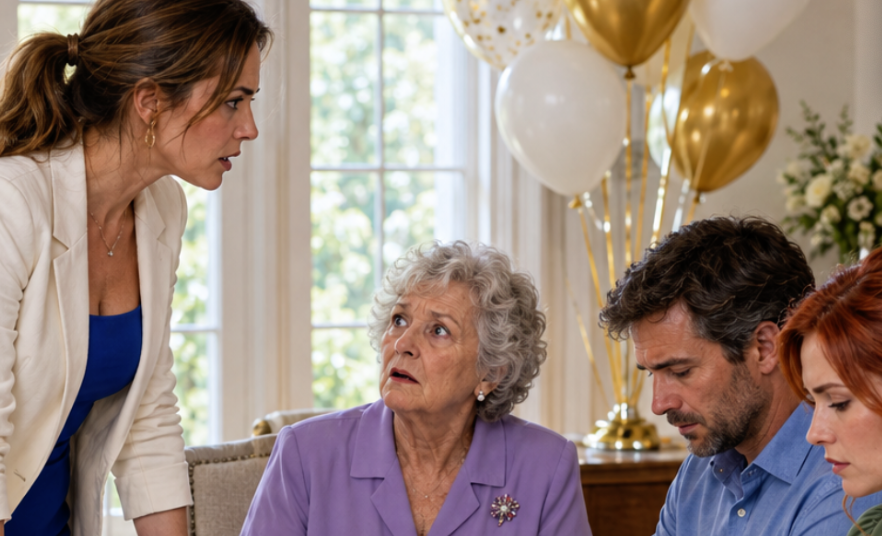
After the hot meal, she tapped her glass with a fork and stood up. She was wearing a new lilac blouse with a brooch, paid for with Vadim’s money.
“My dear ones. Thank you all for coming. I’ve given this a lot of thought and I want to say it in front of everyone, so no one’s surprised later on.”
She found my eyes, looking at me from across the table.
“When I grow very weak, Svetochka will be the one who cares for me. She’s our golden girl. That’s my decision, and the children agree. Isn’t that right?”
Someone started clapping, and then everyone joined in. The cousin from Nerekhta shouted across the table, “You’re lucky, Toma, to have such a daughter-in-law!” My mother-in-law walked around the table, took my hand, and pulled me up from my chair. I stood. She kissed my cheek, turned me to face the guests, and lifted my hand in the air like a boxer after a fight.
Gena stared at his plate. Alla smiled and nodded at the guests.
***
My mother-in-law let go of my hand and returned to her seat. I was left standing.
“Thank you, Tamara Pavlovna.” My voice was shaky; I had to clear my throat. “Since we’re all here, let’s agree on things together. Taking care of someone is serious, it needs to be shared. Tamara Pavlovna has three children: Alla, Gena, and Vadim. If you’re willing to have mom come stay with you on Mondays, please raise your hand.”
It was suddenly quiet, except for the sound of dishes clattering in the kitchen. One of the grandkids giggled and immediately fell silent.
“Wednesdays?”
Alla looked at her mother. Gena stared at his plate. Vadim set down his fork.
“Maybe weekends? Even just once a month?”
Vadim slowly raised his hand, halfway up.
“Realistically, I can take mom to my place in the summer. For a month. Every summer.”
“Thank you, Vadim.” I truly was grateful. “One last question, I promise. Please raise your hand if mom gave you her apartment last August.”
Alla’s face flushed, red splotches creeping up from her neck.
“Sveta, are you out of your mind? This is none of your business!”
“It’s not my business. That’s exactly why I won’t be the one looking after Tamara Pavlovna. By law, it’s the children’s responsibility. And morally, I guess, whoever got the apartment.”
“Sveta, sit down,” Gena tugged at my sleeve.
My mother-in-law sat very straight, but she was looking not at me, but at Alla. I took the key on the red ribbon out of my purse and placed it on the tablecloth next to her wine glass.
“Happy anniversary, Tamara Pavlovna.”
And so I headed for the exit. Nobody tried to stop me. At the coat check, the girl couldn’t find my jacket; I handed her my ticket upside down while Alla’s exasperated ‘Oh, that’s enough’ drifted from the hall, along with the squeak of chairs being pushed back. Outside, wet snow was falling. I stood by the steps without a hat, waiting for my taxi, and dropped my phone into the slush twice.
A month and a half has passed since the anniversary.
Alla now visits her mother. At first on weekends, and since December, every other day. That same evening, my mother-in-law called her and threatened to sue for alimony from all her children—starting with the one who got the apartment. Of course, she never actually filed anything. But Alla keeps going. The family hears from my mother-in-law that her daughter-in-law embarrassed her in front of everyone. Vadim sent the June train schedule to the group chat.
The twenty thousand that Gena transferred from our joint account to the cafe still hasn’t been returned. Alla never sent her share for the banquet either, so Gena had to cover the rest from his own salary.
Now on Saturdays, Gena goes to see his mother by himself. When he comes back, he hardly talks to me—just about bills and what needs to be bought. A week ago during dinner, without looking up, he said:
‘You could have managed without the hands, Sveta. You could have talked to me at home, that’s all. Now Mom is ashamed to even face the neighbors, and you walk around looking satisfied.’
The key on the red ribbon was returned to me the very next day after the anniversary: my mother-in-law sent it through Gena and told him to say it should stay with me, just in case. Now it sits in the drawer of the hallway cabinet, and I don’t touch it.
Tell me honestly: Should I have asked the second question about the apartment in front of the guests, or was the first one about Mondays enough?
All text materials on this channel are protected by copyright. Copying, distributing (including copying to other resources and websites), or any use of the materials from this channel without prior permission from the copyright holder is prohibited. Commercial use is not allowed.
At the reader’s request, place names are omitted and names have been changed.