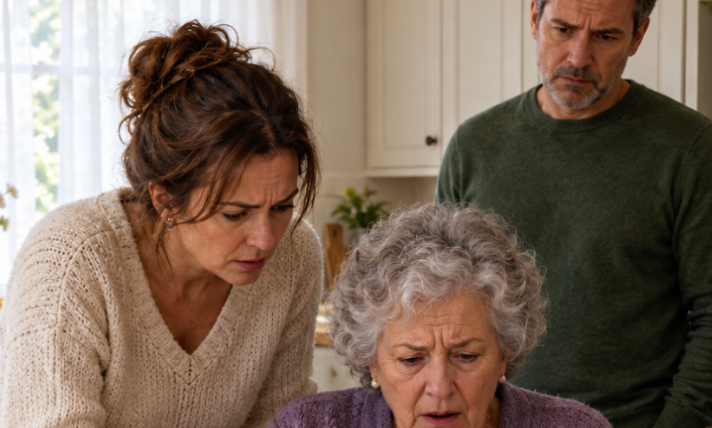
“Turn out your pockets. Right here, in front of everyone, Timofey. That way, no one can say grandma falsely accused her grandson.”
My mother-in-law stood at the kitchen doorway, her bag wide open in her hands. The whole table went silent. Olesya froze, holding a spoonful of salad over her plate, while Danil took out his earbud. Stas looked first at his son, then at me.
Tima stood up. Eleven years old, skinny neck sticking out of his sweater, his ears blazing red. As a speech therapist, I know how children’s ears flush when they’re embarrassed—and how differently they turn red when someone shames them on purpose. It’s not the same.
“Sit down, honey,” I told him. “Rimma Pavlovna, what happened?”
“The money is gone. Sixty thousand, the envelope from the inside pocket. I’ve been saving all year for a prosthesis.” She shook her bag, and a glasses case fell onto the floor. “No one else went into the hallway except him.”
“He went to get his charger. The charger is in his jacket.”
“Then let him show what he has in his jacket. And in his jeans while he’s at it.”
Olesya put down her spoon.
“Mom, maybe you left it at home? In the closet, in your linens, like you did with your pension that time?”
“That time I got mixed up at the bank. But this envelope was in my bag. What, do you think I’ve lost my mind?”
Olesya shrugged and went back to her salad. She didn’t say another word for the rest of the evening.
Tima reached for his pocket. I caught his hand halfway there.
I can’t remember who first brought up that winter before last—was it Olesya or my mother-in-law herself? But someone did. That was the winter nine-year-old Timka took 150 rubles from his grandma’s wallet to buy stickers. The whole family got involved, he cried, returned the money from his piggy bank, and apologized on his own. Two years have passed. But it all resurfaced in a second.
“Stas,” I said.
My husband rubbed his forehead with his palm.
“Tim, just show Grandma, that’s all. It’s nothing.”
It’s nothing. To be honest, I felt disgusted—not even at my mother-in-law.
“No one is turning anything inside out,” I said. “If you’re sure the money was stolen, call the police. Let them come and question everyone who was here. Me, Olesya, Danil. I have nothing to hide.”
“Are you threatening me with the police? In my own house?”
“I’m just suggesting we handle this like adults. There’s no need to shake down a child in front of everyone.”
It was as if my mother-in-law didn’t hear me. She looked right past me at her grandson and said quietly, almost gently:
“Give the money back, Timosha. Return it in front of everyone, and I’ll forget about it. I promise.”
Tim stared at the floor. I took his jacket from the rack, handed it to him, grabbed my bag. On my mother-in-law’s fridge, there was a magnet from Anapa with the corner chipped off, and somehow, that’s what I noticed—not her face.
Stas came out to us about five minutes later. We’d arrived in his car—mine was still parked by our building. The whole way home, Tim stayed silent, forehead pressed to the window.
***
At home, Tim went straight to his room and closed the door. He didn’t slam it. Just closed it.
Stas sat in the kitchen, poured some tea for himself, but didn’t drink any.
“She really saved up for a year,” he said. “Set aside money from her pension. You know she only eats porridge—she can’t chew anything else.”
“I know. But did you see your son in that hallway with her?”
“Ksyusha, but he’s taken money before.”
“A hundred and fifty rubles. Two years ago. And he gave it back himself.”
“I’m not saying he took it now. I’m saying Mom’s suspicion didn’t come out of nowhere.”
I didn’t argue. He had already made up his mind, quietly and in his own way, just like he always does. He finished his now-cold tea in one gulp, rinsed his cup, and set it upside down on the rack. No one does that at our place—only at his mother’s.
I couldn’t sleep that night. Around two, I got up, went into the hallway, and did something I’m still ashamed of: I searched Timka’s jacket. The pockets, the lining, the hood. Then his backpack, every compartment one by one. I found a chewed-up eraser, his transport pass, two candy wrappers from “Korovka,” and a note from some girl named Varya with a drawing of a cat. The cat’s whiskers took up half the page.
Nothing else.
I hung the jacket back up and stood there in the dark, holding onto the rack for a long time. Fool. Accusing my own child.
In the morning, Tim came out for breakfast, sat down, pulled the plate of omelette toward himself, and asked, without looking up:
“Mom, do you believe me?”
“I do.”
He nodded and started eating. I kept watching the top of his head, wondering if he’d heard me rustling in the hallway last night. I didn’t ask.
At lunchtime, between two classes, a message came in from Olesya: “Mom cried all night. You could have called instead of threatening with the police.” In the evening, I called. My mother-in-law didn’t answer. Not that night, not the next.
But she started calling Stas every day. And each time, he went out to the balcony to talk.
The money that slipped away quietly
On Wednesday after work, I went to my mother-in-law’s place alone—no Stas, no Tima. On the way, I picked up some cottage cheese and a couple of jars of baby food. I knew she liked them.
She didn’t open the door right away. Gave me a look, glanced at the bag, let me into the kitchen but didn’t invite me further. On the windowsill, in a jar of water, there was an onion bulb that had sprouted such a long shoot it had fallen onto the radiator and dried out there.
“Rimma Pavlovna, let’s just try to remember where the envelope was. Day by day. I’m not here to argue.”
“What’s there to remember?” She sat down and folded her hands on the oilcloth. “On Tuesday morning, I withdrew money at the ATM by the post office. Put it in the inner pocket, zipped it up. On Saturday I checked—it was there. On Sunday, it was gone.”
“Did you take it out on Saturday?”
“Just checked with my hand. Like I said—it was there.”
By the way, I personally took her to the clinic on Tuesday. Her knee’s a problem, and every other Tuesday I’d pick her up around noon. But since the envelope was still there on Saturday, Tuesday had nothing to do with it. That’s what I thought then. Didn’t think about it any further.
“Did anyone stop by before lunch on Sunday? A neighbor maybe?”
“Kseniya.” She looked straight at me. “What are you getting at? That I lost it myself? Or Olesya took it? Or Danil?”
“I’m saying Tima wasn’t alone in your hallway.”
“Tima’s already taken from me while alone.”
We fell silent. The clock in the other room ticked loudly, with a harsh clatter, as if something had come loose inside.
Then she suddenly turned to the window and, in a completely different tone, said that now she only buys ground meat and cottage cheese at the store, since she can’t chew anything else. She signed up to see a dentist back in April and was supposed to pay the first installment on Monday. She didn’t say it in a complaining way. More like she was confessing something a little shameful. On the last word, her voice faltered, and she coughed to hide it from me.
I remembered how she stayed with us for two weeks when Tima was three months old. At night, she carried him up and down the hallway so I could get a bit of sleep. I’d drift off to the sound of her slippers shuffling back and forth.
I almost said: let me lend you the money. But I stopped myself. Lending it would mean admitting there was a reason for all of this.
“Since you’re all so honest,” she turned to me, her voice back to normal, “let Stas pay it back. He’s your son—he’ll understand.”
“Stas isn’t going to pay for something Tima didn’t do.”
“We’ll see,” she said. “And you don’t need to give me rides anymore. Olesya will take me.”
I set the bag with the cottage cheese on the stool by the door. She still hadn’t touched it when I left.
***
On Friday, Tima had an orthodontist consultation. We’d been told he needed braces in the spring, and have been putting it off since. There were ninety thousand in the joint savings account, which is under Stas’s name. The first installment was forty-five.
The orthodontist, a heavy-set woman in green scrubs, had already shown Tima on the x-ray which tooth was growing in crooked. He was excited because it was called a canine—like a wolf’s tooth.
The receptionist, with eyebrows drawn on like two identical surprises, ran my card and said:
“It’s declined. Insufficient funds.”
My card is an extra one, linked to that same account. I opened the app. The ninety thousand wasn’t there anymore—just thirty. On Thursday, at 7:40 PM, there was a transfer: Rimma Pavlovna K., sixty thousand rubles. No comment attached.
Tima was standing beside me, watching as I scrolled through the screen. I put my phone away and told him we’d reschedule for next week, that the bank was having issues. He nodded, but I don’t think he believed me.
At home, I waited until he sat down to do his homework, then went out to see Stas on the balcony. He was smoking, even though he quit back in the summer.
“You transferred her the money.”
“I did.”
The jerk didn’t even bother to turn around.
“That’s for Tima’s braces.”
“Ksyusha, she said if we paid she’d let it go—and she’d forget about it. Not another word to anyone. I just wanted this to be over, you get that? Just over.”
“You could’ve at least told me.”
“You wouldn’t have let me.”
I wouldn’t have. That’s true.
“You paid for a theft. That means there was a theft.”
“It doesn’t mean anything.”
“It does to her. It does to Olesya. Tomorrow, the whole family will know a father paid for his son’s theft.”
“I’ll get a bonus in December—we’ll make up for it.”
“It’s not about the money, Stas.”
He flicked his ash into an old pea can and finally looked at me. He looked tired, like I was the one who’d been calling him nonstop all week.
“So what is it about? His mom is on her own, she’s sixty-eight, has no teeth. Tima will forget in a month.”
“He won’t forget,” I said.
The balcony door creaked behind us. Tima was standing in the doorway, in his socks, holding his math notebook.
“Dad,” he said. “Did you pay grandma for me?”
Five minutes for the vacuum cleaner
Stas answered him with something like, “This is grown-up stuff, go do your homework.” Tima left. He never asked about the money again. I wish he had.
A week later he came home from school, took off his shoes, and said in the hallway, just in passing like he was talking about the weather:
“Kirill Somov called me a pickpocket.”
“Where’d he get that from?”
“I don’t know. Everyone knows already.”
He said it and went to wash his hands. He washed them for a long time. I could hear the water running and running.
I called Olesya. She said Danil isn’t a snitch, that I shouldn’t blame her son for what I couldn’t keep an eye on, and then hung up on me. I didn’t call her back.
On Saturday, nearly three weeks after that lunch, Tima and I went to the car wash. We planned to switch to winter tires, but the car was so messy I was embarrassed to bring it to the shop. My gray Granta had only been driven by me since that Tuesday: to work and back. Tima walks to school—it’s just across the courtyard—and on weekends, we barely use the car.
The self-service car wash is just outside the city—tokens are fifty rubles each. Tima loves the vacuum cleaner there: the hose is huge, it roars, and it sucks up everything. At the next bay, a woman was vacuuming a child’s car seat, and out poured heaps of buckwheat. I still have no idea how buckwheat gets into a child’s car seat.
“Mom, move the seat back, something’s rustling down there.”
I pushed the front passenger seat all the way back. Tima shoved the hose under the seat; the vacuum howled and choked. Tima turned it off, bent down, and pulled out an envelope.
It was white, gray from dust, with a bent corner. Stuck to it was a folded clinic slip. On the envelope, in my mother-in-law’s big, pressing handwriting: “Teeth.”
Tima held it between two fingers, at arm’s length, like it was hot.
“Mom, I didn’t take it. Really.”
“I know, sweetheart.”
I sat sideways in the driver’s seat with my feet sticking out and suddenly remembered. It was Tuesday, at the crossing by the clinic. A Gazelle van stopped sharply in front of me, I slammed on the brakes, and my mother-in-law’s bag slid off her lap. Everything spilled onto the floor. She picked things up, grumbling at my driving, saying I drive like a taxi driver. Apparently, she didn’t manage to collect everything.
Then I did something I’m actually proud of. I took out my phone and started recording a video. I filmed the seat, the exact spot where the envelope lay, and the dust on top of it. I showed the appointment slip: that same Tuesday, twelve forty, to see the traumatologist. I opened the envelope on camera and counted the money—twelve bills of five thousand. Underneath was an ATM receipt, also from Tuesday morning around nine.
Sixty thousand. Not a ruble more, not a ruble less.
Tima stood nearby the whole time, holding the vacuum hose. We never got around to vacuuming—the token ran out, and a gray stripe of dust remained on the mat under the passenger seat.
***
Stas came back from the garage by evening. I put the envelope on the kitchen table and played the video for him. He watched it twice. Then he picked up the envelope and weighed it in his hand, as if checking if it was real.
“Let’s go to Mom’s now,” he said. “Let’s hand it over and be done with it. You have no idea how happy she’ll be.”
“No.”
“Ksyusha.”
“She searched him in front of everyone. With Olesya there, with Danila there. Everyone in class calls him a pickpocket. And now we’re supposed to quietly bring back the envelope, she’ll just say ‘well, it turned up, so what,’ and that’s it. Tima will still be the kid they searched pockets for.”
“So what do you want? Announce it in the newspaper?”
“Tomorrow is Olesya’s birthday. Everyone’s going to be there. The same people.”
Stas was silent for a long time. He sat down, then stood up again, opened the fridge, and shut it without taking anything.
“That’s harsh,” he said. “She’s sixty-eight.”
“And Tima is eleven.”
“We weren’t even invited.”
“You were invited.”
He snorted, went out to the balcony, and stood there for about ten minutes without a jacket. He came back in with ears as red as our son’s and said nothing.
I couldn’t sleep again that night. I sat in the kitchen, the envelope lying in front of me inside a clear freezer bag. I thought: maybe he’s right. She’s an old woman, made a mistake, got anxious about her money. I’ll take it to her in the morning, hand it over at her door, no need to make her apologize, and let things be as they will.
For some reason, I remembered Arseny from the older kids’ group. For half a year he said “liba” instead of “fish,” and I tried everything, nothing worked. Then one day in the locker room, while putting on his boot, he suddenly said “r,” loud and clear, and his mother broke down crying right there, in her coat and scarf. Though that’s not really the point.
I typed a message to my mother-in-law: “The envelope was found.” I stared at it for about a minute. Then erased it.
Tima appeared in the doorway, in his pajamas, squinting from the light.
“Mom, will Grandma tell them it wasn’t me?”
“She’ll tell them,” I answered.
At that moment, I truly believed it.
The envelope next to the cake
My mother-in-law opened the door herself. She looked at me, at Tima standing behind me, at the bag in my hand.
“You weren’t invited.”
“We’ll just be five minutes.”
I walked into the kitchen without taking off my shoes. Only realized I hadn’t later, when Olesya pointed it out. Tima took off his shoes and neatly placed them against the wall.
The kitchen felt crowded. Olesya was at the head of the table, wearing her new blouse. Danil was glued to his phone. Aunt Ira, my mother-in-law’s sister, had come all the way from Buy bringing a pie. Stas stood by the window. On the table sat a cake covered with unlit candles. The Anapa fridge magnet still hung in its usual spot.
I took an envelope out of the bag and set it right on the tablecloth, next to the cake.
“You asked me to return the money in front of everyone. I’m returning it. In front of everyone.”
The room was so quiet, I could hear the ticking of those familiar clocks from the other room.
Next to the envelope, I placed the parking slip and the receipt.
“I found these under the passenger seat in my car. On Tuesday, five days before that Sunday, I drove you to the clinic. I braked near the crossing and your bag fell. Here’s the slip from that day. The receipt from the ATM is from that day, too. Tima hasn’t been in my car since—he walks to school, and last time we came here, we drove with Stas. There’s even a video of us finding the envelope. Anyone who wants, take a look.”
My mother-in-law picked up the envelope. She opened it and silently counted the money, lips moving. When she finished, she put it all back and smoothed the flap with her hand.
“I did drop my bag that day,” she said quietly, not looking at anyone.
“Did you really plan all this on my birthday?” Olesya looked at me as if I’d spat on the cake.
“Yes, on purpose. So that everyone who was there back then is here now.”
I turned to my mother-in-law.
“Now tell Tima. Out loud. That he didn’t take it.”
She raised her chin and looked at me, not at Tima.
“I’m not going to justify myself to him. He’s taken from me before, everyone knows that. The money’s found, and thank God for that.”
Tima stood in the kitchen doorway—right where she’d stood with her open bag three weeks ago. I couldn’t see his face, just his ears.
“Then there’s a second thing,” I said. “Stas sent you sixty thousand. That was for Tima’s braces. The money’s been found. Send it back. Right now.”
“Ksyusha, it’s a celebration,” Aunt Ira practically got out of her seat. “Come on, really, have a heart.”
I didn’t answer. My mother-in-law looked at Stas for a long time. He glanced away to the window, then looked back at her.
“Mom,” he said. “Do the transfer.”
She reached for her phone and tapped the screen for a while, making mistakes, fumbling again and again. Danil silently took the phone from her hands, asked her something in a whisper, and she nodded. A minute later, Stas’s pocket chimed.
My mother-in-law stood up and pushed back her chair.
“Leave,” she said. Then she looked at her son and added, “All three of you.”
Stas grabbed his jacket and was the first to walk out. The candles were never lit—at least not while I was there.
***
Tima got his braces a month later. The whole first week he ate only puree and laughed that now he and grandma had the same menu. But after that, he stopped making those jokes.
My mother-in-law doesn’t call us anymore. Stas visits her on Sundays by himself, comes home in time for dinner and says nothing about it, and I don’t ask. That same night, Olesya removed me from the family chat, “Relatives.” They say the prosthesis has already been fitted for my mother-in-law.
I saw her once from my car. She was waiting at the bus stop near the clinic, with the same bag, shifting from foot to foot, protecting her knee. It was Tuesday, I was coming home from work. Someone honked behind me so I drove past. I could’ve stopped. I still don’t really understand why I didn’t.
One evening, Stas sat on the balcony for a long time. Then he called me over and said:
I guess I should have been the first to say that nobody was going to turn their pockets inside out. But I didn’t. I stayed quiet. Only, Ksyusha, you shouldn’t have brought it up in front of everyone. Now Mom barely leaves the house.
We never did figure out who started telling everyone in class about the pockets. Danil swears it wasn’t him. And as for what my mother-in-law found in her bag that Saturday, when she was checking the envelope—I still have no idea. Maybe it was her glasses case.
In November, my mother-in-law had her birthday—sixty-nine. Tima came up to me in the kitchen while I was grating beets for a vinaigrette.
“Mom, can I go visit grandma? By myself. Without you guys?”
“Sure,” I said.
He nodded and went off to get dressed. Two hours later, he came back with a jar of sauerkraut and didn’t say a word about it. The jar is still in our fridge. No one has opened it.
Now I keep thinking: I could have quietly handed her the envelope that same evening, right in her hallway. No Olesya, no Aunt Ira, no cake. But instead, I waited until someone else’s celebration, set it out on the table, and in front of the guests, asked her to return the money transfer.
All text materials on this channel are protected by copyright. Copying, distributing (including reposting to other platforms and websites), or any use of the materials from this channel is strictly prohibited without prior permission from the copyright holder. Commercial use is not allowed.