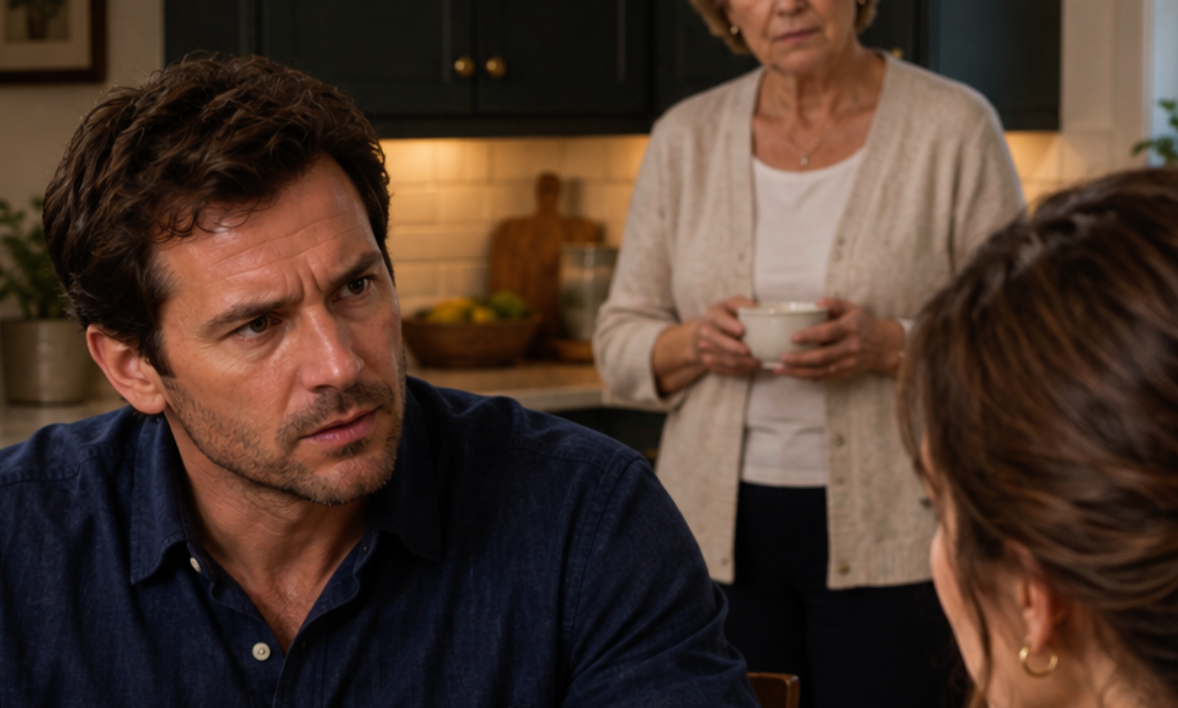
“From now on, you’ll be cooking for my mother every day,” Vadim declared, dropping his fork onto the linen napkin as if he were announcing an order of national importance.
— From now on, you’ll be cooking for my mother every day, — Vadim declared, dropping his fork onto the linen napkin as if reading out some government decree.
Nadezhda quietly set her mug of thyme tea onto a bamboo coaster. The tea was hot and fragrant, but inside she felt an icy knot tighten. The kitchen smelled of fresh lingonberry pie—she’d woken up at six in the morning to bake it before her long shift at work.
Sitting across the table was her mother-in-law, Raisa Stepanovna, theatrically pressing her plump hand to the top of her stomach, lips drooping in a dramatic frown. On her plate lay a lonely slice of plain boiled chicken breast and a few bland circles of zucchini.
— Nadya, you see what state Mother is in, — Vadim continued, squaring his shoulders. He wore a crisply ironed shirt—thanks to Nadezhda—and bore the stern expression of a dutiful son doing his part at someone else’s expense. — The private clinic doctor was clear: strict diet number five. No processed foods, no takeout! Everything fresh, steamed, at set times, four times a day. You work from home three days a week, just sitting at your computer. Would it kill you to make her a soup and some steamed dumplings?
Nadezhda looked from her husband to his mother. Raisa Stepanovna immediately let out a soft, theatrical sigh and rolled her eyes at the ceiling in silent suffering.
— No, — Nadezhda replied evenly. — I am not going to cook for your mother every day. Not every other day, either.
The kitchen fell silent. Vadim’s mouth hung open in shock, and Raisa Stepanovna instantly dropped her hand from her stomach, straightening up and forgetting her act.
— What do you mean, ‘no’? — Vadim demanded, leaning forward. — Nadya, do you even know what you’re saying? This is my mother! She raised me, got me on my feet! And right now, she has a terrible flare-up of pancreatitis! She has no one to cook for her!
— She’s sixty-four, Vadim, — Nadezhda replied sharply. — She’s retired, perfectly healthy for her age, walks Nordic style with her friends, and is more than capable of boiling her own zucchini. I don’t just ‘sit at home’—I’m a senior logistics specialist for pharmaceuticals. I manage temperature-sensitive vaccine shipments for the whole region. If I stop to puree soups for your mom, a delivery for the regional hospital might get delayed.
— Oh, really! — snapped Raisa Stepanovna, her voice suddenly strong and lively despite her ‘illness’. — Zucchini, huh? Vaccines! But what about my liver cramping after your pie yesterday? Valera, son, did you hear? I was like a mother to her when you did the apartment papers, and this is how she treats me! She’s so heartless she even refused to make me soup!
Nadezhda silently got up, cleared the table, and put the dishes in the sink. Her hands shook slightly, but outwardly, she remained perfectly calm—a skill honed over fifteen years in logistics, where only cold calculation and clear instructions work when multimillion shipments are on the line.
Nadezhda was forty-one, a fit woman with a tidy bob haircut and a habit of looking people straight in the eye. The spacious three-room apartment where they lived was hers, inherited from her grandmother. She’d spent five years making payments—living frugally, before even meeting Vadim.
Vadim entered her life six years ago—charming, polite, good with words and flowers. A sales manager for office equipment, he made an average salary but liked to splurge: taking loans for a crossover, buying designer clothes, and firmly believing household chores should vanish by themselves.
The first few years, Nadezhda overlooked his selfishness, thinking she could build a strong family with warmth and patience. She handled all utility bills, groceries, repairs, and daily upkeep. Vadim’s wages went to his auto loan, gas, hobbies, and the occasional ‘family support.’
Vadim had plenty of relatives. In addition to Raisa Stepanovna, who lived two bus stops away, there was his younger brother Igor and Igor’s young wife, Olesya. Igor could rarely hold a job for more than three months and was always searching for the next “high-income startup.” Olesya worked as a content manager and spent her days talking about boundaries and personal growth.
Gradually, all their problems seemed to find their way to Nadezhda. First Raisa Stepanovna asked ‘dear Nadya’ to bring heavy groceries after work. Then she needed help with spring cleaning. Then, half a year ago, the mother-in-law announced a “terrible, incurable pancreatitis” requiring a very special diet.
At first, Nadezhda was sympathetic. She made turkey broths, baked apples with cinnamon, and hauled food containers across the city. But the more she agreed, the more demanding her mother-in-law became — the soup was too thick, the pumpkin not soft enough, the steamed cutlets too dry. And now, Vadim had officially demanded a permanent system.
The next evening, things exploded.
Nadezhda came home from the office around seven, exhausted after a crazy day of blackouts at the warehouse and urgent vaccine reroutes. Her feet ached, her head throbbed.
There were unfamiliar sneakers in the hallway. In the living room, the TV blared, the air smelled of fried pork and garlic. Igor and Olesya lounged on the sofa, while Vadim and his mother sat at the dining table drinking tea with a cream-filled cake.
— Oh, Nadezhda’s here, — Igor announced dryly, not even looking up. — Nadya, there’s no proper cheese in your fridge—only that low-fat stuff. And we couldn’t find any good smoked sausage, so we had to order delivery.
— I told you so! — Raisa Stepanovna piped up, happily munching a giant piece of fatty cake with meringue, washing it down with strong black tea. The fancy bakery box was right on the table. — Nadya’s house is all grass and boiled chicken! A real man can’t eat in this place!
Nadezhda stopped in the doorway. She looked from the cake in her ‘very sick’ mother-in-law’s hand, to the pack of expensive smoked sausage on the table.
— Raisa Stepanovna, — Nadezhda asked quietly. — What about your number five diet? Pancreatitis? Creamy cake and smoked sausage—is that diet food now?
Her mother-in-law didn’t even blush. She dabbed her lips with a napkin and sighed, — Nadya, you don’t understand the medical nuances. When your body is stressed from yesterday’s crusty dinner, it needs glucose and enzymes! The doctor allowed little treats if the soul needs it. But you never brought the boiled veggies, so I had to starve all day!
— She didn’t starve, she had lunch with us, — Olesya chimed in, not looking up from her phone. — We ordered her pizza with ham and a salad with mayo. But actually, Nadya, you’re wrong. Vadim has only one mother. We think you should respect our elders. If I had time, I’d cook, but I have shoots and astrology classes. You’re experienced, you shouldn’t mind.
Nadezhda looked to her husband. Vadim sat there with a guilty, almost confrontational expression but stayed silent, siding with his family. At that moment Nadezhda remembered the character Hobotov from “Pokrovsky Gates”—except Vadim played the victim while really being a tyrant.
— Here’s the deal, — Nadezhda said, taking off her jacket. — Respect is a two-way street. Igor, Olesya, since you’re so concerned about your mother’s health, let’s all pitch in for specialized meal delivery. There are services that bring prepared diets—it costs thirty thousand rubles a month. Two families, fifteen each. What do you say?
The living room went silent. Igor choked on his tea, Olesya put down her phone.
— Why should we pay?! — Igor protested. — We rent, we’re saving for a car! Vadim’s the older brother, his wife works in pharmaceuticals, they’re rolling in cash! Can’t you find fifteen thousand for your own mother?
— We have loans, — Vadim muttered, looking away. — I pay for the car, the bills… I mean, we’re planning renos. Nadya, stop being ridiculous! What services? You could just cook! It costs you nothing, just a couple hours at the stove!
— My two hours at the stove are valuable, — Nadezhda replied. — Since this conversation isn’t working, I’d like everyone to please leave my apartment. I’m tired and want to rest.
— You’re kicking us out?! — Raisa Stepanovna gasped, standing up. — Your own family?! Valera, did you hear that? In my condition, she’s throwing me out on the street!
— Mom, calm down, — Vadim rushed over, grabbing her arm. — Nady just overdid it at work. Everyone, let’s go—I’ll talk to her.
The guests left, loudly slamming the door and sighing the whole way down the stairs.
Later that night, Vadim staged a full-blown drama in the kitchen. He paced, waved his arms, and accused Nadezhda of coldness, selfishness, lacking family values, and disrespecting his roots.
— You’ve become a dried-up bureaucrat! — he fumed. — Your heart’s a ledger book! My mother’s crying! My brother’s hurt! You’re destroying our family over a pot of soup!
— Vadim, — Nadezhda calmly stopped him. — Your mother just ate three slices of creamy cake and half a stick of smoked sausage. She doesn’t have pancreatitis. She likes manipulating us, and you like being generous at my expense. If you care so much about her meals—cook them yourself. Get up at six, boil, transport. You finish work by five.
— I’m a man! — Vadim barked. — I shouldn’t be at the stove after a long day! My job is stressful!
— And I must be at a resort, then, — Nadezhda said dryly and left for the bedroom, locking the door behind her.
The turning point came four days later, on Thursday.
Nadezhda had to do a surprise inspection at a pharmacy warehouse in Raisa Stepanovna’s neighborhood. The job finished early, around three, so she decided to swing by her mother-in-law’s to collect her glass food containers that still hadn’t been returned after a month.
Reaching the second floor, Nadezhda approached the familiar, worn-out door. The intercom was broken, and the door itself was ajar—someone must’ve left it that way.
From inside, she heard loud laughter, clinking glasses, and the mouthwatering smell of fried meat, spices, and garlic.
Nadezhda paused at the threshold. Olesya’s voice rang clearly from the kitchen:
— Mom, you’re a real actress! The way you moaned to Vadik on the phone yesterday, I nearly died laughing! ‘Oh, son, my liver’s burning, only Nadya’s soup can save me!’
Raisa Stepanovna’s deep, satisfied chuckle answered:
— How else? Nadya thinks she’s so lofty with her medicine! If I don’t push, she’ll start spending Valera’s money on her clothes or giving it away to her niece! But this way—my son’s a saint, sending me thirty thousand a month ‘for medicine and doctors’!
Nadezhda felt her world turn upside down. Thirty thousand? Every single month?… Continued in the comments below
“So now you’ll be cooking for my mother every day,” Vadim declared, dropping his fork onto the linen napkin like he was announcing a new law.
Nadezhda gently set her cup of thyme tea onto a bamboo coaster. The tea was hot and fragrant, but inside she felt a tight, icy knot form. The kitchen was filled with the scent of freshly baked lingonberry pie—she’d spent two hours making it, waking up at six in the morning before her long work shift.
Opposite her at the table sat her mother-in-law, Raisa Stepanovna. Raisa theatrically pressed her plump hand to the top of her stomach, her lips turned down in a mournful grimace. On her plate lay a lonely thin slice of boiled chicken breast without salt and a couple of circles of boiled zucchini pulp.
“Nadya, you can see what kind of condition my mother is in,” Vadim went on, squaring his shoulders. He was wearing a shirt carefully ironed by Nadezhda, a stern wrinkle on his forehead as if he was performing his filial duty at someone else’s expense. “The private clinic doctor was very clear: a strict number five diet. No processed food, no cafeteria meals! Everything must be fresh, steamed, on schedule, four times a day. You work a hybrid job, three days a week you’re at home on the computer. Is it really so hard for you to make pureed soup and steamed quenelles?”
Nadezhda shifted her gaze from her husband to her mother-in-law. At once, Raisa Stepanovna let out a soft, barely audible moan and rolled her eyes dramatically toward the ceiling, clearly expressing endless suffering.
“No,” Nadezhda said, her voice calm and steady. “I’m not going to cook for your mother every day. And I’m not going to do it every other day, either.”
A heavy silence fell over the kitchen. Vadim’s mouth dropped open in shock, while Raisa Stepanovna instantly pulled her hand away from her stomach and sat up straight, forgetting all about her act.
“What do you mean, no?” Vadim asked, leaning forward. “Nadya, do you even hear yourself? This is my mother! She washed me, raised me, got me on my feet! She’s having a terrible flare-up of pancreatitis! There’s no one else to cook for her!”
“She’s sixty-four, Vadim,” Nadezhda cut in. “She’s retired, absolutely—well, completely healthy for her age, goes Nordic walking with her friends, and she’s perfectly capable of boiling a zucchini. I don’t ‘sit at home,’ I’m a senior logistics specialist for pharmaceutical products. I oversee the temperature control for vaccine transport across the entire region. If I stop to strain soup for your mother, I’ll mess up a delivery to the regional hospital.”
“Oh, I see how it is!” Raisa Stepanovna chimed in. Despite her supposedly dire diagnosis, her voice was loud and strong. “A zucchini, is it? Vaccines, she says! And what about my liver seizing up yesterday from your pie, huh? Valera, son, do you hear this? I was like a real mother to her when you were sorting out that apartment paperwork, and now she’s tormenting me! Refused me soup! What a hardened heart!”
Nadezhda stood up in silence, gathered the dirty dishes from the table and placed them in the sink. Her hands trembled slightly, but outwardly she stayed perfectly calm—a skill she’d honed over fifteen years in logistics. In a field where schedules collapse and million-dollar shipments can spoil, panic is pointless—only cold calculation and clear instructions will get you through.
Nadezhda was forty-one years old. She was a trim woman with a neat bob haircut and a habit of looking people square in the eye. The spacious three-room apartment where they lived belonged to her. It was inherited from her grandmother, and Nadezhda had paid off the contributions for five years, denying herself everything, all before she ever met Vadim.
Vadim entered her life six years ago. Handsome, attentive, charming with words and always ready with flowers. He worked as an office equipment sales manager, earned an average salary, but loved to live large: taking out loans for a crossover SUV, buying designer clothes, and firmly believing that household difficulties should resolve themselves.
In the first years, Nadezhda overlooked his selfishness. She believed that with patience and warmth, a strong family could be built. She took full responsibility for utility payments, groceries, repairs, and everyday chores. Vadim’s salary went entirely toward paying for his car loan, gas, his personal hobbies, and regular ‘assistance’ to his relatives.
And Vadim had more than enough relatives. Besides his mother, Raisa Stepanovna, who lived just two bus stops away, there was his younger brother Igor and Igor’s young wife, Olesya. Igor never managed to hold a job for more than three months, endlessly searching for some ‘high-income startup,’ while Ole
sya worked as a content manager and spent the whole day talking about personal boundaries and spiritual growth.
Gradually, the family dynamic was such that every problem these people had ended up with Nadezhda. First, Raisa Stepanovna would ask ‘Nadenka’ to swing by after work and haul heavy grocery bags from the supermarket. Then came requests for help with deep cleaning. And half a year ago, her mother-in-law suddenly announced that she was diagnosed with a ‘horrible, incurable pancreatitis’ and now needed a special diet.
At first, Nadezhda was sympathetic. She cooked homemade turkey broths, baked apples with cinnamon, and hauled containers all the way across the neighborhood. But her mother-in-law’s appetite grew alongside Nadezhda’s willingness to oblige. Raisa Stepanovna became picky: the soup was too thick, the pumpkin not soft enough, the steamed cutlets not juicy enough. And now Vadim had officially demanded that this process be set up on a regular basis.
The very next evening, the conflict flared up again.
Nadezhda came back from the office around seven in the evening. Her day was chaotic: a power outage at the warehouse meant she had to swiftly reroute refrigerators carrying medical supplies. Her legs ached, and her head was pounding.
There were unfamiliar sneakers in the hallway. The TV was blaring in the living room, the air thick with the smell of fried pork belly and garlic. Igor and Olesya had made themselves at home on the sofa, while Vadim and his mother sat at the dining table, enjoying tea and cream cake.
“Oh, Nadya is here,” Igor stated dryly, not even bothering to turn his head. “Nadya, you don’t have any normal cheese in the fridge, just some fat-free stuff. And we couldn’t find any smoked sausage, had to order it for delivery.”
“Told you so!” Raisa Stepanovna chimed in, devouring a huge piece of rich cake with meringue and washing it down with strong black tea. On the table was that very box from an upscale bakery. “Nadya’s house is full of nothing but greens and boiled chicken! A real man has nothing to eat here!”
Nadezhda paused in the living room doorway. Her gaze shifted from the cake in her “critically ill” mother-in-law’s hands to the package of smoked sausage on the table.
“Raisa Stepanovna,” Nadezhda said quietly. “What about your special diet? Pancreatitis? Since when are buttercream cake and smoked sausage healthy foods now?”
Her mother-in-law wasn’t even fazed. She dabbed her lips with a napkin with dignity and sighed:
“Nadya, you just don’t understand the nuances of medicine. When the body is stressed from yesterday’s stale dinner, it needs glucose and enzymes! The doctor said I could have a few treats if my soul needs it! But you still haven’t brought me any boiled vegetables. I was forced to go hungry all day!”
“She didn’t go hungry, she had lunch here with us,” Olesya spoke up without looking up from her phone. “We got Mom a pizza with ham and a salad with mayo. But honestly, Nadya, you’re wrong. Vadim only has one mother. Igor and I agree that we need to respect our elders. If I had more time, I’d cook for her myself, but I’ve got film shoots and astrology classes. You’re experienced, you’re used to this.”
Nadezhda glanced at her husband. Vadim sat there with the guilty-yet-confrontational look of someone backing his family. At that moment, Nadezhda thought of Lev Evgenievich Khobotov from “Pokrovskie Vorota”—except Vadim tried to play the victim, while actually being a textbook tyrant.
“Here’s how it’s going to be,” Nadezhda said, taking off her jacket. “Respect should go both ways. Igor, Olesya, since you care so much about Mom’s health, I suggest we chip in for a specialized dietary meal delivery. There are services that provide full meal plans. It costs thirty thousand rubles a month. Let’s split it: fifteen from you, fifteen from Vadim.”
The living room went dead silent. Igor choked on his tea, and Olesya put down her phone.
“Why should we pay?” Igor protested. “We’re renting, saving up for a car! Vadik’s the older brother, his wife works at a pharma company, they’re loaded! Can’t you find fifteen thousand for your own mother?”
“We have loans,” Vadim replied firmly, staring off to the side. “I’m paying for the car, plus utilities… well, we’re planning renovations. Nadya, don’t be ridiculous! What services? You can cook yourself! It costs nothing but two hours of your time in the kitchen!”
“My two hours in the kitchen are worth a lot,” Nadya responded. “Since this conversation isn’t working out, I’m asking everyone to please leave my apartment. I’m tired and want to rest.”
“You’re kicking us out?!” gasped Raisa Stepanovna, rising from the sofa. “Your own family?! Valera, do you hear this? She’s throwing me out on the street! In my condition!”
“Mom, please calm down,” Vadim rushed to her side, supporting her by the elbow. “Nadya’s just overworked. Let’s go—I’ll talk to her now.”
The guests left, making sure to slam the door loudly and sigh dramatically for the whole building to hear.
Later that evening, Vadim put on a real show in the kitchen. He paced from corner to corner, waving his hands and accusing Nadezhda of being cold-hearted, selfish, lacking family values, and disrespecting his roots.
“You’ve turned into a heartless bureaucrat!” he fumed. “You’ve got a ledger instead of a heart! My mother’s crying because of you! My brother is offended! You’re tearing our family apart over a pot of soup!”
“Vadim,” Nadezhda interrupted calmly. “Your mother just ate three pieces of cream cake and half a stick of smoked sausage. There’s no pancreatitis. She just loves to manipulate us, and you love being the good guy at my expense. If you’re so worried about her diet, cook for her yourself. Get up at six in the morning, prepare the food, and bring it to her. You finish work at five in the evening.”
“I’m a man!” Vadim roared. “I shouldn’t be standing at the stove after work! My job is stressful!”
“And I guess my job is a vacation,” Nadezhda concluded, and went off to the bedroom, locking the door behind her.
The turning point came four days later, on Thursday.
Nadezhda was sent for an unscheduled inspection at a pharmacy warehouse, coincidentally in the same neighborhood where Raisa Stepanovna lived. The inspection finished earlier than usual, around three in the afternoon. The paperwork was done, so Nadezhda decided to stop by her mother-in-law’s unannounced—to pick up her glass food containers that had been borrowed a month ago and not returned.
Climbing to the second floor of the five-story building, Nadezhda approached the familiar worn-out faux leather door. The intercom in the building wasn’t working, and the apartment door itself was slightly ajar—probably the latch hadn’t caught when someone went in.
From deep inside the apartment came peals of explosive laughter, the clinking of crystal glasses, and the delicious, rich smell of fried meat, spices, and garlic.
Nadezhda paused at the threshold. From the kitchen, she clearly heard Olesya’s voice:
“Mom, you are such an actress! The way you moaned to Vadik on the phone yesterday, I nearly died laughing! ‘Oh son, my liver is burning, only Nadya’s broth can save me!’”
In response came Raisa Stepanovna’s deep, satisfied laugh:
“And what else should I do with them? Nadya thinks she’s above everyone! Sits with her meds, acting all high and mighty! If I don’t keep her in check, she’ll start spending Valerka’s money on her clothes or give it away to that niece of hers, Dasha! But this way—the boy’s obedient and sends me thirty thousand every month ‘for medicine and private doctors!’”
Nadezhda felt something flip inside her. Thirty thousand? Every month?
“Oh Mom, those Georgian-style pork ribs are fantastic!” Igor chimed in. “You marinated them perfectly! And the cognac is top notch. Vadik still thinks you’re living on porridge!”
“Let her believe what she wants!” my mother-in-law burst out laughing. “Valerka is so naïve—shed a single tear and he’ll give you his last penny. Yesterday, he took twenty thousand from their joint savings account and brought it to me. Said Nadka doesn’t know a thing! We’re going to use that money to buy new tires for Igor’s car! And Nadka can keep steaming her bland turkey! What a clueless little accountant!”
Nadezhda stood alone in the dark hallway, feeling the last remnants of her patience shatter and everything finally become clear.
She reached into her purse for her smartphone, turned on the voice recorder, and quietly pushed the door open just a bit wider. She recorded a full two minutes of their loud, cheerful conversation: the “aching” liver, the money withdrawn from the savings account, and the talk about buying tires for Igor.
Then, moving stealthily, she stepped back, gently closed the door, and made her way downstairs to the yard.
She wasn’t shaking. On the contrary, the sting of hurt was replaced by a cold clarity of mind.
When she got home, the very first thing Nadezhda did was open her banking app. The “joint savings account” she shared with Vadim was registered in his name, but most of the deposits came from her bonuses. Nadezhda looked up the transaction history over the past six months.
What she found was staggering. Every two weeks, money had been withdrawn: sometimes fifteen thousand, sometimes twenty or thirty. The payment notes were always blank, but the dates matched up perfectly with every “scandal” and “attack” of Raisa Stepanovna. Over six months, Vadim had quietly siphoned nearly two hundred and forty thousand roubles from the family budget.
Nadezhda printed out every bank statement. She stacked them neatly, placing them beside the apartment documents proving she was the sole owner, along with utility payment records for the last three years—all under her banking card.
That evening, around eight, Vadim came home. He walked in looking like a wronged saint, holding a half-empty bag with some bread.
“Nadya,” he began sternly from the doorway. “I went to see my mother. She’s really unwell. The doctor says she should be hospitalized, but we could just hire a caregiver who cooks. That would cost forty thousand a month. I think we should take that from our savings fund. Family has to help!”
Nadezhda was seated at the kitchen table, with her laptop open and the printouts lying in front of her.
“Vadim, sit down,” she said calmly.
“I don’t want to have a pointless discussion!” he raised his voice. “She’s fading away, and here you are with your paperwork!”
“Sit down, I said,” her voice carried such a steely note that Vadim instinctively obeyed and took a seat across from her.
Nadezhda played back the audio recording on her phone.
From the speaker, Raisa Stepanovna’s booming laughter rang out, crystal-clear: “…And Valerka took twenty thousand out of their joint account and brought it to me! He said Nadka doesn’t have a clue! We’re using that to buy Igor new tires for his car!…”
Vadim’s face changed rapidly—going from smugly pink to pale, then turning blotchy red. He froze on the chair, unable to say a word.
“This was recorded today at 2:40 PM in your mother’s apartment,” Nadya commented in an even tone. “While you were at work worrying about her ‘decline,’ your mother, your brother, and his wife were happily devouring Georgian-style pork ribs and washing them down with brandy.”
“Nadya… this… this has to be some kind of mistake…” Vadim stammered, his voice cracking. “They just… it was supposed to be a joke…”
“And this is a statement from our savings account,” Nadya pushed some papers toward him. “In the past six months, you’ve stolen 240,000 rubles from our family budget. You took it from me, from our future, from my niece—I couldn’t help her with her education because you kept pleading about your mother’s medication.”
“I did not steal!” Vadim shouted, trying to return to his usual aggressive stance. “I was helping my mother! I’m her son! You have no right to judge me! We’re husband and wife!”
“We were husband and wife,” Nadya corrected him. “Now listen to me carefully, Vadim.”
She stood up from her chair, leaning her palms on the table, and looked down at him.
“In this apartment, you have exactly three suitcases and your fishing rods. The apartment is mine. Tomorrow morning you’ll collect your things and move out to live with your ‘seriously ill’ mother. That’s first. Second: you will return those 240,000 rubles to my account within two months. If the money isn’t there in sixty days, this audio recording and the account statements will go to court with a lawsuit to divide our property, and to your bosses at work—let them see what an ‘honest’ manager they have.”
“You won’t do it!” Vadim croaked, sweat rolling down his forehead. “You won’t bring this kind of shame! What will people say?! We’ve been together for so many years!”
“Oh, I will,” Nadya replied quietly with a smile. “And believe me, I’ll do it with pleasure. Now go pack your things. You’ll spend the night at your mom’s. She could use the company, and she’s already finished those ribs.”
Chaos erupted. Vadim tried shouting, then fell to his knees, grabbing her hands, begging, swearing he’d been led astray, that his mother had drained him dry. Nadya silently took his suitcase from the closet and placed it in the middle of the hallway.
Half an hour later, the heavy artillery joined in. Nadya’s phone rang non-stop—first it was Raisa Stepanovna, then Igor. Nadya put them on speaker.
“You heartless witch!” her mother-in-law shrieked, finally dropping the act of the helpless old lady. “You want to leave my son an orphan?! I’ll drag you through every court for this secret recording! You’ve ruined our lives!”
“Raisa Stepanovna,” Nadya replied calmly. “The recording was made in a public place—your apartment door was wide open. If you’d like to meet in court, be my guest. We’ll also discuss fraud and misappropriation of funds. By the way, buy Igor some tires with the money Vadim sent you. No more transfers are coming.”
She hung up and blocked all three numbers.
By eleven at night, Vadim, sniffling and wiping his nose, finally zipped up the last suitcase. At the door, he turned around, hoping to see that familiar softness and willingness to compromise in his wife’s eyes.
“Nadya… maybe we can talk tomorrow? With a clear head? After all these years…”
“Leave your keys on the table,” Nadya said.
He set down the keychain, grabbed the suitcase handle, and stepped out into the hall. The door closed behind him with a soft, satisfying click.
A few months passed.
Autumn turned into a gentle, snowy winter. Nadya’s life flowed surprisingly smoothly, beautifully, and peacefully. No yelling, no one else’s complaints, no endless containers of steamed cutlets, and no constant feeling of guilt.
Nadya renovated the kitchen—painting the walls a light pistachio shade, buying a new coffee machine and elegant chairs. The apartment was filled with the scent of cinnamon, fresh pastries, and expensive perfume. At work, she was promoted to head of medical logistics—which meant her own office and an impressive salary.
Vadim paid back the money after a month and a half. He had to sell his much-loved crossover, pay off the car loan, and repay his debt to Nadya. Now he was living in his mother’s two-bedroom apartment along with her, Igor, and Olesya.
As a mutual friend told Nadya, life there had become a real domestic nightmare. Raisa Stepanovna, deprived of financial support from her daughter-in-law, started demanding every penny from her sons. Olesya flat-out refused to cook, Igor spent his time lying on the couch, and Vadim found himself cooking zucchini soup for his mother after work—since she still insisted on ‘care and respect for her age.’
Sometimes, Vadim tried to catch Nadya outside her office. He looked gaunt, with dark circles under his eyes and a rumpled jacket.
“Nadya, can we start over?” he pleaded, looking into her eyes. “I get it now. Mom went too far, and I was a fool. I miss our home, your warmth…”
Nadya looked at him with the gentle, kind smile of someone who has finally recovered from a long illness.
“Sorry, Vadim, but I’m on a schedule,” she replied, adjusting her cozy scarf. “The thermal containers have been sent out, the routes are set, and there are no extra passengers allowed in my life anymore.”
She turned and walked lightly toward her car, leaving him behind—in the very life he had chosen for himself.