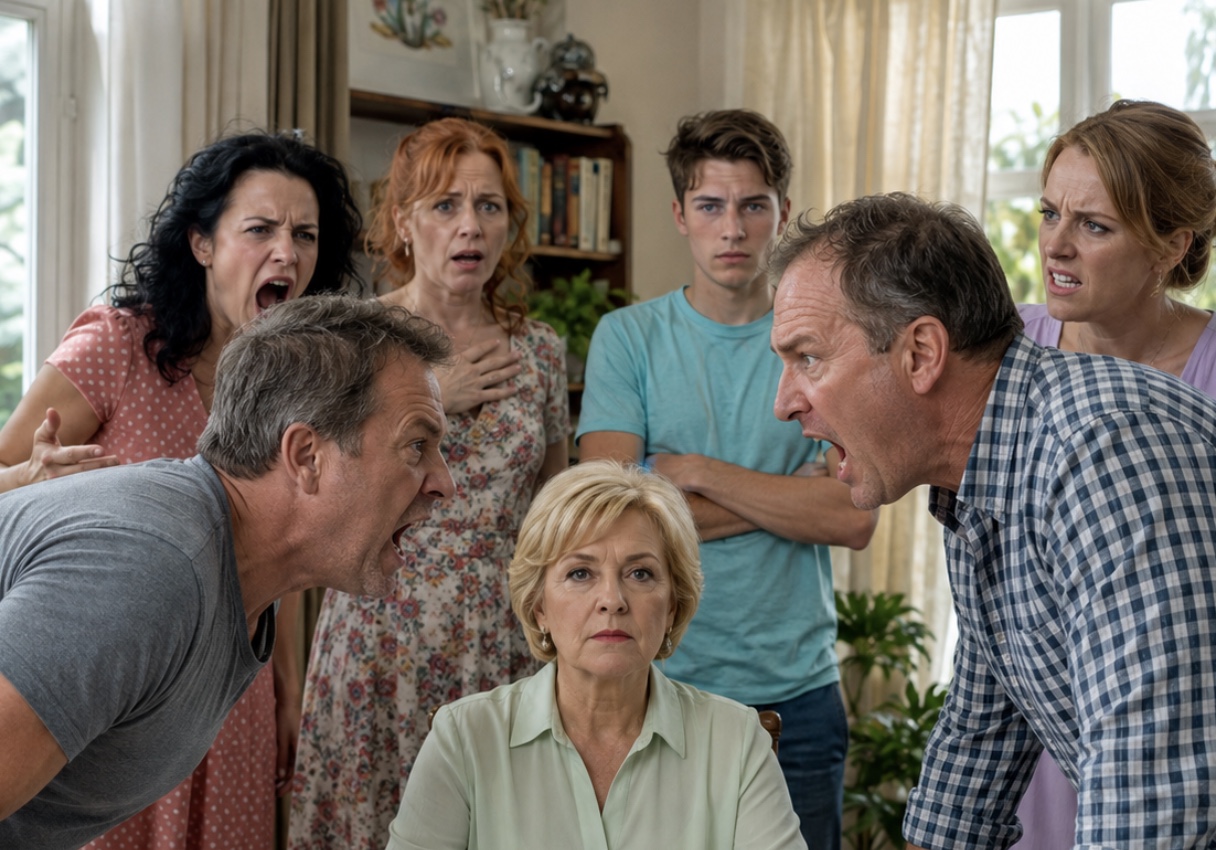
“Look, Tanya, I’m not blaming you. It’s just that every woman has her place in a home. Her own purpose. I, for example, always knew that my job was to protect the family. To keep everyone together.”
Her mother-in-law, Lyudmila Vasilyevna, said it so gently and sincerely that someone unfamiliar with the situation might even have been touched. She sat at the head of the table—very deliberately at the head, even though the apartment belonged to Tanya and Sergey—with her hands folded neatly on the tablecloth, as though she had just shared some profound piece of wisdom.
Around her sat Sergey’s sister Irina and her husband Gennady, their distant relative Zinaida Markovna, whom Tanya had seen perhaps three times during four years of marriage and who always looked at her with a faint, suspicious squint, and Sergey himself. Tanya’s husband sat slightly apart from the others, turning a spoon between his fingers and saying nothing.
August was hot, humid, and suffocating. The living-room windows were wide open, yet the air still felt heavy, like the atmosphere before a thunderstorm. On the table stood a small dish of cookies and cups of tea that no one was drinking.
To an outsider, it might have looked like an ordinary family evening.
But Tanya knew perfectly well that this was no family gathering.
It was a trial.
It had all started a month earlier, when Sergey once again failed to show up for work.
Not because he was sick.
 
Not because something terrible had happened.
He simply didn’t feel like going.
He stayed in bed until lunchtime, staring at the ceiling. Then he called his mother, and within an hour she appeared with a pot of soup and the expression of a long-suffering heroine.
“My poor boy is exhausted,” she told Tanya, as if Tanya had asked for an explanation.
Sergey was always exhausted.
Exhausted by work. By responsibility. By the need to make decisions. By life itself.
He had a remarkable talent for being tired while looking like a man whom the whole world had somehow wronged.
His mother saw it and understood him.
Tanya saw it too.
She simply understood it differently.
They had been married for four years. During the first six months, everything had seemed normal—or almost normal.
Then came his mother’s “helpful advice.”
After that came visits three times a week.
Eventually Lyudmila Vasilyevna began coming over even when Tanya wasn’t home, and Sergey opened the door for her as though this were the most natural thing in the world.
One evening Tanya returned from work and discovered that her mother-in-law had rearranged the furniture in the bedroom.
“It looks much better this way, Tanya dear. Trust me, I can see these things.”
 
Tanya said nothing.
She had spent a long time saying nothing.
She worked full-time as an accountant at a small medical clinic, got up at seven every morning, and usually came home around six, sometimes later. She cooked, cleaned, managed the household, and for the past year and a half had paid nearly all the bills herself because Sergey was “trying to find himself.”
He had been searching for himself for a very long time.
Thoughtfully.
Thoroughly.
And with no visible results.
His mother supported him wholeheartedly.
“He needs time,” Lyudmila Vasilyevna would say. “Not everyone is made for the chaos of office life. Seryozha is a sensitive person.”
The sensitive person, meanwhile, bought expensive sneakers, went drinking with friends, and explained to Tanya that she simply “didn’t understand his nature.”
And now came the family council.
Lyudmila Vasilyevna had organized it herself. She called Tanya the evening before and said in a voice sweet as jam:
“We need to talk, Tanya dear. As a family. No hard feelings.”
Tanya agreed.
She had been preparing for this conversation for a long time.
“We want you to understand one simple thing,” her mother-in-law continued, glancing toward Zinaida Markovna like an actress checking her prompter. “Seryozha is the way he is. He needs support. Understanding. Not all this…”
“What exactly is ‘all this’?” Tanya asked calmly.
Lyudmila Vasilyevna frowned slightly.
 
She didn’t like direct questions.
“Well… pressure. Complaints. You’re always demanding something from him.”
Sergey nodded.
It was the kind of nod a child gives when his mother defends him at a parent-teacher meeting.
Irina and Gennady remained quiet. Gennady studied the cookies. Irina pretended to be deeply interested in her tea.
Zinaida Markovna watched Tanya with that familiar narrowed gaze, as though examining an object that was somehow in the way.
“We discussed it,” Lyudmila Vasilyevna said, and the word we sounded heavy and official, almost like a verdict. “And we think you need to reconsider the way you’re living. Seryozha could stay with me for a while. Until things settle down. And the apartment could be rented out. Extra money never hurts.”
Tanya looked at her husband.
He was still turning the spoon between his fingers.
“Sergey,” she said quietly, “what do you think?”
He shrugged.
Exactly like that.
He shrugged like a teenager being asked whether he had done his homework.
“Well… Mom probably knows what’s best.”
Lyudmila Vasilyevna practically glowed.
Tanya stood up from the table.
She walked into the hallway without slamming doors or making a scene.
In the bedroom, inside the top drawer of the dresser, there was a folder.
An ordinary blue cardboard folder tied with strings.
Tanya took it, returned to the living room, and placed it on the table in front of her mother-in-law.
“You’re suggesting we rent out the apartment?” Tanya asked. “Interesting idea.”
Lyudmila Vasilyevna looked at the folder with mild confusion.
“What’s that?”
“Documents,” Tanya replied.
“For the apartment.”
The room became noticeably quieter.
Not the explosive silence that comes before a scandal, but the wary silence that falls when everyone suddenly stops moving.
Gennady put down his cookie.
Zinaida Markovna raised her head.
Even Sergey stopped spinning his spoon.
Tanya opened the folder and took out a sheet of paper.
“This apartment was purchased three years ago,” she said evenly. “With my money. The money came from the sale of my grandmother’s apartment. Here is the purchase agreement, and here is the property registry extract. I am the owner. The only owner.”
Lyudmila Vasilyevna’s mouth opened.
“But Seryozha…”
“Sergey is registered as living here,” Tanya interrupted. “That’s all.”
A car passed outside.
Somewhere below, children were laughing. It was August, evening, the familiar sounds of the courtyard.
Life outside continued normally, completely indifferent to what was happening in the living room.
Zinaida Markovna exchanged a glance with Lyudmila Vasilyevna.
There was something in that look.
Not shock.
Not exactly confusion.
More like recalculation.
A quick, practical reassessment of the situation.
“Tanya,” her mother-in-law began in a noticeably different tone, “but we are a family…”
“Yes,” Tanya agreed, sitting down again. “A family.”
 
She placed the paper back into the folder and tied the strings into a neat knot.
Sergey stared at her with the expression of a man who sensed that something was wrong but couldn’t quite understand what.
He was used to Tanya staying quiet.
Used to her giving in.
Used to her eventually agreeing for the sake of peace, for the sake of avoiding conflict, for the sake of letting Lyudmila Vasilyevna leave satisfied.
But tonight Tanya had no intention of giving in.
And everyone around the table seemed to realize it.
Lyudmila Vasilyevna paused for perhaps three seconds.
That was all the time she needed to adjust.
Over four years, Tanya had learned this particular talent of her mother-in-law’s very well.
She never retreated immediately.
She regrouped.
“All right,” Lyudmila Vasilyevna said with the tone of someone generously acknowledging another person’s point. “The apartment is yours. No one is arguing about that. But it doesn’t change the essence of what we’re discussing. We’re talking about your family. About the way you two are living.”
“And how are we living?” Tanya asked.
“Badly, Tanya dear. I can see it.”
Zinaida Markovna nodded eagerly, as if she had been waiting for precisely that line.
“Seryozha has been nervous. He’s lost weight. Irina can confirm it.”
Irina flinched, clearly not expecting to be pulled into the conversation.
She glanced quickly at her husband.
Gennady continued looking at the table.
“Well… he does seem…”
“Tired,” Lyudmila Vasilyevna prompted.
“Tired,” Irina repeated obediently.
Tanya looked at Sergey.
He sat there like a man receiving a massage—relaxed and faintly pleased.
He enjoyed this.
 
He liked it when his mother spoke about him as if he were fragile and suffering.
It relieved him of the need to explain anything himself.
“Seryozha is tired because there is no peace in the home,” his mother continued. “When there is harmony in a family, a man flourishes. But when a woman tries to control everything…”
“Lyudmila Vasilyevna,” Tanya interrupted quietly, “I work full-time. I run the household. I pay for everything. What exactly am I doing wrong?”
Her mother-in-law pressed her lips together.
It was an inconvenient question.
Specific.
Practical.
The kind that couldn’t be answered beautifully with vague philosophy.
“It isn’t about money,” she finally said. “It’s about the atmosphere. A home needs the right atmosphere.”
“What kind?”
“A warm one. A feminine one. The kind that makes a husband want to come home.”
Gennady coughed softly.
Tanya almost felt sorry for him.
The conversation had already lasted more than an hour.
Outside, darkness slowly settled over the city. August surrendered daylight reluctantly, keeping the sky bright for as long as possible.
The children in the courtyard had gone quiet. Other sounds replaced them—a song playing from someone’s car, neighbors talking on a bench.
During that hour, Lyudmila Vasilyevna managed to explain several important things to Tanya.
A real wife, she said, knew how to create comfort—not simply clean a house, but truly create an atmosphere.
Seryozha had been an extremely sensitive boy as a child, so he required a special approach.
Money wasn’t what mattered.
Spiritual closeness mattered.
And some women, once they achieved success in life, began looking down on their husbands, which destroyed marriages.
That last remark was clearly aimed at Tanya.
When his mother called him a “sensitive boy,” Sergey actually blushed slightly.
Not from embarrassment.
From pleasure.
He truly believed he was sensitive.
It explained many things in his mind.
Why he couldn’t work with colleagues who “didn’t understand him.”
Why getting up early was so difficult.
Why loud noises bothered him, meaning Tanya had to take phone calls in the kitchen with the door closed.
By then, Zinaida Markovna had become completely comfortable and started contributing sayings of her own.
“The husband is the head, the wife is the neck.”
“You don’t bring your own rules into someone else’s monastery.”
The second one was particularly absurd considering the “monastery” belonged to Tanya.
Tanya remained silent.
Not out of submission.
Out of calculation.
She let them talk.
Let them say everything they had come to say.
Let them empty their entire arsenal.
At around eight thirty, Lyudmila Vasilyevna reached the final stage.
“We think,” she said, once again using that grand, authoritative we, “that you should take some time off. Rest. Go somewhere for a while. Seryozha can stay with me for a week or two. He’ll spend some time in a normal environment, recover, and then the two of you can talk calmly.”
Tanya slowly turned toward her husband.
“Is that what you want?”
Sergey rubbed his temple.
“Well, Mom says it would probably be better…”
“I’m asking you,” Tanya said. “Not your mother.”
Silence.
 
“Well… probably. I need to rest.”
“From what?”
He didn’t answer.
He shrugged again.
That endless shrug he used instead of actual words.
Tanya stood up and gathered the cups from the table, simply because she needed something to do with her hands.
She carried them into the kitchen and stood there for a minute.
Through the window she could see the street. The lamps had already come on, spreading orange pools of light across the gray pavement. The leaves on the poplar trees hung completely still in the hot, heavy air.
Then she returned to the living room.
“All right,” Tanya said evenly. “Sergey can go stay with his mother whenever he wants.”
Lyudmila Vasilyevna nodded with satisfaction.
“There you go. That’s sensible.”
“But I want all of you to understand something,” Tanya continued, and something in her voice made her mother-in-law straighten slightly. “I’m not taking a vacation. I’m not leaving. This is my apartment, and I’m staying here. If Sergey wants to live with you for a while, that is his decision. The decision of an adult man.”
Lyudmila Vasilyevna opened her mouth, but Tanya continued.
“And one more thing. The folder doesn’t contain only the apartment papers. There are other documents too. But those are for another conversation. When the time comes.”
Zinaida Markovna narrowed her eyes.
Irina looked toward the folder, still sitting near the edge of the table—blue, ordinary, tied neatly with strings.
“What documents?” her mother-in-law asked.
For the first time, there was caution in her voice.
“Later,” Tanya said calmly. “Not tonight.”
She picked up the folder, returned it to the bedroom, placed it in the drawer, and closed it.
For a few seconds, she stood alone in the dark bedroom, away from the voices in the living room.
They had begun talking quietly among themselves.
Lyudmila Vasilyevna was saying something quickly to Zinaida Markovna.
Judging by the scrape of a chair, Sergey had stood up.
Tanya looked at herself in the mirror above the dresser.
An ordinary face.
A little tired.
But calm.
During four years of marriage, she had learned one important thing.
There are different kinds of silence.
There is the silence of weakness, when a person simply has nothing to say.
And then there is the silence of someone who already has everything they need.
Everything necessary.
Everything safely stored in a blue folder.
And they could feel the difference.
The guests finally left around ten.
Lyudmila Vasilyevna was the last to go. She moved slowly and with dignity, fastening her handbag by the door as though Tanya should be grateful for the privilege of watching her leave.
“Think about what I told you,” she said before stepping out. “I don’t want anything bad for you. I care about the family.”
 
“I know,” Tanya replied.
The door closed.
Sergey stood in the hallway staring at his wife.
He was clearly waiting for something.
A scandal.
Tears.
A long emotional argument.
Tanya gave him none of those things.
She simply walked past him, went to the bathroom, washed her face, returned to the kitchen, and put the kettle on.
“Why aren’t you saying anything?” Sergey asked from the kitchen doorway.
“I’m tired.”
“Come on, Tanya…”
“Sergey, go to bed. We’ll talk tomorrow.”
He lingered for a moment, then went to sleep.
Tanya stayed in the kitchen until midnight with a cup of tea.
She wasn’t thinking about what had already happened.
She knew all of that.
She was thinking about what would happen next.
The following morning, Sergey went to stay with his mother.
He packed quickly and efficiently, looking like a man who had finally received permission to do something he had wanted for a long time.
He took several T-shirts, his phone charger, and his favorite pillow.
The pillow, of all things, he remembered.
“I’ll be gone for a week,” he said in the hallway.
“All right,” Tanya replied.
“You’re not upset?”
She looked at him.
A tall, fairly handsome thirty-four-year-old man stood in front of her with a pillow tucked under his arm and a slightly guilty expression in his eyes.
“No,” Tanya said truthfully.
He left.
Tanya closed the door, leaned her back against it, and for the first time in several days took a deep breath.
For the next three days she lived in silence.
It felt strange at first.
Unfamiliar.
But good.
She woke up when she wanted.
Cooked only for herself.
 
In the evenings she walked through a small park nearby.
On the fourth day, Lyudmila Vasilyevna called.
“Tanya, I need to come by. It’s about something important.”
“What is it?”
“Seryozha’s things. He left a few things behind and asked me to pick them up.”
Tanya thought for a moment.
“All right. Come at six.”
Her mother-in-law arrived at five forty-five—fifteen minutes earlier than agreed, which was a small demonstration in itself.
Tanya opened the door and let her inside.
Lyudmila Vasilyevna immediately looked around with a quick, sharp glance, the way someone inspects a room to see what has changed.
Tanya had cleared unnecessary things from the living-room table, arranged her own books on the shelves, and moved an armchair closer to the window.
Small changes.
But her mother-in-law noticed every one of them.
“You’ve already started rearranging everything to suit yourself,” she said with a faint smirk.
“I live here,” Tanya replied.
Sergey’s remaining belongings—some folders, old discs, and a box of tools—were packed and waiting in the hallway.
Lyudmila Vasilyevna looked at them, then at Tanya.
“Can we talk?”
“If you want.”
They sat down in the living room.
This time her mother-in-law skipped the long introduction.
Apparently, three days had changed something in her.
“What’s in that folder?” she asked directly.
Tanya stood up, brought the folder, and placed it on the table.
She opened it and took out several documents.
“Here,” she said calmly. “Take a look.”
Lyudmila Vasilyevna picked up the papers.
She read them slowly, much more slowly than she usually spoke.
Her face began to change.
Not dramatically.
There was no sudden expression of shock.
It simply seemed to sag slightly, making her look older.
There were three documents in the folder.
The first was a prenuptial agreement, drawn up and notarized eight months earlier.
Tanya had proposed the agreement to Sergey after yet another conversation in which he suggested that the apartment should be transferred into both their names because “that would be fair.”
Sergey had agreed easily.
He signed it without reading it carefully.
He rarely read anything he signed.
The agreement clearly stated that the apartment would remain Tanya’s property under any circumstances and would not be considered jointly acquired marital property.
The second document was a bank statement.
For three years, Tanya had been putting part of her salary into a separate account that she had opened before the marriage.
There was a very specific amount saved there.
Not a fortune.
But enough.
The third document was a printed copy of messages.
Neatly organized.
With dates.
Sergey had been corresponding with his mother in great detail.
They discussed how they needed to “deal with the apartment issue.”
How “Tanya won’t understand until she’s confronted with a done deal.”
How his mother would “take care of everything.”
 
Lyudmila Vasilyevna finished reading and placed the papers on the table.
A car passed outside.
Somewhere in the courtyard, a door slammed.
“Where did you get these messages?” her mother-in-law finally asked.
Her voice was controlled, but something inside it had collapsed.
“Sergey left his tablet at home,” Tanya replied. “He often left it here. Sergey has always been good at leaving things behind.”
Lyudmila Vasilyevna said nothing.
It was unusual.
She almost never remained silent for so long.
“What are you planning to do?” she finally asked.
“I’ve already done it,” Tanya said. “I filed for divorce three days ago. On Monday.”
Her mother-in-law raised her eyes.
“Does Seryozha know?”
“He will. The court papers will arrive, and then he’ll know.”
Lyudmila Vasilyevna slowly stood up.
She straightened her cardigan and picked up her handbag.
She looked at Tanya with an expression Tanya couldn’t immediately identify.
Then she understood.
It was confusion.
Real confusion.
No performance.
No calculated reaction.
“You’ve been preparing for this all along?” she asked.
“I’ve simply been living my life,” Tanya replied. “Working. Paying the bills. Putting up with things. And then I stopped putting up with them.”
Her mother-in-law collected Sergey’s things without saying another word.
She paused for a moment in the hallway, as though searching for one final powerful statement.
Apparently she couldn’t find one.
She left.
Tanya stood beside the closed door for a while.
Then she returned to the living room and sat in the armchair by the window—the one she had moved three days earlier.
From there, she could see a strip of sky above the rooftops.
It was still bright, still unmistakably August, with a thin pink line glowing far away in the west.
The folder remained on the table.
Tanya looked at it and realized that she felt neither anger nor triumph.
Only exhaustion.
And underneath that exhaustion, something else.
Something she couldn’t quite name yet.
Something that felt very much like freedom.
Her phone rang.
Sergey.
Tanya looked at the screen.
 
She waited until the call ended.
Then she put the phone aside.
Outside, August was fading.
There would be plenty to deal with later—calls, conversations, court hearings, documents, awkward questions from acquaintances.
All of that would come.
But not tonight.
Tonight she simply sat in her own chair, in her own apartment, drinking tea.
For now, that was enough.
The divorce was finalized two months later, in October, inside a gray courthouse with plastic chairs lining the corridor.
Sergey came with his mother.
Lyudmila Vasilyevna had to wait outside because she wasn’t allowed into the courtroom, and judging by her expression, she considered that a personal insult.
Sergey looked lost.
Apparently, he still expected Tanya to change her mind.
Or cry.
Or ask for one more chance.
She did none of those things.
The judge asked the standard questions.
Tanya answered briefly and clearly.
Sergey hesitated, fidgeted, and repeatedly glanced toward the door where his mother was waiting.
At one point he said quietly:
“Tanya, maybe we could still…”
“No,” Tanya replied.
There was no anger in her voice.
Just no.
Twenty minutes later, it was over.
Outside, the October sun was unexpectedly warm.
Tanya walked down the courthouse steps and stopped for a moment, lifting her face toward the sky.
Behind her she could hear Lyudmila Vasilyevna speaking rapidly and quietly to Sergey.
Tanya didn’t listen.
She crossed the street to a small public garden and sat on a bench.
She took out her phone and sent a message to her friend:
That’s it. I’m out.
Her friend replied immediately with a ridiculous picture and three exclamation marks.
Tanya smiled.
Life didn’t suddenly become easy after that.
Life rarely becomes easy overnight.
There were phone calls from Zinaida Markovna, who felt compelled to offer moral advice.
There were mutual acquaintances who considered it their duty to share their opinions.
And there was Sergey, who continued sending vague messages for another three months—sometimes angry, sometimes apologetic, sometimes suggesting reconciliation.
But the blue folder had done its job.
The apartment remained Tanya’s.
So did the money in her account.
And yes, four years of her life had passed in that marriage.
But Tanya no longer thought of those years as wasted.
She had learned a great deal.
Most importantly, she had learned not to wait for other people to decide how she should live.
She would decide for herself.
 
Calmly.
With the right documents ready when needed.
Tanya rose from the bench and began walking down the street flooded with October sunlight.
She didn’t look back.
She simply kept moving forward.