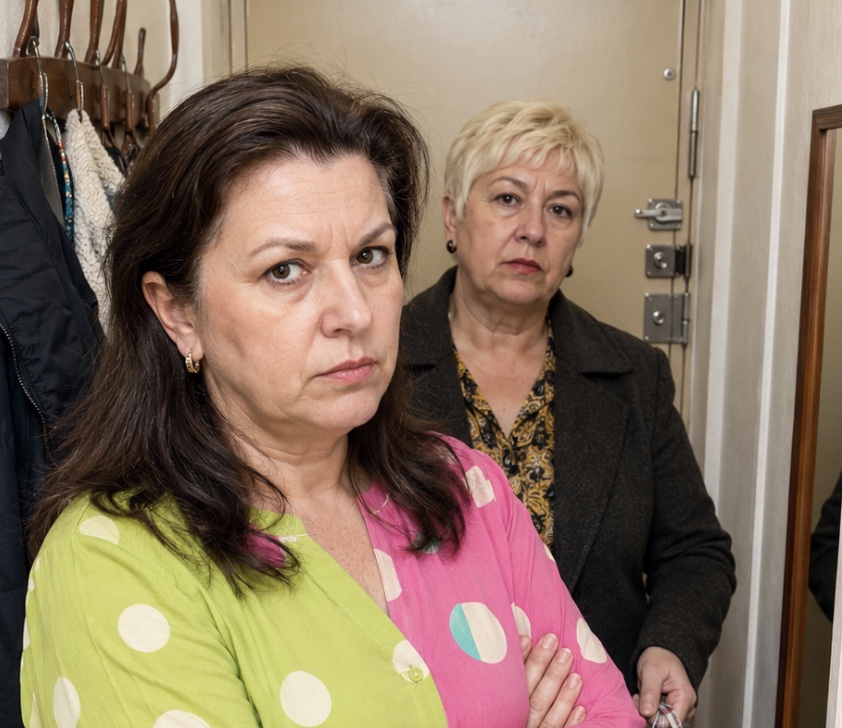
On that rainy Thursday in July, Antonina Pavlovna stood in our cramped entryway, straight as a drawn bowstring, wearing her usual severe raincoat the color of wet asphalt.
At her feet were two enormous plaid bags—the kind usually carried by market traders or by people forced to pack up an entire lifetime in a panic. My mother-in-law’s face was completely unreadable. Her stubborn chin was lifted high, and her tense fingers were wrapped tightly around the wooden handle of her cane umbrella.
I stood opposite her with my arms folded across my chest, feeling the familiar, heavy irritation beginning to boil inside me.
After ten years of marriage to Igor, I knew that posture and that look far too well. I was used to her cold, appraising tone and her constant dissatisfaction. She always knew better: how I should run the household, what I should feed my husband, which activities our daughter Dasha should attend, and what we ought to save money on.
 
And now she had appeared on our doorstep with all her belongings, without warning or even a phone call, and she made no attempt whatsoever to soften the awkwardness. No quiet “hello,” no embarrassed apology for the inconvenience. Just a dry, abrupt order about clearing out the wardrobe.
“Mom,” Igor said, stepping forward and gently but firmly placing his broad shoulder between us. “Anya will decide how we should arrange the guest room. We’ll find space for everything. Don’t worry. Give me your coat. Come in, wash your hands.”
Antonina Pavlovna frowned and gave her son a long, gloomy look. Then she leaned her umbrella against the wall and began undoing the buttons of her coat.
That was when I noticed that her fingers were trembling slightly.
The enormous three-door oak wardrobe had been standing in our small guest room for eight years. Antonina Pavlovna had brought it to us soon after Igor and I moved into the apartment. She claimed the old giant no longer fit into her newly renovated bedroom and that we could use the extra storage anyway.
Back then, she had absolutely forbidden anyone from dismantling the main structure. She was afraid the dried-out wood would never fit together properly again. The movers removed only the doors, shelves, and drawers, while four men carried the heavy frame out in one piece.
No one touched the back panel.
Since then, that bulky Soviet-era monument had become a reliable home for spare blankets, winter jackets, and dusty boxes.
Without saying anything, I went to the kitchen, tore several thick garbage bags from a roll, and returned to the guest room to clear the shelves.
Inside the wardrobe, the air smelled of mothballs and dry wood.
As I pulled out another bag filled with forgotten scraps of fabric, my elbow accidentally caught a flat cardboard box on the top shelf. The box tipped sideways, the lid slipped off, and a pair of old work gloves fell to the floor with a dull slap.
They looked like ordinary construction rubbish.
They were made from rough gray canvas, with green rubber dots across the palms. The fabric had darkened with age, and the cuffs were frayed almost to threads.
Holding them between two fingers with mild disgust, I dropped them into the garbage bag. I assumed they were something Igor had forgotten after our renovation years ago.
“Don’t you dare.”
Antonina Pavlovna’s sharp voice came from behind me.
By then she had changed into her gray house cardigan. She rushed toward me, bent down, and pulled the canvas gloves out of the trash.
“They’re just old construction rubbish, Antonina Pavlovna,” I said, trying to keep my voice calm. “They’re torn.”
“Don’t throw away something you didn’t earn yourself,” she replied sternly.
Almost tenderly, she smoothed the rough fabric with her knotted fingers.
Then she placed both gloves on the bedside cabinet, turned around, and left the room with quick, even steps.
I closed my eyes and took a deep breath.
Be patient, Anya, I told myself. She’s in trouble.
By evening I was standing at the stove.
Cooking had always been the best way for me to calm my nerves. Golden oil hissed in a heavy cast-iron skillet as I browned juicy pieces of chicken thigh until they developed a caramel-colored crust.
The tiny kitchen filled with the warm, rich aroma of roasted meat. I added several cloves of garlic and a fresh sprig of rosemary. Once the chicken was perfectly browned, I poured in thick sour cream, lowered the heat, and let the sauce simmer slowly.
On the next burner, fluffy mashed potatoes stayed warm beneath a heavy lid, freshly whipped with baked milk. Beside them, the first July cucumbers from my parents’ country garden filled a glass bowl with their crisp, fresh scent.
There were only three of us at dinner.
 
Thankfully, Dasha was staying at my parents’ summer house, so she did not have to witness the oppressive atmosphere.
Antonina Pavlovna ate in silence.
At one point, she reached across the table for the salt. The sleeve of her cardigan slid upward, and my attention was suddenly drawn to her hands.
I had never examined them so closely before.
The joints of her fingers were painfully swollen. Her skin was rough, red, and dry, covered with pale old scars and tiny cracks. Her nails were cut short and unevenly, and her fingers clearly did not bend properly.
Those were the hands of someone who had once spent far too long doing exhausting physical work.
She noticed me looking.
Immediately she pulled her hands beneath the table and did not say another word for the rest of dinner.
Later, after my mother-in-law had gone to her room, Igor shut our bedroom door firmly and sat heavily on the edge of the neatly made bed.
He rubbed his face with both hands.
“Igor, what actually happened?” I asked quietly, sitting beside him. “Why did she come here with only two bags? Why did she leave her apartment?”
My husband exhaled shakily, staring at the floor.
“There is no apartment anymore, Anya. Sveta sold it.”
Sveta was Igor’s younger sister.
Antonina Pavlovna’s lifelong favorite.
The daughter who had always been forgiven for everything.
“What do you mean, sold it?” I blinked at him in confusion.
“Two years ago, Sveta persuaded Mom to transfer the apartment to her as a gift,” Igor said in a hollow voice. “She told her it would make the property safer and that nothing would change for Mom. Mom didn’t tell me. She was afraid I’d argue with her. Once the gift transfer was registered, Sveta became the sole owner. Mom kept living there as usual and believed her daughter would never force her out. But they never signed a separate agreement properly protecting Mom’s right to continue living there.”
Igor looked at me bitterly.
 
“Then Sveta sold the apartment. She brought buyers there whenever Mom was at the clinic, at the store, or visiting us. She told them the apartment was temporarily occupied by an elderly relative who would move in with her son after the sale. The new owners arrived yesterday evening with the official property registry documents. Legally, they couldn’t simply throw Mom out overnight, but she was so shocked and humiliated that she didn’t argue. She packed the essentials and left on her own. And Sveta turned off her phone.”
I listened to him, feeling something inside me turn to ice.
Antonina Pavlovna, the domineering woman who had always seemed indestructible, had been driven from her own home by her own daughter.
“She has nowhere else to go, Anya,” Igor said. “She has nothing left.”
The next day, Friday, Igor went to work and Antonina Pavlovna quietly left for the pharmacy.
My phone rang.
Sveta’s number appeared on the screen.
I answered.
“Hi, Anya,” my sister-in-law said brightly, in a disturbingly casual tone. “Listen, Mom’s staying with you, right? Great. Tell her to look for her old savings book. She had money put aside for her funeral expenses. Quite a lot, actually. I need to borrow it for a couple of months. Creditors are breathing down my neck.”
She paused only briefly.
“And one more thing. Mom’s old oak wardrobe is still in your guest room, isn’t it? I found someone online who wants to buy it. At least I’ll get something for it. Have it ready.”
For a moment, I could barely breathe.
The woman who had deprived her own mother of a safe place to live was calling to squeeze the last of her savings from her—and sell furniture that was sitting inside someone else’s home.
“No movers are coming here, Sveta,” I said, my voice vibrating with restrained anger. “The wardrobe stays. It belongs to your mother.”
“Anya, stay out of things that don’t concern you, okay?” Sveta’s tone instantly became shrill. “It’s family property! I’m just as much her daughter as Igor is, and I have the right to decide what happens to it!”
“Antonina Pavlovna will decide,” I replied clearly. “The wardrobe belongs to her, and she personally brought it into our home. If you call again demanding money or furniture, I’ll hire a lawyer. We’ll examine the gift agreement, collect evidence of how you misled your mother, and take the matter to court. And if the lawyer believes there are grounds to suspect fraud, we’ll go to the police as well. You’ve already sold the apartment. That doesn’t mean you get to strip your mother of every last thing she owns.”
 
I ended the call.
Only then did I realize I was not alone.
When I turned around, Antonina Pavlovna was standing in the narrow hallway, holding a pharmacy bag against her chest.
She had heard everything.
There were no tears in her faded eyes, but her face had turned gray.
For a long moment, she stared at me without blinking.
Then she slowly lowered her head and gave me a silent nod, as if acknowledging something far more important than words could express.
After that, she went quietly to her room.
On Saturday morning, Igor finally decided to repair the warped doors of the old oak wardrobe.
Age and the uneven floor had twisted the heavy wooden frame slightly.
Moving it while it was full was impossible.
First, we removed the remaining clothes, pulled out the drawers, lifted away the shelves, and took off the heavy doors. Igor carefully placed pieces of thick felt beneath the legs so we would not scratch the laminate flooring.
Then we pressed our hands against the smooth side of the wardrobe and pushed together.
Even emptied out, the frame moved reluctantly, scraping forward a few centimeters over the felt.
At that moment, the thin fiberboard back panel bowed slightly.
There was a dry, papery rustle.
 
A thick white A4 envelope dropped onto the floor through a cloud of dust that had been gathering there for years.
Traces of old stationery glue were visible around its edges.
Someone had once pushed the envelope into the narrow gap between the fiberboard backing and the heavy upper crosspiece of the wardrobe. The top shelf could easily be removed, so Antonina Pavlovna would only have needed to lift it out and slide the envelope down behind the panel from inside.
She had never needed to move the massive wardrobe at all.
The envelope could only be seen now because the back panel had shifted away from the frame.
Igor picked it up and brushed off the gray dust.
On the front, in Antonina Pavlovna’s neat, almost calligraphic handwriting, was a single word:
“Igor.”
Underneath it, written in a different color of ink, was a date.
Exactly seven years earlier.
Igor carefully tore open one edge.
Inside was a thick stack of official documents and a squared notebook page folded in half.
My husband unfolded the note.
Standing close beside him, I read over his arm.
“My son,
 
I know you were looking for these papers so you could throw them away, but I decided to keep them. For myself. As a memory.
If this envelope is ever found, it probably means I am no longer alive, or someone has finally decided to sell this old wardrobe to strangers.
You asked me—begged me—never to tell Anya the truth.
I won’t.
I don’t want Anya to spend the rest of her life looking at me as though she owes me every breath Dasha takes.
Help stops being help when the person giving it expects lifelong gratitude.
Let her think I am cold instead.
You can argue with a cold person. You can live freely around them. But when someone is your savior, you spend your whole life lowering your head in front of them.
I am already sixty. I have lived my life and arranged it as best I could. You still have your lives ahead of you, and you have a little girl to raise.
Protect your family.
I love you.
Mom.”
I stopped breathing.
Slowly, I looked down at the stack of documents.
They were ordinary official papers: a copy of an employment contract, additional agreements, shift schedules, and payroll statements bearing the blue stamps of a cleaning company called Clean City LLC.
Position: cleaner of industrial and commercial premises.
Working hours: night shift, 10:00 p.m. to 6:00 a.m.
 
Workplace: the largest shopping and entertainment center in our city.
Every document was in Antonina Pavlovna’s name.
And the dates matched perfectly with the most terrifying period of our lives.
Seven years earlier, when Dasha was two, she began suffering severe attacks in which she struggled to breathe.
After examinations, doctors diagnosed her with a severe form of allergic bronchial asthma.
The first acute episode was brought under control in the hospital, but months of treatment and recovery lay ahead.
We needed to buy prescribed medication and inhalation equipment, replace some of her bedding, purchase good air purifiers, and pay for a recommended rehabilitation program because waiting for a state-funded place would have taken far too long.
For months, Igor and I tried to gather the money.
We applied for financial assistance, approached banks, and borrowed from friends and acquaintances.
And during that exact period, without telling anyone, Antonina Pavlovna took a night job.
When the final deadline arrived for us to pay for Dasha’s rehabilitation, Igor brought home everything his mother had managed to save during those exhausting months.
She had put aside her night wages, part of her pension, and the money she earned from extra shifts, keeping only enough to cover her most basic needs.
It was not enough to pay for everything.
But it filled the final gap that could otherwise have cost Dasha her place in the rehabilitation center.
At the time, Igor told me, without meeting my eyes, that his mother had managed to sell his late father’s collection of antique coins for an unexpectedly high price.
I remembered crying with relief.
Dasha began to recover.
Later, I went to Antonina Pavlovna’s apartment to thank her sincerely.
I stood in her living room, and she answered with icy calm:
“There’s nothing to thank me for. That was your father-in-law’s money. I wouldn’t have given you anything myself. You need to learn to live within your means.”
I had been deeply hurt.
I remember thinking, What a cold-hearted woman.
Now, staring at those salary statements, the entire past rearranged itself before my eyes.
I suddenly remembered how Antonina Pavlovna used to visit us on Sundays during those months.
She would sit on the very edge of a stool, always with deep shadows beneath her eyes.
I remembered the faint but unmistakable smell of harsh industrial chemicals clinging to her otherwise respectable clothes.
Back then, I would become angry whenever she ran a finger along one of my shelves and said sternly:
“Anya, it’s dirty in here.”
 
I thought she was simply trying to humiliate me.
But it had been an automatic habit.
For months she had spent her nights cleaning enormous commercial floors.
A woman who had spent her entire working life surrounded by the quiet of library shelves had silently picked up a mop and caustic cleaning chemicals to save my daughter.
She worked nights.
She saved every paycheck.
And quietly handed the money to Igor.
Then she forced him to lie to me.
She willingly carried my resentment for years so that I would never feel indebted to her, so that she could protect the wounded pride of a young mother devastated by her own financial helplessness.
Later, Igor explained that the rough canvas gloves had been issued for handling heavy garbage bags, metal buckets, and cleaning equipment.
For wet cleaning, employees used thin rubber gloves that tore quickly.
But that thick canvas pair had survived every one of her shifts.
My husband stood in front of me with his arms hanging at his sides.
“I begged her to stop,” he said. “When I found out where she was going every night, I yelled at her. And she said, ‘You’re a man. You’ll take the money and tell your wife it came from your father’s coins. Otherwise, I won’t come to your home again at all.’”
Igor sighed heavily.
“After Dasha recovered, I wanted to tell you the truth again. But Mom made me repeat my promise. She said that if you knew, every visit from her would remind you of a debt she never wanted you to feel. I knew keeping quiet was hurting both of you, but I couldn’t break my promise to her. Then she took all the work papers away and hid them. I thought she had burned them years ago.”
A burning pain spread through my chest.
I turned around and left the room.
Antonina Pavlovna was sitting at the kitchen table.
 
The two old work gloves were lying in front of her.
She had put one aside and was trying to repair a split seam on the other with a thick needle.
But her damaged joints no longer obeyed her properly.
The needle kept slipping against the stiff canvas, and her hands trembled helplessly.
She had never thrown the gloves away.
She had kept them as a silent memorial to the one period of her life when she had managed to become a shield for our family.
I walked over to the table.
Gently, I placed my hand over her worn, battered one.
Antonina Pavlovna flinched.
Her face tightened, revealing how deeply shaken she was, but her familiar defensive hardness returned almost immediately.
I carefully opened her fingers and took the needle from her hand.
Then I pulled the canvas glove free.
“I’ll sew it myself, Antonina Pavlovna,” I said.
My voice sounded unusually soft, yet firm.
“Leave it. You’ve already worked far too much for us.”
She froze.
For a moment, it seemed as if she had stopped breathing.
She understood everything.
She understood that the secret she had guarded for years had finally been uncovered.
I did not overwhelm her with emotional speeches.
People as strong as she was could not tolerate pity.
 
Instead, I slowly pushed the needle through the thick canvas, pulled the thread through with difficulty, made several strong stitches, and tied a knot.
The seam was not particularly neat, but it held.
Antonina Pavlovna watched my hands in silence the entire time.
I placed both gloves beside each other, stood up, and returned to the other room.
The final confrontation came the following evening, on Sunday.
Someone rang the doorbell insistently.
Sveta was standing outside.
She looked angry and confident, clearly intending to take whatever she believed belonged to her.
“Well, weren’t expecting me?” she said.
She did not even bother taking off her shoes before stepping into the entryway.
“Where’s the wardrobe? And tell Mom to bring me her savings book. I don’t have time to argue with you people.”
Igor came out of the room and stood directly in front of her, blocking the way.
There was none of his former softness in his posture.
“The wardrobe stays here, Sveta. And so does Mom’s money,” he said in a low, perfectly calm voice. “You’re not getting a single penny.”
“Igor, are you out of your mind?” Sveta threw her hands into the air. “I have debts to pay! That’s family money! Mom! Mom, tell him!”
The guest-room door opened.
Antonina Pavlovna stepped into the hallway.
She stood straight, her chin lifted as always.
But there were no tears in her eyes.
Nor was there any trace of the blind affection she had always shown her younger daughter.
There was only coldness.
“Mom, tell them to give me my share!” Sveta demanded.
Antonina Pavlovna stared at her for several long seconds.
“You’ve already taken everything you wanted, Sveta,” my mother-in-law said evenly, without emotion. “You got the apartment, and you sold it. I will give you nothing else. No money. No belongings.”
“You’ve all lost your minds!” Sveta shouted. “I’ll sue! I have rights!”
“Go ahead,” I said, stepping out of the kitchen. “We’ve already contacted a lawyer ourselves. We gave him the gift agreement, the property registry extract, and everything else we managed to collect. He’s reviewing whether there are grounds to challenge the transaction and preparing the court documents. If necessary, he’ll ask the court for interim protective measures. So from now on, you won’t be dealing with us informally. Everything will be handled officially. Igor and I will not pay your debts anymore.”
Sveta looked from me to her brother, then to her mother.
She was clearly waiting for Antonina Pavlovna to defend her as she always had.
But her mother did not move.
“Leave, Sveta,” Igor said sharply. “And don’t come back to this house.”
At last, my sister-in-law realized that the arrangement she had relied on for years had collapsed for good.
She spun around angrily and slammed the door behind her.
 
Igor quietly locked it.
The apartment fell silent.
Antonina Pavlovna remained standing in the hallway, staring at the closed door.
Her shoulders dropped almost imperceptibly.
I walked past her into the guest room.
I approached the open oak wardrobe, where we had already returned the drawers.
Then I firmly pulled out the top drawer—the most convenient one, the place where people usually keep their most valuable belongings.
I removed my neatly folded things and emptied it completely.
Then I returned to the kitchen, picked up the old work gloves from the table, carried them back into the room, and gently placed them at the bottom of the empty drawer.
Antonina Pavlovna approached silently and stopped in the doorway.
She looked at the empty shelves.
At the worn canvas gloves resting in the most honored place.
Then she looked at me.
 
“The wardrobe is completely yours now,” I said, meeting her tired eyes.
“And so is this home. You are not a guest here.”
Antonina Pavlovna slowly ran her palm along the edge of the empty drawer.
“Don’t throw the gloves away, Anyechka,” she whispered.
It was the first time in ten years that she had ever called me that.
“I won’t,” I answered.