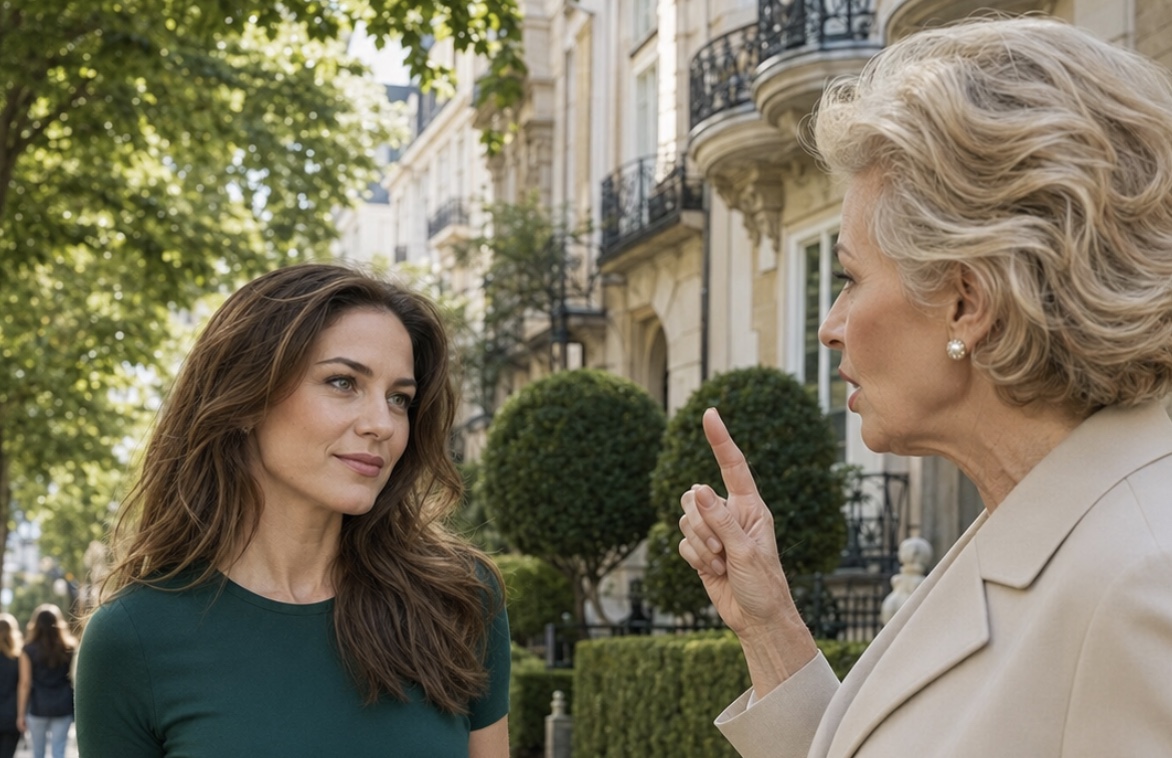
Margarita Vasilyevna delivered the statement in an even, almost casual tone while gently stirring the cooling tea in her porcelain cup. She sat at the kitchen table with her back perfectly straight, displaying posture that seemed remarkable for a woman of sixty-eight. She was wearing an elegant cream-colored blouse purchased with her older son’s money and an expensive pair of gold earrings.
Polina, who had been standing at the sink with a sponge in her hand, slowly turned off the faucet. The sound of running water stopped. A heavy, oppressive silence settled over the kitchen, broken only by the steady clink of the teaspoon against the rim of the cup.
Polina was forty-three and managed a large branch of a national pharmacy chain. Her days were filled with endless invoices, medication expiration checks, arguments with dissatisfied customers, complicated staff schedules, and responsibility for enormous amounts of money passing through the registers. She was accustomed to dealing with problems quickly and efficiently, but her mother-in-law’s words sounded so absurd that Polina wondered whether she had misunderstood them.
“Forgive me, Margarita Vasilyevna, but I’m not sure I understand what you’re saying,” Polina replied calmly, drying her wet hands on a kitchen towel. “Which family, exactly, am I supposed to support?”
“Slavik’s family, of course,” her mother-in-law said with a shrug, as though she were explaining something obvious to a child. “They’re going through a difficult period. Karina is on maternity leave, and the twin boys need to start the preparatory program at that prestigious academy. It costs eighty thousand rubles a month. Slava’s salary is modest. He’s still trying to find himself and launch his own project.”
She took another composed sip of tea.
“You and Anton don’t have children living at home anymore. Your son is grown up and studying in another city on a state-funded place. Both of you earn good money. You have a management position at the pharmacy, and Anton spends all day at the auto service center. Forty thousand rubles won’t make any real difference to you, but his own brother desperately needs help. I believe you should transfer forty thousand to them every month.”
Heavy footsteps sounded in the hallway.
Anton, Polina’s husband, entered the kitchen. He had just returned from work, carrying the faint scent of engine oil, strong coffee, and exhaustion. Anton worked as a vehicle diagnostics specialist at a major dealership. His hands were rough from years of handling tools, but those same hands had built the comfortable life he and Polina now shared.
After hearing the last part of his mother’s speech, he leaned against the doorframe and folded his arms across his chest.
“Mom, you’ve gone too far,” Anton said in a low, hoarse voice. “We don’t owe anyone anything. Slava and I are both grown men. He’s thirty-five years old. If he can’t afford an elite school for his children, they can attend the ordinary free school in their neighborhood.”
“Anton! How can you speak that way about your own nephews?” Margarita Vasilyevna exclaimed, pressing one hand dramatically to her chest. “They are gifted boys. They deserve a proper start in life. Meanwhile, the two of you sit on your money like misers guarding a treasure chest.”
She turned an accusing look toward Polina.
“Just like in the film Moscow Does Not Believe in Tears. She becomes a manager and suddenly thinks she can look down on her relatives. Polina bought herself new boots. I saw them in the hallway. Karina has been wearing the same winter coat for three years.”
“My boots were purchased with the salary I earn by standing on my feet for ten hours at a time,” Polina answered coldly. “And we already transfer forty thousand rubles to you every month for your medical treatment. For injections in your joints, private cardiologists, and stays at health resorts. We pay your utility bills and regularly bring you bags of groceries. Do you believe that still isn’t enough?”
Her mother-in-law immediately changed tactics.
Her eyes filled with tears, her voice began to tremble, and her perfectly straight back suddenly curved forward. In a matter of seconds, the confident, commanding woman transformed into a helpless elderly pensioner.
“Do you think I would take a single kopeck from you if it weren’t for my illnesses?” she sobbed. “My pension is tiny. Every ruble goes toward medication. I lie awake at night because of the pain in my knees. I’m your mother. I raised you. I sacrificed years of sleep for my children.”
She dabbed at the corner of one eye.
“And Slavik is such a sensitive boy. This cruel world is difficult for him. Karina is fragile too. Who will help them if we don’t? I can’t do it on my pension, which means the responsibility falls on you.”
The conversation ended without any agreement.
Margarita Vasilyevna left with her lips tightly pursed in resentment, refusing even the container of homemade meat patties Polina offered her.
Anton remained at the kitchen table for a long time, staring into his mother’s abandoned cup of cold tea. Polina walked up behind him, wrapped her arms around his shoulders, and rested her chin gently on the top of his head.
She knew how deeply the situation hurt him.
Anton had always been the responsible son. He had paid for the renovation of his mother’s apartment, covered her countless wishes, and tolerated the fact that his younger brother Slava had always been the favorite—the one whose mistakes, debts, and failures were endlessly forgiven.
The following morning, Polina arrived at the pharmacy at eight o’clock.
The familiar smell of antiseptic, dried medicinal herbs, and medication always had a calming effect on her. She changed into a spotless white coat, checked the cash registers, and greeted the pharmacists beginning their shifts.
The day quickly fell into its usual rhythm.
Suppliers delivered a new shipment of antibiotics. Barcodes had to be checked, display shelves reorganized, and paperwork signed. Then Polina had to deal with an irritated customer who was furious because the pharmacy had run out of discounted blood-pressure monitors.
Shortly before lunch, she finally found a quiet moment.
Polina sat in her small, windowless office, drinking lukewarm green tea and reviewing invoices. Her thoughts kept returning to the previous evening.
Forty thousand rubles every month for her mother-in-law’s treatment.
She and Anton had been transferring that amount for two years.
Margarita Vasilyevna claimed that she received expensive imported injections to restore cartilage in her joints, as well as intravenous treatments at a private clinic on the other side of the city. As a pharmacist, Polina knew exactly how much those medications cost. Even allowing for the clinic’s markup, the amount her mother-in-law requested had always seemed slightly excessive.
Yet Polina had never asked to see receipts.
She had considered such a demand humiliating, as though she were accusing an elderly woman of lying about her health.
Someone knocked on the office door, interrupting her thoughts. A young pharmacist named Dasha leaned inside.
“Polina Sergeyevna, there’s a man asking about some rare medication. He says you promised to reserve it for his grandmother.”
Polina suddenly remembered the order and hurried into the retail area.
After helping the customer, she made a decision.
The following day was her day off. She would visit Margarita Vasilyevna herself, examine the doctors’ prescriptions, and check the boxes and empty ampoules from the medication. Perhaps the clinic was deceiving an elderly patient, prescribing unnecessary procedures or charging outrageous prices.
If that was the case, Polina knew exactly how to expose them.
On Wednesday morning, Polina bought Margarita Vasilyevna’s favorite éclairs, stopped at a supermarket for fresh cottage cheese and fruit, and drove to her mother-in-law’s apartment.
She had her own set of keys because Anton was frequently asked to come over and repair a leaking faucet, adjust the television, or fix some other household problem.
After climbing to the third floor of the old brick building, Polina rang the doorbell.
There was no answer.
She called her mother-in-law’s mobile phone.
“Hello, Polinochka?” Margarita Vasilyevna answered in an unexpectedly cheerful voice. “I’m at the clinic waiting for my physiotherapy appointment. I won’t be home for another two hours.”
“That’s all right, Margarita Vasilyevna,” Polina replied. “I’ll let myself in, put the groceries in the refrigerator, and continue with my errands.”
She opened the door with her key and entered the apartment.
The rooms smelled of old books and lavender soap. Polina unpacked the groceries in the kitchen and placed the box of éclairs on the table.
Then her eyes moved toward the partly open bedroom door.
She remembered the real reason for her visit. She had intended to examine the medical documents and medication packaging to understand what treatment her mother-in-law was actually receiving.
Polina entered the bedroom.
A blood-pressure monitor sat on the bedside table beside several inexpensive headache tablets and a bottle of nasal drops. There were no traces of costly imported medication, no syringes, no empty ampoules, and no clinic receipts.
Near the window stood an old writing desk with several drawers.
Polina knew that Margarita Vasilyevna stored her medical records and bills inside it.
She pulled at the top drawer. It opened with difficulty because a thick cardboard folder had become wedged against the frame. Polina carefully shifted the folder to free the drawer.
A stack of papers slipped out and scattered across the floor.
She crouched down to gather them.
Her gaze fell on a line of large printed text.
It was not a medical report.
It was a shared-construction agreement for a residential property.
Polina frowned and turned the page over.
Under the heading “Participant in Shared Construction,” she saw the name Karina Eduardovna—Slava’s wife.
The property described in the contract was a spacious townhouse in an exclusive new development outside the city.
Its price was twenty-five million rubles.
Polina’s heart began to beat faster.
She sat down at the writing desk and started examining the contents of the folder with methodical concentration.
There was a mortgage agreement in Slava’s name.
The monthly payment was one hundred and thirty thousand rubles.
But the most revealing documents were still to come.
Inside a transparent sleeve, Polina discovered printed bank statements from Margarita Vasilyevna’s account.
The transactions were painfully familiar.
On the tenth day of every month, exactly forty thousand rubles arrived from Anton.
On the eleventh day, the same forty thousand rubles were transferred to Karina’s account with the note:
“Mortgage payment from Mom.”
There had been no private clinic.
No expensive joint injections.
No paid cardiologists.
For two full years, Polina and Anton had denied themselves a proper vacation, postponed renovating their bathroom, and saved money on countless small pleasures because they believed they were paying for an elderly woman’s medical care.
In reality, they had been financing a luxury property for Slava and his wife.
Polina continued going through the documents.
The next paper made her smile bitterly.
It was Slava’s income certificate from the previous year, submitted to secure mortgage approval.
The official salary of the supposedly struggling younger brother who was “still trying to find himself” was three hundred and fifty thousand rubles a month.
He worked as a senior software developer for an international technology company.
As for Karina, who allegedly had to wear the same winter coat for three years, receipts in the same folder showed that she regularly paid for a premium fitness club, purchased designer handbags, and transferred large sums to travel agencies.
The truth was now completely clear.
Slava and Karina earned excellent money, but their appetite for luxury was even greater. They had taken on an expensive property, refused to give up their extravagant lifestyle, and then recruited Margarita Vasilyevna to help cover the difference.
Fully aware of their real financial position, Margarita Vasilyevna had performed the role of a sick and helpless pensioner with astonishing skill. She had drained money from her responsible older son so that her favorite younger son could enjoy a beautiful life.
Now that the children’s expenses had increased, she had decided to raise the tribute by demanding another forty thousand rubles directly from Polina.
Polina took out her phone.
Her hands moved with calm precision.
She photographed the property agreement, Slava’s income certificate, the mortgage schedule, and, most importantly, the bank statements proving exactly where their money had gone.
When she finished, she carefully returned every document to the folder, placed it back in the drawer, and left the apartment, closing the door quietly behind her.
That evening, Polina waited for Anton in the kitchen.
Her laptop stood open on the table, displaying the photographs she had taken.
Anton washed up, changed into comfortable clothes, and began telling her about a difficult customer whose car had developed a serious transmission problem.
“Anton, please sit down,” Polina said, pouring him a cup of strong tea.
He sat, noticed the seriousness in his wife’s expression, and looked toward the laptop screen.
Then he began to read.
At first, confusion appeared on his face.
Next, his eyebrows rose.
Then the muscles in his jaw tightened.
He moved through the photographs one by one, studying every figure.
His brother’s income certificate.
The mortgage agreement.
His mother’s bank transfers.
Anton remained silent for a long time.
He simply stared at the wall in front of him.
Polina did not rush him. She understood that at that moment, his faith in the people closest to him was collapsing.
“So that’s what happened to the money for her joints,” Anton finally said.
His voice contained no emotion at all, which made it more frightening than anger.
“And Karina has supposedly been wearing the same coat for three years. I was such a fool. I took extra shifts because I was worried Mom wouldn’t have enough money for medicine.”
“What are we going to do?” Polina asked gently, covering his hand with hers.
“What we should have done a long time ago,” he replied firmly. “Call all three of them. Invite them to dinner on Sunday. Tell them we discussed the school fees and made our decision. Let them think they’re coming here to celebrate.”
Sunday evening began like an ordinary family dinner.
Polina roasted meat in the oven, prepared several salads, and arranged the table beautifully.
The relatives arrived on time.
Margarita Vasilyevna was glowing with satisfaction, already savoring her victory.
Slava wore an expensive cashmere sweater and carried himself with a faintly patronizing smile.
Karina complained about the weather and traffic while describing how exhausting it was to raise two energetic children.
Everyone took their seats and served themselves food.
Anton poured juice and mineral water into the glasses.
“Well, my dears,” Margarita Vasilyevna began ceremoniously, raising her glass of juice, “I’m delighted that good sense has finally prevailed. A family must support one another. Slava, Anton and Polina have decided to help you pay for the boys’ academy.”
Slava nodded graciously.
“Thank you, brother. You’re really saving us. Every kopeck matters at the moment. The industry is in crisis, clients are delaying payments, and we barely know how we’re going to make ends meet.”
Karina sighed sorrowfully as she delicately speared a slice of cucumber with her fork.
Polina rose from the table.
She walked to the sideboard, opened a drawer, and removed a thick paper envelope.
Returning to the table, she placed it in front of Slava.
“This is for you, Slava,” she said with a faint smile. “Your first payment toward the academy.”
Slava rubbed his hands together eagerly and opened the envelope.
Instead of crisp banknotes, he pulled out a stack of color printouts.
The first page was his income certificate, clearly showing a monthly salary of three hundred and fifty thousand rubles.
The next was a statement from Margarita Vasilyevna’s bank account.
Slava’s face changed instantly.
He turned pale, and his eyes darted nervously from one person to another. He flipped through several more pages and found photographs of the mortgage agreement for the townhouse.
Noticing her husband’s reaction, Karina leaned over his shoulder.
She gave a quiet gasp and covered her mouth with one hand.
Margarita Vasilyevna, still unable to understand what was happening, snatched the papers from her son.
She put on her glasses, read several lines, and threw the printouts onto the table as though they had burned her fingers.
“What is this?” she shouted, red patches spreading across her face. “You searched through my belongings? How dare you, you shameless woman! This is an outrageous invasion of privacy!”
Anton slowly rose from his chair.
His height and broad shoulders had always commanded respect, but now he looked like a thundercloud about to break.
“An invasion of privacy?” his voice boomed through the kitchen. “And what do you call taking money from me while pretending you need treatment for your joints? Is that some kind of family tradition?”
“Anton, listen, you’ve misunderstood everything,” Slava stammered, trying to move his chair away from the table. “These are investments. Mom wanted to help us. It was her own decision.”
“Be quiet,” his older brother said coldly. “You earn nearly half a million rubles a month. You’re buying luxury property. Your wife practically lives at an exclusive fitness club. Meanwhile, I crawl under cars and work myself to exhaustion to pay your mortgage while my own wife has to economize.”
“You don’t need the money!” Margarita Vasilyevna suddenly shrieked, losing the last of her self-control. “You already have an apartment, and your son is grown! Slavik needs to maintain his status. His career requires it. He’s intelligent and talented, while you do nothing but turn wrenches all day.”
She struck the table with her palm.
“I have every right to distribute the family’s money as I see fit. You were obligated to help!”
Polina stared at her mother-in-law, stunned by the twisted logic.
In Margarita Vasilyevna’s world, conscience did not exist. There were only the needs of her favorite son, and those needs justified deception, theft, and emotional manipulation.
“No more money, Mom,” Anton said, emphasizing every word. “Nothing for your joints, nothing for groceries, and nothing for your utility bills. You and Slava lied to us for two years. From now on, your successful, talented, status-conscious son can support you completely. He has more than enough money to do it.”
“You can’t do this to me! I’m a sick woman!” Margarita Vasilyevna cried, clutching at her chest in another attempt to gain sympathy.
“Should I call an ambulance?” Polina asked calmly, taking out her phone. “I know several doctors through the pharmacy. I can arrange a complete medical examination immediately.”
Her mother-in-law glared at her with hatred.
She understood that the performance was over.
Margarita Vasilyevna jumped to her feet, grabbed her handbag, and stormed toward the hallway.
“I will never set foot in this house again!” she shouted from the doorway. “You’re greedy, jealous, heartless egotists!”
Slava and Karina hurried after her without saying another word.
The front door slammed.
Silence returned to the kitchen.
Anton lowered himself back into his chair, covered his face with both hands, and released a long, heavy breath.
Polina walked over, wrapped her arms around him, and kissed his temple.
It was finally over.
Five months passed.
Golden autumn settled over the countryside.
Wrapped in a warm blanket, Polina sat on the veranda of a small, comfortable country house and sipped hot thyme tea.
She and Anton had dreamed of owning a place outside the city for years, but there had never seemed to be enough money.
Once the monthly transfers to Margarita Vasilyevna stopped, their family budget recovered with surprising speed. They were able to take out a modest personal loan and purchase a plot of land with a charming wooden cottage near the forest.
Margarita Vasilyevna called several times during the first few weeks.
She cried, complained about sudden rises in her blood pressure, and accused her children of cruelty.
Anton listened for exactly two minutes, asked whether she needed him to call a doctor, and then ended the conversation.
Once she realized that her old methods of guilt and emotional pressure no longer worked, she turned her attention toward Slava.
Through mutual acquaintances, Polina learned that serious arguments had begun in the younger brother’s household.
After losing the dependable financial support supplied by her older son, Margarita Vasilyevna began demanding the same money from Slava.
Karina was furious.
She had been forced to give up her personal trainer and move the twins to an ordinary municipal kindergarten so that they could continue paying the mortgage on the townhouse while also covering Margarita Vasilyevna’s endless demands.
Anton stepped onto the veranda carrying a platter of sausages he had just grilled over the fire.
He smiled at his wife, his eyes calm and confident.
Polina took another sip of tea and breathed in the fresh forest air.
At last, her life belonged to her and to the man who had always stood beside her.
No one would ever again be allowed to treat the fruits of their labor as personal property.