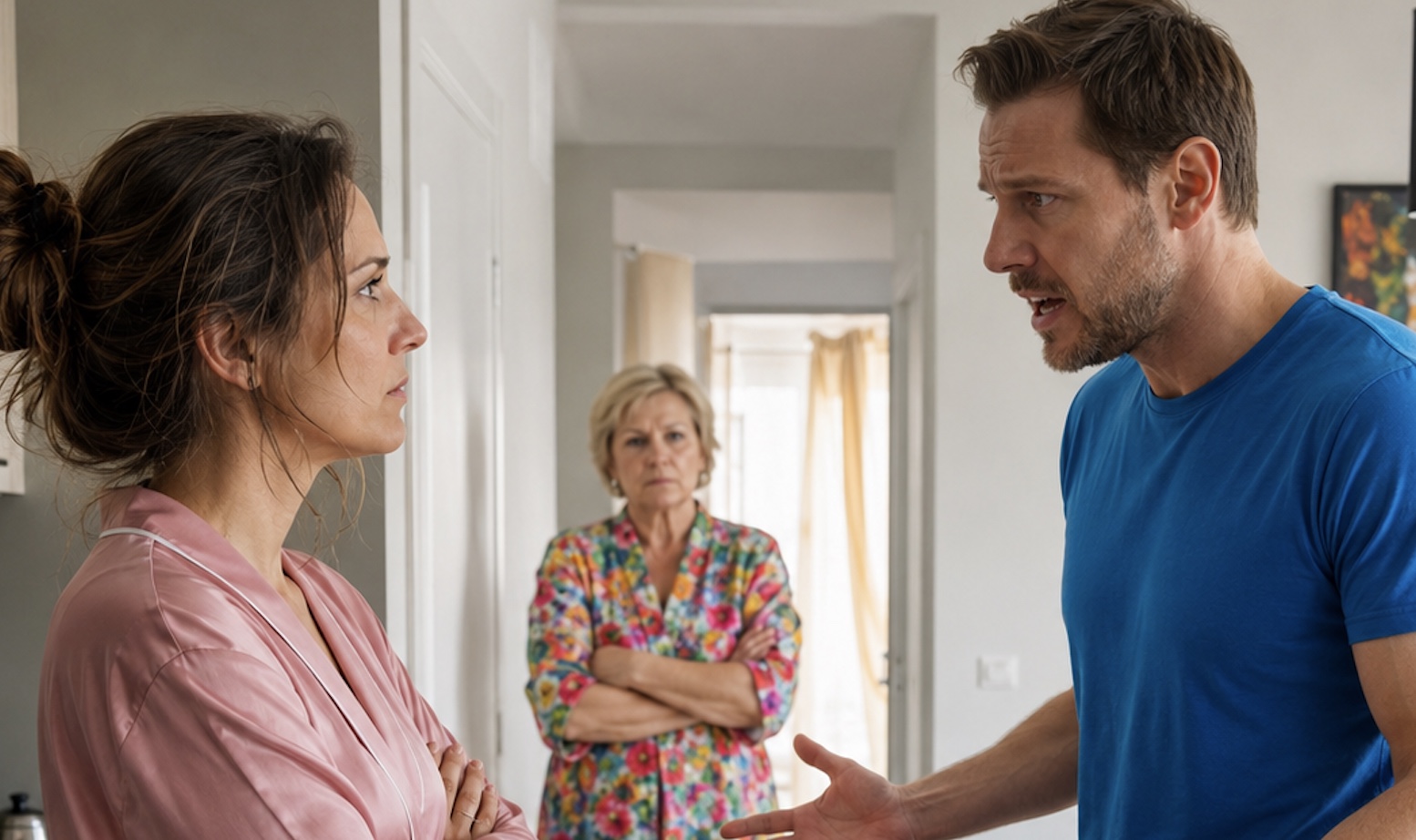
“Where are Mom’s things?”
Vadim stood barefoot in the middle of the kitchen, wearing a wrinkled T-shirt, staring at me as though I had carried away not two suitcases in the middle of the night, but his entire childhood.
I placed a cup in front of him. The tea had just been brewed, and a calm, almost peaceful ribbon of steam rose from it. Beyond the window, the courtyard of our new apartment complex in Yaroslavl looked gray beneath the morning sky. The hazard lights of someone’s car blinked in the parking lot, while near the entrance a maintenance worker scraped away the remains of dirty snow.
For the first time in a week, the apartment was silent.
There was no heavy smell of heart medicine, no criticism that porridge was “boiling incorrectly,” and no endless rustling of shopping bags from which Zinaida Pavlovna seemed to pull out one new rule after another.
“She’s at the hotel near the clinic,” I said clearly. “I ordered a taxi for seven twenty. She’s already gone.”
Vadim blinked slowly.
Then his gaze shifted to the table.
My folder containing the apartment documents lay there. On top were the property extract, the purchase agreement, and a copy of the ownership certificate. I had arranged them neatly on purpose.
No dramatics. No doors slamming.
I wanted there to be no noise for him to hide behind that morning.
“Are you serious?” he asked hoarsely.
“Completely.”
Vadim lunged for his phone.
“Natasha, what have you done? Mom has just had medical tests. She’s weak. She’s an elderly woman!”
I looked at him and suddenly realized I was not even angry anymore.
I was simply tired—the kind of exhaustion a person feels after being asked to endure something for so long that everyone begins treating her patience as a clause in the marriage contract.
“You shouldn’t lie to your mother, Vadim,” I said quietly. “But you shouldn’t make decisions behind your wife’s back either. And you cannot move people into my home without my permission.”
He stared at me as though he were seeing me for the first time—not as the convenient woman who would always smooth things over, but as the owner of the apartment, a woman who had finally decided that someone else’s suitcases did not automatically earn permanent residence beneath her roof.
Only a week earlier, I would never have believed that morning would end this way.
It began when Vadim called me one evening and casually announced:
“We’ll be home soon. Don’t be surprised—I’m bringing Mom with me for a couple of days.”
At the time, I was standing in the household-products aisle of a supermarket, choosing dishwasher detergent.
It was an ordinary Tuesday.
My cart contained tomatoes, cottage cheese, chicken breast, and discounted cat food that my colleague Svetlana had asked me to pick up. I was thinking about the report due the next day, several unresolved supply orders, and how nice it would be to get to bed early.
“What do you mean, bringing her with you?” I asked, holding the phone against my shoulder. “Why are you telling me only now?”
“It all happened quickly,” he muttered. “Mom was scheduled for some tests. She’ll stay with us for a couple of days. You don’t mind, do you?”
You don’t mind, do you?
He always said it in exactly the same tone.
It was never a genuine question. It was a formality presented after the decision had already been made, when there was no graceful way to refuse.
I remained silent slightly longer than he found comfortable.
“Natasha?”
“Couldn’t you have asked me earlier?”
“Oh, don’t start. She’s my mother.”
I grabbed the first box of detergent I saw and dropped it into the cart.
At that moment, the familiar discomfort rose inside me. If I said no, I would immediately become cruel, cold, and ungrateful. If I said yes, the entire burden would once again land on me, the way wet clothes are thrown over a radiator—silently and for far longer than expected.
“Fine,” I exhaled. “A couple of days.”
He sounded delighted, failing to notice how dry my voice had become.
“Great. Thank you, sweetheart.”
When I opened the apartment door, they were already inside.
Zinaida Pavlovna stood in the hallway wearing a dark coat. Beside her were two large suitcases, a checkered travel bag, and a plastic sack filled with medication.
The two suitcases immediately bothered me.
Nobody comes “for a couple of days” carrying that much luggage. For two days, a person packs a nightgown, slippers, medication, and a toothbrush—not two suitcases, one of which, as I later discovered, contained a winter robe, food containers, a wool blanket, and a jar of dried herbs for “proper tea.”
“Natashenka,” she said in a drawn-out voice, examining the hallway, “everything is certainly very pretty here, but that shoe cabinet is in a terribly inconvenient place. I’ve already tripped over it.”
I had not even taken off my coat.
Vadim hovered beside her like a guilty schoolboy trying to please his teacher and his mother at the same time.
“Mom, be careful. Natasha, could you put the kettle on? Mom’s tired from the trip.”
That was how it began.
There was no scandal. No declaration of war.
A foreign order simply entered my apartment, and my husband pretended it was a minor domestic inconvenience.
I had bought the two-bedroom apartment three years before our wedding.
By myself.
I had taken out a mortgage, lived inside endless payment spreadsheets, recalculated my budget late at night, accepted extra work, and gone without vacations. Everything in that apartment had been placed where it was because I had chosen it: the table near the window, the gray sofa, the bookshelf in the living room where the books were not decorative because I actually read them, the white grain jars in the kitchen, and the blue towels that Vadim always confused with the gray ones.
When we married, I did not invite him into some abstract “woman’s apartment.”
I welcomed him into my home.
Into a place that had already rested on my shoulders long before he arrived.
That was why it hurt so much to see how casually he brought his mother inside without truly asking, discussing it with me, or considering where I was supposed to fit into their arrangement.
On the first evening, I still tried to remain calm.
I reheated the chicken, sliced vegetables, found fresh bedding, and cleared a shelf in the wardrobe. I offered Zinaida Pavlovna the sofa bed in the living room. It unfolded easily. I added a new mattress topper and chose one of the thicker pillows from the cupboard.
She sat on the edge of the sofa, pressed her palm against it, and immediately frowned.
“I can’t sleep on this. I have a bad back. I need a proper mattress.”
I looked at Vadim.
He lowered his eyes as though he had already known what would happen next.
“The bed in the bedroom is wider,” he mumbled in a conciliatory tone. “Natasha, what’s the big deal? We can sleep out here for a couple of nights.”
I stood near the television holding the bedding and did not immediately understand what he meant by “we.”
He meant him and me.
Sleeping on the sofa in the living room.
In my own apartment.
Because his mother’s bad back had decided that our mattress deserved more consideration than either of us did.
“Vadim,” I said quietly. “Are you being serious?”
He sighed as though I were creating a problem where none existed.
“She’s old, Natasha.”
Old became the master key that unlocked every door for the rest of the week.
She was old, so she could take over our bedroom.
She was old, so she did not have to carry her own cup.
She was old, so I had to be patient.
She was old, so my life had to move over slightly.
And then slightly more.
And then more again.
I gave in that night—not because I respected the demand, but because I did not want to start a war on the very first evening.
Vadim and I carried our blanket into the living room and spread it across the sofa that had been intended for his mother half an hour earlier.
Zinaida Pavlovna entered our bedroom, looked around, touched the curtains, and remarked:
“It’s rather dark in here. You should replace these with something lighter.”
Not “Perhaps you could.”
Not even “In my opinion.”
You should.
The next morning, she woke me at half past six.
For a moment, I did not know where I was. My back had stiffened from the sofa, my neck ached, and Vadim was snoring beside me with his face buried in the pillow.
Then I heard the loud clattering of a saucepan lid from the kitchen.
“Natasha!” Zinaida Pavlovna shouted. “Do you have oatmeal? Vadik will ruin his stomach if he doesn’t eat porridge.”
I sat up and stared into the darkness behind the curtains.
My phone showed 6:34 a.m.
By the time I entered the kitchen, Zinaida Pavlovna had already opened my cupboards, moved the sugar bowl, taken out a packet of oats, found a saucepan, and clicked her tongue in disapproval.
“This little pot is inconvenient. And your butter is stored in the wrong place. How do you manage to cook in here?”
“Usually in silence,” I muttered, reaching for a bowl.
She ignored my tone as effortlessly as though the apartment no longer contained any voice she was required to respect.
Vadim appeared ten minutes later, sleepy and guilty. The moment he saw his mother, his face softened into that special smile that turns a grown man back into a little boy.
“Mom, why did you get up and do everything yourself? Natasha, thank you for helping her.”
I nearly laughed.
Helping.
In my own kitchen.
That was the first morning I wanted not merely to object, but to leave for work early so I would not have to watch another woman take control of my stove while my husband thanked me for assisting her.
At work, I told Svetlana everything in a few clipped sentences between an email to a supplier and an urgent invoice check.
Svetlana was the kind of woman who never rationed sugar in her tea or truth in a conversation.
She listened silently, pushed her keyboard aside, and asked:
“Who owns the apartment?”
“I do. I bought it before the marriage.”
“Then don’t confuse a guest visit with an occupation.”
“It’s too early to call it an occupation,” I protested, though I already knew I was lying more to myself than to her.
Svetlana snorted.
“Too early is when someone arrives with slippers and one shopping bag. When she brings two suitcases and takes over the bedroom immediately, that isn’t ‘a couple of days.’ That’s a reconnaissance mission.”
I wanted to tell her it was not that bad.
That perhaps Zinaida Pavlovna merely had a difficult personality.
That Vadim would explain everything later.
That the medical tests might genuinely take some time.
But I said nothing, because I remembered the two suitcases, the jar of herbs, and her confident statement that my curtains needed replacing.
By evening, the apartment felt even smaller.
Zinaida Pavlovna rearranged my grain jars “properly,” spread her medication across the kitchen table because “that way you don’t forget it,” and requested a separate shelf in the bathroom.
Then she announced that I used the wrong washing-machine setting and added that she would hand-rinse my blouses because “your cheap synthetic fabric will fall apart quickly.”
I stood at the sink, rinsing soap from the plates, while something heavy and quiet grew inside me.
It was not an explosion.
It was a weight.
It felt as though it was not merely unfamiliar feet walking through my apartment, but someone else’s sense of entitlement.
Vadim responded the way he always did.
He smoothed things over.
“Natasha, don’t take it personally.”
“Natasha, Mom doesn’t mean any harm.”
“Natasha, she’s from a different generation.”
Eventually, “don’t take it personally” began to sound almost insulting.
Everything was happening personally.
In my bedroom.
In my bathroom.
In my kitchen.
On the third day, Lilia called.
Not me, of course.
Her mother.
I returned home early because of a disrupted shipment and heard Zinaida Pavlovna’s voice from the hallway.
She was sitting in the kitchen wearing my robe—the robe that had been hanging in my bathroom and had somehow ceased to belong exclusively to me. She spoke loudly into the phone, with the satisfaction of someone who knew she had an ally.
“Everything is wonderful here. The apartment is large. There’s plenty of room. Natasha is at work all day, so I can cook lunch for Vadik and put things in order… What? Until autumn? We’ll see. She’ll get used to it.”
I stopped in the hallway and slowly placed my keys on the console table.
I did not slam the door.
I did not cough to announce my arrival.
I simply stood there for several more seconds so I could hear the rest.
“Of course I’m not coming to stay with you,” Zinaida Pavlovna said with a laugh. “Your place is cramped. But a son’s home is still his home.”
It was no longer “Natalia’s apartment.”
It had already become “her son’s home.”
I entered the kitchen so quietly that she flinched.
“Who will get used to it?” I asked.
Zinaida Pavlovna did not blush or look embarrassed.
She merely turned her phone face down on the table.
“You’re home already?”
“As you can see. So who is supposed to get used to what?”
She adjusted my robe around her shoulders.
“You shouldn’t eavesdrop on your elders.”
“And you shouldn’t arrange to move into my home while speaking to your daughter.”
Her lips tightened.
“This is not only your home. You are Vadim’s wife. In a family, everything is shared.”
“Not this apartment.”
“Oh, here we go,” she said with wounded sarcasm. “Are you going to bring out your precious documents now?”
I looked at her and suddenly understood that this was a test.
It was not a misunderstanding.
It was not a personality clash.
She was testing the strength of my boundaries.
If I swallowed this too, the next step would no longer be “a few days.” It would be furniture, duplicate keys, changed locks, and conversations with the neighbors about how a mother had moved in with her son.
Vadim came home late that evening.
He walked through the door, encountered my silence, and immediately sensed that something had changed.
“What happened?” he asked cautiously while removing his shoes.
“Your mother was discussing with Lilia how she plans to stay here until autumn,” I said. “She also said I would get used to it.”
He froze for a second, then rubbed his forehead irritably.
“You know how they talk. They probably didn’t mean anything by it.”
“Did you?”
“What do you mean?”
“Do you know how long she intends to live here?”
He did not answer immediately.
That silence revealed more than any explanation could have.
“Vadim.”
“Natasha, things really are difficult for her right now. The tests, her blood pressure, her age…”
“Until autumn?”
“Stop clinging to one phrase.”
“I’m not clinging to a phrase. I’m clinging to my apartment.”
He exhaled sharply and dropped into a chair.
“You’re turning this into a huge drama. She’s my mother.”
“And I’m your wife. Yet somehow nobody thought to ask me.”
He looked up, and something flashed in his eyes that made the last warmth inside me turn cold.
It was not regret.
It was annoyance.
As though I were standing in the way of a convenient solution.
“I thought you would understand,” he said.
At that moment, everything became painfully clear.
Vadim was accustomed to me solving problems silently.
I would find space for his mother.
I would move aside.
I would endure it.
I would wait it out.
He did not consider that betrayal.
He called it family life.
On the fourth day, Grigory Ilyich entered the story.
He lived across the hall.
He was a retired police officer—thin, observant, and accustomed to noticing what others missed. We had greeted each other for years, sometimes exchanged parcels near the elevator, and once he had even helped me carry a flat-packed wardrobe inside when Vadim was stuck at work.
He never interfered in other people’s affairs.
That was precisely why I knew something serious had happened when he stopped me near my door.
“Natalia, one moment,” he said quietly.
I turned.
“Your relative was looking for a locksmith this afternoon. She also asked me whose name the apartment was registered under.”
My palms went cold.
“What exactly did she ask?”
“Whether your husband was the owner, how long you had lived here, and whether you had ever lost your keys. She said, ‘Young people are disorganized. Someone needs to put things in order.’ I didn’t tell her anything useful, of course. But I thought you should know.”
I stared at Grigory Ilyich, unsure whether I felt more shame or anger.
Shame that things had gone this far in my own home.
Anger that things had gone this far in my own home.
“Thank you,” I managed.
He nodded.
“Better not to make a scene. But act quickly.”
At work, Svetlana listened to me again.
This time, she did not joke.
“That’s enough, Natasha. Stop doubting yourself. When someone starts searching for a locksmith to change the locks in another person’s apartment, that is no longer a difficult personality. That is an attempted takeover powered by sheer audacity.”
“I don’t want to scream.”
“You don’t need to scream. You need a statement. Short, clear, and without any pity they can later use against you.”
During lunch, we literally wrote the statement on a café napkin between work calls.
Svetlana kept saying:
“Remove the emotion from that sentence.”
“Don’t overexplain.”
“Stop defending yourself. You are not the one on trial.”
I laughed nervously, but that napkin later sat in my handbag beside my passport and the apartment documents.
That evening, Zinaida Pavlovna met me at the door with a displeased expression.
“Where are your apartment papers?” she demanded without even greeting me. “I wanted to put them in a folder so they don’t get lost.”
I removed my boots and straightened.
“You touched my documents?”
“What’s the problem? Important things should all be kept in one place.”
“For most people, perhaps. Mine are kept exactly where I choose to keep them.”
She threw up her hands in injured outrage.
“My goodness, you’re so prickly. I was only trying to help.”
“I don’t need your help. I need you to stay out of my private papers.”
Vadim entered the hallway at precisely that moment.
As always, he tried to remain good in both our eyes.
“What is it now?”
“Your mother has been searching through my documents,” I said.
“I only wanted to organize them…”
“Mom, don’t touch her things,” he muttered wearily.
Then he turned to me.
“Natasha, don’t make such a big deal out of it either.”
Either.
As though we had both violated the same boundary.
She had searched through my legal documents.
I had noticed.
And somehow we were equally responsible.
Sometimes I think the worst betrayals in a marriage do not happen in a bedroom or a bank account.
They happen in phrases like, “You’re both at fault.”
They happen when your right to your own walls is treated as equal to someone else’s arrogance simply because your husband is too cowardly to choose a side.
I barely slept that night.
I lay on the sofa listening to Zinaida Pavlovna coughing in our bedroom, Vadim shifting beside me, and a street-cleaning vehicle brushing along the pavement outside before dawn.
I stared into the darkness and, for the first time, allowed myself to think something simple without fear:
If I did not stop this now, there would be nowhere left for me to retreat.
The following morning settled everything sooner than I expected.
I woke early and went to the kitchen for water.
As I passed the hallway, I heard Vadim speaking on the phone.
His voice was sleepy and subdued.
“Yes, Lilia, definitely until autumn… Natasha will get used to it. Where else is she going to go? No, Mom can’t afford a hotel… Oh, stop worrying. Natasha isn’t going to throw a tantrum.”
I froze behind the corner.
Not because I wanted to eavesdrop.
My legs simply stopped moving.
And at the words “Where else is she going to go?” everything inside me that Vadim called patience—and that I had continued calling a marriage—finally came to an end.
I did not confront him immediately.
I did not tear the phone out of his hand.
I did not shout, “Thank you for deciding my life for me.”
Instead, I returned to the living room, sat on the edge of the sofa, and suddenly saw my apartment exactly as it had been before they arrived.
Bright.
Quiet.
My cups in the cupboard.
My habit of drinking tea near the window.
The Saturday radio playing in the kitchen.
A book lying on the windowsill.
A home in which I lived instead of servicing someone else’s sudden migration.
Then I stood up and began packing Zinaida Pavlovna’s suitcases.
Calmly.
That calmness was what infuriated Vadim most later.
Not what I had done, but the manner in which I did it.
I did not throw her belongings around.
I folded her robe carefully, packed her medication, the bag of dried herbs, the nightgowns, the charger, and her slippers.
I even wrapped her jar of ointment in a towel so it would not break.
I placed the clinic prescription on the console table.
Then I ordered a taxi to a hotel beside the diagnostic center, paid for the first night with my own card, and printed the address.
After that, I took out the folder containing the apartment documents and placed it on the kitchen table.
When Zinaida Pavlovna emerged from the bedroom and saw the suitcases near the door, at first she did not understand.
“What is this?” she asked.
“Your taxi will arrive in fifteen minutes,” I replied. “The hotel is close to the clinic. It will be convenient for your next appointment.”
Her face flushed instantly.
“You’re throwing me out?”
“I’m putting an end to an unauthorized move-in.”
Her shouting brought Vadim running from the hallway.
What followed was the morning with which I began this story.
He rushed between his phone, his mother, and me, unable to believe that the usual command to “be patient” no longer worked.
Zinaida Pavlovna clutched at her chest, then her wounded pride, then her son.
“Vadik, are you seeing this? She’s throwing your mother into the street!”
I pushed the documents toward him.
“Look. The apartment was purchased by me before the marriage. I am the sole owner. Your mother’s status as a guest ended when she began talking about staying until autumn, searching for a locksmith, and trying to get hold of documents she supposedly wanted to ‘organize.’”
Vadim looked at the papers as though none of the information was new, yet somehow the pages had suddenly become unbearably heavy.
“You misunderstood everything.”
“Really?” I gave a humorless laugh. “Then repeat what you told Lilia this morning. Especially the part about where else I was supposed to go.”
His face turned pale.
Zinaida Pavlovna spun toward him.
“What do you mean, Lilia? You called her?”
And then I witnessed something rare.
A man who had spent years keeping peace at someone else’s expense suddenly found himself standing not at the center between two women, but in an empty space created by his own cowardice.
He looked at his mother, then at me, then at the suitcases.
Finally, he said the one thing that could no longer save anything.
“Natasha, we have to help somehow.”
“Helping is fine,” I said quietly. “Lying is not. Nobody asked me. You told me it would be a couple of days. Then you began rewriting the rules of my home without my permission. From this point onward, each of you can solve your own problems.”
“You’re far too harsh,” Zinaida Pavlovna hissed.
“No. You didn’t come here to visit. You came here to take control.”
She threw her hands into the air.
“What exactly have I done? I asked for porridge? I have a bad back, so I couldn’t sleep on the sofa. I tried to organize your documents. And I only mentioned the locks because your security is terrible!”
“You also told the neighbors that you had moved in with your son,” I added. “Was that another act of concern?”
Vadim jerked his head toward me.
“You dragged the neighbors into this too?”
“I didn’t. Your mother did.”
A phone rang.
The taxi driver.
I turned to Vadim.
“The choice is simple. You help your mother find somewhere to stay and remain my husband. Or you leave with her and become my ex-husband. There is no third option in which I quietly get used to this.”
His mouth opened, then closed.
During that pause, every sound in the apartment seemed unnaturally clear: Zinaida Pavlovna’s heavy breathing, the cooling water in the kettle, and the ignition of a car outside.
“Are you giving me an ultimatum?” he asked.
“No. I am removing other people’s assumed right to control me.”
Zinaida Pavlovna gasped theatrically.
“Son, can you hear the way she speaks to you in front of your mother?”
“And did you hear the way you discussed me when I wasn’t present?” I interrupted. “You sounded just as calm. The only difference is that you thought I would never hear you.”
She tightened her lips, finally realizing that shouting would not win this time.
“I’m not paying for a hotel,” she snapped at Vadim.
“Neither am I,” I replied. “The first night has already been covered. After that, you can make your own arrangements. Vadim has a sister. And you, Zinaida Pavlovna, have a daughter.”
I think that was the moment Vadim finally understood that his favorite habit—postponing every difficult decision until it disappeared inside Natasha’s patience—was no longer available.
He could not simply confront me with a decision and then act surprised by my coldness.
The apartment in which he had lived since our wedding as though it were his natural habitat had not ceased to be my property merely because it had become convenient for everyone except me.
He helped his mother carry the suitcases downstairs in silence.
He did not even look at me as he left.
Zinaida Pavlovna kept glancing around the hallway as though she still hoped to launch one final attack.
“You’ll regret this,” she said from the stairwell.
I did not answer.
This was not a situation in which anything needed to be proven.
The suitcases beside the door had already proven everything.
An hour later, Lilia called me.
I did not answer.
Two hours later, Vadim called.
“They’re going to stay with Lilia,” he said dully. “Mom refuses to stay at the hotel.”
“That’s your decision.”
“Do you even understand what you’ve done?”
I looked around the empty kitchen.
The grain jars were once again standing where I had placed them.
The table was clear.
There were two cups instead of three.
“Yes,” I said. “I took my home back.”
He remained silent for a long time.
Then he exhaled.
“I need some time.”
“For the first time in a week, you have it.”
He had no answer and ended the call.
The next morning, the apartment woke differently.
There was no porridge being prepared at half past six.
No loud criticism of my saucepan.
No scent of someone else’s ointment in the bathroom.
No whispered telephone conversations.
I walked barefoot into the kitchen, opened the window, and let ordinary morning air enter the room—slightly damp, urban, and springlike.
My documents lay on the table.
My ficus stood on the windowsill, where nobody had yet managed to declare that it was “in the wrong place.”
And suddenly, I understood that during the entire week, it had not even been my mother-in-law who exhausted me most.
It was the belief that I was expected to tolerate everything for the sake of peace, even though there had never been any peace at all.
Svetlana messaged me near lunchtime.
“Well?”
I sent back one word.
“Quiet.”
Her answer appeared almost immediately.
“That’s the test. If your home became quieter after the confrontation, then the confrontation was necessary.”
Vadim did not return home that evening.
Nor the next.
At first, he sent long, confused messages explaining that I should have shown more understanding.
Then his messages became shorter.
Finally, he sent only one sentence:
“I never thought you were capable of doing this.”
I read it without even smiling.
People often fail to imagine that a quiet woman may one day stop being convenient.
Three days later, Grigory Ilyich met me beside the elevator.
He studied me carefully, as though checking not the situation itself but whether I could finally stand upright again.
“Feeling lighter?” he asked.
“Yes.”
“Good. An apartment should be a place where a person can breathe, not a place where she must constantly justify herself.”
I entered my home and locked the door with my own locks.
At that moment, I understood something with perfect clarity.
I had not thrown an elderly woman out.
I had removed someone else’s imagined right to control my life.
And perhaps that was what Vadim would find hardest to forgive.
Not the hotel.
Not the suitcases.
But the fact that one day, his familiar command to “be patient” finally ran into a wall.