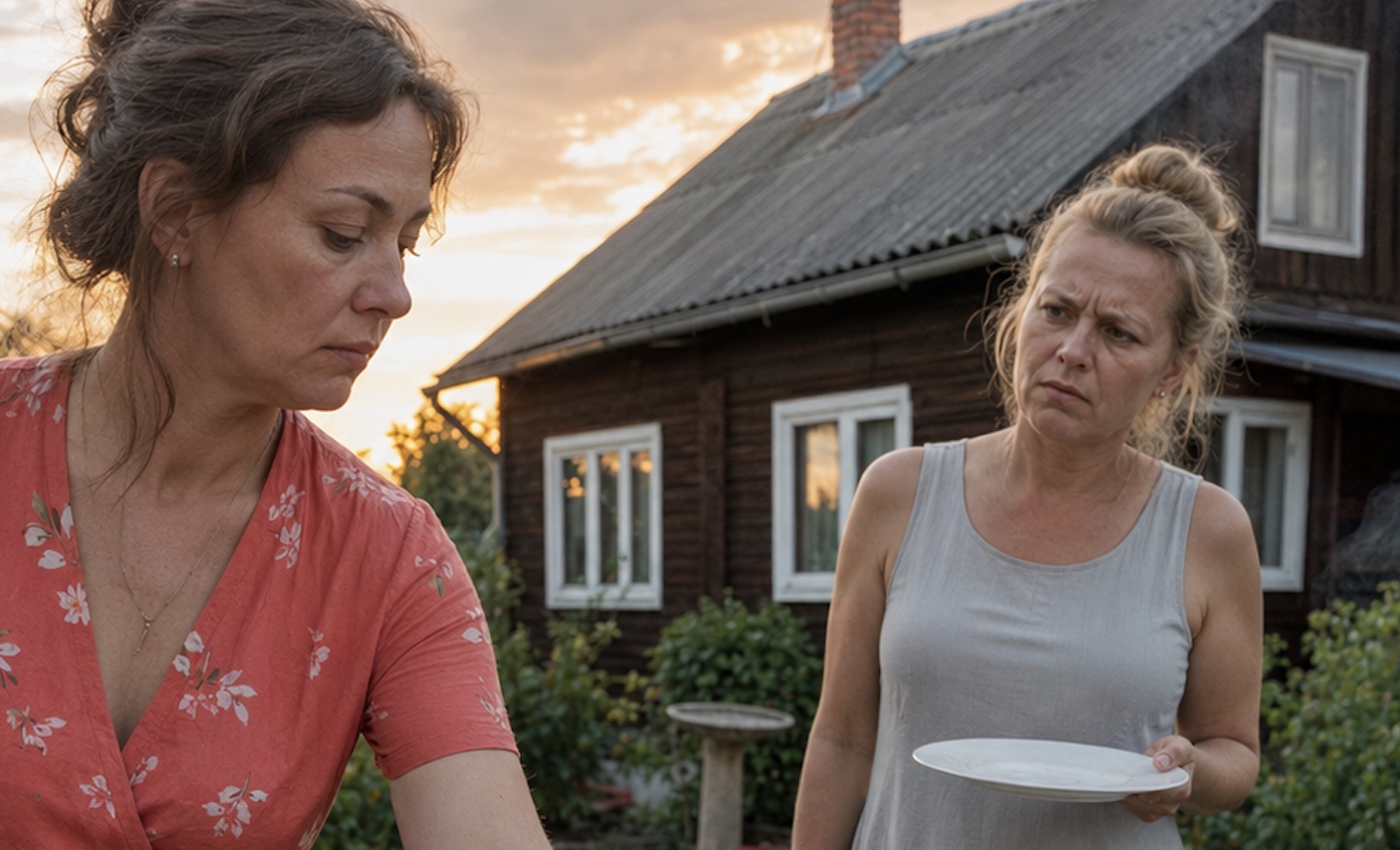
Sveta stood on the veranda of the country house, watching a familiar figure walk along the winding path from the gate with two children trailing behind her. As always, Inga was carrying an enormous bag stuffed with children’s toys and an inflatable swimming ring. Eight-year-old Alyona and five-year-old Maksim hurried after their mother, loudly discussing everything they planned to do that day before they had even reached the house.
“Not again,” Sveta sighed, stepping away from the window. “Misha, your sister is here.”
Mikhail looked up from his laptop. He had spent the last three hours working through a stack of documents. For him, the country house was not only a place to relax but also somewhere he could work peacefully, far from the noise of the city. Unfortunately, that peace was regularly interrupted by Inga’s visits.
“Again? She was here just last weekend,” he grumbled, saving his file and closing the laptop.
A second later, they heard the familiar knock: two short taps, one long one, followed by two more short taps. It was Inga’s signature entrance.
“Hello, my dears!” Inga burst into the house like a summer storm, instantly filling every room with her loud voice and restless energy. “Children, say hello to your uncle and aunt!”
Alyona and Maksim obediently kissed their relatives on the cheek before racing off to explore the house as though they had never seen it before, even though they had been there only a week earlier.
“How are you? How’s work?” Inga asked, looking around and already deciding where she would settle herself. “It’s unbearably hot in the city. Here, though, it’s paradise. Fresh air, peace and quiet. We won’t stay long. We’ll just swim and have lunch. The children begged me to bring them here!”
Sveta silently watched the familiar performance. Inga always claimed they would not stay long, yet somehow they never left before evening. Sometimes they even stayed overnight. There was always an excuse. The children were tired, the roads were busy, or it was suddenly “too late to drive home.”
“Inga, perhaps next time you could call us before coming?” Sveta suggested carefully. “We might have plans or be preparing to go somewhere.”
“Oh, don’t be silly!” Inga waved her hand dismissively. “We’re family! Alyona, Maksim, don’t touch Uncle Misha’s papers!”
But the children had already taken over the living room. Toys were scattered across the floor, Maksim had turned the television volume all the way up, and Alyona was opening drawers in the dresser.
“Aunt Sveta, do you have anything tasty?” Alyona asked, already heading toward the refrigerator.
“Of course, sweetheart.”
Sveta opened the refrigerator and took out yogurt, fruit, and juice. Deep down, she knew that the children were not responsible for their mother’s behavior, but her irritation grew stronger with every visit.
Meanwhile, Inga had already changed into her swimsuit and stretched out on a lounge chair beside the pool. From time to time, she shouted instructions at the children as they splashed in the water.
Mikhail tried to return to work, but concentrating was impossible. The children screamed and laughed, while Inga spoke loudly on the phone, telling her friends about her “luxurious weekend at the country house.”
By lunchtime, Sveta had prepared a simple salad and reheated soup from the previous day. As usual, Inga praised the meal, then immediately explained how she cooked the same dishes “completely differently” using a secret ingredient.
The children ate enthusiastically, leaving food, crumbs, and dirty dishes everywhere without cleaning up after themselves.
“Misha, do you have any tools?” Inga asked, already planning another activity. “Maksim wants to build or repair something. He’s growing into such a talented little handyman!”
With a heavy sigh, Mikhail put aside the documents he still had not managed to finish reading and led his nephew toward the tool shed.
Sveta cleaned up after the children, mentally calculating how much food they had eaten and wondering, as always, how two small children could create such an astonishing amount of mess.
That evening, when Inga finally began preparing to leave, Sveta could no longer remain silent.
“Inga, perhaps we really should agree on visits in advance,” she said. “We come here to work and rest, not to entertain guests every weekend.”
Inga’s face changed immediately. Her expression filled with wounded indignation.
“Oh, I see! So we’re bothering you now! And I thought we were family and that you were always happy to see us. Misha, are you hearing what your wife is saying?”
Mikhail suddenly found himself trapped between his wife and his sister.
“Sveta, come on… Inga, of course we’re happy to see you, but she’s right. Maybe you could at least let us know before coming.”
“What are you talking about?” Inga exclaimed. “We don’t arrive empty-handed! And the children are perfectly well behaved. They never cause trouble.”
Sveta nearly laughed. By that point, the “well-behaved” children had broken a cup, drawn on the table with markers, and flooded the bathroom floor.
“It isn’t about the children,” Sveta explained patiently. “It’s about the fact that we have our own plans and our own lives. And honestly, it would be nice if you occasionally brought something with you. Biscuits for tea, perhaps, or fruit for the children. We feed everyone every time you visit, and then we spend hours cleaning afterward.”
Inga puffed up like an offended turkey.
“Well, excuse me for being such a burden! I didn’t realize I had to pay for the privilege of visiting my own brother!”
“Don’t twist her words,” Mikhail said wearily. “This isn’t about money. It’s about—”
“I understand everything perfectly!” Inga cut him off. “We won’t bother you again!”
She gathered the children and drove away, slamming the car door for dramatic effect.
Mikhail and Sveta were left behind to deal with the aftermath: wet towels, scattered toys, dirty dishes, and stains throughout the house.
“Do you think she understood?” Mikhail asked as he collected the children’s books from the floor.
“I doubt it,” Sveta replied with a sigh. “But at least we might have two peaceful weeks.”
Almost three weeks passed before Inga called.
Her voice sounded conciliatory, although there was still a trace of deliberate hurt in her tone.
“Misha, hello. How are you? How’s your health?”
“I’m fine,” Mikhail answered cautiously. “How are you and the children?”
“We’re all well. Listen, could we come over this weekend? The children miss the country house so much. They keep asking when we can visit Uncle Misha and Aunt Sveta again.”
Mikhail looked at Sveta. She shook her head meaningfully.
“Inga, we were planning to—”
“We won’t come empty-handed!” Inga interrupted quickly. “I’ll bring something delicious and some fruit for the children. I promise we’ll be perfect guests!”
Hearing this, Sveta gave a hesitant nod. Perhaps Inga had finally understood. Maybe she really was willing to change.
“All right,” Mikhail agreed. “Come on Saturday around lunchtime.”
“Thank you, darling! We’re so excited! See you then!”
On Saturday, Inga arrived carrying a large bag. With a proud flourish, she took out a wedge of expensive cheese, a bag of peaches, and several cartons of juice for the children.
“Look, just as I promised!” she announced. “The cheese is almost French. Everyone at the store recommended it. And look at these peaches. Aren’t they beautiful?”
Sveta was pleasantly surprised. The cheese looked excellent, the peaches smelled wonderfully fresh, and the children were delighted with the juice.
“Thank you, Inga,” she said sincerely. “That was very thoughtful of you.”
“Oh, it’s nothing. We’re family!” Inga replied, glowing with satisfaction. “Why don’t we make shashlik? I feel like celebrating!”
Encouraged by his sister’s apparent change in attitude, Mikhail agreed to arrange a small family feast. He went to the store to buy meat and vegetables while the women prepared salads.
Inga was unusually helpful and considerate. She helped set the table and kept an eye on the children.
The evening was genuinely pleasant. The cheese was delicious, the grilled meat turned out tender and juicy, and the children played happily on the grass. Inga told funny stories, Mikhail cooked at the grill, and Sveta enjoyed the rare feeling of peaceful family harmony.
When darkness fell and the children began to yawn, Inga stood up and walked toward the table.
“Where’s the cheese we brought?” she asked. “We’ll take the rest home with us.”
She began placing the remaining cheese, the uneaten peaches, and the unopened juice cartons back into her bags.
Sveta and Mikhail exchanged a look. Sveta felt the evening’s warmth vanish, replaced by disappointment.
“Inga, what are you doing?” she asked quietly.
“What does it look like? I’m taking our food home,” Inga replied calmly, continuing to pack. “The children have school, and there’s nothing for them to eat tomorrow.”
“But you brought those things as a gift.”
“What gift?” Inga asked. “I said I wouldn’t come empty-handed, and I didn’t. Of course I’m taking the leftovers. There’s no reason to waste perfectly good food.”
She methodically collected everything she had brought.
Then she looked at the remaining grilled meat and salads.
“Do you have a container for the meat?” she asked. “I’ll take these vegetables too. You can always cook more, but I have children to feed at home.”
“Inga,” Mikhail protested, “we prepared that food for everyone. We bought all the ingredients.”
“Oh, don’t be ridiculous,” she said, waving him off. “You have a country house and a vegetable garden. Everything is free for you here. I live in an apartment in the city, where I have to buy every little thing. The children are growing. They need food.”
She packed almost all the leftovers into containers, leaving the hosts with little more than scraps.
The children were already asleep in the car by the time Inga finished gathering everything.
“Thank you for a wonderful evening!” she said cheerfully as she loaded the bags of food into the car. “We had such a lovely time. We’ll definitely come again!”
Mikhail and Sveta stood by the gate and silently watched the car’s lights disappear down the road.
On the table behind them, only dirty plates and crumpled napkins remained.
“Well,” Sveta said softly, “do you understand now that she’s never going to change?”
Mikhail stared at the empty table and nodded.
“I understand. She didn’t come to visit us. She came for a free meal. She even took back everything she brought.”
“Do you know what upset me most?” Sveta asked as she gathered the empty plates. “It isn’t that she took her own groceries. It’s that she genuinely doesn’t understand why it’s wrong. To her, it’s completely normal to arrive, eat, sunbathe, and then carry the rest of our dinner home.”
“I thought she had understood what we were trying to tell her.”
“She understood only that she had to bring something for appearances. Then she took it all back. That’s almost worse than arriving empty-handed.”
They cleared the table in silence, each absorbed in private thoughts.
Sveta remembered how pleased she had been that morning when she saw the cheese and peaches. She had truly believed that her relationship with her sister-in-law might improve.
Mikhail thought about the sister who had once been his closest friend but had gradually turned into an intrusive freeloader.
“What are we going to do?” Sveta asked as she loaded the dishes into the dishwasher.
“I don’t know,” Mikhail admitted. “Talking to her is useless because she doesn’t listen. But we can’t completely forbid her from coming. She’s still my sister, and the children haven’t done anything wrong.”
“We could simply stop answering her calls,” Sveta suggested. “Maybe then she’ll understand that she can’t behave this way.”
“That would look childish.”
“And how is she behaving?” Sveta asked. “She’s a grown woman acting like a spoiled child who believes everyone owes her something.”
Mikhail knew his wife was right. Inga truly believed that relatives were obligated to feed her, entertain her, and tolerate all her demands. The saddest part was that she honestly could not see anything wrong with her behavior.
A week later, Inga called again.
“Misha, hello! How are you? We had such a wonderful time last weekend. The children are still talking about the grilled meat. Could we come again next Saturday?”
Mikhail looked at Sveta, who shook her head firmly, and rejected the call.
“She’s calling again,” he said, switching off his phone.
“Don’t answer,” Sveta asked. “She needs to understand that we’re serious.”
Inga called several more times.
Then she sent him a message.
“Misha, what happened? Why aren’t you answering?”
A few minutes later, another message appeared.
“Is Sveta against us visiting? But we had such a wonderful evening!”
Then came a third.
“Are you offended because I took the leftovers? They would only have gone bad!”
Mikhail and Sveta did not reply.
They realized that explanations were pointless. Inga was simply incapable of understanding that it was rude to inconvenience relatives and then take advantage of their hospitality.
A month passed.
Inga stopped calling.
Sometimes Mikhail wondered whether they had treated her too harshly. But then he remembered the years of unannounced visits, ruined plans, emptied refrigerators, and endless cleaning.
Sometimes, the only way to stop unacceptable behavior was to refuse to let it continue.
Sveta no longer flinched whenever the doorbell rang on weekends. Mikhail could work peacefully at his computer without fearing that he would suddenly have to abandon everything to entertain unexpected guests.
Their country house became a place of rest again instead of a free family restaurant.
Occasionally, Mikhail wondered whether there might have been another way to solve the problem. But then he remembered Inga’s expression as she packed the leftover cheese into her bags, and he understood that some people truly could not be changed.
The only option was to protect their own lives and refuse to let such people disturb their peace.
Summer was coming to an end, and they enjoyed every quiet evening on the veranda, knowing that no one would suddenly appear demanding to be fed, served, and entertained.
Sometimes they felt sad that family relationships could end so badly. Yet both of them understood that respect for other people’s boundaries was the foundation of any healthy relationship.
When someone was incapable of understanding that, limiting contact was sometimes the only reasonable choice.
In autumn, while they were preparing to close the country house for the winter, Sveta found a forgotten box of expensive biscuits in a cupboard. Inga had once brought it “as a gift” and apparently forgotten to take it home.
“Look,” Sveta said, showing the box to Mikhail. “The only thing she left behind in all these years.”
Mikhail smiled sadly.
“She probably just forgot about it. Had she remembered, she would definitely have taken it with her.”
They both laughed, and somehow everything felt lighter.
Their boundaries had finally been established, their peace had been restored, and a quiet winter lay ahead without unexpected visits or demands on their hospitality.