Viktor Semyonovich unlocked the front door as usual and stopped short in the hallway.
The apartment was strangely silent. There was no clatter of dishes from the kitchen, no comforting smell of dinner cooking. Normally, by the time he came home, Lida would already be busy at the stove—boiling something, frying cutlets, baking pies. Their home had always been filled with the aroma of fresh pastries and homemade meals.
“Lida?” he called, taking off his coat.
“I’m in the kitchen,” came her calm reply.
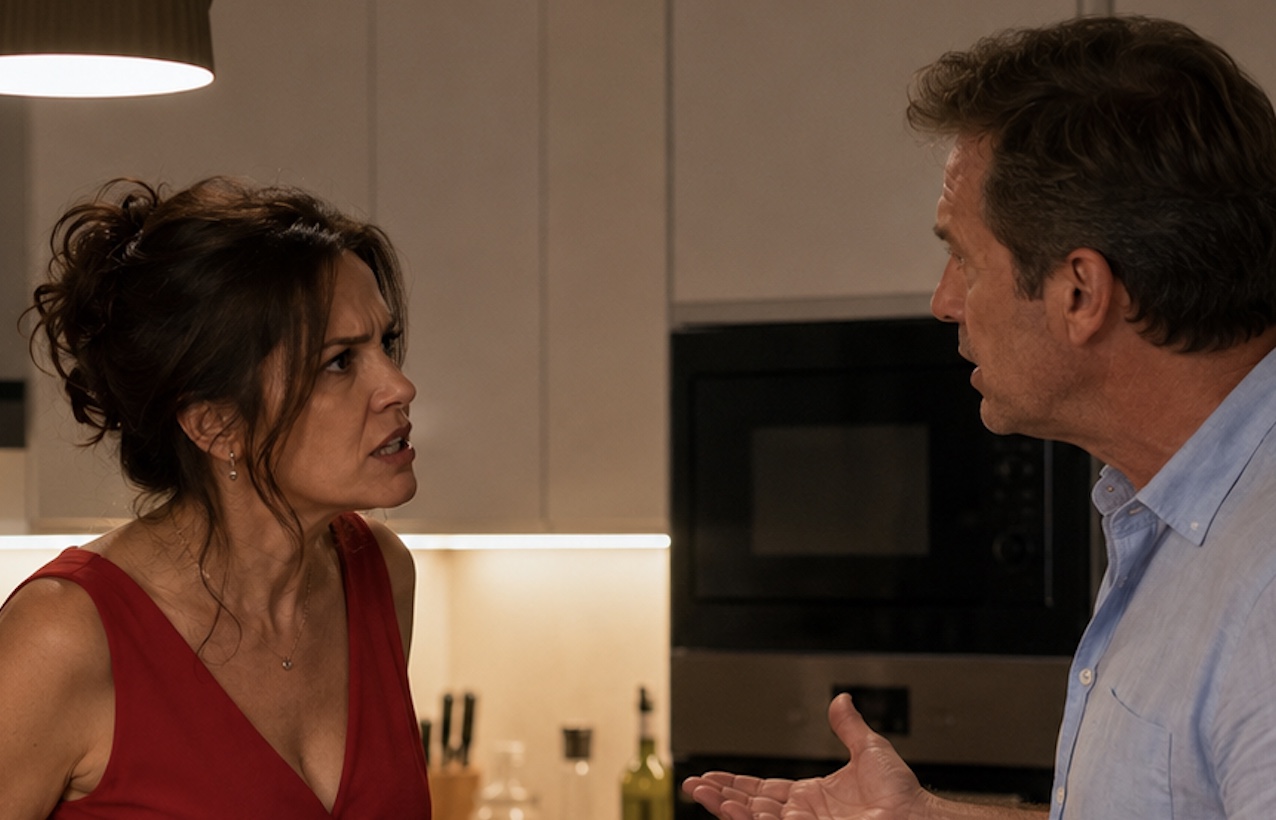
Viktor walked in and found his wife sitting at the table with a cup of tea. The stove was cold. There were no pots, no chopping boards, no signs that she had even considered making dinner.
“Where’s the food?” he asked in surprise.
“What food?” Lida replied without looking up.
“What do you mean, what food? Dinner. I just got home from work, and I’m starving. Are you feeling sick?”
At last, Lida raised her eyes. There was something unfamiliar in them, something Viktor had never noticed before.
“No, I’m not sick. I’ve simply stopped cooking.”
“What do you mean, stopped?” he asked, confused, as he sat down across from her. “You always cook. Your meat patties, your borscht, those cabbage pies…”
“That’s over, Vitya.”
Viktor stared at her, unable to understand what was happening. Only yesterday, everything had seemed normal. Lida had welcomed him home with a hot meal, told him about her day, and watched television with him in the evening. She had seemed unusually thoughtful, perhaps, but he had not paid much attention.
It had all begun two weeks earlier, when Lida returned from work glowing with excitement.
“Vitya, you won’t believe it! I received a bonus!” she exclaimed, waving an envelope in the air. “A big one! It was for the project I’ve been working on for six months.”
“How much?” Viktor asked immediately.
“One hundred thousand rubles! Can you imagine? A whole hundred thousand!”
Viktor gave a low whistle. It really was a considerable amount. His engineering salary was modest, and Lida’s earnings were hardly impressive either. A bonus like that felt like an unexpected gift from fate.
“You know what?” Lida continued eagerly. “Let’s go somewhere. We could take a holiday for a week, maybe even ten days. We haven’t travelled anywhere in such a long time.”
“Wait,” Viktor interrupted. “There’s no need to rush. That’s a serious amount of money. We should think carefully and spend it wisely.”
“What is there to think about? We’re both exhausted. All we do is work. When was the last time we had a proper rest?”
“Lida, be sensible. Money is money. You shouldn’t waste it without thinking.”
And Viktor did think about it.
For an entire week, he considered different possibilities, calculated expenses, and discussed the matter mostly with himself. Then he remembered that his mother’s seventieth birthday was approaching.
It was an important anniversary, and choosing a gift for Raisa Petrovna was never simple. Viktor’s mother was a demanding woman who never hid what she expected from her son.
“Vitenka,” she often said, “I won’t be around forever. A mother wants to know that her son remembers her while she is still alive. It would be nice if you spoiled me occasionally.”
And Viktor did spoil her.
He bought her expensive presents, paid for renovations in her apartment, and helped maintain the country house she had decided she needed “for her health.” Lida had never openly objected, although Viktor sometimes noticed the way her lips tightened whenever he announced another expense connected to his mother.
One morning over breakfast, he finally shared his brilliant idea.
“Listen,” he said, “Mother’s anniversary is coming up soon.”
“Yes, I know.”
“We need to choose something special. A serious gift.”
“Do you have anything in mind?”
“Yes. And I think I’ve come up with the perfect solution. We’ll buy her a gold watch with diamonds. Something elegant and respectable. She has always dreamed of owning one.”
Lida looked at him.
“And how are we paying for it?”
“With your bonus,” Viktor replied enthusiastically. “Isn’t that a great idea? We solve two problems at once. We won’t have to struggle over what to buy, and since the gift will be from both of us, we’ll save money too.”
Lida said nothing. She slowly stirred her tea.
“It’s brilliant, really,” Viktor went on, becoming more pleased with himself. “Mother will be thrilled. She has always said she wants something valuable that can eventually be passed down to the grandchildren. A family heirloom, you know?”
“To the grandchildren,” Lida repeated quietly.
“Exactly. When we have children, imagine how happy she’ll be. She’ll say, ‘Now that is a proper gift! What a wonderful son I raised!’”
“You want to buy your mother a present with my bonus?” Lida asked suddenly.
There was something in her voice that made Viktor pause.
“Well… yes. Why not?”
“So from now on, you can eat at her house,” Lida snapped. “There won’t be any homemade feasts here for you.”
Viktor was stunned.
He had expected her to admire his cleverness, perhaps even thank him for finding such an elegant solution. Instead, she was angry.
“Lida, are you joking?”
“No, Vitya. I’m completely serious.”
“But why? The gift will be from both of us. Mother will believe you contributed too.”
“I will have contributed. I’ll have contributed my entire bonus. What exactly will you contribute?”
“What do you mean? The idea was mine. I was the one who thought of it.”
“You thought of spending my money on your mother. Very clever.”
“But she is your mother now too. We’re a family.”
“A family,” Lida agreed. “Except in this family, my money always seems to go toward your mother, while no one cares about my dreams.”
“What do dreams have to do with anything? We don’t live in a fairy tale.”
“No, we don’t. We live in the real world, where I’ve spent twenty years cooking all your favourite dishes while you decide that my bonus belongs on your mother’s wrist.”
“Lida, don’t behave like a child. A good gift is an investment in peaceful family relations. When Mother is happy, life is easier for all of us.”
“You know what, Vitya? I want a peaceful life too. That is why I’m no longer cooking.”
“What do you mean, you’re not cooking?”
“Exactly what I said. My hands are tired, my back hurts, and I’ve lost my inspiration. You said it yourself—we don’t live in a fairy tale.”
And she kept her word.
At first, Viktor assumed it was a temporary tantrum. He expected her to calm down after a day or two. But the days passed, and Lida remained firm.
“Couldn’t you make something simple?” he pleaded. “I can’t keep eating in cafés or surviving on sandwiches every day.”
“And I can’t keep standing over the stove every evening knowing that the money I earned went toward pleasing your mother.”
“But I already bought the watch.”
“Wonderful. Now your mother has a beautiful watch, and I have more free time.”
“Lida, be reasonable. You enjoy cooking.”
“I used to. I enjoyed cooking when I believed I was doing it for our family—for the two of us. Somehow, after watching my bonus disappear into a present for your mother, I lost the desire.”
“All right,” Viktor said eventually. “Let’s make a deal. I’ll choose something else.”
“There’s no need. It’s too late.”
“Why is it too late?”
“Because I’ve finally understood something. You will always put your mother before me. Her interests will always matter more than mine, and I’m tired of accepting it.”
“She’s my mother! She gave birth to me and raised me.”
“And what am I? A stranger? I’ve spent twenty years beside you. I cook for you, wash your clothes, support you when you have problems, and make this home comfortable. Yet whenever money or an important decision is involved, only your mother’s opinion seems to count.”
“You’re exaggerating.”
“Am I? Who decided what car we bought? Your mother. Who chose the neighbourhood where we moved? Your mother. Whose money paid for her country house? Mine. Whose money covered the repairs in her apartment? Mine again. And now my bonus has paid for her birthday present.”
“I didn’t make those decisions alone. I discussed everything with you.”
“You didn’t discuss anything. You informed me after the decision had already been made. Those are two different things.”
Viktor fell silent.
Somewhere inside, he knew his wife was right. Still, he could not accept the idea that taking care of his mother was somehow wrong.
“You know what?” he said at last. “If you don’t want to cook, then don’t. I’ll manage somehow.”
“Then manage.”
“But it’s ridiculous. We’re a family.”
“A family where the husband’s mother is more important than his wife. Yes, I know that kind of family.”
“Lida, what are you saying? You know I love you.”
“I know. I also know you love your mother more.”
“That’s a completely different kind of love.”
“Yes, it is. Your love for your mother is self-sacrificing. You’ll do anything for her. Your love for me is convenient. You’re used to taking.”
“How can you say I only take? I work. I bring money home.”
“You bring money home, and then you spend it on your mother’s needs. Along with mine.”
“All right,” Viktor said. “Suppose you’re right. What are you suggesting?”
“I’m not suggesting anything. I’m simply not cooking anymore.”
“That’s all?”
“For now.”
“And what if I promise never to spend your money on Mother again?”
“We’ll see. But I still won’t cook.”
“Why not?”
“Because I’m tired. I’m tired of cooking for a man who doesn’t value me.”
“I do value you.”
“Do you? Then why did you spend my bonus without having a real conversation with me?”
“I thought you wouldn’t mind.”
“No. You thought I would stay quiet, as I always have. This time I didn’t.”
“So what happens now?”
“Now you learn to cook. Or ask your mother to feed you, since she is so important.”
“Lida, you know this is absurd.”
“It was absurd for me to remain silent for twenty years. From now on, I’m going to speak.”
“Speak, then. But why make such a dramatic change?”
“Because you wouldn’t understand otherwise. You’ve grown used to me enduring everything, forgiving everything and always being understanding. I’m not doing that anymore.”
“But we can come to an agreement.”
“An agreement? I tried for twenty years. I gently told you that I didn’t like seeing my money constantly spent on your mother. I said I wanted to use some of it for myself, or for us. You never listened.”
“I listened, but…”
“But your mother’s needs always came first. So now you can live with the consequences.”
“You can’t behave like this.”
“Yes, I can. And I will. You want food, make it yourself. You want to spoil your mother, use your own money.”
“What if I pay back the bonus?”
“How exactly? Jewellery cannot simply be returned.”
“I could repay you from my salary.”
“No, thank you. Keep your money. You might need it for your mother.”
“Lida, be reasonable.”
“I am being reasonable. I simply came to my senses far too late.”
“All right,” Viktor said, defeated. “Don’t cook. But at least tell me what I’m supposed to do.”
“What is there to explain? Live however you choose. Just don’t expect me to organise your life for you anymore.”
“What does that mean?”
“It means I’m no longer your servant. I’m your wife. A wife who has a right to her own opinion and her own money.”
“I never thought of you as a servant.”
“Really? Who washed your shirts? Who prepared your favourite meals? Who cleaned the apartment and bought the groceries?”
“You did, but…”
“Yes, I did. And who decided how our money was spent? Who chose what mattered and what didn’t?”
“I did, but I always consulted you.”
“You announced your decisions. That isn’t consultation.”
“What do you want from me, Lida?”
“Nothing. I only want you to understand that I’m not an object that must remain silent and tolerate everything. I’m a person with my own wishes and dreams.”
“I already understand that.”
“No, you don’t. If you did, you would never have spent my bonus on a diamond watch for your mother.”
“But it seemed like a sensible idea.”
“Sensible for whom? For you and your mother. For me, it was humiliating.”
“Humiliating? How?”
“I spent six months working on that project. I stayed awake at night, worried constantly and worked myself to exhaustion. When I received that bonus, I was happy because I thought we could finally take a trip and rest together. Then you took the money and used it to make your mother happy.”
“It was a good gift. Mother is delighted.”
“Yes. Your mother is delighted, and I’m miserable. Yet that doesn’t seem to concern you.”
“It does concern me, but…”
“But Mother matters more.”
“She doesn’t matter more. It’s just…”
“She does, Vitya. She always has. And I’m tired of pretending otherwise.”
“What do you expect me to do?”
“Nothing. Continue living as you always have. Only without my elaborate meals.”
“But I’m used to them.”
“Then get unused to them.”
“What if I change?”
“We’ll see. But I still won’t cook.”
“Never?”
“Never.”
“But that’s… strange.”
“What was strange was staying silent for twenty years. Telling the truth is perfectly normal.”
“What truth?”
“That I’m not your mother. I don’t have to satisfy your every need. I have wishes and dreams too.”
“I’ve never objected to your wishes.”
“Really? Then why did you spend my bonus?”
“Because I thought you wouldn’t object.”
“You thought I would keep quiet. But I didn’t.”
“So what happens now?”
“Now you decide what matters more to you—your mother or your wife. Because we cannot continue living like this.”
“You can’t force me to choose in such a harsh way.”
“Yes, I can. For twenty years, I came second. I won’t accept second place anymore.”
“But Mother is old. She may not have much time left.”
“And how much time do I have? I’m not immortal either, Vitya.”
“It’s different with Mother.”
“Yes, it is different. With her, you’re a devoted son who believes he must take care of her. With me, you’re a husband who expects to receive without giving anything back.”
“What do you mean, without giving anything back?”
“What do you give me, other than your presence?”
“Lida, how can you say that?”
“I’m saying the truth. You’re used to receiving a delicious dinner, clean clothes and a comfortable home. But when it comes to my needs, suddenly they’re not important.”
“They are important, but…”
“But not important enough to spend money on. A watch for your mother comes first.”
“I’m sorry, Lida. I never meant to hurt you.”
“Maybe not. But you did. And it wasn’t the first time.”
“What should I do?”
“Learn to live differently. Without expecting me to serve you.”
“What if I really change?”
“We’ll see. But the old Lida is gone.”
“What old Lida?”
“The woman who tolerated everything and stayed silent. The woman who placed your needs above her own and convinced herself that it was normal.”
“So what will happen now?”
“Now there will be fairness. If you want to spend money on your mother, spend your own. If you want elaborate meals, cook them yourself.”
“But I don’t know how.”
“You’ll learn. Or ask your mother. She seems to matter enough.”
“Lida, honestly…”
“What? I’m saying what I think for the first time in twenty years.”
“Are we really going to live like this?”
“I don’t know how we’re going to live. But I do know we won’t live the old way anymore.”
“What if I…”
“No more ‘what ifs.’ I’ve made my decision.”
“But we’re family.”
“A family where one person matters more than another isn’t a real family. It’s something else.”
“Lida, give me another chance.”
“Another chance? I gave you chances for twenty years. That’s enough.”
“But I love you.”
“I know. You love me in your own way—a way that is comfortable for you.”
“Then how should I love you?”
“As an equal. As a human being whose opinion matters. As your wife, not your servant.”
“I don’t think of you as a servant.”
“You may not think the word, but that is how you treat me.”
“What do I do now?”
“Think. I’ve spent twenty years thinking for both of us. Now it’s your turn.”
Lida rose from the table and left Viktor sitting alone in the kitchen.
He could not understand how one watch had changed everything. He had only wanted to do what seemed best.
Yet the longer he sat there, the more he began to realise that his wife was right.
He had become used to believing that Lida would endure everything, understand everything and forgive everything. Her opinion had always existed somewhere in the background, but he had rarely treated it as something truly important.
Now he would have to learn how to live differently.
Without her elaborate dinners.
Without the comfort he had taken for granted.
Without the certainty that his wife would always remain beside him, no matter what he did.
The diamond watch for his mother had turned out to be far more expensive than one hundred thousand rubles.
It might cost him his marriage.
Perhaps, in the end, that would force him to change. Perhaps change was long overdue.
Viktor did not yet know how to repair what he had broken.
He knew only one thing.
There would be no more homemade feasts.