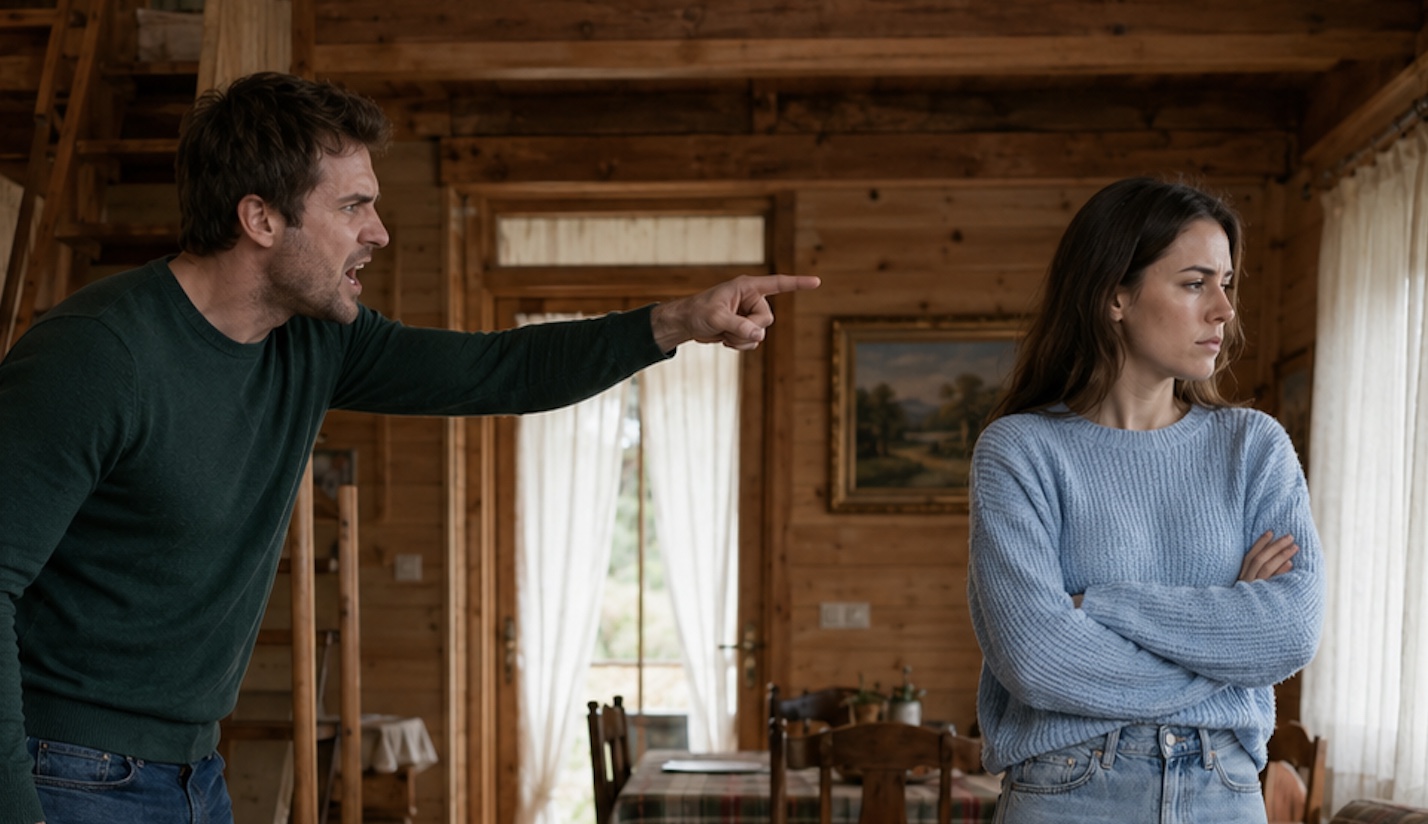
“Sell the country house, and we can save our marriage. Refuse, and you can start packing,” Ilya declared, fully expecting Ksenia to be frightened.
He said it calmly, almost casually, while sitting at the kitchen table and staring at his phone. Warm air drifted through the open window, carrying the scent of sun-heated leaves and dust after a scorching day. The corner of a utility bill trembled in the breeze on the windowsill. Someone outside was watering a flower bed, while loud music played from a neighboring building.
Ksenia looked at her husband for several seconds without changing her expression.
“Say that again,” she asked.
Ilya raised his head. He looked composed, even confident. He had clearly prepared for this conversation and intended to follow a plan he had already worked out.
“I said the country house needs to be sold. You have to stop clinging to a piece of land that only consumes your time and energy. We’ll use the money to help Kirill buy an apartment. Things are difficult for him right now. Rent keeps increasing, and he, his wife, and their child are all squeezed into one room at her parents’ place. If you dig your heels in again, I don’t see any point in continuing this marriage.”
Ksenia slowly placed her keys on the cabinet beside the front door, removed her light jacket, and hung it on a hook.
She had returned from work later than usual. A machine had broken down at the workshop, and she had been forced to wait for a technician. The heat had been unbearable all day. The asphalt seemed to melt beneath people’s feet, and even those waiting in line to buy water had been irritable.
But the moment she heard her husband’s conditions, her exhaustion disappeared.
“So your brother wants an apartment, but I’m the one who has to sell my country house?”
“Don’t twist my words. The place is sitting unused.”
“It isn’t unused.”
“You go there twice a month.”
“I go there whenever I decide to.”
Ilya placed his phone facedown on the table.
“That’s exactly the problem. Everything always has to happen the way you decide. I’m tired of living with someone who only thinks about herself.”
Ksenia walked to the refrigerator, took out a bottle of water, and poured herself a glass. She drank slowly without taking her eyes off him.
Ilya hated being interrupted, but what irritated him even more was the other person remaining calm. He liked immediate reactions—hurt, excuses, attempts to bargain.
Ksenia gave him none of those things.
The country house had been left to her by her grandfather seven years earlier. The small wooden building stood in a gardening community about forty kilometers outside the city. The land was well maintained, with apple trees, currant bushes, and an old gazebo that Ksenia and her father had repaired before she had even met Ilya.
After her grandfather’s death, she had waited the legally required six months, accepted the inheritance, and registered everything in her own name.
Ilya entered her life later.
During the first years of their marriage, he had been indifferent to the property. Occasionally, he came along to grill meat, carry wooden boards, or repair the water pump, but he never took an interest in the documents, expenses, or Ksenia’s plans for the place.
His relatives, however, quickly recognized its usefulness.
Ilya’s mother, Lyudmila Borisovna, enjoyed visiting with a friend. His older brother Kirill had asked several times to use the property for gatherings.
Ksenia did not always agree, and gradually her country house became a source of resentment within Ilya’s family.
“You decided to give me an ultimatum because of Kirill?” she asked.
“Not only because of him.”
“Then list the other reasons.”
Ilya leaned back slightly in his chair.
“You’re closed off. You never consult me. You make every decision on your own. It’s the same with the country house. I offered a reasonable solution, and you refuse even to discuss it.”
“You didn’t offer anything. You already decided where the money would go and informed me that I would be thrown out of my own apartment if I didn’t agree.”
“Don’t be dramatic. The apartment may legally belong to you, but we live here together.”
“Exactly. We live here together. We don’t own it together.”
The apartment they were sitting in had been purchased by Ksenia before the marriage. Ilya moved in after the wedding. He had kept his small studio apartment and rented it to an acquaintance.
He spent the rental income however he pleased, considering it his personal money. Ksenia had never demanded an account of it or suggested that he sell his property to help one of her relatives.
Ilya knew perfectly well who owned the apartment.
That made his threat that she should “pack her things” particularly absurd.
Ksenia sat down across from him.
“All right. Let’s assume I sell the country house. What happens next?”
Ilya brightened. He thought she was beginning to give in.
“We buy a small apartment. Kirill will gradually pay us back.”
“Pay whom back?”
“Us.”
“Over what period?”
“We can discuss that.”
“What kind of agreement will be drawn up?”
Ilya frowned.
“Are you serious?”
“Completely. In whose name will the apartment be registered?”
“Kirill’s, of course. He has a child.”
“Then why should the money come from me?”
“Because you have the means.”
“You own a studio apartment.”
Ilya’s expression changed. He ran his fingers along the edge of the table and looked at his wife with considerably less confidence than before.
“My studio is not part of this discussion. It’s financial security.”
“For whom?”
“For us.”
“No. For you. Your property is ‘financial security,’ while mine is a useless plot of land.”
“The studio generates income.”
“Then sell it and help your brother.”
“I’m not required to give up my property.”
Ksenia smiled faintly.
“But I am?”
Ilya stood up and walked toward the window. He was not an unintelligent man, and by now he had realized that his own arguments contradicted one another.
Still, he had no intention of backing down.
“You reduce everything to legal technicalities. We’re talking about helping someone close to us.”
“Then help him.”
“I’m helping however I can.”
“So far, your version of helping involves selling my country house.”
He turned sharply.
“I’m not going to keep proving that your position is wrong. You have an unhealthy attachment to that place. It’s an old house, the road is inconvenient, and it constantly requires money. You’re only holding on to it because your grandfather left it to you.”
“Even if that’s true, it’s reason enough.”
“And our marriage isn’t reason enough?”
“Reason enough for what? Giving my property to your brother?”
“Reason enough to show that you’re willing to sacrifice something.”
Ksenia placed her glass closer to herself and interlaced her fingers.
“All right. What are you willing to sacrifice?”
Ilya said nothing.
“We’re not touching your studio,” she continued. “You don’t plan to sell your car. You don’t want to use your savings. But you propose testing my devotion by selling my country house. Convenient system.”
“I contribute to this family in other ways.”
“How?”
“I live with you. I support you.”
“That isn’t a contribution, Ilya. That is normal behavior between spouses. And judging by today’s conversation, you’ve even decided to turn that into a favor.”
He slapped his palm against the table. Not hard, but forcefully enough to display his irritation.
“You know what? I’ve had enough. You calculate everything. You turn everything into a transaction.”
“Because you came to me with a transaction. My country house in exchange for preserving the marriage.”
“I’m trying to get through to you.”
“No. You expected to scare me.”
The room fell silent.
Children laughed somewhere outside. Then came the squeal of brakes and someone’s angry voice.
Ilya stared at Ksenia as though he were seeing her for the first time—not as his wife, but as someone who could not be pushed toward the desired decision with a single threat.
“Then answer me directly,” he said. “Are you refusing?”
“I’m not selling the country house.”
“So you’re choosing it.”
“No. You were the one who placed our marriage beside property that doesn’t belong to you and tried to force me to choose between them.”
Ilya nodded slowly.
“Fine. Then we’re separating.”
“Fine.”
That was not the answer he had expected.
Ksenia saw it in the way he froze before reaching his chair. He had clearly assumed that she would panic, begin explaining how much she valued their relationship, offer a compromise, or at least ask for time.
But Ksenia had already understood the most important thing.
The ultimatum had not been an impulsive outburst. Ilya had planned it in advance, discussed it with his relatives, and come home convinced that his wife would surrender.
“Just like that?” he asked.
“You gave me two options yourself.”
“And there’s nothing keeping you here?”
“What kept me here was respect. You ended that today.”
Ilya lowered himself into his chair.
“You’re emotional right now.”
“No. You’re the emotional one. I’m seeing everything clearly.”
She stood, picked up her phone, and walked into the bedroom. Ilya did not follow.
Ksenia closed the door, not because she wanted to hide, but because she needed to decide calmly what to do next.
First, she opened her banking application.
They did not have a joint account, but there was a bank card Ilya used for household purchases. It was linked to Ksenia’s account.
She disabled his access immediately.
Then she checked the documents. The papers for the apartment were kept in the bottom drawer of the dresser. The country house documents were stored separately in a home safe.
Everything was where it belonged.
Only then did Ksenia call her father.
“Dad, are you free tomorrow morning?”
“Until noon. What happened?”
“We need to drive to the country house.”
“Did something break?”
“Not yet. But some people may suddenly develop an unnecessary interest in the property. I want to replace the lock cylinder and check the windows.”
Her father did not ask unnecessary questions.
“I’ll pick you up at nine. Should I buy the new lock?”
“I’ll get it myself.”
After the call, Ksenia sent a message to Sergei Pavlovich, her neighbor at the gardening community. He lived there almost the entire summer and always noticed unfamiliar cars.
“If you see Ilya or any of his relatives near my property without me, please call.”
His reply came a minute later.
“Understood. Is everything all right?”
“I’ll handle it.”
Next, she wrote to the chairman of the gardening community and asked him not to issue duplicate barrier keys to anyone in connection with her property and not to accept requests from outsiders concerning electrical connections or construction work.
The old remote control belonged only to Ksenia and her father, but she was not going to rely on the decency of people who had already decided how to dispose of her property.
She acted without rushing.
She did not touch Ilya’s belongings or change the apartment lock while he was still living there. However, she moved the documents and valuables to a location he could not access.
Half an hour later, Ilya entered the bedroom.
“Who did you call?”
“My father.”
“Why?”
“We’re going to the country house tomorrow.”
“To hide the documents from me?”
“The documents have been secure for a long time.”
He stopped in the doorway.
“Do you seriously think I might do something?”
“This morning I didn’t think you would ask me to sell my inheritance in exchange for remaining married.”
“Don’t make me sound like a criminal.”
“I didn’t. Interesting that you chose that word yourself.”
Ilya pressed his lips together but quickly regained his composure.
“Does Kirill know about our conversation?”
“I don’t know. Ask him.”
“So you aren’t even going to speak to him?”
“About what? The most convenient way for him to dispose of my property?”
“He never demanded anything.”
“Then your idea looks even worse. You decided to give my property to someone who never even asked for it.”
Ilya looked away.
Ksenia noticed immediately.
“He did ask,” she said.
Her husband did not answer.
“When?”
“What difference does it make?”
“A significant one. When did you begin discussing this?”
“A few weeks ago.”
Ksenia nodded.
Now everything made sense.
During the previous month, Ilya had asked several times how much the country house might be worth. He had wanted to know whether a spouse’s consent was required to sell inherited real estate. He had suggested inviting an acquaintance who worked as an appraiser.
At the time, Ksenia had paid little attention. Ilya had explained the questions as ordinary curiosity.
“Have you already found a buyer?” she asked.
He raised his head too quickly.
“No.”
“So you were looking.”
“I was only researching the market.”
“With whom?”
“An acquaintance.”
“Name.”
“Ksenia, stop interrogating me.”
“Name.”
He walked farther into the room and sat on the edge of the bed.
“Denis. He works in country real estate.”
Ksenia knew Denis. He was one of Ilya’s former university classmates—a loud, sociable man who loved boasting about profitable deals.
“Has he seen the documents?”
“No.”
“Does he know the address?”
Ilya remained silent.
“So he does.”
“He only looked at the property on a map.”
“Who gave him the cadastral number?”
“I did.”
Ksenia felt heat rise into her face, but she did not raise her voice.
“You gave a realtor information about property that belongs to me and asked him to assess it without my permission?”
“I wanted to understand our options.”
“You wanted to prepare the sale before giving me your ultimatum.”
“That isn’t a crime.”
“I didn’t mention a crime. I said you acted behind my back.”
Ilya stood.
“Because it’s impossible to reach an agreement with you!”
“You never tried.”
“I knew you would refuse.”
“So you decided to prepare everything first and then threaten me with divorce?”
“I wanted you to see the practical benefit.”
“I have seen it.”
He fell silent.
“Tomorrow, you will contact Denis in front of me,” Ksenia said. “You will tell him that the owner is not selling the property and never authorized an appraisal or advertisement.”
“I don’t have to report to you.”
“Then I’ll call him myself.”
“Do whatever you want.”
“That is exactly what I’m going to do.”
Ilya left the bedroom, closing the door more forcefully than necessary.
Ksenia did not go to bed until midnight.
She did not cry or replay the happiest years of their marriage in her mind. Instead, she made a list of actions.
First, protect the property.
Second, speak to a lawyer.
After that, decide what to do about the marriage.
It was not because she intended to file for divorce immediately. She needed to understand the scale of what was happening.
One thing was a foolish ultimatum made under pressure from relatives.
Another was weeks of preparation, a property valuation, and the possible search for a buyer.
Her father arrived at exactly nine the following morning.
Nikolai Stepanovich was a short, sturdy man who repaired refrigeration equipment for a living and disliked pointless conversation.
When he saw his daughter carrying a small bag and a new lock cylinder, he asked only one question.
“Does Ilya know we’re going?”
“He knows.”
“Is he coming?”
“No.”
By then, Ilya had already left. He had slept in the living room during the night, dressed silently in the morning, and gone out.
He left his mug and breakfast plate on the table, as though trying to demonstrate that everyday life was continuing as usual.
Ksenia did not clean up after him.
The drive to the gardening community took less than an hour. The sun was already high. The fields outside the city had burned yellow, and the air shimmered above the highway.
At the entrance to the community, people were selling raspberries and cucumbers. Two women with shopping carts sat at a bus stop.
Ksenia opened the gate and immediately noticed footprints near the porch.
Wide soles had left marks in the dry earth. A cigarette butt lay beside the fence, even though neither she nor her father smoked. A fresh scratch had appeared beside the keyhole.
Nikolai Stepanovich crouched and ran his finger across the metal.
“Someone tried a key.”
Ksenia examined the steps.
“Ilya came here without me.”
“Did he have a key?”
“I gave him one once. Later he said he had lost it.”
Her father looked up at her.
“It doesn’t look lost.”
Ksenia took out her phone and called Sergei Pavlovich.
The neighbor answered immediately.
“Ksenia? I was just about to call you. There was a car near your property yesterday afternoon. A gray one. Two men were walking along the fence.”
“Was Ilya with them?”
“No. One was tall and wearing a light-colored shirt. I didn’t know the other one. I asked who they were looking for. They said they were viewing the property before a sale.”
Ksenia closed her eyes for a moment.
“Did they enter?”
“No. The gate was locked. One of them tried to open it, but then they left. I assumed you had sent a realtor.”
“No. Thank you for telling me.”
Her father had been standing beside her and heard everything.
“So they already brought a buyer,” he said.
“Or an appraiser.”
“Without you, there isn’t much difference.”
Ksenia unlocked the house and checked every room.
Nothing was missing.
Her grandfather’s tools remained in the cupboard. The dishes were still on the shelves, and the old photographs were inside the desk drawer.
She removed the previous lock cylinder, installed the new one, and tested the door several times. Then she changed the lock on the gate as well.
The procedure required nothing complicated—a new cylinder, a screwdriver, and several minutes of work.
Ksenia kept one set of keys and gave another to her father.
“What now?” Nikolai Stepanovich asked.
“Now I speak to Denis.”
She called his number.
“Good afternoon, Denis. This is Ksenia, Ilya’s wife.”
“Hello. Ilya said you would be contacting me soon.”
Ksenia glanced at her father. He frowned.
“What exactly did he say?”
“That you were considering selling your country house. I brought a client yesterday, but we couldn’t get inside. It’s an interesting property, although your asking price is obviously above the market.”
“Denis, I am not selling the country house. I never authorized Ilya to look for a buyer, and I did not consent to anyone being shown the property.”
There was a pause.
“Wait. He said it was a family decision.”
“It was his decision alone. I am the owner.”
“I see.”
Denis’s voice became more cautious.
“Have you published an advertisement?”
“Not yet. I only showed the address to a client.”
“No advertisements and no sharing of my contact details. If information has already been published anywhere, remove it today.”
“All right. I didn’t know.”
“Now you do.”
She ended the call and immediately sent Denis a written message repeating what she had said.
He replied that no listing had been published and that he would no longer be involved with the property.
Nikolai Stepanovich leaned against the porch.
“Do you still think Ilya just lost his temper?”
“No.”
“What are you going to do?”
Ksenia looked at the house, at the warm wooden boards of the terrace, and at the apple trees beneath which her grandfather used to set up a folding table.
Ilya had decided that the property could be converted into money, and the money into gratitude from his brother.
It was not because he was foolish. On the contrary, he had calculated everything.
He had simply made one mistake.
He believed Ksenia feared losing her husband more than she feared losing herself.
“First, I’ll give him the opportunity to tell me the truth,” she said. “Then I’ll decide how much longer he has in my apartment.”
That evening, Ilya returned as though nothing had happened. He brought home a watermelon, placed it on the kitchen counter, and asked:
“Did you go to the country house?”
“Yes.”
“Was everything all right?”
“It is now. We changed the lock cylinder.”
His gaze lingered on Ksenia for a second.
“Why?”
“Because the old key wasn’t quite as lost as you claimed.”
Ilya did not answer.
Ksenia took a printed photograph of the footprints from her bag and placed it in front of him.
“Denis brought a buyer there yesterday.”
Ilya slowly removed his watch and placed it beside his phone.
“He moved too quickly.”
“No. He followed your instructions.”
“I wanted to assess the demand before making any decisions.”
“You gave him the address and cadastral number and told him the decision had been made by the family.”
“It would have been, if you were being reasonable.”
Ksenia sat down opposite him.
“Now listen carefully. The country house is not being sold. Denis knows that. You no longer have access to it. The second matter concerns the apartment where we live.”
Ilya gave a tense smile.
“Have you decided to take revenge?”
“I’ve decided to accept your condition. You said that if I didn’t sell, we would separate.”
“I said it in the heat of the moment.”
“No. People don’t search for buyers in advance when they are acting in the heat of the moment.”
He rubbed a hand across his face.
“Ksenia, let’s not destroy our marriage over a piece of land.”
“This marriage isn’t being destroyed by the land. It’s being destroyed because you tried to dispose of property that wasn’t yours and used divorce as a method of coercion.”
“I admit I chose a harsh approach.”
“You’re only admitting what you can no longer hide.”
Ilya looked at her for a long moment.
“What do you want?”
Ksenia opened the folder beside her.
“The complete truth. Who came up with the idea of selling the country house? What did you promise Kirill? What other steps have you taken?”
“And if I refuse to answer?”
“Then you pack your things tonight.”
For the first time in two days, Ilya looked not angry but wary.
Now Ksenia was the one giving the ultimatum.
Ilya turned his gaze toward the window.
In the courtyard, a man wearing a light shirt was attempting to fit his car into a narrow space between two other vehicles. He reversed several times, turned the wheel, moved forward, and stopped again.
Ilya watched him as intently as though the outcome of the parking attempt would determine his answer.
“Kirill asked for help with housing,” he finally said. “Not for us to buy him an apartment outright. He only wanted a chance to escape the situation he was in.”
“How was my country house supposed to create that chance?”
“We planned to sell it, add some money, and make a down payment.”
“Who is ‘we’?”
Ilya brushed his palm across the table as though gathering invisible crumbs.
“Me, Kirill, and Mom.”
“Excellent. Three people decided what should happen to the fourth person’s property.”
“We didn’t decide. We discussed it.”
“You don’t bring a buyer to a discussion.”
Ksenia opened the folder and removed a blank sheet of paper.
“Continue.”
“Continue what?”
“In whose name was the apartment supposed to be registered?”
“Kirill’s.”
“Who was adding the rest of the money?”
“He was going to take out a mortgage.”
“What is the current status of his divorce?”
“He isn’t getting divorced.”
Ksenia held his gaze.
“Yesterday, you said he was living with his wife and child at her parents’ home.”
“They separated temporarily.”
“So the apartment was supposed to protect Kirill in case they divorced?”
“Not only him. Alyona would remain with the child, and Kirill would pay the mortgage.”
Ksenia picked up a pen.
“Your brother has no divorce, no decision about where the child will live, and no approved sale of my country house. Yet there is already a buyer and a plan to register an apartment in Kirill’s name. What was I being promised?”
“That the money would be paid back gradually.”
“Under a written agreement?”
Ilya grimaced.
“You’re doing it again.”
“Of course I am. Your family spent several weeks planning to take control of my property. I want to know how thoroughly you prepared.”
“No one intended to take anything from you.”
“Then why doesn’t Kirill sell his car? Why doesn’t your mother sell her country house? Why don’t you sell your studio?”
“Because that wouldn’t be enough.”
“But my property would be?”
“The country house is worth more than you realize. A new road may be built nearby, and land prices have increased. Denis said this was a good time to sell.”
Ksenia stopped writing.
“How does Denis know about the new road?”
“He has his sources.”
The conversation had just become more interesting.
Ksenia put down her pen and tilted her head slightly.
“That’s why you were in a hurry.”
“I wanted to sell at a good price.”
“No. You wanted to sell before I discovered that the land might soon become much more valuable.”
Ilya raised a hand.
“No one knows whether that road will actually be built.”
“But Denis brought a client the very next day?”
“The client had been looking for land in that area for a long time.”
“At the old price.”
Her husband did not answer.
Ksenia realized that she had reached the heart of the matter.
Kirill truly did need housing, but the family’s charitable intentions were only one part of the scheme. Ilya had learned that the land might increase in value and wanted to complete the sale quickly.
The buyer Denis had found was probably hoping to obtain the plot before the information became known to other landowners.
“How much did Denis offer for the property?” she asked.
Ilya named the sum.
Ksenia opened several saved listings on her phone.
She had been monitoring prices herself for the previous two months, although she had never mentioned it to her husband. Even without the new road, similar properties were selling for considerably more.
“He offered almost a third below market value.”
“The house is old.”
“People aren’t buying it for the house.”
“But it would sell quickly and without drawn-out negotiations.”
“Were you and Denis going to split the difference?”
Ilya stood abruptly.
“You’re crossing a line.”
“You crossed the line when you brought a buyer to property that doesn’t belong to you. I asked a question.”
“We were not splitting anything.”
“Was there a commission?”
Her husband turned away.
“Denis promised me a percentage for bringing him the client.”
Ksenia laughed briefly, without amusement.
“Now it all makes sense.”
“Don’t invent things. The money would still have gone toward the family.”
“Your brother’s family. And your percentage would have remained with you.”
“I was planning to spend it on renovations.”
“In whose apartment?”
Ilya fell silent again.
“Your studio?”
“Possibly.”
“So the plan was this: sell my country house below market value, register an apartment in Kirill’s name with the proceeds, invest your commission in your studio, and then convince me that I had saved our marriage.”
“You’re presenting everything in the ugliest possible way.”
“I simply removed the speech about helping your family and followed the movement of the assets.”
He approached and planted both palms on the table.
“Listen. Yes, I made a mistake. I should have spoken to you from the beginning. But I’m tired of your control. You constantly examine the figures, documents, and conditions. It’s impossible to make a quick decision with you.”
“A quick decision benefited you, Denis, and Kirill. It brought me nothing except a financial loss.”
“Money isn’t the only thing that matters.”
“Is that why you decided to make money from my country house?”
Ilya stepped back.
His face showed the weariness of a man still searching for the right wording while already realizing that no wording could change the facts.
“What are you going to do now?” he asked.
“Tonight, you’ll take the things you need and move into your studio.”
“There’s a tenant living there.”
“Then go to a hotel, your brother’s place, or your mother’s. That is no longer my concern.”
“You can’t throw me out in one evening.”
“I’m not putting you on the street. You own a home. Your rental agreement with your tenant is your responsibility.”
“He paid in advance.”
“Then choose another option.”
“What if I refuse to leave?”
Ksenia looked at the time.
“Then the conversation will become longer and more unpleasant, but the outcome won’t change. The apartment belongs to me. We have no children. You proposed that we separate. I agreed.”
“I meant something else.”
“I know exactly what you meant. You expected me to be frightened. Your calculation was wrong.”
Ilya straightened and stared at her for several seconds. Then he picked up his phone and left the kitchen.
Ten minutes later, wardrobe doors began opening and closing in the bedroom.
Ksenia did not go to check what he was packing. She had already secured the documents and valuables. Everything else could be counted later.
Ilya packed one large suitcase and a sports bag.
He paused beside the mirror in the hallway, adjusted the collar of his shirt, and returned to the kitchen.
“I’ll stay with Mom. In a couple of days, you’ll calm down, and we’ll talk normally.”
“We have already spoken normally.”
“You’re acting as though I robbed you.”
“You tried to arrange the sale of my property without my consent. The only thing that stopped you was the fact that the transaction couldn’t proceed without the owner’s signature.”
“I didn’t forge any documents.”
“Don’t exaggerate your virtues.”
Ilya’s face twitched.
“You’ll regret destroying everything so easily.”
“You had a month to feel regret before taking a buyer to my gate.”
He picked up his bags and opened the door.
“I’ll leave the keys. That way you won’t start another interrogation.”
Ilya placed a key ring on the cabinet.
Ksenia counted the keys. There were two for the apartment. The country house key was missing.
“Where is the old key to the country house?”
“I don’t know.”
“You tried to use it yesterday.”
“That wasn’t me.”
“Then who was it?”
Ilya paused in the doorway.
“I gave it to Denis.”
“You will collect it and give it to my father by tomorrow evening. We changed the lock, but you will return the key anyway.”
“Why, if it no longer works?”
“So you don’t retain the habit of keeping things that belong to other people.”
He left without saying goodbye.
Ksenia closed the door and remained standing in the hallway for a while.
The apartment immediately felt more spacious, although Ilya had taken only two bags.
She did not feel relief.
What she felt was clarity.
In less than twenty-four hours, her husband had changed from a man with whom she had been building a future into a participant in a poorly designed property scheme.
No conversation could reverse that transformation.
The following day, Ksenia met with a lawyer.
The couple had no children and had not purchased any real estate together, but Ilya could refuse to consent to the divorce. The lawyer explained that if they both agreed and submitted the application together, the marriage could be dissolved through the civil registry office.
If Ilya refused, the issue would be settled in court.
Ksenia had no intention of persuading him.
That same evening, Lyudmila Borisovna called.
“Are you satisfied now?” her mother-in-law demanded instead of offering a greeting. “Ilya is sitting here and refusing to speak to anyone.”
“He was the one who set the condition.”
“Men sometimes say things they don’t mean. A sensible wife doesn’t cling to every careless phrase.”
“He did more than speak. He gave a realtor information about the country house and brought a buyer there.”
“Because he wanted to help his brother.”
“For a commission.”
Her mother-in-law fell silent.
Judging by the pause, she had not known about the commission.
“What commission?”
“Ask your son.”
“Even if that’s true, he planned to spend it on something for both of you.”
“On renovating his studio.”
There was silence on the other end. Ksenia could hear the television playing in Lyudmila Borisovna’s room.
“He told me the renovation was necessary so he could eventually sell the studio and buy the two of you a larger home,” her mother-in-law finally said.
“He never told me that.”
“Then perhaps he wanted it to be a surprise.”
“There have been too many surprises paid for with my property.”
“Can’t you at least give him a chance to explain?”
“He already has.”
“And what happens now? Divorce?”
“If Ilya agrees to come to the registry office, yes.”
Lyudmila Borisovna raised her voice.
“Over one mistake?”
“A mistake is confusing the date of an appointment. Ilya spent a month preparing to sell someone else’s property.”
“You never loved him if you could decide this so quickly!”
“Love does not require a woman to become a convenient source of assets.”
Ksenia ended the call without waiting for another accusation.
Two days later, Ilya sent her a photograph of the old country house key and wrote that he had delivered it to Nikolai Stepanovich.
Then he suggested that they meet at a café.
Ksenia agreed.
She wanted to hear whether he was capable of taking responsibility for his actions without his mother and brother standing behind him.
Ilya arrived first. He looked tired but remained composed.
“I’m ending the lease on the studio,” he said immediately. “The tenant will leave in a month, and I’ll move in.”
“Good.”
“I also spoke with Denis. There won’t be any deal.”
“There couldn’t have been one anyway.”
“I understand that. And I admit I acted wrongly.”
Ksenia waited for him to continue.
“But divorcing over this would be stupid,” he added. “We can sign a prenuptial agreement. Everything you own will remain yours, and everything I own will remain mine. I won’t interfere again.”
“You never had the right to interfere in the first place.”
“I’m offering guarantees.”
“Guarantees of what? That next time you’ll choose property that is harder for me to protect?”
Ilya frowned.
“You don’t want to reach an agreement.”
“An agreement is possible when both parties know the terms beforehand. You found a buyer first and demanded my consent afterward.”
“I was sure you would agree once you understood Kirill’s situation.”
“You were sure I would be afraid of losing you.”
He looked away.
Ksenia removed a sheet of paper from her bag. It contained the address and opening hours of the civil registry office.
“Friday at ten. If you agree, we’ll submit the application together.”
Ilya did not take the paper.
“And if I don’t come?”
“Then I’ll file through the court.”
“You’ve decided everything.”
“You made the decision that evening. I simply refused to choose the option you had prepared for me.”
Ksenia placed money on the table for her coffee and left.
On Friday, Ilya came.
He was seven minutes late, but he arrived alone, without his mother or brother.
They submitted the divorce application together.
Outside, the August heat hung heavily over the city. People crowded into the narrow strips of shade beside buildings. Cold water was being sold near the bus stop, and gray haze hovered above the road.
After leaving the registry office, Ilya stopped Ksenia on the steps.
“Kirill has reconciled with his wife,” he said. “They aren’t going to buy an apartment for now.”
“So I was supposed to sell my country house for a problem that ceased to exist a week later.”
“It looked serious at the time.”
“That’s why property should never be sold because of someone else’s urgency.”
Ilya gave a faint smile.
“You were always calculating.”
“No. I simply believe that what belongs to me is mine, and what belongs to someone else is theirs.”
“I hope the country house was worth it.”
Ksenia studied him carefully.
“This was never about the country house. Had you honestly asked me to help, I would have considered several options. I might have lent Kirill money under a written agreement. I might have allowed him to stay at the house for part of the summer. But you decided it would be easier to take away my right to choose.”
Ilya had no answer.
They walked away in opposite directions.
A month later, Ksenia returned to the country house.
Heavy machinery was working near a neighboring property, and surveyors were taking measurements beyond the gardening community.
The rumors about the new road had been true.
Property prices began to rise.
Denis called her himself.
“Ksenia, I have a client. The offer is much more attractive this time.”
“The property isn’t for sale.”
“Are you sure? This is an excellent moment.”
“Excellent for whom?”
He laughed, understood the implication, and did not press the matter.
Ksenia ended the call and walked into the garden.
Her grandfather’s old table stood in the shade of the apple trees. Several boards had dried and split, and one leg needed reinforcement.
She took tools from the shed and began working.
The divorce was finalized by autumn.
Ilya moved into his studio and later sent a brief message asking to collect the books he had left behind.
Ksenia arranged a time, packed them into a box, and handed them to him at the door.
He no longer possessed any keys to her apartment.
Lyudmila Borisovna tried several more times to explain that Ksenia had destroyed the marriage because of stubbornness.
Ksenia did not argue.
She had stopped participating in conversations in which facts had to be replaced by a version that was more convenient for the other person.
She did not sell the country house.
The following summer, Ksenia renovated the kitchen and reinforced the terrace. Sometimes she stayed there for an entire week while working remotely.
Her father visited on weekends. Sergei Pavlovich brought over the first cucumbers of the season, and in the evenings, the voices of neighbors drifted through the trees.
One day, Ksenia found an old photograph inside a drawer.
Her grandfather stood beside the newly built house, young and pleased, holding a hammer in his hand.
A message had been written on the back:
“It isn’t enough to build a place of your own. You also have to know how to keep it.”
Ksenia ran her finger across the faded letters and returned the photograph to its place.
Ilya had expected the threat of loneliness to force his wife to surrender her inheritance.
But Ksenia understood the true cost of such concessions.
Had she sold the country house once, another reason would eventually have appeared for her to sacrifice something else.
Her husband’s studio could not be placed at risk. Neither could his mother’s comfort or his brother’s interests.
Only Ksenia’s property was considered expendable.
She refused to remain part of a family built on such rules.
Not because of an old wooden house.
Not because of a few acres of land.
Ksenia protected the one thing Ilya had already begun using without her consent: her right to decide whom she helped, what she sold, and with whom she chose to continue her life.