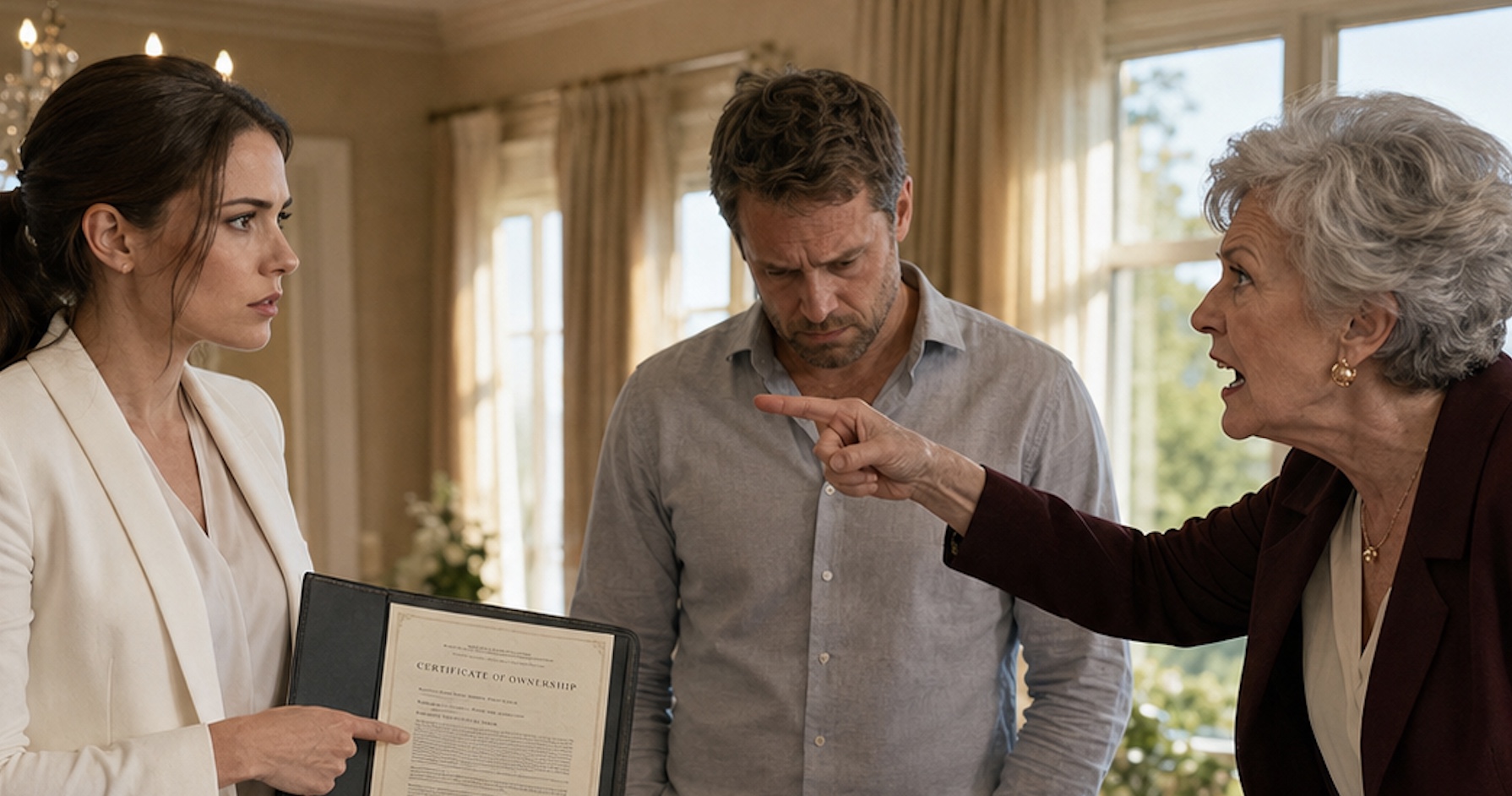
Olesya slowly placed the folder on the table and looked carefully at Galina Stepanovna.
Her mother-in-law stood in the middle of the open-plan kitchen and living room wearing a travel suit, her chin raised high, carrying herself as though she had arrived not at someone else’s home, but at an estate that had long ago been promised to her.
Two suitcases, a large checked bag, and a plastic sack containing house slippers were crowded together in the hallway. Beside them stood Galina Stepanovna’s younger daughter, Elena. She had already taken off her jacket, hung it on a hook, and placed her makeup bag on the hallway cabinet, as though she believed that once one of her possessions had claimed a space in the house, she had claimed it too.
“Throwing you out?” Olesya repeated calmly. “That’s an interesting way to put it. So you’ve already decided that you live here?”
Viktor, Olesya’s husband, stood by the window, studying the yard with exaggerated concentration.
He did not interfere.
Only the fingers of his right hand kept tightening and relaxing, betraying how uncomfortable the conversation made him.
Olesya noticed and allowed herself the faintest smile.
How many times had he done exactly this whenever he wanted the difficult parts of life to resolve themselves without his involvement?
His mother applied pressure. His wife tolerated it. Later, Viktor would claim that he “hadn’t wanted to hurt anyone.”
But that approach no longer worked.
There were strangers’ suitcases inside Olesya’s home, and those strangers had begun acting as though they had every right to control her space.
It had all started several months earlier with what seemed like a harmless request.
Viktor had returned home one evening looking gloomy. He spent an unusually long time washing his hands in the bathroom, then came into the kitchen and explained that a pipe had burst in his mother’s apartment.
The repairs were expected to take a while. Contractors came only every other day, the neighbors downstairs were complaining, and Galina Stepanovna was anxious and unable to sleep.
“Let Mom stay with us for two weeks,” he had said. “Three at the most. She just needs somewhere to wait until everything is fixed.”
Olesya had not been pleased, but she chose not to start an argument.
The house was spacious. It had two bedrooms, an open-plan kitchen and living room, a small office, and a veranda. There was enough room, and three weeks did not seem unbearable.
She only made one thing clear: a temporary guest must not begin behaving like the owner.
Viktor nodded so quickly that it was obvious he simply wanted the subject closed.
Galina Stepanovna arrived with one bag and a box of medicine.
For the first few days, she behaved almost perfectly. She thanked Olesya for the clean bedding, praised the house, and told her she had done well to preserve her grandmother’s inheritance.
By the end of the first week, however, her tone had changed.
She began opening cupboards, checking where towels were kept, inspecting the pantry, asking why there were so few coat hooks in the hallway and why old armchairs still stood on the veranda.
She never asked permission.
She simply commented.
At first, Olesya answered briefly. Later, she stopped responding altogether. Not because she agreed, but because she saw no reason to argue with someone who was supposedly staying only temporarily.
Temporary guests, Olesya had always believed, understood boundaries without having to be reminded.
Galina Stepanovna either did not understand them or deliberately pretended not to.
After two weeks, she asked Viktor to bring another bag.
Then another box.
Then a small folding table because, according to her, “Olesya’s house wasn’t arranged properly for sorting medicine and paperwork.”
One afternoon, Olesya returned from the store and found that the guest room now contained far more than her mother-in-law’s clothes.
There were piles of old magazines, plastic storage containers, extra towels, a housecoat, and even a table lamp.
“Mom, why did you bring so much?” Viktor asked, though there was no firmness in his voice.
“I need to live like a normal person,” Galina Stepanovna snapped. “I’m not staying at a railway station.”
Olesya said nothing, but her fingernail pressed so hard into the handle of her shopping bag that the thin plastic tore.
A month passed, and the repairs in Galina Stepanovna’s apartment seemed to be moving suspiciously slowly.
First, the contractor became ill.
Then the materials were not delivered.
After that, the downstairs neighbor supposedly left town without signing some inspection document.
Olesya stayed out of it until Viktor announced something over dinner.
“Lena is coming for a couple of days. She’s having trouble with her landlord. We need to help her.”
Olesya looked up from her plate.
“Elena is an adult. Why is she coming here?”
“Where else is she supposed to go? She can’t stay at Mom’s apartment while it’s being repaired.”
“She could stay at a hotel, with a friend, or find another rental.”
Viktor grimaced as though his wife had said something offensive.
“Don’t start. Two days won’t change anything.”
Two days became a week.
A week became a month.
Then one day, Olesya heard Elena speaking to a friend on the phone.
“I’ll stay at my brother’s place for now. The house is huge. There’s plenty of room.”
That was the moment Olesya fully understood that they had stopped seeing the house as hers.
Elena did not help with cleaning or cooking, yet she occupied the space noisily and confidently.
Her hair dryer roared every morning. Her cosmetics covered the bathroom counter. Bags of clothes appeared inside Olesya’s office because the guest room was “already too crowded with Mom’s things.”
Galina Stepanovna began inviting people over.
First, it was a neighbor from the next street.
Then a distant relative.
Then a woman she knew from the clinic.
They drank coffee, discussed local gossip loudly, and always found a way to mention how lucky Viktor was to own such a beautiful house.
One afternoon, Olesya overheard Elena showing the veranda to a visitor.
“You could turn this into a summer bedroom,” Elena said. “It would be perfect for Mom.”
Olesya walked into the yard, picked up a pair of pruning shears, and spent a long time cutting dead branches from the old apple tree.
Her hands were trembling so badly that the blades slipped past the branches several times.
Whenever Olesya complained, Viktor gave her the same answers.
“Just be patient a little longer.”
“They’re not strangers.”
“Mom is getting older. This is difficult for her.”
“Lena is going through a hard time too.”
Olesya listened while staring into the cup in front of her rather than at her husband.
She was determined not to lose control too soon.
She knew that if she started shouting without preparation, everyone would dismiss it as an emotional outburst from an unreasonable wife.
So instead of collecting anger, she began collecting facts.
She noted the date each new bag arrived.
She recorded who had occupied her office.
She remembered who invited visitors without asking.
She wrote down who told the neighbors that the house belonged to Viktor.
She did not sit at the table making notes in front of everyone. Instead, she created a private file on her phone and added a brief entry every evening.
The idea of keeping such a record made her uncomfortable.
But not nearly as uncomfortable as living in her own home as though it were a public waiting room.
Everything changed completely on a Saturday morning.
Olesya stepped onto the porch carrying a basket of wet laundry when she heard Galina Stepanovna speaking to their neighbor, Tamara Ignatyevna, on the other side of the fence.
“My Viktor is such a good man,” her mother-in-law said proudly. “The house is large and solid. My son carries the whole burden himself. Olesya acts like the owner, of course, but that’s temporary. A man is the head of the household. Lena and I will settle in properly, and then we’ll see. Maybe we’ll add an extension so everyone can be comfortable.”
Olesya stopped on the top step.
The laundry basket suddenly felt much heavier.
She stared down at the wet clothes, then toward the fence.
Tamara Ignatyevna responded cautiously, but Galina Stepanovna continued.
“Paperwork is only a formality. Everything belongs to both spouses after marriage. Anyone with sense knows that.”
Olesya turned around and carried the basket back inside.
The laundry remained wet.
She went straight to the bedroom, opened the bottom drawer of the dresser, and took out the folder containing the ownership documents.
The house had been left to Olesya by her maternal grandmother.
Her grandmother had died two years before Olesya married Viktor, although the inheritance process was not completed until after the wedding because the required six-month period ended after they had officially registered their marriage.
At the time, Olesya had consulted a lawyer.
He had explained the situation clearly: inherited property did not become marital property simply because the heir was married when the legal paperwork was finalized.
Olesya was the sole owner.
Her name appeared on the official property register.
Viktor had not contributed to purchasing the house, had not invested money into acquiring it, and had no ownership rights.
He lived there because he was married to the owner.
Judging by recent events, he had either told his mother a very different story or allowed her to create a version that suited her.
Olesya did not create a scene immediately.
She waited until evening.
Viktor had returned from the garage, and Galina Stepanovna and Elena were sitting in the kitchen-living room discussing where they should place an additional wardrobe.
“Nowhere,” Olesya said, entering with the folder in her hands.
Elena turned toward her with an irritated expression.
“What do you mean? Mom’s clothes are still sitting in bags.”
“They’re in bags because your mother will take them home when she is ready to return to her apartment. And you, Elena, need to find your own place to live.”
At first, Galina Stepanovna did not seem to realize how serious Olesya was.
She smirked, adjusted the sleeve of her cardigan, and shook her head condescendingly.
“Olesya, don’t start. There’s enough room for everyone in my son’s house.”
That was when Olesya placed the folder on the table.
“This is not your son’s house,” she said evenly. “It belongs to me. I inherited it from my grandmother. I completed the legal process after six months, and I am the only registered owner.”
Viktor’s head snapped up.
Elena looked at her brother, then at her mother.
Galina Stepanovna finally picked up the first document, but she held it as though the paper might burn her fingers.
“Are you doing this deliberately to humiliate us?” she asked, her voice quieter than usual.
“No. I’m bringing this conversation back to reality.”
“Viktor lives here. That means it’s his home too.”
“Viktor lives here because he is my husband. That does not give him ownership rights.”
Viktor stepped toward the table.
“Olesya, why are you doing this in front of everyone? You could have spoken to me privately.”
Olesya studied him until he fell silent.
“I did speak to you. Many times. You chose not to hear me.”
Galina Stepanovna recovered quickly.
Red patches appeared on her cheeks, and her voice grew loud again.
“What if my son files for division of property? Do you think you’re the cleverest person in the room? The house was registered while you were married.”
“He can file whatever he wants,” Olesya replied. “First, he would have to find a legal basis for it. Inherited property is not divided in divorce.”
Elena gave a dismissive snort.
“Lawyers can prove anything these days.”
“They prove things with evidence, not with empty statements. Here is the evidence. Viktor’s name is not here. Neither is yours. Neither is your mother’s.”
Viktor gripped the back of a chair.
“You want to throw my mother into the street?”
Olesya slowly turned toward him.
“No. I want your mother to return to her own apartment. I also want your sister to solve her housing problems without using my property. Those are two entirely different things.”
“Mom’s apartment is under renovation.”
“I called the building management office today. The emergency repair was completed a long time ago. The rest is cosmetic work that she chose to drag out. The apartment is habitable.”
Galina Stepanovna dropped the document onto the table.
“You investigated me?”
“I checked the excuse that was being used to turn my house into a hostel.”
Silence filled the room.
From the hallway came the sound of water dripping from Elena’s wet boots onto the entry mat.
Viktor had gone pale.
He finally seemed to understand that Olesya had not simply grown tired. She had prepared.
Elena was the first to speak.
“Fine. Let’s say the house is yours. What now? Are we supposed to sleep on the street tomorrow?”
“You are an adult. You have a job, friends, and the ability to rent a room. I am not required to provide you with one.”
“How generous of you,” Elena said through clenched teeth. “Clearly, family means nothing to you.”
Olesya placed the papers neatly back inside the folder.
“Family members don’t arrive at someone else’s home with suitcases and announce that they are in charge.”
Galina Stepanovna raised her chin.
“Viktor, can you hear how she is speaking to us?”
Viktor rubbed his hand across his face.
“Olesya, surely we can avoid extremes. Let Mom stay until the end of the month. Lena too.”
“No. They have until the end of the week. Seven days is enough time to pack and leave.”
“You’re giving me orders?”
“I am setting rules in my own house.”
Olesya barely slept that night.
It was not because she doubted herself. Her body simply could not relax after holding so much tension for so long.
She lay awake listening to drawers being closed in the next room, Elena recording voice messages, and Galina Stepanovna whispering with Viktor in the kitchen.
Olesya could not make out every word, but the tone was enough.
They were discussing her.
They were deciding how to pressure her, how to make her feel guilty, and how to portray her as heartless.
Olesya got out of bed, pulled on her robe, and walked quietly toward the kitchen.
She stopped outside the door and heard Viktor say:
“She won’t change her mind.”
“Then you need to decide whose side you’re on,” Galina Stepanovna replied. “Either you’re a man, or you’re just an accessory to her precious paperwork.”
Olesya did not enter.
She returned to the bedroom and smiled for the first time in days.
It was not a happy smile.
It was a smile of clarity.
Everything was simple now.
Viktor was not choosing between his mother and his wife.
He was choosing between honesty and a convenient lie.
The next morning, Olesya placed three sheets of paper on the table.
They were not property documents.
They were an inventory of everything that needed to be removed from the house: Galina Stepanovna’s suitcases, boxes, Elena’s bags, the folding table, old magazines, and the dishes her mother-in-law had brought “for her own use.”
“What is this now?” Elena asked, narrowing her eyes sleepily.
“A list of other people’s belongings in my house, so no one can later accuse me of keeping something.”
“You’re treating us like tenants now?”
“Tenants pay rent and sign an agreement. You have done neither.”
Galina Stepanovna grabbed the paper, scanned it, and laughed nervously.
“Look at her, Viktor. She’s so thorough. She even counted her mother-in-law’s towels.”
“Yes,” Olesya said. “Because later those towels might suddenly become the basis for another accusation.”
Viktor remained silent.
This time, his silence protected no one.
By evening, the conflict had burst into the open.
Galina Stepanovna called a relative and loudly complained that her daughter-in-law was “throwing her husband’s mother out after everything she had done for the family.”
Elena walked around the house with her phone, filming short videos and repeatedly trying to capture Olesya on camera.
“Put the phone away,” Olesya said.
“Why? Are you afraid of the truth?”
Olesya stepped closer, and Elena instinctively backed toward the cabinet.
“I do not give you permission to film me inside my home. Point that camera at me again, and the next conversation will take place in front of the police.”
Elena lowered the phone, but her eyes hardened.
“Call whoever you like. We’ll tell them you’re forcing us out.”
“You are not registered here. You do not own the property. You remained after a temporary invitation, and I have asked you to leave. Everything else exists only in your imagination.”
Galina Stepanovna slammed her palm against the kitchen counter.
“Viktor! Are you really going to let her speak to your mother like this?”
Viktor looked at Olesya, then at his mother.
He seemed exhausted, his face worn and defeated.
“Mom, maybe you really should go back to your apartment.”
Galina Stepanovna froze.
Her mouth opened, but for several seconds, no words came out.
The following day, however, it became clear that she had no intention of surrendering.
Instead of packing, Galina Stepanovna lay down in the guest room and announced that her blood pressure had “shot through the roof.”
Elena sat beside her, sighing loudly.
Viktor rushed from room to room, bringing water, searching for the blood pressure monitor, and begging Olesya to be more compassionate.
Olesya called a doctor.
She did it calmly, without arguing.
The doctor arrived, examined Galina Stepanovna, and said there was no serious reason for hospitalization. She only needed rest and her regular medication.
After the doctor left, Galina Stepanovna glared at Olesya with barely concealed anger.
“Are you satisfied now? You humiliated me in front of a stranger.”
“I took care of your health,” Olesya replied. “Now you can continue packing without the performance.”
Elena jumped to her feet.
“You’re completely heartless!”
“No. I have simply stopped participating in a play where you are always the victims and I am expected to pay for the scenery with my home.”
On Friday morning, Olesya woke to an unusual noise.
Someone was moving suitcases in the hallway, opening the front door, then closing it again.
She stepped out of the bedroom and saw Galina Stepanovna wearing her coat.
Beside her stood an unfamiliar man holding a measuring tape.
“Who is this?” Olesya asked.
The man cleared his throat awkwardly.
“I’m here about the wardrobe. I was told I needed to measure the space.”
Olesya turned toward her mother-in-law.
“What wardrobe?”
Galina Stepanovna straightened her back.
“A proper one. I can’t live out of suitcases forever.”
For a moment, Olesya felt no anger at all.
She looked at Viktor, who had appeared in the bedroom doorway, then at Elena, who was trying to hide a smile.
“There will be no measurements,” Olesya told the man. “You were given false information. This property belongs to me, and I did not place an order.”
The carpenter nodded, quickly folded his measuring tape, and left.
Olesya closed the door behind him and turned back to Galina Stepanovna.
“That’s it. The deadline has changed. You are leaving today.”
“You wouldn’t dare,” Galina Stepanovna whispered.
“I would. And I will.”
Viktor stepped forward.
“Olesya, stop. You’re destroying this family.”
She looked at him for a long moment.
There was no regret on his face.
Only the frustration of a man whose easiest escape route had just disappeared.
“The person who protects her home is not the one destroying the family,” Olesya said. “The family is destroyed by the man who brings people into that home, allows them to disrespect its owner, and stays silent while they claim what belongs to someone else.”
Elena bristled.
“So you’ll throw Viktor out too?”
“If Viktor believes this house belongs to his mother, he is free to leave with her and test that belief from somewhere else.”
Viktor recoiled as though Olesya had slapped him.
“Are you serious?”
“Completely.”
The packing turned into a loud, ugly spectacle.
Galina Stepanovna grabbed her belongings and threw them into bags while accusing Olesya of being ungrateful.
She brought up every jar of pickles she had ever given her son, every night she had stayed awake with Viktor when he was a child, and every grievance she had collected over the years.
At first, Elena continued arguing. Eventually, she began silently stuffing clothes and cosmetics into bags.
Olesya stood by the door with her inventory, marking each item as it left.
She was not trying to humiliate them.
She simply wanted the performance to end without leaving them another excuse to return.
“Here are your towels. These are your containers. Your medicine. Your magazines.”
“Keep them and choke on them!” Elena snapped.
“No. Take them. I don’t need what belongs to someone else.”
Galina Stepanovna suddenly turned toward Viktor.
“Son, are you coming with us?”
Viktor looked at his mother, then at his wife.
For a moment, Olesya saw a silent plea in his eyes.
Pretend none of this happened.
Let me remain the good son and the innocent husband.
But Olesya did not rescue him from the consequences of his own choices.
“I’m staying,” Viktor said quietly.
Galina Stepanovna went pale.
Elena loudly zipped one of the bags.
“Wonderful,” she said. “So your wife matters more than your mother.”
For the first time, Olesya raised her hand sharply, stopping the familiar manipulation before it could continue.
“This is not about who matters more. Your brother is an adult man, not another piece of luggage. He is responsible for his own decisions.”
Galina Stepanovna walked toward the door, then turned at the threshold.
“You’ll regret this.”
“Perhaps,” Olesya replied. “But I will not regret taking back my home.”
When they stepped outside, Olesya held out her hand to Viktor.
“The keys.”
He frowned.
“What keys?”
“The ones you gave your mother and Elena.”
“I didn’t give Elena any. Only Mom.”
“Then take them back from your mother now. And make sure she didn’t make a copy.”
Galina Stepanovna heard them from the porch and spun around.
“This is humiliating!”
“No. This is a normal precaution after someone tried to order furniture for my house without my permission.”
The keys had to be returned immediately.
Galina Stepanovna removed the keyring from her pocket so slowly that it seemed she was surrendering not a piece of metal, but her authority.
Olesya took the keys herself.
Elena dramatically turned out the pockets of her jacket to prove she had none.
“The taxi will be here in ten minutes,” Viktor said, looking at his phone. “I ordered one.”
“We don’t need it,” Galina Stepanovna snapped. “We’ll manage.”
There were too many bags, however, and ten minutes later they left in the taxi after all.
Olesya remained on the porch until the car disappeared around the corner.
Then she closed the door, removed the spare keyring from its hook, and locked it inside the desk drawer.
That same day, she called a locksmith.
There were no more speeches, no more arguments, no invented paperwork.
She simply replaced the front-door lock.
The old mechanism went into a plastic bag and was stored in the utility room.
The house seemed to breathe again.
That evening, Viktor tried to talk.
He paced between the kitchen and hallway for a long time before finally sitting across from Olesya.
“Do you understand that Mom may never speak to me again?”
Olesya closed her laptop.
“She will. Once she understands that she can no longer control my house through you.”
“You make it sound like we’re your enemies.”
“No. I spent a long time trying to think of you as family. You treated my house like emergency accommodation.”
Viktor lowered his head.
“I didn’t think it would go this far.”
“You didn’t think because not thinking was convenient. Your mother was happy, your sister had somewhere to stay, and you remained the devoted son. Meanwhile, I was expected to smile while being pushed out of my own space.”
He opened his mouth to object, but the words seemed to fail him.
For the first time, he was forced to look beyond his mother’s hurt feelings and face the consequences of his own silence.
A week later, Galina Stepanovna called him.
Olesya saw her name on Viktor’s phone screen but did not leave the room.
The conversation was brief.
At first, Viktor tried to explain himself. Then his replies became short and firm.
“No, Mom.”
“No, you won’t be getting another key.”
“No, Olesya is not obligated to do that.”
“Lena is an adult. She can solve it herself.”
After the call, Viktor sat on the edge of the sofa for a long time with the phone still in his hands.
Then he walked over to Olesya.
“I told her the house belongs to you. I also told her I will never again discuss anyone moving in without speaking to you first.”
Olesya nodded.
There was no joy on her face.
Only exhaustion and a cautious sense of peace.
“Good. But one conversation is not enough.”
“I understand.”
“I’m not sure you do. So I’ll say it plainly. If you ever bring someone into my home again without my permission, you will leave with them.”
Viktor looked at her differently then.
Not as though she were merely a wife who was upset.
He looked at her as the owner of the house, a woman who had already proved that she could carry a decision through to the end.
Spring arrived quickly.
The soil in the yard began to dry, buds appeared on the old apple tree, and the veranda was quiet again.
Olesya carried an armchair outside, sat down with a notebook, and for the first time in months calmly wrote a list of things that needed to be done around the house.
Not for her mother-in-law.
Not for Elena.
Not for guests she had never invited.
For herself.
Viktor came outside and stopped in the doorway.
“May I sit with you?”
Olesya allowed him to.
They remained silent for several minutes.
Then he said quietly:
“I was wrong.”
She did not rush to forgive him.
She did not pretend everything had been forgotten.
She looked toward the garden and answered:
“Being wrong is making a mistake once. You chose what was convenient again and again. Now you will have to spend a long time proving that you finally understand the difference.”
Viktor nodded.
The house itself had not changed.
The same walls.
The same roof.
The same yard.
The same old apple tree beside the fence.
Yet to Olesya, it finally felt like hers again.
Not because someone had recognized her rights at last.
Because she had stopped asking for respect in a situation where all she had ever needed to do was show the documents, take back the keys, and close the door on those who had entered someone else’s life and tried to take control of it.