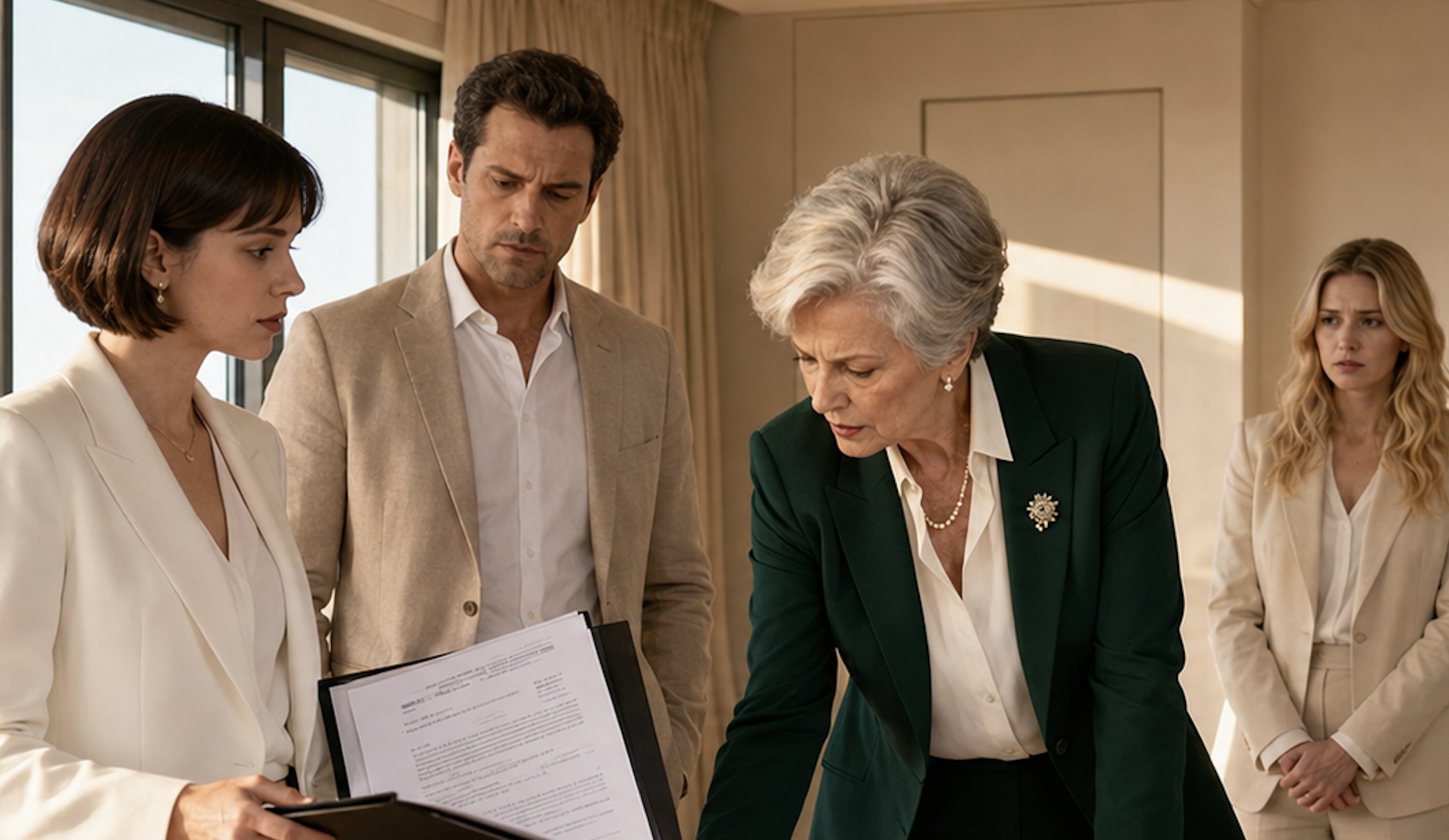
“Pack up and leave the house. My daughter and her family are moving in,” her mother-in-law announced, confidently stepping into the living room.
Eva slowly rose from the armchair and looked at Nina Alekseevna with such steady attention that it seemed she was not looking at her husband’s mother, but at a stranger who had come to the wrong address.
“Excuse me?”
“Don’t start, Eva. You heard me perfectly well,” her mother-in-law said, walking into the room. She removed her gloves and placed them on the edge of the dresser. “Oksana and the children can’t keep moving from one rented place to another. Your house is big. You and Pavel will have enough space in the annex. Or you can stay with my sister in the village for a while. She lives alone. There’s plenty of room.”
Eva was silent for several seconds.
Not because she was confused. She simply could not understand how easily Nina Alekseevna was making decisions about someone else’s house, someone else’s rooms, someone else’s life.
Pavel was sitting on the sofa. He pretended to adjust the strap of his watch, although he had been fiddling with it for a full minute and still had not managed to fasten it.
“Pavel,” Eva said quietly, “do you also think I should leave my own house for your sister?”
Her husband raised his eyes, immediately looked away, and let out a heavy sigh.
“Well, not exactly leave it… Mom, you said it too harshly.”
“How should I have said it?” Nina Alekseevna snapped. “Should I crawl in front of her? Beg for permission to let your own sister live in the house?”
“Your sister can be invited as a guest,” Eva replied. “But she cannot be moved in here with her whole family without the owner’s consent.”
Nina Alekseevna gave a short laugh.
“The owner! Do you hear that, Pavel? She already calls herself the owner, as if you’re nobody here.”
Eva walked over to the table, opened the lower drawer, and took out a thick blue folder. Pavel immediately froze. He knew that folder well. It contained the house documents, which Eva never left lying around and never handed to anyone.
“No, Nina Alekseevna,” Eva said, spreading the papers across the tabletop. “Not ‘already.’ I have been the owner of this house since the day I inherited it from my grandfather. Six months after his death. Everything is legally registered. There is one owner. Me.”
Her mother-in-law jerked her shoulder.
“Don’t try to frighten me with papers. You live here together.”
“We do. But that does not turn this house into your family dormitory.”
Nina Alekseevna’s cheek twitched. She had clearly expected tears, arguments, excuses, persuasion — but not this calm silence, in which every word Eva said sounded too clear to ignore.
And it had all started, oddly enough, with an ordinary Sunday lunch.
Oksana had come to visit with her husband, Artyom, and their two children. Eva had nothing against guests. The house really was spacious: two bedrooms, a study, a large living room, a kitchen, a veranda, and a small annex in the yard where Eva’s grandfather had once kept tools and old magazines.
After her grandfather’s death, Eva had not moved into the house immediately. It stood on the edge of town, near a pine grove. Her grandfather had built it himself, putting patience into every board and stubbornness into every nail. As a child, Eva had spent her holidays there. She had eaten berries straight from the bushes, hidden in the attic from adult conversations, and fallen asleep to the sound of rain on the roof.
When her grandfather passed away, her own relatives said at once:
“The house is yours. He always said he would leave it to you. Take care of it.”
And Eva did take care of it.
She did not turn the house into a museum and was not afraid to update things, but she did everything carefully. Some parts she repaired, some she replaced, and some she left exactly as they had been. At first, Pavel was happy about the move. He said it was calmer to live outside the city, that the air was better, and that he liked waking up without the noise of traffic.
Then Nina Alekseevna noticed the house.
At first, she visited rarely. She would bring bags of groceries, walk from room to room, and say:
“You’ve settled in well. So much space. Not like our two-room apartment.”
Eva smiled politely.
Then her mother-in-law started staying longer. She would ask for tea, stay for dinner, or suddenly decide to spend the night because “it was too dark to go back.”
Eva did not object. Nina Alekseevna was Pavel’s mother, and Pavel always reacted painfully whenever his wife asked that visits be arranged in advance.
“She’s not a stranger,” he would say.
Eva did not argue. Only once did she remark:
“Pavel, not being a stranger doesn’t mean she can come whenever she wants.”
He nodded then and promised to talk to his mother, but the conversation apparently disappeared somewhere between his “yes, yes” and his mother’s “don’t make things up.”
Oksana entered the story later.
Pavel’s sister was loud, quick, and completely convinced that everyone around her was obligated to understand her situation. She had a three-room apartment in the city, a husband, two children, and endless complaints about how cramped, inconvenient, far away, noisy, expensive, and generally unbearable everything was.
“We’re thinking of selling the apartment,” she announced at Sunday lunch, neatly cutting into the meat casserole. “I’m tired of living in a box. I want a house.”
“A house is not only space,” Eva said carefully. “It also means repairs, a yard, constant expenses, clearing snow in winter, taking care of everything in summer.”
“Oh, don’t scare me,” Oksana waved her off. “At least the children would have fresh air. Artyom says it’s time for us to expand too.”
Pavel brightened.
“That’s right. Children are better off in a house than in an apartment.”
That was when Nina Alekseevna looked at Eva for a long moment. Too long.
“You see, Oksanochka,” she said, “some people live in comfort and don’t even appreciate their happiness. A big house, and no children.”
Eva lifted her eyes from her plate.
“Nina Alekseevna, what exactly do you mean by that?”
“Oh, nothing. Just saying.”
But people do not say such things for no reason.
After that lunch, her mother-in-law began visiting more often. And almost every time, she brought up the same topic as if by accident.
“What do you need the study for? You hardly ever sit there.”
“I sit there when I work on orders.”
“You could work in the bedroom with a laptop.”
“I’m comfortable in the study.”
“And the annex? You could make a room there.”
“I could. But I haven’t planned to.”
“You never plan anything, never plan anything… The house is going unused.”
One day Eva could not hold back.
“What do you mean, unused? We live here.”
“Well, the two of you live here. But Oksana has children. They need the space more.”
Pavel was nearby at that moment. He coughed, pretended to look for his phone, and went out onto the veranda.
Eva watched him go and, for the first time, smiled bitterly. Her husband was disappearing more and more often exactly when he needed to say one simple word: no.
The real warning came through their neighbor, Valentina Sergeevna.
Eva was returning from the store when the neighbor waved to her from the gate.
“Evochka, wait a minute.”
“Did something happen?”
Valentina Sergeevna awkwardly adjusted her headscarf.
“I just wanted to ask… Is it true your relatives are moving in?”
Eva stopped.
“What relatives?”
“Well, your husband’s sister. Nina Alekseevna was saying yesterday at the bus stop that soon there would be children’s laughter here, that the house would finally ‘come alive.’ I was surprised. You hadn’t said anything.”
Eva gripped the handles of her shopping bag more tightly.
“No, Valentina Sergeevna. No one is moving in with me.”
The neighbor widened her eyes.
“So that’s how it is… And they were already discussing a moving truck. I thought you knew.”
Eva thanked her and went home.
The bag hurt her hand, but she only noticed it when she reached the porch. Inside, everything became unusually collected. Even her breathing evened out. There were no tears, no shouting. Only one clear understanding: behind her back, decisions had already been made.
That evening, she asked Pavel directly.
“Is your sister planning to move in with us?”
Her husband dropped his spoon into his plate.
“Who told you that?”
“So she is.”
“Eva, not permanently. We were just discussing an option.”
“Who was discussing it?”
Pavel rubbed the bridge of his nose.
“Mom, Oksana… I was there.”
“And where was I during this discussion?”
“Well, you weren’t home.”
Eva slowly pushed her plate away.
“Interesting reason. I wasn’t home, so my house could be divided up.”
“Don’t start. It’s a complicated situation.”
“For whom?”
“For Oksana.”
“Did she sell her apartment?”
“Not yet.”
“Has she found buyers?”
“They’re thinking about it.”
“Has she rented a place?”
“Why rent if they can temporarily…”
Pavel stopped himself, but it was too late.
“Go on,” Eva said.
“I didn’t mean it like that.”
“You meant it very clearly.”
He leaned back in his chair with exhaustion.
“Eva, why are you immediately against it? Oksana isn’t a stranger. The children need a normal house. They’ll stay for a couple of months while they sort things out.”
“In our house?”
“In your house,” he corrected quickly. “But we’re husband and wife.”
Eva looked at him for a long time.
“Pavel, if we are husband and wife, why didn’t you tell me before your mother started telling the neighbors?”
He had no answer.
The next day, Eva went into town on business and came back earlier than planned.
Nina Alekseevna was standing by the gate. Oksana was beside her. They were arguing animatedly about something, holding a measuring tape.
Eva stopped behind the lilac bush and heard her sister-in-law’s voice:
“Artyom can park the car here. And the children’s bicycles can go over there, under the canopy.”
“Yes,” her mother-in-law said in a businesslike tone. “And Eva doesn’t need the study anyway. We’ll make that into a room for the girls. The boy should be closer to the window.”
“And where will she and Pavel go?”
“We’ll find something. Fix up the annex, and it’ll be fine. They’re still young. They can manage.”
Eva’s cheeks burned. She stepped out from behind the bush.
“What are you measuring?”
Oksana flinched so sharply that the measuring tape snapped shut with a loud click.
Nina Alekseevna turned around without the slightest embarrassment.
“Oh, you’re back already.”
“I asked what you’re measuring.”
“We’re looking at the space. Since a conversation will have to happen anyway.”
“No conversation has to happen. The answer is already here.”
Oksana frowned.
“What answer?”
“No one is moving into my house.”
Her mother-in-law narrowed her eyes.
“You haven’t even listened.”
“I don’t need to listen to a plan in which I have already been evicted.”
Oksana stepped forward.
“Who evicted you? Why are you making a scene? We’ll just live here for a while. It’s not like you’ll be out on the street.”
“Oksana, you have an apartment.”
“We’re planning to sell it.”
“When you sell it, then you can decide where to live next. But not at my expense.”
Her sister-in-law turned pale with anger.
“Does Pavel know what you’re really like?”
“Pavel knows whose house this is.”
Nina Alekseevna sharply lifted her chin.
“Then we’ll talk to Pavel.”
“Talk to him. But leave the keys to my gate on the table, if you took them without asking.”
Her mother-in-law blinked.
Oksana fell silent too.
Eva understood immediately: they had keys.
Pavel had made a duplicate.
That evening, she waited for her husband on the veranda. On the table in front of her lay the set of keys she had found in the drawer near the entrance. Two of them were new, shiny, with colored plastic covers.
“What is this?” she asked when Pavel came in.
He noticed the keys and stopped.
“Eva…”
“I asked what this is.”
“Mom asked for them just in case. What if something happened and we weren’t home?”
“What would happen? To my house?”
“You’re twisting words again.”
Eva stood up.
“No. I am holding on to the keys you made without my permission and gave to a woman who decided to move her daughter into this house.”
Pavel flushed.
“She is my mother!”
“And this is my house.”
He ran a hand over his face.
“Do you understand how cruel you look right now?”
“Do you understand how you look?”
He fell silent.
Eva picked up the keys and put them in her pocket.
“Tomorrow I’m changing the locks. I’ll call a locksmith in the morning.”
“Don’t turn this into a circus.”
“The circus was arranged without me. I’m simply closing the door.”
The next day, the locksmith arrived after lunch. Pavel stood in the hallway, gloomy, but did not interfere. Eva paid for the work, took the new keys, and put them in her bag.
Nina Alekseevna appeared that evening.
She pulled the front door handle, then pulled it again. A second later, the doorbell rang.
Eva opened the door.
Her mother-in-law stood on the porch with a face where outrage was fighting confusion.
“You changed the locks?”
“Yes.”
“Without consulting anyone?”
“I consulted with the owner of the house.”
Nina Alekseevna turned crimson.
“Pavel!” she shouted into the house. “Do you hear how she’s talking to your mother?”
Pavel came into the hallway.
“Mom, let’s not shout.”
“Not shout? She locked me out of the house!”
“It’s her house,” Pavel said unexpectedly.
Eva turned toward him. He said it quietly, but he said it.
His mother looked at him as if he had personally betrayed her.
“Oh, I see. So your wife is more important than your own sister.”
“Mom…”
“No. I understand everything.”
She turned around and left, her heels striking loudly against the steps.
At that moment, Eva thought it was over.
But she did not know Nina Alekseevna well enough.
Three days later, a moving truck pulled up to the house.
Eva was sorting documents in her study when she heard men’s voices at the gate. She stepped onto the porch and saw Artyom, Oksana’s husband. He was standing next to the driver and pointing toward the gate.
In the back of the truck were boxes, a child’s bicycle, a folding bed, several bags of belongings, and a large television.
Oksana stood by the gate with the children.
“What is going on?” Eva asked.
Oksana gave her a strained smile.
“Don’t start in front of the children.”
“I asked what is going on.”
Artyom spread his hands.
“Nina Alekseevna told us the matter was settled. We thought Pavel had talked to you.”
Eva looked at Oksana.
She held Eva’s gaze for only a couple of seconds.
“We can’t cancel everything now. The truck is paid for, the things are packed, the children are tired.”
“Turn the truck around.”
“Are you serious?” Oksana raised her eyebrows. “You want us to stand in the street with children?”
“You have your own apartment.”
Oksana stepped closer abruptly.
“We rented it out.”
Eva did not even understand at first.
“To whom?”
“To some people Artyom knows. For a few months. We needed money for the future house.”
Eva gave a short laugh. Not because it was funny, but because the audacity had become impossible to fit into ordinary words.
“So you have an apartment. You rented it out, took the money, and decided to live in my house for free?”
Artyom coughed awkwardly.
“Oksana said you had agreed.”
“Oksana lied.”
Her sister-in-law’s fingers trembled. She quickly grabbed her daughter by the shoulder, as if the child could protect her from the conversation.
“Don’t you dare say that.”
“Then don’t give me a reason.”
Pavel came out of the house. He saw the truck, the boxes, his sister, the children. His face turned gray.
“Oksana, why are you here?”
“What do you mean why? Mom said you had handled everything.”
“I handled nothing.”
“So you’re sending us back now?” Oksana’s voice broke into a shriek. “Wonderful! Just wonderful! A brother throwing his sister and children out!”
Eva took out her phone.
“I’m calling the police if you try to bring anything into my house.”
Nina Alekseevna appeared as if on schedule. She got out of a taxi, saw the scene, and immediately headed for the porch.
“Eva, stop this disgrace.”
“The disgrace began when you ordered a move into someone else’s house.”
“I am a mother! I am saving my daughter!”
“Save her in your own apartment.”
Her mother-in-law froze.
“My place is too small.”
“And mine is not a public passageway.”
Oksana began to cry. The children looked fearfully from their mother to their grandmother. Artyom stood near the truck and clearly regretted having come at all.
Pavel went up to his sister.
“Oksana, go home.”
“Home?” she snapped her head up. “There are already people living in our apartment!”
“Then rent a place.”
“With what money?”
Eva could not hold back.
“With the money you got from renting out your own apartment.”
Oksana fell abruptly silent.
And that silence said more than any explanation could have.
Nina Alekseevna frowned.
“What money?”
Oksana shot her mother an angry look.
“Mom, not now.”
Eva looked at her mother-in-law.
“You didn’t even know that?”
Nina Alekseevna was thrown off. For the first time, her face showed not outrage, but an unpleasant realization: her daughter had used her too.
“Oksana,” she said slowly, “you told me you had nowhere to go.”
“We don’t! The apartment is occupied!”
“But you rented it out yourself?”
Oksana flared up.
“Because we had to find a way somehow!”
“You won’t find a way at the expense of my house,” Eva said, putting her phone back into her pocket.
The truck driver, who had been silent until then, carefully asked:
“So, are we unloading or not?”
“No,” Eva answered. “You are not.”
Artyom waved his hand.
“Let’s go.”
“Artyom!” Oksana cried.
“What, Artyom?” he suddenly turned sharply toward his wife. “You told me everything was agreed. I’m standing here like an idiot in front of the driver. In front of the children. In front of everyone. Why did you do this?”
Oksana opened her mouth but said nothing.
Eva saw Pavel’s jaw tighten. He was looking at his sister differently now. Not as a poor relative in need of pity, but as a grown woman who had calculated the entire performance perfectly.
The truck left fifteen minutes later.
Oksana and her family left after it.
Nina Alekseevna remained by the gate. She kept adjusting the bag on her shoulder, as if she did not know what to do with her hands.
“You could have been softer,” she finally said.
Eva looked at her tiredly.
“And you could have chosen not to bring other people’s belongings to my house.”
“Other people? She is my daughter.”
“To you, she is your daughter. To me, she is someone who tried to move into my house through deception.”
Her mother-in-law hunched her shoulders as if from cold, although the evening was warm.
“You were still too harsh.”
“No, Nina Alekseevna. Harsh is coming here and telling the owner to leave her house.”
Her mother-in-law did not answer.
She walked to the bus stop without saying goodbye.
After that story, a strange silence settled over the house for several days.
Pavel tried to talk, but every time he began with the wrong thing.
“Mom is upset.”
Eva said nothing.
“Oksana also didn’t expect everything to turn out like that.”
Eva closed her book.
“Pavel, that is exactly what she expected. She only thought I would give in.”
He would sit across from her, rub his forehead, and sigh.
“I’m guilty.”
“Yes.”
He looked up.
“You’re not even arguing.”
“What’s the point? You said the truth yourself.”
Pavel sat silently for a long time.
“I thought that if I kept quiet, everything would somehow resolve itself.”
“It did resolve itself. Just not the way you wanted.”
A week later, he packed some of his things.
Eva did not ask him to leave. He placed a travel bag by the door himself and said:
“I need to live separately for a while. To figure things out.”
Eva looked at the bag, then at her husband.
“Where?”
“At my mother’s.”
She nodded.
“Leave the house keys on the dresser.”
Pavel took out the keyring. His fingers moved slowly, as if he hoped that at the last second she would tell him to keep them.
Eva said nothing.
He placed the keys down and left.
On the porch, he stopped.
“Do you really think I chose them?”
“I think you spent too long not choosing me.”
Pavel wanted to answer, but only lowered his head and walked to the car.
Eva closed the door.
Not loudly. Not dramatically. She simply closed it.
Autumn came quickly.
Leaves covered the path to the gate, silver moisture lay on the grass in the mornings, and the house became itself again. Not a storage place for other people’s plans, not an emergency landing strip for relatives, but a place where every object stood exactly where its owner had decided it should stand.
One evening, someone rang at the gate.
Eva went outside and saw Oksana.
She was alone. No children, no husband, none of her usual boldness. She held a bag in her hands.
“Can we talk?”
“Talk here.”
Oksana gave a nervous little laugh.
“You won’t even let me into the yard?”
“No.”
Her sister-in-law looked at the path, the porch, the light in the windows.
“We moved out from those people. We went back to the apartment.”
“Good.”
“Artyom is angry with me.”
Eva was silent.
“Mom too. She says I disgraced her.”
“She chose to participate.”
Oksana tightened her grip on the handles of the bag.
“I wanted what was best.”
“For yourself.”
“Yes, for myself!” Oksana suddenly said sharply, and for the first time there was not arrogance in her voice, but exhaustion. “I’m tired of living like I always have to twist and struggle my way out of everything. I saw your house and thought: there it is. Ready. Warm. Spacious. Why should you have it and not me?”
Eva looked at her without anger.
“Because my grandfather built this house. Not your husband. Not your mother. Not Pavel. My grandfather.”
Oksana looked away.
“I know.”
“No. You are only beginning to understand that now.”
They stood in silence for a while.
Then Oksana held out the bag.
“There’s a child’s toy inside. My son left it in your yard that day. I found it in the car. I thought maybe it was yours.”
“Leave it by the gate.”
Oksana put the bag on the bench.
“Pavel is at Mom’s.”
“I know.”
“He has changed a lot.”
“That is his matter now.”
Oksana looked up at her.
“Are you going to divorce him?”
Eva answered calmly:
“If we cannot come to an agreement, we’ll settle it through court. We have jointly acquired property, and he still isn’t ready to talk calmly.”
Oksana nodded.
“I see.”
She stood there a little longer, then said quietly:
“I really thought you wouldn’t dare.”
Eva almost smiled.
“For some reason, everyone thought that.”
Oksana left.
A month later, Pavel came.
He looked tired. Not broken, not pitiful — just like a man who had finally spent several weeks without the convenient habit of hiding behind other people’s backs.
“May I come in?”
Eva did not answer immediately.
Then she opened the gate, but she did not invite him into the house. They stayed on the veranda.
“I talked to Mom,” he said. “And to Oksana too.”
“And?”
“They’re offended.”
“That’s not news.”
Pavel nodded.
“But I understood something else. All this time, I thought I was keeping the peace. In reality, I was just giving them hope that you would give in.”
Eva listened silently.
“I should never have given them the keys. I should never have discussed the house without you. I should never have allowed Mom to speak to you like that.”
“That all sounds right, Pavel. Only it’s late.”
He clasped his hands together.
“I know.”
“What do you want?”
“To come back.”
Eva looked at the garden. At the wet branches of the apple tree. At the old bench her grandfather had once made from thick planks. Everything around her was so familiar that any foreign noise immediately felt unnecessary.
“No.”
Pavel jerked his head slightly, as if he had expected a different answer.
“Not at all?”
“Not now. Time will show what happens later. But you will not live here again until I understand that you know how to say no — not only after everything has already been destroyed.”
He swallowed.
“Can I take the rest of my things?”
“Of course. I packed some of them in boxes. You can take the rest while I’m here.”
Pavel entered the house only after Eva stepped aside. He did not argue, did not ask to keep the keys, did not look for someone to blame. He simply took his things.
As he was leaving, he paused at the door.
“The house really is good.”
Eva did not answer at once.
“Yes. That is why I didn’t let anyone take it from me.”
Pavel left.
This time, she closed the door without pain.
Later, Nina Alekseevna tried several times to pass messages through acquaintances, saying that “Eva had destroyed the family.” Eva did not respond to such talk. The neighbors, who had seen the truck, the boxes, and the performance by the gate, drew their own conclusions.
One day, Valentina Sergeevna said to her over the fence:
“You were right not to let them in back then. Anyone who arrives with belongings without permission will never respect the owner afterward.”
Eva only nodded.
In winter, she finally renovated the annex. Not for Pavel, not for Oksana, and not for Nina Alekseevna. For herself. She turned it into a workshop where she could work with wood, keep her grandfather’s tools, and calmly do the things she had never had time for before.
One day, she found her grandfather’s old notebook in a drawer. Between its yellowed pages lay a photograph: her grandfather standing on the porch of the newly built house, young and smiling, wearing a work shirt and holding a hammer in his hand.
On the back, in his large handwriting, he had written:
“A home is not held up by its walls. A home is held up by the person who refuses to hand it over to someone else.”
Eva looked at those words for a long time.
Then she placed the photograph on a shelf in the workshop.
And for the first time in many months, she laughed calmly.
Without anger.
Without resentment.
Simply from the clear understanding that her grandfather would probably have approved of that day by the gate, when she had not allowed the truck full of someone else’s boxes to enter her yard.
And Nina Alekseevna never crossed the threshold of that house again.
Because now she knew: in this house, decisions were not made by the person who spoke the loudest, nor by the person who considered herself older, wiser, or more important.
The decisions here were made by Eva.
And the keys to the front door belonged only to her.