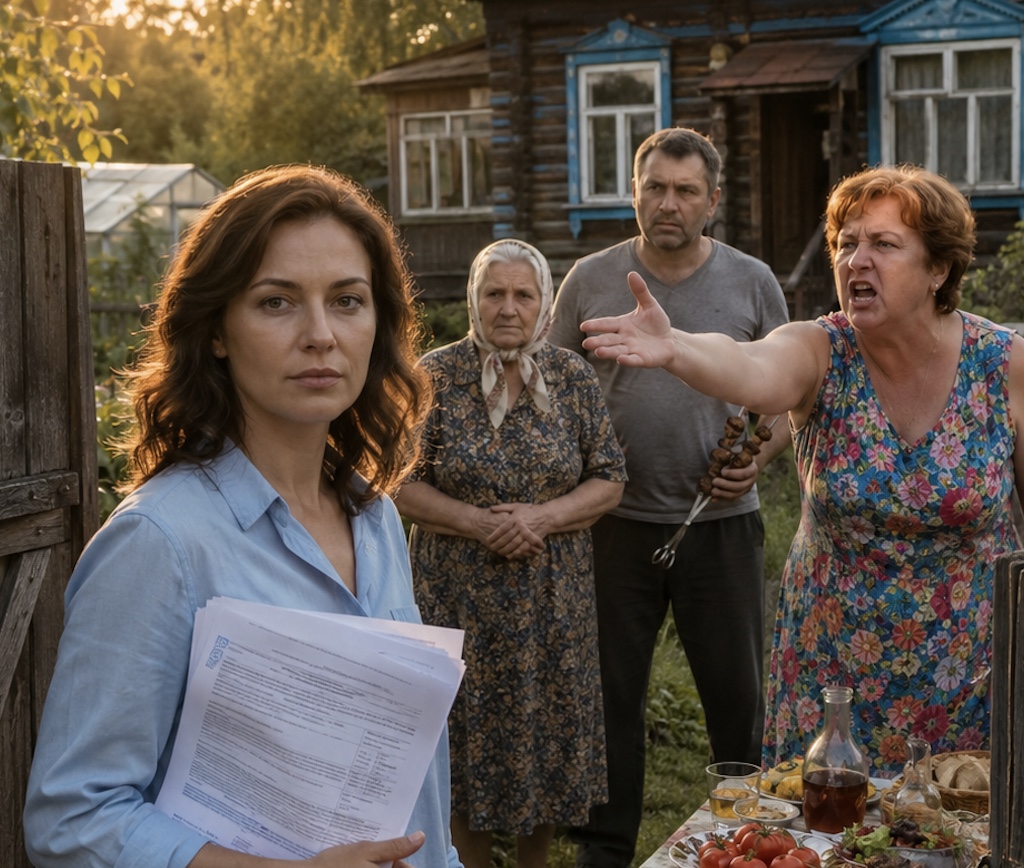
“Natalya, are you going to peel the potatoes, or are you just going to sit there like some lady of leisure?” Larisa, my sister-in-law, threw the words across the table without even looking at me.
I was sitting on a bench under the apple tree. I had only just arrived — two hours by train, then another twenty minutes on foot from the station, carrying bags. It was nearly thirty degrees outside. I had not even had time to drink a glass of water.
“Larisa, I just got here. Let me catch my breath.”
“Oh, catch your breath,” Larisa snorted. “We’ve been working since morning — weeding the beds, preparing the barbecue — and she needs to ‘catch her breath.’ City princess.”
I stayed silent.
I had always stayed silent at that dacha. For twelve years, I had kept quiet. Ever since I married Dima.
I should explain.
My name is Natalya. I am thirty-six. I work as a nurse in a private clinic — I have been head nurse for four years now, and I earn fairly well for our town. I have been married to Dmitry for twelve years. Our son, Artyom, is eleven.
Dima is a good man. Calm, hardworking, a long-distance truck driver. But Dima has a family. And his family is a whole separate universe — one where I had been treated like an outsider for twelve years.
My mother-in-law is Valentina Mikhailovna. Quiet, not a bad woman by nature, but completely under her daughter’s thumb.
And then there is the daughter — Larisa. My sister-in-law. Dima’s older sister, forty-five years old, divorced, with two grown children who, by the way, had long since moved out and visited their mother maybe once a year.
Larisa is a commander by nature. In that family, she decides everything. Who goes where, who buys what, who lives how. Her word is law. Dima has obeyed her since childhood — she is eight years older than him and practically raised him like a second mother.
And that Larisa disliked me from the very first day. For no reason. Simply because “her brother brought some woman home.” For twelve years there were little jabs, orders, insults — “city girl,” “soft-handed,” “came here to enjoy everything ready-made.”
And that “everything ready-made” meant the dacha.
The dacha deserves its own explanation.
It was a six-hundred-square-meter plot in a garden cooperative outside our town. A small log house stood there — modest but sturdy, with two rooms and a veranda. There was a greenhouse, vegetable beds, apple trees, currant bushes. A good dacha, well cared for.
Dima’s whole family considered it “their family dacha.” Larisa ruled over it as if it belonged to her. She decided which beds were for what, moved furniture around inside the house, and determined who would sleep in which room whenever the family gathered there.
Every weekend — barbecue. Every summer — “family gatherings.” Larisa at the head of the table, raising toasts “to our family, to our home.”
I was allowed at that dacha as unpaid help. I arrived — and immediately I had to wash floors, peel potatoes, clean dishes, weed the beds.
“You’re young, it’s not hard for you.”
And Larisa “supervised the process” from a lounge chair.
I tolerated it for twelve years. Because Dima always asked me, “Natasha, please don’t quarrel with Larka. She’s just like that, you can’t change her. Just be patient.”
So I was patient.
Until that summer.
And now comes the most interesting part — who that dacha actually belonged to.
That dacha had never belonged to Dima’s family.
Never.
Not for a single day.
That dacha belonged to my grandmother. Mine. Praskovya Stepanovna.
Let me explain how that happened, because it matters.
When Dima and I got married, we did not have our own place. We rented. My grandmother — my mother’s mother — lived alone in her apartment in town, and this very dacha in the cooperative belonged to her.
Grandma loved the dacha, but at her age — she was already over seventy then — it had become difficult for her to travel there.
So twelve years ago, when Dima and I had just married, Grandma said, “Natashenka, you and Dima should go to my dacha. Use it, take care of it. It will make me happy to know it isn’t becoming overgrown.”
So we started going there.
And because Dima is a family man, he brought all his relatives along. His mother, his sister. And somehow, gradually, almost invisibly, over twelve years, that dacha turned in Larisa’s mind into “the Kuznetsov family dacha.”
Kuznetsov was Dima’s surname.
But the dacha belonged to my grandmother, Praskovya Stepanovna Kovalyova.
Larisa, of course, knew this at the beginning. But over twelve years, she either forgot or pretended to forget. She behaved as though the dacha were the ancestral estate of her own family.
“We’ve been here for twenty years,” she would say — although it had been twelve at most, and not “we,” but Dima and I, by my grandmother’s kindness.
My grandmother, Praskovya Stepanovna, died that spring. Quietly, in her sleep, at the age of eighty-two. I loved her deeply — she had practically raised me, because my mother worked a lot. Even now, I sometimes cry for her.
After Grandma’s death, the inheritance was opened. And then an interesting detail came to light.
Grandma had left a will. She had drawn it up five years earlier and had told no one.
According to the will, both the apartment and the dacha went to me.
Only me.
Not to my mother — and my mother, by the way, was not offended. She had her own home and said herself, “Natasha, Grandma loved you most of all, and that’s right. You visited her every week.”
Not to the other grandchildren.
To me.
I accepted the inheritance. Six months passed, and everything was officially registered. I am renting out Grandma’s apartment for now. And the dacha — now, completely and fully — belongs to me.
To Natalya.
According to the documents, the owner is Kuznetsova Natalya Sergeyevna. Well, by marriage I’m Kuznetsova now, but still the same me — Natalya.
And somehow Dima’s family decided to ignore that detail.
More precisely, Larisa ignored it.
She continued acting as if nothing had changed. As if Grandma had simply “existed,” and then “passed away,” while the dacha had always been “ours” and remained “ours.”
That was her mistake.
Now let’s return to that hot day under the apple tree.
I was sitting and resting. Larisa was nagging me about the potatoes. Dima was standing by the grill with skewers. My mother-in-law, Valentina Mikhailovna, was sorting currants into a bowl.
And then Larisa said the sentence that became the final straw.
“Natalya,” she said, setting down her glass of kvass. “I’ve been thinking. Since your old grandmother died, may she rest in peace, the dacha needs to be registered properly. As a family matter. I already talked to Dimka. Let’s register it fifty-fifty. Half for me, half for Dima. And you — well, you’re Dima’s wife, so that means you’re kind of included too. Fair is fair.”
I slowly turned toward her.
“Larisa. Please repeat that. What exactly do you want registered fifty-fifty?”
“The dacha! Are you deaf? The dacha — half for me, half for Dima. It’s family property! I’ve been breaking my back here for twenty years. These garden beds are mine, I put up the greenhouse, I planted the currants. Why should it all go to you alone? You’ve barely been here at all.”
I looked at Dima.
Dima stood there with the skewers and stared at the ground.
A familiar pose. I had studied it well over twelve years.
“Dima,” I said calmly. “Did you discuss this with Larisa?”
“Natasha… well… Larka suggested it… I didn’t exactly…”
“So you discussed it.”
Dima said nothing.
“I see,” I said.
I stood up and walked over to my canvas bag hanging by the gate. From it, I pulled out a folded sheet of paper. A fresh extract from the property registry — I had received it a week earlier, once the inheritance process was fully completed.
I had not brought it on purpose. The documents for the dacha were simply still in my bag because I had been dealing with membership fees at the cooperative.
I unfolded the paper and looked at Larisa.
“Larisa. You say this dacha is family property. Yours and Dima’s, half and half. Did I understand you correctly?”
“Correctly!” Larisa was already turning crimson. “And don’t act like—”
“Good. Then I’ll read something to you now. Everyone listen, including you, Valentina Mikhailovna.”
My mother-in-law lifted her eyes from the currants.
“Extract from the Unified State Register of Real Estate. Object: summer house and land plot number forty-seven in the garden partnership ‘Beryozka.’ Owner: Kuznetsova Natalya Sergeyevna. Share of ownership: sole ownership. One hundred percent. Basis: certificate of inheritance under the will of Kovalyova Praskovya Stepanovna.”
I raised my eyes.
“Kuznetsova Natalya Sergeyevna is me. In case anyone forgot.”
Silence.
Only the grill crackled.
“Larisa,” I continued, “this dacha has never been your family’s. It belonged to my grandmother, Praskovya Stepanovna. Twelve years ago, she allowed Dima and me to use it out of kindness. And all of you followed us here. And over twelve years, for some reason, you decided it was your ancestral home.”
“I… we…” Larisa choked.
“And now Grandma is gone. According to her will, the dacha passed to me. Only me. This is my personal property. Not family property, not Dima’s, not common property — mine. Do you understand the difference?”
“That’s… that’s not fair!” Larisa jumped up. The lounge chair creaked under her. “This is our dacha! We’ve been grilling barbecue here for twenty years! I planted the beds! I built the greenhouse!”
“Twelve years, Larisa. Twelve, not twenty. And the greenhouse, by the way, was built by my grandmother before you ever came here. I can show you photos — it has been standing since 2005. As for the currants, yes, you planted a couple of bushes. Thank you for that, truly. But a few currant bushes do not make you the owner of six hundred square meters of land and a house.”
Larisa turned so red that I almost worried about her blood pressure.
“You… who do you think you are, calling yourself the mistress here? What property are you opening your mouth about?”
“My own, Larisa. I opened my mouth — or rather, the registry extract — about my own property. About the dacha that legally belongs to me. Imagine that: the law allows an owner to manage her own property.”
“Dimka!” Larisa screamed, turning to her brother. “Dimka, why are you silent? Say something! This is yours too! You’re her husband!”
Dima cleared his throat.
“Natasha. Well… we’re family. Maybe we really should… somehow do it as a family…”
I looked at my husband for a long time.
A very long time.
“Dima. I’m going to ask you one question. In front of everyone. And I want you to answer honestly.”
“What question?”
“Tell me. When your sister’s car broke down the year before last, and she needed one hundred thousand for repairs — who gave it to her? Don’t remember? I’ll remind you. No one did. Not you, not your mother. You didn’t have the money. So who gave it to her in the end? I did. From my own salary, from my nurse’s wages. Larisa still hasn’t paid it all back, by the way. Seventy thousand is still outstanding. Larisa, do you remember the seventy thousand?”
Larisa fell silent.
“That… that’s different…”
“No, it isn’t different. It is exactly the same. When my money is needed, I’m ‘family.’ But when it comes to my dacha, I’m a city princess who has opened her mouth over someone else’s property. Convenient, isn’t it?”
“Natasha, why are you saying it like that…” Dima muttered.
“And another thing, Dima. When your mother, Valentina Mikhailovna, needed eye surgery last year — who arranged it? Who got her into my clinic through contacts? Who paid half the cost? I did. Valentina Mikhailovna, am I telling the truth?”
My mother-in-law said quietly, “You are, Natashenka. You helped me very much then. I remember.”
“Thank you, Valentina Mikhailovna. At least someone remembers.”
I folded the registry extract and put it back into my bag. Then I took out the keys to the dacha house — I had collected them from inside while the others were working in the garden. I slipped them into my pocket.
“Now, to the point. I am not transferring this dacha to anyone. Not half, not a quarter, not any share at all. This is my inheritance from my grandmother, and I will preserve it in her memory. That’s one.”
Larisa opened her mouth.
“Don’t interrupt me. I’m not finished. Two. You may use the dacha — but according to my rules. That means you come when I allow it. You behave like guests, not owners. I will decide what gets planted in the beds. No one moves anything inside the house without my permission. And most importantly — no one ever calls me a soft-handed city princess again or orders me to peel potatoes like a servant. I come to my own dacha to rest. If I want to peel potatoes, I will. If I don’t want to, I won’t. Is that clear?”
“How dare you…” Larisa began.
“Larisa. Three. If you don’t like my rules, you don’t come to this dacha anymore. At all. You have your own apartment — rest there. Plant currants on your balcony. Fry barbecue in a pan. But here, you come by invitation and according to the rules of the owner. Meaning mine.”
I turned to my husband.
“Dima. And this is for you separately. I love you. We have been together for twelve years, and we have a son. But remember one thing. Today, here, in front of your sister, at my dacha — the dacha I inherited from my grandmother, whom I buried and still cry for — you suggested registering it ‘fifty-fifty.’ You sided with your sister against your wife. I am forgiving you for that now — once. But if you ever again take Larisa’s side against me, I will start asking myself whether I need a husband who values his sister more than his wife and son. Think about that.”
Dima went pale.
“Natasha… forgive me… I was stupid… Larka pushed me into it, I didn’t think…”
“‘Larka pushed me into it.’ Dima, you are forty years old. Your sister still pushes you around like you’re five. Maybe it’s time you started thinking for yourself?”
Larisa left the dacha that day.
With noise and drama.
She gathered her slippers, her sundress, her wounded pride, and went to the station without waiting for the barbecue. She shouted something about “you’ll all regret this,” “so much for family,” and “you’ve all drained my blood.”
I did not run after her.
I poured myself some kvass from the bottle, sat down under the apple tree in the very lounge chair where Larisa usually acted like royalty, and for the first time in twelve years, I felt like the mistress of that dacha.
Not the maid.
The mistress.
My mother-in-law, Valentina Mikhailovna, sat down beside me. She was silent for a while. Then she said quietly, “Natashenka, forgive Larisa. She is… simply unhappy. Divorced, children gone, alone. So she clings to everything and commands everyone, just so she can feel important somewhere.”
“Valentina Mikhailovna,” I said, “I’m not throwing her away. I simply put her in her place. Being unhappy is not a diagnosis and not an indulgence. I am not always happy either. But I do not try to take other people’s property or humiliate them for twelve years straight.”
“Yes,” my mother-in-law sighed. “You’re right, Natashenka. I watched for twelve years while she treated you like that… and I felt sorry for you. But I… I’m a little afraid of her myself. She shouts at me too.”
“That, Valentina Mikhailovna, we will fix as well. You are my mother-in-law. I respect you, and you are a good person. If you want to come to my dacha, you are welcome anytime. You personally — I am always glad to see. And I will protect you from Larisa too, if needed. Enough being afraid of her.”
My mother-in-law began to cry.
Quietly.
And then she hugged me.
For the first time in twelve years.
Dima and I talked for a long time afterward. At home, that evening. He apologized. I explained everything to him calmly, point by point.
That I was not against his family. That I loved him and respected Valentina Mikhailovna. But that I had spent twelve years in the role of a servant, and I would not do that anymore.
That I now had something of my own — Grandma’s apartment, Grandma’s dacha — and it was mine. No one would take it from me “as a family,” or “for fairness,” or “because Larka decided so.”
Dima understood. Not immediately — my husband can be thick-headed — but he understood.
And, surprisingly, after that he grew up a little. He started running to his sister for advice less often. He started discussing things with me more. Once I even heard him say to Larisa on the phone, “Larisa, this is a matter for my family. Natasha and I will decide it ourselves.”
I almost fell off my chair when I heard that.
For the first time in twelve years.
A year passed.
Larisa sulked at us for about three months. She did not call, did not visit. Then she called herself. Dryly.
“Can I come to the dacha on Saturday to pick currants? They’re mine, after all.”
I answered, “Larisa, come. Pick the currants — I don’t mind. Help yourself. But don’t command in the house and don’t shout at me. Agreed?”
She was silent for a moment, then said, “Agreed.”
She came.
She picked the currants.
She behaved quietly. Unusually quietly. She even said thank you when she left. I gave her a jar of raspberry jam to take home — made according to Grandma’s recipe.
Larisa took it, looked at me strangely, and said, “Thank you, Natasha.”
No poison in her voice.
For the first time in thirteen years.
By the way, she paid back the seventy thousand six months later. Herself. In installments, but she paid it back. I did not ask — she did it on her own. Apparently, something clicked in her head after that day at the dacha.
She realized the freebies were over.
And that I was not some soft-handed city girl who had come to enjoy what was ready-made.
I was a person who knew what belonged to her and knew how to protect it.
I put the dacha in order — my own way.
I planted Grandma’s favorite phloxes along the path. I hung an old photograph of Grandma on the veranda — young, wearing a headscarf, standing under that very apple tree.
Now Artyom, my son, goes there with me. Together we weed the beds, pick raspberries, and drink tea on the veranda in the evenings. He remembers Great-Grandma Praskovya a little — he was small when she was still alive, but he remembers.
“Mom, is this Great-Grandma’s dacha?” he asks.
“It’s ours now, son,” I answer. “Great-Grandma left it to us. We’ll take care of it.”
And we will.