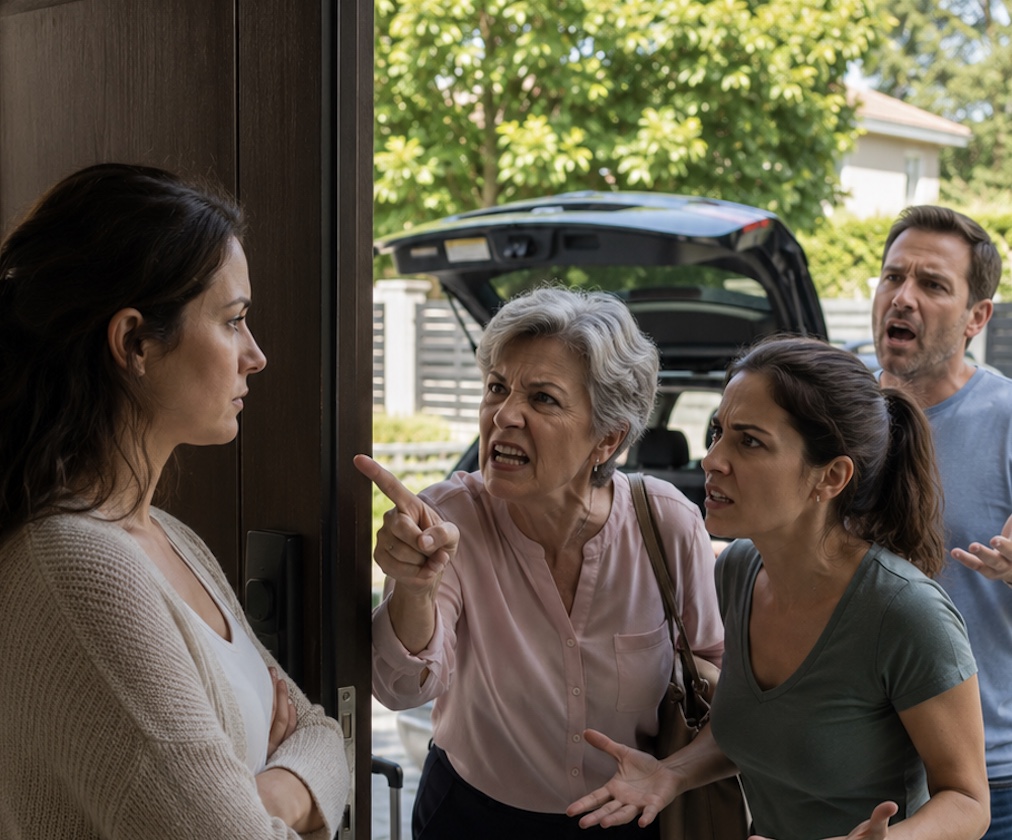
“Have you completely lost your mind? Now we can’t even get into our own house!” the relatives fumed outside the locked door.
Inga stood in the hallway, looking through the peephole. One after another, three cars pulled into the yard. First came Vadim’s old silver foreign car, then Svetlana’s dark crossover, and finally the car of Inga’s husband, Oleg. He had clearly rushed straight from work, throwing his jacket over his shirt in a hurry: the collar stuck out awkwardly, and one side of the jacket had folded inward.
People were already crowding the porch. Her mother-in-law, Zoya Pavlovna, stood closest to the door, pressing the bell as if the lock were supposed to open from the force of her finger alone. Svetlana kept yanking the handle. Vadim paced from window to window, peering inside and shielding his eyes from the reflection with his hand.
Inga did not move.
The house was quiet, warm, and spotless after the morning cleaning. On the kitchen counter lay neatly folded electricity bills, the receipt from the locksmith who had changed the locks that day, and the old bunch of keys Inga had collected one by one over the past few months. Not all of them, of course. Her husband’s relatives had never intended to return a complete set. That was exactly why she had called the locksmith.
Another blow landed against the door from outside.
“Inga!” Oleg shouted. “Open this door immediately!”
She tilted her head slightly, as if checking whether she had really heard that word.
Immediately.
In her house.
After everything they had done here.
That morning, the house had still smelled of someone else’s tobacco, grilled meat, cheap air freshener, and wet shoes. After the relatives’ last visit, Inga had spent two hours gathering plastic cups from the yard, carrying out garbage bags, scrubbing the stove, and removing a child’s jacket Svetlana had left on an armchair with the casual remark:
“I’ll pick it up later. You have plenty of space anyway.”
There was plenty of space.
Just not for other people’s arrogance.
The house had come to Inga from her parents. Her father had spent almost ten years building it: first a small summer cottage, then an extension, then a proper kitchen, heating, a bathroom, and a second floor with two rooms. Her mother had planted lilacs along the fence, protected the old apple tree, and always said:
“A house should rest together with its owners, not turn into a public passageway.”
After her parents died, Inga inherited the house after six months, completed the paperwork, and for a long time could not even come here without a heavy feeling in her chest. Every time she opened the door, she expected to hear her father searching for a screwdriver in the workshop or her mother calling her over to see the first jasmine bloom.
Back then, Oleg had been attentive. He came with her, silently helped sort through old things, fixed the gate, and mowed the grass. Inga was grateful to him because she thought: here is a man who understands how gently one must treat another person’s memories.
They spent the first summer in the house together. They came on Friday evenings and left on Sundays. Inga read on the veranda, Oleg fussed over the grill, and sometimes they invited a couple of friends — always in advance. Slowly, the house stopped being a place of pain. It became alive again.
Then one day Oleg brought his mother.
“Mom wants to see it,” he said when they were already on the way. “She’s been asking for a long time. It’s nothing serious. We’ll sit for a couple of hours.”
Zoya Pavlovna entered the house with the expression of someone inspecting construction work.
“Not bad,” she said, looking around the kitchen. “Though the space could have been used more intelligently. A tall cabinet would fit over there. And who sleeps in this room?”
“No one sleeps there permanently,” Inga replied. “It’s the guest room.”
“A guest room? Good. That means it’ll be convenient for me when I come.”
Inga decided then that it was a joke. She smiled politely, poured tea, and put cookies on a plate. Zoya Pavlovna spent the whole evening walking around the house, opening doors, asking where the linens were kept, why there was no greenhouse on the property, why the bathroom was so large, and why they had not cut down the apple tree if it was already old.
When her mother-in-law left, Inga said to her husband:
“I didn’t like the way your mother looked around. As if she had already decided she would live here.”
Oleg laughed.
“Come on. That’s just how she is. She was curious.”
Inga said nothing then. She did not yet know that in this family the word curious meant allowed to touch, and the word relatives meant access without permission.
Two weeks later, Oleg asked:
“Why don’t we leave Mom a spare key? What if she wants to come before us, air the place out, water the flowers?”
“I don’t have flowers that need watering every day.”
“Well, you never know. And it’s convenient.”
“Oleg, this is my house. I feel calmer when only we have the keys.”
He looked at her with such hurt, as if she had forbidden his mother from drinking water.
“You don’t trust her?”
“I don’t want to hand out keys.”
“She’s my mother.”
Inga gave in then. Not because she agreed. She was simply tired of arguing over something that seemed small. One key. What could possibly happen?
Everything happened.
At first, Zoya Pavlovna came alone on a Wednesday without warning. Inga found out that evening when Oleg said:
“Mom stopped by today. She said she picked the apples before they went bad.”
“What apples? I was planning to pick them myself on Saturday.”
“Well, she didn’t know.”
“She could have called.”
“Inga, are you seriously upset over apples?”
The following weekend, her mother-in-law came with Vadim. Her brother-in-law brought his wife, their two children, and an inflatable pool. Inga opened the gate and saw Oleg’s nephews running around the yard with bags of chips while Vadim unrolled the garden hose.
“We won’t stay long,” he said cheerfully. “Mother said you have plenty of space here. The kids need fresh air.”
Zoya Pavlovna was sitting on the veranda as if she had arrived at her own summer house.
“Inga, don’t frown. The house is big enough for everyone.”
Inga looked at Oleg. He avoided her eyes and started taking bags out of the car.
“I thought you wouldn’t mind,” he muttered later when they were alone in the kitchen.
“You didn’t ask me.”
“Well, they’re already here. We can’t exactly throw them out.”
And that phrase — we can’t exactly throw them out — became Oleg’s favorite shield. We can’t throw out Mother. We can’t throw out my sister with her children. We can’t throw out Vadim; he’s tired. We can’t throw out relatives; they already bought food. We can’t throw out guests; it would be awkward.
Yet somehow, it was perfectly acceptable for Inga to wash the floors after them, collect towels, search for missing chargers, fix the broken handle on the small room’s door, and listen to remarks about how she was too nervous as a hostess.
Svetlana appeared later than the others, but she immediately behaved more confidently than all of them. She arrived in July with her two children and a friend.
“We’re only here for one day,” she said, kissing Oleg on the cheek. “It’s too hot at home. The kids are exhausted.”
One day turned into three. Svetlana’s friend slept in the guest room, the children occupied the downstairs sofa, and Svetlana herself spread her things out in Inga’s parents’ bedroom because “it’s cooler there.”
When Inga saw someone else’s cosmetics on her mother’s dresser, her fingers tightened around the door handle until her knuckles turned white.
“Svetlana, this is my parents’ room. I don’t want strangers staying there.”
Her sister-in-law did not even turn around right away. She finished applying mascara, then looked at Inga through the mirror.
“Strangers? Interesting. I’m your husband’s sister.”
“That doesn’t change the fact that you took the room without asking.”
“Oh, Inga, don’t start. The room is just standing empty, and you’ve turned it into a museum.”
That evening, Inga had her first serious fight with Oleg.
“Your sister is sleeping in my parents’ room.”
“She has the kids with her. It’s uncomfortable for her downstairs.”
“And is it comfortable for me to see some stranger walking around my house in my shirt?”
“She took it by mistake. Svetlana said she thought it was hers.”
“In my wardrobe?”
Oleg rubbed his face with both hands.
“What do you want me to do? Start a scandal right now?”
“I want you to tell your family not to come here without permission, not to take rooms, and not to touch my things.”
“You’re making everything complicated.”
Inga laughed sharply.
“No, Oleg. You’re the ones who simplified everything. Down to the level of a train station.”
After that argument, he walked around gloomy for two days, answering in short phrases, as if Inga had done something unforgivable. Then he bought her flowers and said:
“Let’s not turn this into a war. I’ll talk to them.”
He really did talk to them. In front of Inga, on the phone, softly and cautiously:
“Mom, at least warn us before you come. Inga worries.”
Zoya Pavlovna answered so loudly from the other end that Inga heard her even from the hallway:
“What is she worrying about? We didn’t burn her house down. On the contrary, we brought it to life. Otherwise she sits there alone like a queen.”
Oleg only said:
“Come on, Mom…”
And that was all.
From that “Come on, Mom,” his relatives understood the main thing: Oleg would not defend his wife’s boundaries. That meant they could continue.
By autumn, the house had stopped being a place of rest. Whenever Inga came, she first checked who had been there without her. There were crumbs on the counter, other people’s jars in the fridge, forgotten hair ties in the bathroom, and Vadim’s cigarette butts near the shed. Once she found children’s rubber boots in the closet. Another time, a bag with men’s slippers.
“They’re mine,” Vadim said when Inga asked. “I left them so I wouldn’t have to bring them every time.”
“Why did you decide you could store your things in my house?”
“Where else am I supposed to keep them? In the car? Don’t be ridiculous.”
He truly did not understand. And that frightened her more than rudeness. These people had become so used to what belonged to someone else that they no longer saw the boundary.
In November, Zoya Pavlovna arrived with a neighbor. Inga learned about it by accident when a woman from the neighboring property, Nina Stepanovna, called her.
“Inga, do you have guests? I’m looking at your gate — there’s an unfamiliar car, smoke from the chimney, music playing.”
That day, Inga was in the city at work in the records department of a construction firm. She dealt with project documents and liked order and precision. After Nina Stepanovna’s call, she asked to leave early, got into her car, and drove out of town.
When she opened the door with her key, the house was noisy. Zoya Pavlovna was sitting at the kitchen table with her neighbor and Vadim. On the table were sliced meats, bread, jars of pickles, and sweets. Dishes were piled in the sink. The television blared from the living room.
“Oh!” her mother-in-law said happily. “We thought you were only coming tomorrow.”
“That’s obvious.”
Inga took off her shoes, walked into the kitchen, and stopped by the table.
“Who gave you permission to come here without me?”
Zoya Pavlovna slowly placed her fork beside her plate.
“Oleg gave us keys.”
“Oleg is not the owner of this house.”
Vadim snorted.
“Here we go.”
“No,” Inga corrected quietly. “Here we continue. Because this started a long time ago.”
Her mother-in-law’s neighbor quickly stood up.
“I should probably go.”
“Sit down, Nina Mikhailovna,” Zoya Pavlovna said. “This is a family conversation.”
“No,” Inga cut in. “This is a conversation between the owner of the house and people who entered without invitation.”
Zoya Pavlovna turned crimson.
“Listen to how she talks now. Her parents left her a house, and suddenly she doesn’t consider people to be people.”
“I consider people to be people when they ask permission.”
Vadim stood so abruptly that the chair scraped across the floor.
“Listen, Inga, don’t go too far. We didn’t do anything bad.”
“You came into my house without me, brought in an outsider, used the kitchen, lit the stove, ate, turned on the TV, and did not even call.”
“What of it?” Zoya Pavlovna snapped. “The house was standing there. Were we supposed to freeze outside?”
Inga looked at her closely. In that moment, her mother-in-law no longer seemed like an elderly woman who deserved respect out of politeness. In front of her sat a person who knew exactly what she was doing and was testing how far she could go.
“Gather your things,” Inga said.
“What?”
“Gather your things and leave.”
Vadim smirked.
“Are you serious?”
“Absolutely.”
Zoya Pavlovna rose, her hand resting on the back of the chair.
“I’ll call Oleg.”
“Call him.”
Oleg arrived an hour later. During that time, Zoya Pavlovna had managed to call Svetlana, complain to someone else, and declare three times that Inga was disgracing the entire family. Vadim sat in his car in the yard but did not leave. Her mother-in-law’s neighbor left almost immediately, even forgetting a bag of sweets behind.
Oleg entered the house tired and angry.
“What is going on?”
Inga stood by the kitchen window, washing a cup her mother-in-law had left with dried tea at the bottom.
“Your mother came into my house without invitation and brought a guest.”
“Mom said you threw her out.”
“Yes.”
Oleg fell silent. He was clearly waiting for excuses, tears, explanations. But Inga placed the cup on the drying rack and turned to him calmly.
“I no longer want anyone coming here without my permission.”
“Inga, that’s too much. Mom used the key. You gave it to her yourself.”
“I gave her the key for an emergency. Not for gatherings.”
“You’re making my mother sound like a thief.”
“No. I’m making her sound like a person who does not respect other people’s boundaries.”
Zoya Pavlovna threw up her hands.
“Did you hear that? Other people’s! I’m a stranger to her!”
Oleg glanced at his mother, then back at his wife.
“Let’s not do this in front of Mom.”
“Exactly in front of Mom. Because the problem isn’t that you don’t understand. You understand everything. It’s just easier for you to tell me to endure than to tell them to stop.”
Those words hit their mark. Oleg lowered his eyes, rubbed the back of his head, and said quietly:
“Mom, let’s go.”
Zoya Pavlovna recoiled as if he had betrayed her.
“So you’re going to let her?”
“Mom, let’s go,” he repeated, more firmly this time.
They left. For the first time in a long while, Inga closed the door and heard silence.
But that silence was not victory.
It was only a pause.
A week later, Svetlana sent a message: “We’re coming on Saturday. The kids need fresh air.”
Inga replied: “No.”
A minute later came the answer: “What do you mean, no?”
Inga wrote: “Exactly that. We are not expecting guests.”
Svetlana called. Inga did not answer. Then Oleg called.
“You refused Svetlana?”
“Yes.”
“She’s offended.”
“She’ll survive.”
“The kids’ activity was canceled. She was already planning it.”
“Planning what? My house?”
“A rest.”
“She can rest somewhere else.”
Oleg was silent for a long time.
“You’ve become harsh.”
“I’ve become clear.”
After that, a cold war began. The relatives did not come for almost a month, but Inga knew it was not respect. It was waiting. Zoya Pavlovna passed phrases through Oleg like, “Let her choke on her house.” Svetlana posted photos of her children in the family chat with the caption, “A pity when adults deprive little ones of fresh air.” Vadim wrote briefly: “What nonsense. Big house, zero use.”
Inga left the family chat. Oleg noticed that evening.
“Why did you do that?”
“So I don’t have to read hints about my own house.”
“They’re just hurt.”
“Great. Let them be hurt without me.”
In December, Oleg suggested:
“Maybe we should celebrate New Year’s there? Invite my family. Sit normally, talk things through, fix everything.”
Inga looked at him for so long that he began to get nervous.
“Are you seriously suggesting that we invite people into my house who have spent a month discussing how greedy and heartless I am?”
“Well, we have to make peace somehow.”
“Making peace is when both sides admit they were wrong. Your relatives don’t want peace. They want the old keys back.”
Oleg looked away.
“You’re exaggerating.”
Inga walked to the hallway closet, took out a box, and opened the lid. Inside were things the relatives had forgotten: Vadim’s slippers, a child’s sweater, a toy car, Svetlana’s makeup bag, a pack of napkins, and Zoya Pavlovna’s old comb.
“Do you see this? They had already started settling in. Each one left a piece of themselves here like a mark.”
“They’re just things.”
“No, Oleg. They’re a habit. Today slippers, tomorrow a folding bed, then ‘we’ll stay for the summer,’ and then your mother will tell the neighbors this is your family house.”
He sharply raised his head.
“She never said that.”
Inga smiled bitterly.
“She did. To Nina Stepanovna. Nina repeated it to me word for word: ‘The house is ours; it’s just registered in Inga’s name.’”
Oleg froze. An unpleasant realization flickered across his face, but he quickly hid it behind irritation.
“Neighbors love gossip.”
“And your mother loves keys.”
After that conversation, they barely spoke for two days. Inga took care of her own affairs. Oleg slept at home but kept his distance. He was not exactly angry — more confused. He wanted everything to go back to the way it had been. For his mother to come again, for his sister to stop sulking, for his brother to slap him on the shoulder, and for his wife to silently clean up the consequences of other people’s rest.
But the old Inga no longer existed.
The final straw was not an argument.
It was a photograph.
Inga saw it by accident on Svetlana’s social media page. In the photo, Svetlana’s children were standing on the porch of Inga’s house. The picture was old, taken in the summer, but the caption was new:
“We miss our dacha. Hopefully the adults will stop being capricious soon.”
Under the photo, Zoya Pavlovna had written: “We’ll go soon. She won’t get away from us.”
Inga sat with the phone in her hand, staring at the screen for several seconds. Then she enlarged the caption, took a screenshot, and sent it to Oleg.
He called back almost immediately.
“Why did you send me this?”
“So you can see what your family calls my house.”
“Svetlana just worded it badly.”
“And your mother too?”
“Inga, stop picking at words.”
“These are not just words. This is a plan.”
“What plan?”
“To return to the place where they feel comfortable. Without asking.”
Oleg exhaled wearily.
“I’ll talk to them.”
“No need. I’ve already decided.”
“What have you decided?”
“I’m changing the locks tomorrow.”
He did not answer right away.
“You wouldn’t dare.”
Inga slowly straightened. That “wouldn’t dare” did not sound like surprise. It sounded like the truth finally exposed. He also believed she had to ask permission for her own doors.
“It’s my house, Oleg. I dare.”
“My things are there.”
“I’ll pack your things. You can pick them up.”
“Inga, you’re destroying our marriage over keys.”
“No. The keys simply showed me who considers themselves what in my life.”
The next day, she came to the house early. The locksmith was a calm man in his fifties. He worked quickly and asked no unnecessary questions. Inga showed him the house documents, her passport, and the old locks. He nodded and took out his tools.
“Does this happen often?” she asked.
“Relatives?” he clarified without turning around.
Inga looked at him in surprise.
“Is it that obvious?”
“You can tell by the locks. When people change them after a break-in, they look different. When they change them after relatives, there’s a special kind of silence.”
Inga unexpectedly laughed. Not happily, but with relief.
“So I’m not the first.”
“You have no idea how many people think someone else’s door is a temporary misunderstanding.”
An hour later, the house had new locks. Inga tested each key, opening and closing the door several times. The metal turned smoothly, firmly. She put the old key ring into a bag, then changed her mind, took it out, and left it in the kitchen. Let it lie there. As a reminder that patience can also become evidence against oneself.
She did not call anyone.
She did not write explanations.
She did not warn anyone.
That evening, Oleg came back to the city apartment irritated.
“You really changed them?”
“Yes.”
“And you didn’t even give me a key?”
“Not yet.”
“So now a husband has to ask permission?”
“A husband has to understand that this is not a public entrance.”
He threw his bag onto the floor near the door.
“Are you trying to humiliate me?”
“I’m trying to protect my house.”
“From my family?”
“From everyone who decided my permission was unnecessary.”
Oleg went into the kitchen, poured water, and drank half a glass at once. His hand trembled when he set the glass down on the counter.
“Mother was planning to go there tomorrow.”
“I know.”
“How?”
“She wrote it under Svetlana’s photo.”
He clicked his tongue in irritation.
“God, Inga, those are just words on the internet.”
“Wonderful. Then tomorrow she simply won’t get into the house.”
Oleg turned sharply.
“Do you understand what kind of scandal this will cause?”
“I do.”
“And you don’t care?”
Inga looked at him carefully, calmly, almost with pity.
“No, Oleg. I do care. For the first time, I care about myself.”
The scandal began the next day after lunch.
Inga came to the house in advance. She knew his relatives loved arriving without warning, but now, after changing the locks, she wanted to meet that moment herself. Not hide, not justify herself over the phone, not listen to Oleg’s retelling. She wanted to face it herself.
She brewed ordinary black tea but did not drink it. She simply moved the cup aside and laid out documents on the kitchen table: the ownership certificate, the property extract, the old inheritance papers, and the locksmith’s receipt for the changed locks. Not for the relatives.
For herself.
So she could see clearly what they had all tried to blur with their “It’s convenient for us,” “The children need it,” and “The house is empty anyway.”
Around three o’clock, Svetlana’s car drove into the yard. Then Vadim arrived. Then a taxi stopped, and Zoya Pavlovna got out with two bags. Inga watched from the second-floor window as they moved confidently, without hesitation. Not like guests. Like people who had arrived somewhere they expected the door to be open.
Svetlana was the first to climb onto the porch and push her key into the lock.
The key did not fit.
She frowned and tried again. Then she pulled out her key ring and sorted through the keys. Vadim came up beside her.
“Give it here.”
He tried his own key.
Nothing.
Zoya Pavlovna set her bags on the porch.
“What are you fumbling with? Open it already, it’s cold.”
“It doesn’t fit,” Vadim said.
“What do you mean it doesn’t fit?”
Svetlana pressed the doorbell. Once. Twice. Then she began pressing it without stopping.
Inga stood in the hallway and looked through the peephole.
First, their faces showed confusion. Then irritation. Then understanding. Svetlana suddenly stepped back from the door and lifted her head toward the windows.
“She’s here! I saw movement!”
Vadim yanked the handle.
“Inga! Open up!”
Zoya Pavlovna stretched her neck toward the peephole.
“What have you done? Open this door immediately!”
Inga remained silent.
Ten minutes later, Oleg arrived. Clearly, they had called him right away. He jumped out of the car, first forgetting to turn it off, then went back, turned the key, slammed the door, and hurried up the porch steps.
“What’s going on?” he asked, though he already understood everything.
“Your wife changed the locks!” Svetlana shouted. “We were coming with the kids, Mother dragged bags here, and now this circus!”
“Where are the children?” Inga whispered behind the door, to herself.
There were no children.
So Svetlana was already adding pity where facts did not help.
Oleg called her. Her phone vibrated on the small table in the hallway. Inga looked at the screen but did not answer.
He knocked with his fist.
“Inga, open up. Let’s talk normally.”
Zoya Pavlovna threw up her hands.
“Normally? She has thrown us out into the street! Her husband’s own mother!”
Vadim pulled the handle again, harder.
“Enough! You’ll break the lock, and then you’ll pay for it yourself!”
Inga opened the inner hallway door but left the front door locked. Now she could hear them clearly.
“Vadim, step away from the door,” she said loudly.
Everyone outside froze.
“So you are in there!” Svetlana shouted triumphantly.
“I am exactly where I should be. In my own house.”
Zoya Pavlovna stepped closer.
“Open.”
“No.”
A pause fell. It was so dense that even Vadim stopped making noise.
“What do you mean, no?” Oleg asked.
“I mean no. From now on, no one enters here without my invitation.”
Svetlana gave a short, bitter laugh.
“Did you hear that? She has invitations now. Should we make appointments too?”
“Yes,” Inga replied. “And accept refusal if it doesn’t suit me.”
“Are you completely out of your mind?” Vadim slapped his palm against the door. “We’ve come here so many times!”
“Exactly.”
“We helped, by the way!”
Inga raised an eyebrow.
“With what? Cigarette butts near the shed? A broken handle? Other people’s things in my closets? Or trash in the yard?”
“Don’t count every little thing!” Zoya Pavlovna shouted. “People were relaxing!”
“You relaxed in my house. I worked after you.”
Oleg spoke more quietly:
“Inga, at least open the door for me.”
She looked at his silhouette through the frosted glass.
“Why?”
“I’m your husband.”
“Then say it right now, in front of everyone: the house belongs to me, they will no longer have keys, and they have no right to come here without my permission.”
Behind the door, everything went silent.
Oleg did not answer immediately. Inga could almost see him looking at his mother, then at his sister, then at his brother. Choosing not the truth, but convenience.
Zoya Pavlovna broke the silence first.
“Son, you don’t have to answer to her. You used this house together during the marriage, so morally it belongs to both of you.”
Inga smiled bitterly.
There it was.
Not by documents. Not by law. Not by respect.
By a conscience they had invented for themselves.
“According to the documents, the house is mine, Zoya Pavlovna. It came to me as inheritance from my parents. It is not marital property.”
“Now she’s waving documents around!” her mother-in-law hissed. “And when my son mowed the grass here, did he ask for documents too?”
“Your son mowed the grass because he lived with me and rested here. That does not make him the owner.”
Vadim scoffed.
“How convenient. The man invested himself, and now you’re throwing everyone out.”
Inga took the folder from the table, though they could not see it. Simply holding the documents felt good.
“Vadim, in all this time you brought nothing here except your family, slippers, and garbage. Don’t use the word invested so confidently.”
Svetlana raised her head sharply.
“How dare you talk to us like that?”
“Calmly.”
“We came to you like decent people!”
Inga gave a short laugh.
“Svetlana, you slept in my parents’ room and called it empty. You brought a friend without asking. Your children rummaged through my drawers, and you told me I was nitpicking. Don’t talk to me now about decency.”
“Now she’s dragging children into this!” Svetlana snapped.
“I’m dragging facts into this.”
Oleg knocked again, more softly this time.
“Inga, enough. Don’t make a spectacle in front of the neighbors.”
“The neighbors have been watching your spectacle for a long time, Oleg. I simply used to stay silent in it.”
The gate on the neighboring property really did open. Nina Stepanovna stepped out, supposedly toward the mailbox, but she walked so slowly that she could have studied every button on Zoya Pavlovna’s coat. Then the elderly neighbor across the road, Pavel Grigoryevich, appeared in his doorway.
Oleg’s relatives noticed the audience and began speaking louder. Now they needed not only to get inside, but also to look offended.
“She won’t let us in!” Zoya Pavlovna shouted toward the neighbor. “Her husband’s own family!”
Nina Stepanovna stopped by her gate.
“And whose house is it?” she asked calmly.
The mother-in-law hesitated for a second.
“What difference does it make? It’s a family house!”
Inga opened the door.
She did not fling it open, nor did she hide behind a chain. She simply opened it and stepped onto the threshold. She was wearing a gray home outfit, her hair pulled back, and there was no tremor in her voice. In her hand was the folder with the documents.
The relatives all leaned forward at once, but Inga raised her palm.
“No one is entering the house.”
Oleg stepped toward her.
“Inga…”
“You either. Not until this conversation is over.”
His face changed. Not from anger. From surprise. For the first time, he understood that he no longer had the old access either.
Zoya Pavlovna jabbed a finger at the folder.
“What did you bring out? Trying to scare us?”
“No. Remind you. The house is registered in my name. I inherited it after my parents died. You are not owners, you are not registered here, and you have no agreements with me. The keys you had were given to you only because I once trusted my husband. That trust is over.”
Svetlana’s face flushed in blotches.
“Take your keys then! Choke on them!”
“The old keys no longer work. But I will still take every copy you have, so no one later claims they accidentally tried to open the door.”
Vadim smirked.
“And what if we don’t give them back?”
Inga looked straight at him.
“Then I call the police right now and report that a group of people is trying to enter my house, pulling at the door, and refusing to leave my property.”
Zoya Pavlovna gasped.
“You’d call the police on family?”
“On people who don’t understand the word no.”
Oleg turned sharply to his brother.
“Give her the keys.”
“What?” Vadim stared at him. “Are you serious?”
“I said give them to her.”
Svetlana stepped back.
“Oleg, are you insane? She’s going to throw you out next, and you’re taking her side?”
Inga looked at her husband.
“That’s a good question. What do you think, Oleg? You have a home in the city where you’re registered. Here, you were a guest and the husband of the owner. Do you understand the difference?”
He went pale. For several seconds, he looked at her, then quietly asked:
“Are you kicking me out?”
“I’m saying I will no longer allow your family to live through you in my house. What happens to us depends on who you decide to be right now: my husband, or your family’s representative in the takeover of someone else’s space.”
Svetlana laughed harshly.
“Takeover! Did you hear that? Now we’re occupiers!”
From her gate, Nina Stepanovna said loudly:
“It’s not right to go somewhere without asking. I understand Inga.”
Zoya Pavlovna spun toward her.
“No one asked you!”
“No one needs to ask me,” the neighbor replied calmly. “I’m standing on my own property.”
That phrase seemed to cut Zoya Pavlovna down. She turned back to Inga, but there was less confidence in her now.
“So that’s how you’ve decided? To cut your husband off from his mother?”
“No. I’m cutting your key ring off from my lock. You can communicate with your son anywhere you like.”
Vadim pulled out his keys first. He removed the old key from the ring and threw it onto the wooden step.
“There. Happy now?”
Inga did not bend down. She looked at Oleg.
“Pick it up.”
“What?” he asked, confused.
“Your brother threw the key to my house at my feet. Pick it up and hand it to me properly.”
Vadim stepped forward.
“You’re going to give orders now?”
Suddenly, Oleg bent down, picked up the key, and handed it to Inga. His fingers were cold, his face tense.
“I’m sorry,” he said almost inaudibly.
Inga took the key but did not answer.
Svetlana demonstratively began removing her own key from the ring.
“What pettiness. You tore everyone apart over a house.”
“No, Svetlana. Because of this house, it became clear who thought they were entitled to what.”
“Why do you keep repeating that?” her sister-in-law snapped and threw the key into Oleg’s palm. “Here. Give it to your lock owner.”
“Put it down yourself,” Inga said.
“Absolutely not.”
“Then leave the property.”
Svetlana opened her mouth, but Oleg unexpectedly said:
“Svetlana, put the key down.”
“Are you kidding me?”
“Put it down.”
His sister turned sharply, placed the key on the step as if it burned her fingers, and moved away.
Zoya Pavlovna was the last. Her bags still stood at her feet. Offense remained on her face, but her eyes darted from her son to the neighbors, from the door to the folder in Inga’s hand.
“I lost my key,” she said at last.
Inga nodded.
“That is why the locks were changed.”
“Oh, so that’s how it is.”
“Exactly.”
“You’ll regret this,” her mother-in-law said quietly. “No man can stand living long with a woman like you.”
Inga looked at Oleg. He was silent. And that silence was more honest than all his previous promises to talk, explain, and fix things.
“Maybe,” Inga said. “But the house will stand. And so will I.”
Zoya Pavlovna grabbed her bags.
“Oleg, take me home.”
He did not move.
“Oleg!” she repeated more loudly.
“I’ll call you a taxi,” he replied.
His mother froze.
“What?”
“I’m staying to talk to Inga.”
Svetlana flared up.
“She didn’t even let you inside!”
“Then I’ll talk outside.”
For the first time all day, Inga felt not joy, but tired surprise. Oleg had made a step in the right direction, but too late and too uncertainly. She no longer wanted to grab at that step as if it were salvation.
“No,” she said. “There will be no conversations today. Today, all of you are leaving.”
Oleg turned to her.
“Inga, please.”
“No. I will not discuss my sanity on the porch of my own house under the shouting of your relatives. You may come tomorrow alone. No keys, no bags, no requests to ‘just step inside for a minute.’ We will talk in the yard or in the city.”
He swallowed and nodded.
“All right.”
Zoya Pavlovna looked at her son as if he had renounced her in front of everyone.
“You’re going to let her treat us like this?”
Oleg slowly turned to his mother.
“Mom, it’s her house.”
Three words.
Simple. Late.
But the porch became so quiet that it was as if someone had switched off all the noise.
Svetlana was the first to recover.
“Wonderful. Just wonderful. Remember this, Oleg: when she throws you out without even socks on, don’t come crying to us.”
“Svetlana, enough,” he said.
“No, not enough! We came here for years!”
Inga smiled faintly.
“Exactly, Svetlana. You came here for years and forgot one thing: you were not invited forever.”
Vadim waved his hand.
“Let’s go. Everything is clear here.”
They began heading back to their cars. Svetlana slammed her door loudly. Vadim said something into his phone in an irritated voice. Zoya Pavlovna stood for a long time before getting into the taxi Oleg had called, still waiting for her son to change his mind, open the door, and return her old place in the family arrangement. But Oleg stood by the porch, looking at the ground.
Inga collected the keys from the step and counted them. Then she looked at her husband.
“Tomorrow at six. In the city. At the café near the notary’s office.”
“Why near the notary’s?”
“There’s a legal consultation office nearby. We need to calmly discuss how we will live from now on. And what belongs to whom as well.”
He nodded again. The old self-confidence was gone from his face. Only the confusion of a man who had thought for too long that his wife was simply angry, only to realize she had drawn conclusions.
“I really didn’t want it to turn out like this,” he said.
Inga put the keys into her pocket.
“You didn’t want a scandal. But you did nothing to stop it from reaching this point.”
Oleg had no answer.
When the cars left, the yard became empty. The snow by the porch was trampled, and near the gate there remained marks from Zoya Pavlovna’s bags. Nina Stepanovna was still standing by her fence.
“Inga, are you all right?” she asked.
Inga turned to the neighbor and smiled for the first time that day.
“I’m all right.”
“You did the right thing. A house needs an owner, not a crowd.”
Inga nodded.
She went inside, locked the door with the new key, and pressed her palm against the warm wood. She did not slide down to the floor, did not burst into tears, did not rush from room to room. She simply stood there for several seconds, listening to the house.
The silence was different now.
Not empty.
Not frightened.
Hers.
In the kitchen, Inga placed the old keys in a metal box. She put the screenshots, printed documents, and locksmith’s receipt there too. Not out of fear. For order. She had allowed other people to turn her life into chaos for too long, and now she was putting everything back in its place.
The next day, Oleg came to the meeting alone. Without his mother, without his sister, without the familiar phrase that there was no need to ruin relationships. He looked tired.
“Mom said she doesn’t want to know you anymore,” he began.
Inga stirred sugar into her coffee, but she did not drop the spoon. She placed it neatly on the saucer.
“That’s her right.”
“Svetlana is angry too.”
“That’s her occupation.”
“Vadim thinks you arranged everything on purpose to humiliate us.”
“And you?”
Oleg looked at his hands for a long time.
“Yesterday, I understood for the first time that they really did think of the house as theirs. Maybe they didn’t say it out loud. But they thought it.”
Inga said nothing.
“And I…” He faltered. “I allowed it.”
“Yes.”
He raised his eyes.
“Do you want a divorce?”
Inga did not answer right away. Outside the window, people walked by, cars passed, someone laughed near the entrance. An ordinary day, in which what was being decided was not the fate of the house, but her own ability to stop betraying herself for other people’s peace.
“I want you to move out of my city apartment for a while,” she said. “Live separately. Think about where helping relatives ends and betraying your wife begins. And I will think about whether I need a marriage in which I had to protect my house from my husband by changing the locks.”
Oleg frowned but did not argue.
“The apartment is yours too.”
“Yes. Bought before marriage. And you know that perfectly well.”
“I’m not making any claims.”
“Not now. Yesterday your mother also talked about what was fair ‘morally.’”
He lowered his head.
“I understand.”
“I hope so.”
They reached an agreement without shouting. Two days later, Oleg picked up some of his things while Inga was home. He placed the keys to the city apartment on the hallway table himself. She checked whether all sets were there. Not because she wanted to humiliate him, but because she no longer intended to live on trust that worked only in one direction.
The relatives still tried to pressure her.
Zoya Pavlovna sent a long voice message, calling Inga ungrateful and cruel. Inga did not listen to the end. She saved it just in case and blocked the number.
Svetlana wrote: “The children are asking why Aunt Inga doesn’t love them anymore.”
Inga answered once: “Don’t involve the children. Adults answer for their own actions.” After that, she blocked her too.
Vadim came to Inga’s city building one evening but did not get farther than the entrance. He called Oleg, then texted Inga: “We need to talk like adults. Stop hiding.”
Inga called the police — not for drama, but for order. She reported that a man was standing near the entrance, demanding a meeting and refusing to leave. Vadim left before the patrol arrived and never appeared again.
A month later, Oleg came again. This time without arrogance, irritation, or attempts to make Inga guilty.
“I rented an apartment,” he said. “Mom was offended that I didn’t go to her. But I realized that if I went to her, nothing would change.”
Inga nodded.
“That’s reasonable.”
“I want to save our marriage.”
She looked at him calmly.
“And I want to save myself. If those wishes ever coincide, we’ll talk.”
They did not divorce immediately. Not because Inga was afraid of being alone, but because she did not make decisions out of spite. She gave herself time. She gave Oleg time too. But he never received the keys to the house again.
In spring, Inga came there alone. She opened the gate, walked along the path, and paused near the apple tree. Buds were swelling on the branches. There were no strange cars by the porch, no bags on the veranda, no voices in the house belonging to people who had called her greedy for claiming the right to close her own door.
She opened the new lock, entered, and stopped for a second.
The house smelled of wood, cleanliness, and free space.
Inga went to the kitchen, opened the window, and let in fresh air. Then she took her mother’s tablecloth from the cupboard, but did not set the table for guests. She simply ran her hand over the fabric and put it back. Not everything has to be restored to the way it used to be. Sometimes memory lives better where strangers’ hands no longer touch it.
That evening, she sat on the veranda with a notebook and began writing a list of things to do: check the roof after winter, call a stove repairman, plant new currant bushes, order a sign for the gate: “Private Property.” Without anger. Without challenge. Simply as a fact.
Her phone vibrated. A message from Oleg:
“Can I come on Saturday? Alone. To help with the yard. If you don’t want me to, I’ll understand.”
Inga looked at the screen for a long time. Then she replied:
“Not yet.”
And that no required no explanation.
She put the phone aside and looked out at the yard. Where other people’s cars had once stood, smooth evening light now lay across the ground. The gate was closed. So was the door. And for the first time in a long while, Inga was not waiting for someone to start pulling at the handle.
She remembered the day when the relatives had stood on the porch, shouting about “their own house.” How Zoya Pavlovna had demanded that the door be opened, how Svetlana had raged, how Vadim had thrown the key, and how Oleg had paced nervously across the porch, clearly not expecting things to turn out that way.
Back then, Inga had stood inside the house perfectly calm. Outside, a real hysteria was already beginning. Someone among the relatives shouted indignantly:
“Have you completely lost your mind? Now we can’t even get into our own house!”
Hearing the word own, Inga had smiled slowly.
Because this sense of ownership over her house — a feeling that belonged to strangers — was exactly what she had endured in silence for far too long.
And it was in that very moment that free access to her life ended for all of them at once.