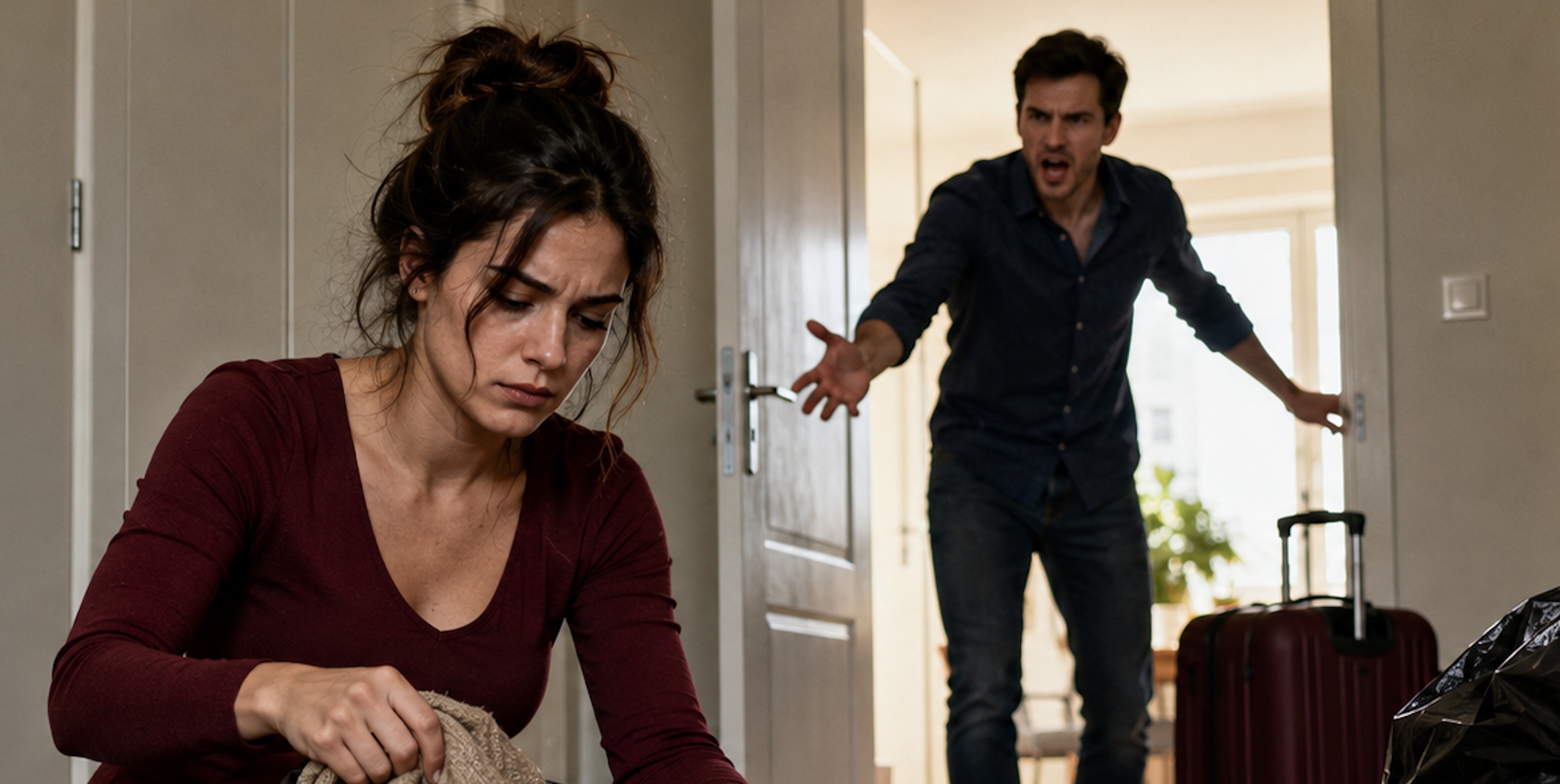
“So it’s settled, then. Denis will bring his things over this weekend, and you’ll drop the keys off to me tonight,” came the cheerful, slightly commanding voice of Viktor’s sister through the phone speaker lying carelessly on the kitchen table.
Anna froze with a damp sponge in her hand. She had been wiping the counter near the sink, about to make her morning coffee. Her husband, sitting at the table in a stretched-out old T-shirt, quickly jabbed the screen to turn off the speaker, pressed the phone to his ear, and turned toward the window. He muttered something unclear, agreeing, nodding to the invisible person on the other end, and then hurriedly ended the call.
A thick, ringing silence settled over the kitchen. The only sounds were the distant hum of morning traffic outside the window and the hollow drip of water from the faucet that had not been fully turned off.
“What keys?” Anna asked quietly, placing the sponge on the edge of the sink. “And where exactly is Denis coming?”
Viktor nervously ran a hand over his thinning hair and tried to put on an easy smile, but it came out crooked, like a schoolboy caught with someone else’s cheat sheet.
“Anya, I told you. Well… I was going to tell you last night, but you fell asleep early. Marina called. They’ve got a problem. Denis got into university, but he didn’t get a dorm room. Not enough points, apparently. And you know how expensive rent is now. He’s family, after all. My nephew. I offered to let him live in our little one-room place. The tenants moved out last week anyway.”
Anna felt something cold and heavy slowly rise inside her. She walked to the table, pulled out a chair, and sat down across from him, looking straight into his eyes.
“What do you mean, our little one-room place, Vitya?” Her voice was frighteningly calm. “We don’t have any ‘our’ one-room apartment. We have the apartment we live in now, which my parents bought before I ever met you. And we have the small apartment on the outskirts that I inherited from my grandmother. My inheritance.”
“Oh, here we go,” Viktor said, rolling his eyes theatrically as he leaned back in his chair and folded his arms across his chest. “Yours, mine. We’re a family, Anna! Fifteen years of marriage, and now we’re going to start dividing property when a relative needs help? The boy needs to study. He can’t sleep at the train station.”
“The boy can rent a room with classmates, the way thousands of students do. Or his parents can find housing they can afford. The tenants moved out because I was planning to do some light cosmetic repairs and rent the place out for more. Dasha is finishing school next year. She needs tutors for advanced math and physics, and that costs a lot of money. We agreed that all the income from Grandma’s apartment would go toward our daughter’s education. Have you forgotten?”
Viktor grimaced as if all his teeth had started aching at once. The topic of money always irritated him. He worked as a manager at a logistics company and earned an average salary, but most of his income went toward maintaining his car, buying new fishing rods, fish finders, and other “manly necessities” he considered absolutely essential. Anna, meanwhile, carried the main household expenses on her shoulders, working as a merchandise specialist at a large garden center.
“Dasha still has a whole year before graduation. We’ll save up for her tutors,” he waved her off. “I’ll put money aside from my salary. But Denis needs a place right now. I already promised my sister. I can’t back out now. My family won’t understand. I told her he could live there for free while he studies. He’ll just pay the utilities, so it won’t cost you anything.”
“For free?” Anna felt her breath catch from outrage. “For four years? You gave away my only source of extra income, promised someone the keys, and took money away from your own daughter’s education just so you could look good in front of your sister?”
“Stop making me out to be some monster!” Viktor raised his voice and slammed his palm on the table. The cup with unfinished tea gave a miserable clink. “You’re acting like you can’t spare a chunk of concrete for family! It’s disgusting, honestly. I’m not ruining my nerves first thing in the morning. I’m going to work. I took the keys from the hallway drawer last night. After work I’ll take them to Marina. We agreed to meet by the metro.”
He jumped up, scraping the chair loudly across the tile. Viktor went into the hallway and began getting ready with unnecessary noise, slamming the wardrobe doors. Anna remained sitting in the kitchen. She did not run after him, did not scream, did not try to snatch the keys back.
She simply listened as the front door lock clicked, then as the shared entry door shut with a heavy thud.
Her mind was strangely clear. There were no tears. No hysterics like in films. There was only one sharp, crystal-clear realization: this man had just crossed a line from which there was no return.
The rest of the day passed as if through fog, though Anna mechanically did everything she needed to do. She saw her daughter off to school, ironed her blouse, made breakfast. Then she called work and took an unpaid day off, saying she felt unwell. Her manager, knowing Anna’s sense of responsibility, let her go without asking unnecessary questions.
Left alone in the spacious apartment filled with morning sunlight, Anna poured herself a cup of cold coffee, went to the window, and stared down at the restless city below.
She remembered their life together. How Viktor had moved into this very apartment fifteen years earlier with one sports backpack and an old television. How she, blinded by love, had registered him there so he could find a proper job. How she had hung wallpaper by herself while he “handled important matters” on the phone, lying on the couch. How she went back to work when Dasha was barely a year old because Viktor’s salary was catastrophically insufficient even for diapers, and asking his parents for help was “embarrassing.”
And now he was making decisions about her inheritance. Letting his nephew live there for free for four years. The worst part was that he genuinely did not understand what he had done wrong. In his version of the world, a wife was a convenient extension of himself, a resource he could use however he wanted.
Anna stepped away from the window and took a folder of documents from the drawer. She found the certificate of inheritance and ran her eyes over the lines. Legally, the apartment belonged only to her. Morally, even more so. Her grandmother had saved from every pension payment to leave her granddaughter at least some kind of safety net.
The decision formed by itself, natural and inevitable, like the changing of the seasons.
Anna opened the lower drawer of the kitchen cabinet where she kept household supplies. She pulled out two rolls of thick black 120-liter garbage bags — the sturdy kind with ties, strong enough not to tear even when filled with construction debris.
Then she went into the bedroom.
She opened the wardrobe. The left side belonged to Viktor.
Silently, Anna began packing her husband’s things into garbage bags.
First came the suits and shirts. She did not throw them around or tear them in a fit of rage. She calmly removed them from the hangers, folded them in half, and lowered them into the black plastic. Jeans, hoodies, and stacks of T-shirts followed.
The next bag was for shoes. Expensive winter boots he had bought with last month’s bonus while Anna still wore autumn boots with worn-out heels. Sneakers. Dress shoes.
Then she moved to the bathroom. She swept his shaving foam, razor, expensive cologne — the one Marina had given him for New Year’s — his toothbrush, and his sharply menthol-scented shower gel from the shelf. All of it went into a smaller bag.
Then came the storage room.
That was where Anna took the longest.
Fishing gear. Rods. Cases full of lures and hooks. Thermal underwear. A special backpack for winter fishing. All the things that had drained money from the family budget. She packed them in solid batches, pulling the yellow plastic ties closed with a dull, satisfying sound.
By lunchtime, a formidable barricade of seven swollen black bags stood in the hallway. They looked like silent guards protecting the entrance to her new life.
Anna sat down on the small bench in the entryway and wiped her damp forehead with the back of her hand. She looked over the results of her labor. The apartment seemed to have been cleansed. It became easier to breathe. The smell of his cologne was gone. The T-shirts thrown over chairs were gone. The constant feeling of a person’s presence draining the life out of her was gone.
At three in the afternoon, Dasha came home from school. She took off her backpack, looked in surprise at the black bags, then at her mother.
“Mom, what is all this? Are we starting renovations? Or throwing out junk?”
Anna walked over to her daughter, wrapped an arm around her shoulders, and kissed the top of her head. The girl smelled of chalk and sweet perfume.
“No, sweetheart. These are your father’s things. He’s moving out.”
Dasha went still. There were no tears in her eyes, no panic. At fourteen, she was clever enough to have noticed how her father spoke to her mother, how he brushed off requests to help with homework, how he disappeared with friends every weekend.
“Are you getting divorced?” the girl asked quietly.
“Yes. It will be better this way. For both of us. Go to the kitchen. I warmed up some soup for you. I need to make an important call.”
Anna waited until her daughter disappeared behind the kitchen door and called a locksmith from the building management company. Uncle Misha, an elderly, grumbling but reliable handyman, arrived half an hour later. For a thousand rubles and a cup of good tea, he quickly replaced the lock cylinder on the front door without asking unnecessary questions.
Only the most important thing remained.
Grandma’s apartment.
Anna knew Viktor planned to hand the keys over to his sister that evening.
She called a taxi. The ride took about forty minutes. On the way, Anna phoned the head of the homeowners’ association in that building and warned him not to let any strangers into the fourth-floor apartment. When she arrived, she unlocked the door with her own key. The apartment smelled of dust and old wallpaper. Anna walked into the kitchen and sat down on a stool.
Now she only had to wait.
She did not have to wait long.
Toward evening, a key turned in the lock. The door creaked open, and Viktor walked into the entryway. Marina was with him. They were talking loudly.
“Here, come in,” Viktor was saying in his deep voice. “The wallpaper is old, of course, but it’s livable. The sofa folds out, the fridge works. It’ll be perfect for Denis. Anya wanted to start repairs here, but I told her, why waste money if our own people will be living here?”
Anna stepped out of the kitchen with her arms crossed.
Viktor stopped mid-sentence.
Marina, who had already managed to take off one shoe, froze with her sandal in her hand.
“What are you doing here?” Viktor asked, confused. “You’re supposed to be at work.”
“I came to check on my property,” Anna replied calmly. “And to ask you to leave premises that do not belong to you. Marina, put your shoe back on.”
Her sister-in-law turned a deep red, her eyes narrowing with hostility.
“Vitya, what kind of circus is this? We had an agreement. Denis is arriving tomorrow with his things. I bought him the tickets.”
“Then let Denis and his things go sleep on a folding bed in your living room,” Anna said sharply. “Or rent a place. This apartment is not being given to anyone. Especially not for free.”
Viktor took a step forward, his face blotching red.
“Have you lost your mind? You’re humiliating me in front of my sister? I gave my word!”
“I didn’t,” Anna said, holding his heavy gaze without looking away. “Under Article 36 of the Family Code of the Russian Federation, property received by one spouse during marriage through inheritance is that spouse’s personal property. You have no right to make decisions about this apartment, promise the keys, or move tenants in. Put the keys on the cabinet.”
“Oh, so now you’re a legal expert,” Viktor sneered. “Been reading the internet? Fine. Rent out your dump. Choke on those pennies. But remember this: if this is how you treat me, I won’t play nice either. I’ll file to divide the apartment we live in. Half of it is mine.”
Marina nodded triumphantly and tossed her sandal onto the mat.
“That’s right, Vitya! Let her learn how to treat relatives. Ungrateful woman.”
Anna did not even smile. It suddenly became unbearably boring to look at this man, who now felt like a stranger.
“File,” she nodded. “Just don’t forget to hire a good lawyer before court. That apartment was bought with money from the sale of my mother’s premarital apartment. All bank transfers, receipts, and sale contracts showing the source of the funds are safely stored in a separate folder. Court practice in such cases is very clear. You did not contribute a single ruble to the purchase, and the court can verify that easily. You’ll leave with exactly what you came to me with fifteen years ago. A backpack. Speaking of which — keys on the table.”
Viktor stood rooted to the spot.
He had not expected resistance like this. He was used to Anna smoothing things over, compromising, avoiding conflict. With force, he threw the key ring onto the wooden cabinet. The keys clinked pitifully.
“Let’s go, Marina,” he said through clenched teeth. “There’s no one to talk to here. Some people have calculators instead of hearts.”
They walked out, slamming the door behind them.
Anna slowly exhaled. Her knees trembled slightly from the tension, but her soul felt unexpectedly light. She locked the door with two turns of the key, went downstairs, and called a taxi home.
When she returned, she found Dasha sitting over her textbooks. Her daughter looked up from her notebooks.
“Mom, Dad came. Well… he tried to.”
“And?” Anna took off her coat and hung it on the hook.
“He pulled the handle, rang the doorbell, knocked. I didn’t open. I went to the door and told him you changed the lock and that he should take his things, because they were standing in the shared entryway. He swore a lot. Then I looked through the peephole and saw him carrying those black bags to the elevator. He had to come back about five times. He was cursing through the whole stairwell.”
Anna went into the kitchen and put the kettle on.
“Were you scared?”
“A little,” Dasha admitted, following her. “Mom… are we going to live just the two of us now?”
“Just the two of us. Tomorrow I’ll file for divorce. And this weekend we’ll go to Grandma’s apartment, buy some nice light wallpaper and paint for the radiators. We’ll do a simple renovation in the evenings over a week. I already posted an ad, and the realtor said that once it’s freshened up, we can rent it for a third more. That will be enough for a good math tutor.”
Dasha came over and hugged her mother tightly.
“Thank you, Mom.”
That evening, Anna’s phone would not stop buzzing. Her mother-in-law wrote, accusing her of destroying the family. Marina wrote, cursing Anna’s greed. Viktor sent message after message, alternating between threats and pathetic pleas to let him come back because Marina and her husband did not want to keep him in their cramped two-room apartment, and he had no money to rent a place.
Anna did not read those endless walls of text. She simply opened each chat and pressed Block.
One tap — and the person disappeared from her digital reality, just as he had disappeared from her real life along with the black garbage bags.
She poured herself hot tea with lemon, took her favorite mug — the one Viktor had always tried to throw away because of a tiny chip on the handle — and sat down in the armchair.
The apartment was quiet.
There was no television roaring with endless sports broadcasts. She did not have to think about what to cook for dinner for a grown man who was never satisfied: the meat was always either under-salted or the fish too dry.
A divorce process lay ahead. Perhaps she would need to hire a lawyer to fend off Viktor’s absurd claims to the washing machine or television. But those were minor things. Dust that would eventually settle.
The main thing was already done.
She had taken back her territory, her right to control her own money, and her life.
The next day, during her lunch break at the garden center, Anna went onto the Gosuslugi website. Filing for divorce turned out to be surprisingly simple. No tears. No long explanations in offices. Just electronic fields to fill in.
Life gradually found a new rhythm.
Two weeks later, Anna and Dasha finished the repairs in the inherited apartment. They put up inexpensive but stylish wallpaper, hung new curtains, and scrubbed the windows until they shone. Tenants appeared the very next day — a young IT couple with no bad habits and no pets. The contract was signed, and the first payment and deposit landed in Anna’s bank account. Part of the money immediately went toward the first month of tutoring for her daughter.
Viktor tried waiting for her outside work.
Once, he approached the entrance of the garden center with a crumpled bouquet of chrysanthemums. He looked awful — unshaven, wearing a stale shirt. Clearly, living at his sister’s place on borrowed mercy was not doing him any good.
“Anya, stop being ridiculous,” he began in his usual tone, trying to grab her by the elbow. “We taught each other a lesson, and that’s enough. I had a fight with Marina. Denis got into a dorm after all — slipped the building manager some cash. Let’s make peace. I want to come home.”
Anna gently but firmly removed his hand.
“Your home is wherever your things are, Viktor. And I packed your things in garbage bags. The court will divorce us in a month. Don’t come here again, or I’ll call security.”
She turned and walked toward the metro, feeling his confused, angry stare on her back. And in that moment, she finally understood that she would never, under any circumstances, regret what she had done.
Six months later, they received the official divorce certificate. The court left both apartments to Anna, exactly as she had said it would. Viktor got only his beloved fishing equipment and the old car bought on credit — a credit he now had to pay off himself.
And Anna simply lived.
In the evenings, she and her daughter watched comedies, baked pies, and made plans for the future. And every time Anna walked past the empty hook in the hallway where her ex-husband’s jacket used to hang, she felt not emptiness, but freedom.