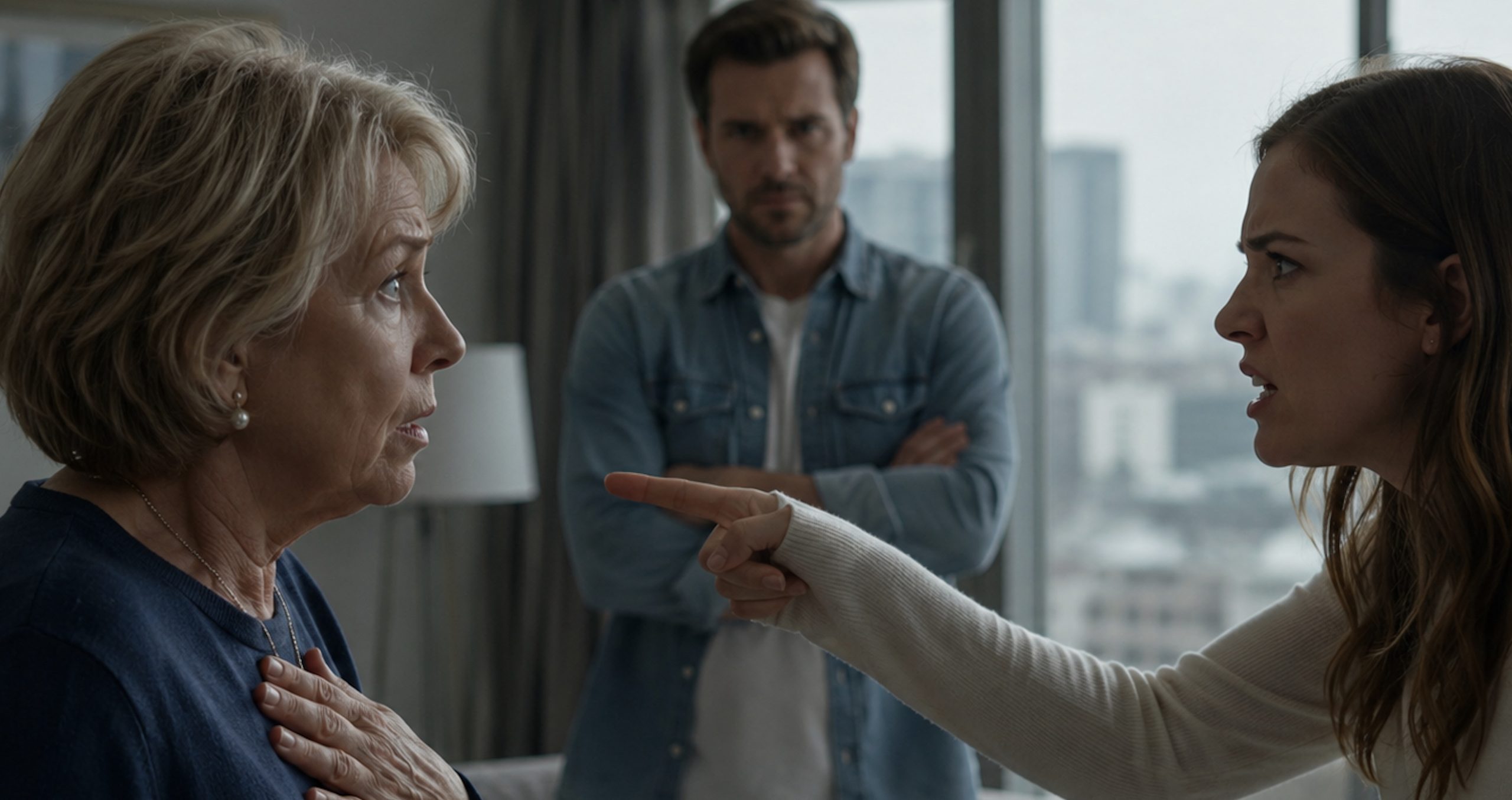
The slap came suddenly and sharply, like a window shutter banging open in a winter storm.
Vasilisa did not stagger. She simply stood in the middle of the living room, where the air smelled of expensive perfume and old resentment, and looked at Anna Petrovna. She looked at her for a long, calm moment, so steadily that the older woman finally turned her eyes away.
“Throw that ragged little tramp out!” her mother-in-law repeated, quieter now, but with the same poisonous certainty as she turned to her son. “Igor, do you hear me? She is not worthy of you. She never was.”
Igor stood by the window. Outside, a snowstorm raged, covering the parked car in the courtyard with thick white powder — a new, shining car that still gleamed through the veil of snow. He was not looking at his mother. He was looking at Vasilisa.
“I’ll be right back,” Vasilisa said.
Her voice was even. No tears. No trembling. And that, perhaps, frightened Anna Petrovna more than anything else.
They had met almost a year earlier in the small town where Vasilisa had been born, raised, and chosen to remain. It was the kind of town people dismissively call “the provinces” — one main street lined with shops, creaking swings in the park, and a school where she taught second grade. The children loved her. Every morning she came in with notebooks tucked under her arm, greeted the cleaner, Aunt Masha, by name instead of with a careless nod, and knew that little Seryozha Kravtsov had been sleeping badly because his parents had started fighting again.
Igor appeared at the end of March. He had come on a business trip, checked into the only hotel in town, and on the second day got lost while looking for the local archive. Vasilisa explained the way, then walked him there, then they had coffee in a café with crooked tables and cotton curtains. He was two hours late to the archive. She was late to a rehearsal for the school spring performance. Neither of them regretted it.
He came back three more times — no longer for work. By summer they were messaging every day. By autumn, he had come to meet her friends. By November, she went to the city to meet his mother.
Anna Petrovna opened the door, looked Vasilisa up and down, and smiled — the kind of smile only very well-mannered people can produce when they are trying to hide disappointment.
“Come in,” she said. “Would you like some tea?”
The tea was strong and far too sweet. The conversation was polite and full of thorns.
Anna Petrovna had raised her son alone. Her husband had died young — Igor had not yet turned eight when it happened. She worked, saved money, denied herself everything, took him to clubs, watched his grades, demanded, insisted, believed. She poured everything she had into him — time, strength, dreams. In return, she wanted only a little: for him to achieve something. To become someone. To be able to say to the neighbors, “My Igor…” and see their eyes light up.
And he had achieved it. A good position, a respectable salary, the respect of his colleagues. She was quietly and tirelessly proud of him, the way one is proud of the work of an entire lifetime.
That was why a provincial schoolteacher in a modest coat, with laughing eyes, seemed to Anna Petrovna like a disaster. At first, she did not say it directly. She simply asked, every time they met, “Do they pay you well there?” or “You must be planning to move to the city, aren’t you?” or “Igor can help you find a proper job, of course.” She pronounced the word “you” as if it weighed as much as a stone.
Vasilisa smiled. She answered softly. She explained that she had no intention of finding work elsewhere — she was happy where she was. For some reason, that made her future mother-in-law even angrier.
“Mom, stop it,” Igor would say.
“I’m only worried about you, sweetheart.”
She was always worried. It was both her favorite weapon and the meaning of her life.
December brought snow and news.
Igor called his mother and told her he had been promoted. Anna Petrovna cried with happiness — quietly, joyfully, pressing the phone to her chest. Then he arrived in a new car — large, expensive, the kind she had once seen in an advertisement and thought, If only… After that, he brought her a mink coat.
Anna Petrovna tried it on in front of the mirror. Her hands trembled slightly.
“This is for you, Mom.”
She looked at herself — an aging, tired woman wrapped in luxurious fur — and felt that it had all been worth it. All those years, all the sacrifices, all the strictness — none of it had been in vain.
And it was then that the old sense of injustice washed over her again. If her son was so successful, so wealthy, so worthy — why did he need that girl from the provinces? Why did he need a schoolteacher who rode the bus and wore the same coat for the third winter in a row?
“Igor,” she said that evening when Vasilisa stepped into the kitchen, “you deserve better.”
He said nothing. She took his silence for agreement.
At first, the criticism was indirect.
“Vasenka, you must get so tired spending all day with children. Igor needs a wife who still has energy for the home.”
“Vasenka, you’re so thin. You really should eat better. Igor likes everything to be nice at home.”
“Vasenka, you don’t have experience with city life. That isn’t a reproach, just… keep it in mind.”
Vasilisa answered patiently and without offense. She understood that behind those words was not pure cruelty, but fear. Fear of losing control over the son Anna Petrovna had held in her hands for so many years. Vasilisa tried to speak to her honestly, without blame.
“Anna Petrovna, money doesn’t make a family. You know that better than I do. You raised a wonderful man by yourself, and that takes not money, but love and strength.”
“Don’t lecture me, girl,” Anna Petrovna snapped.
With each visit, her words grew sharper. With each visit, Anna Petrovna became less careful.
“You’re going to her again?” she would ask Igor. “Why? What keeps pulling you there?”
“Mom, I love her.”
“Love passes. Common sense remains.”
Igor grew angry, left, returned. He was trapped between two women and did not know how to free himself without tearing something apart.
Vasilisa saw it. She saw how tense he became every time his mother began speaking. She saw how exhausted he was.
One day she told him:
“Let it be the way you decide. I won’t fight your mother. I’ll only fight for us.”
He took her hand. For a long time, he said nothing.
“Give me time,” he asked.
The January evening was white and quiet — snow fell slowly, almost unwillingly. They arrived together, Igor and Vasilisa, but the silent expectation of scandal was already in the apartment, as it always was.
Anna Petrovna was in a bad mood from the doorway. Something had happened at work, or a neighbor had said the wrong thing, or perhaps too much had simply built up inside her — she could not have explained it herself. She looked at Vasilisa, at her calm face, at her simple dress, at the way she confidently put the kettle on, and irritation rose inside her like a dark wave.
“You’re already acting like this is your home,” she threw at her.
“Anna Petrovna, I only put the kettle on.”
“Don’t interrupt me.”
“I wasn’t interrupting.”
“You always argue!” Anna Petrovna’s voice rose. “Igor, do you hear her? Always snapping back! She thinks that because you brought her here, she’s the mistress of the house now?”
“Mom, stop.”
“No, you stop! Stop bringing her here! I am telling you, she is not your match! She is not your match! Penniless nobody, came here to cling to you because she has achieved nothing herself…”
“Anna Petrovna,” Vasilisa said evenly, “I am asking you to stop.”
“Shut up!”
And then something happened that even Anna Petrovna herself had probably not expected. Her hand rose on its own, and the slap rang through the silent apartment like a gunshot.
“Throw that ragged little tramp out! Do you hear me, Igor? Throw her out!”
Igor looked at his mother as though he were seeing her for the first time.
Vasilisa did not cry. She did not scream. She simply said:
“I’ll be right back.”
And she went into the hallway.
Anna Petrovna felt victorious — but only for three seconds, no more. Then she saw her son’s face.
“Igor…”
“Be quiet,” he said softly.
Vasilisa returned. In her hands was a laptop. She placed it on the table beside the untouched tea and opened it.
“Here,” she said, addressing Anna Petrovna. “Look.”
The older woman stared at the screen and did not understand. Then she began to understand.
The mortgage contract. The name of the payer. The date of the last payment. The account from which the money had been withdrawn.
“This…” she began.
“This is the apartment your son lives in,” Vasilisa said. “I pay the mortgage. Here is the insurance for the car. Here is the purchase agreement. I bought the car too.”
The silence was so deep that the wind could be heard humming outside the window.
Anna Petrovna slowly turned her eyes to Igor. He did not look away.
“Is this true?” she asked.
“Yes,” he said. “It’s true.”
“But… the promotion… you said…”
“There was no promotion, Mom.”
He sat down. Picked up a glass of water, then set it back without drinking.
“You suggested it yourself. Remember? A year ago, when I complained that you interfered in every decision I made. You said, ‘If you achieve something on your own, I’ll leave you alone.’ I got tired of proving myself. So I just… pretended.”
“But where did all this come from, then…”
“Mom.” He lifted his eyes to her. “Vasilisa is wealthy. Truly wealthy. Her parents gave her a share in the family business. She could never work a day in her life if she didn’t want to — but she works because she loves children and wants to feel useful. And all this time, you insulted her. Called her poor. Slapped her.”
Anna Petrovna opened her mouth.
“The fur coat you wear,” Igor continued, “was bought with her money. With the money of the ‘ragged little tramp.’”
Anna Petrovna’s face changed, as if a shadow had passed over it.
She looked at her daughter-in-law.
Vasilisa was already holding scissors — large ones with blue handles, taken from the kitchen drawer.
“Please return the coat,” she said.
Anna Petrovna’s hands would not obey her. She laid the coat across the back of a chair, and the fur gleamed in the chandelier light — dark, thick, expensive.
Vasilisa picked it up without a word.
The first cut came easily.
Anna Petrovna cried out — a short cry, as if the pain were her own.
“Don’t…” she whispered. “I understand that I…”
“It was bought with my money,” Vasilisa said, not stopping. “And this is my decision.”
A second cut. A third. Pieces of fur fell to the floor in dark strands.
Igor did not get up. He watched.
When it was over, Vasilisa carefully placed the scissors on the table and straightened.
“Anna Petrovna,” she said, and there was no triumph in her voice, no anger — only exhaustion, “I am not your enemy. I never was. But I will not allow anyone to humiliate me. No one.”
Her mother-in-law sat with her head lowered. Her shoulders shook.
“Forgive me,” she finally managed to say. The words came with difficulty, as though they were the first she had spoken in years. “I… I didn’t know.”
“You knew everything you needed to know,” Vasilisa replied. “That your son loves me. That should have been enough.”
They left the next day.
Not in haste — they packed calmly, neatly, taking only what they needed. Igor filled boxes in silence, occasionally glancing at Vasilisa. She answered with her eyes, and something invisible and important passed between them, like an electric current.
His mother came to the door when they were carrying out the last things.
“Igor,” she said. “I am sorry.”
“I know, Mom,” he answered.
“Will you come back?”
He stopped. For a long time he looked at her — at the woman who had given him everything she had, and who had just sat crying over the ruined fur coat.
“Maybe,” he said. “Later. When all of this has… settled a little.”
She nodded. She did not ask again.
As Vasilisa passed her, she stopped for a second.
“Anna Petrovna,” she said quietly, “your son is a good man. You raised him that way. That is true.”
Her mother-in-law did not lift her head.
The door closed.
Beyond the city, the snowstorm had calmed. The highway was wide and empty, the headlights cutting through the darkness. Vasilisa looked out the side window at the white fields, the lonely trees along the road, the stars beginning to appear through gaps in the clouds.
“Are you all right?” Igor asked.
“Yes.”
“I’m to blame. I should have…”
“You did what you could.” She turned to him. “We did what we had to do.”
He took her hand. The road unrolled ahead of them into the darkness, into the snow, into whatever would come next.
“Is spring beautiful in your town?” he asked.
“Very,” she answered. “The lilacs bloom so strongly there that they make your head spin.”
“Tell me about it.”
She told him. He listened. The blizzard remained behind them.
And ahead of them was spring — the spring in which they planned to marry. The one no one would take away from them again.