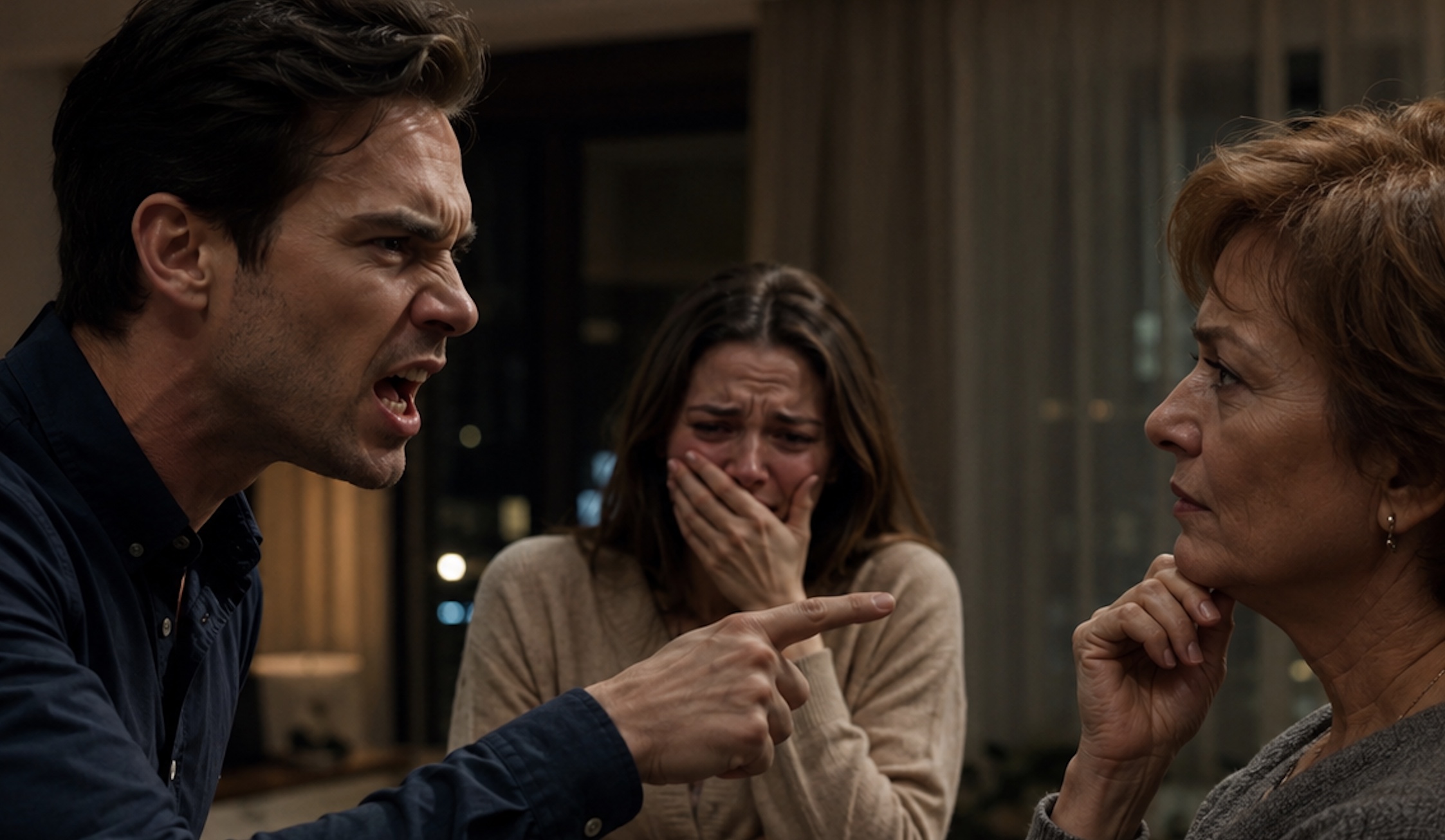
“Well, you should have seen your face when I mentioned your first job, Irochka. Like a beaten dog. Did you really think Mr. Voronov, a man worth billions, would appreciate your little attempt to join a conversation about stock prices? I was saving the situation, sweetheart. Saving your husband from embarrassment while you were trying to sound clever.”
Valentina Andreevna tossed her keys onto the small table in the hallway without even turning to look at her son and daughter-in-law, who had entered behind her. The sound of metal striking polished wood cracked through the apartment like a whip. She moved deeper inside, unbuttoning her cashmere coat as she walked, every movement suggesting that the evening had gone perfectly—and that she alone knew how to behave in high society.
Sergey closed the front door carefully, as if one extra sound might make the whole apartment explode. His hands were trembling slightly, not from fear, but from the adrenaline that had been boiling in his blood for the last two hours. Slowly, he removed his jacket, feeling his shirt clinging to his back. They had driven home in silence, but it had not been an empty silence. It had been charged, electric, the kind of silence that seemed to make sparks jump behind the dashboard.
Irina stood by the mirror, taking off her long earrings. Her movements were terrifyingly calm. No shaking hands. No red blotches on her neck to betray panic. Only in the mirror did Sergey see her eyes—dark, dry, and furious. She carefully placed the earrings in a small jewelry box, then turned toward her mother-in-law, who had already settled into the living-room armchair like a queen on her throne.
“You told Voronov that I worked as a cleaner in a dormitory to pay for Sergey’s education,” Irina said quietly. Her voice was even, stretched tight like a wire. “And then you added that, out of old habit, I still save money on laundry detergent, which is why Sergey’s shirts sometimes smell like cheap soap. Was that your ‘saving’ joke?”
Valentina Andreevna laughed, dramatically throwing her head back. The chandelier light shimmered across the perfect hairstyle that had taken a stylist three hours to create before the reception.
“Oh, don’t be so dull. It’s called storytelling. People need Cinderella stories. They get bored hearing about your two university degrees and your internship in Europe. That’s dry. Lifeless. But a devoted wife who scrubbed floors for her brilliant husband? That touches people. Voronov likes those tearjerker stories. I was creating an image for you, silly girl. The image of a loyal, simple woman. You should thank me for adding at least a drop of humanity to you. Otherwise you just sat there like a frozen fish.”
Sergey walked to the center of the room. He could feel his pulse beating somewhere in his throat. His mother sat before him, relaxed and pleased with herself, sincerely unaware—or pretending to be unaware—of the scale of the disaster she had caused.
“Mom,” Sergey tried to keep his voice calm, but it came out hoarse. “Ira never cleaned dormitory floors. We studied on scholarships. I received a stipend. And we take my shirts to the dry cleaner—the same dry cleaner Voronov himself recommended to me six months ago. You made both of us look like idiots. Did you see how his wife looked at Ira? Like she was dirt. You humiliated her publicly, in front of people my contract depends on. Why?”
Valentina Andreevna grimaced as if she had a toothache and waved her perfectly manicured hand.
“Humiliated her? I brought her back down to earth. Look at her, Seryozha. She has started imagining herself as some society lady. That dress… the color doesn’t suit her at all. Makes her look five years older. And her manners? Who holds a wine glass by the bowl? Only peasants. I saw how uncomfortable she made everyone. My story lightened the mood. Everyone laughed, everyone relaxed. As for what Voronov’s wife thought—I couldn’t care less. What matters is that Voronov himself saw this: Sergey has a simple, hardworking woman at home. She doesn’t reach for the stars, which means the husband is the head of the family. That strengthens your authority, my son.”
“My authority?” Sergey stepped closer to her. “My authority is built on professionalism, not on people pitying my wife. You lied about her past. You hinted that she can’t cook by bringing up that burned pie from five years ago—a pie that never even existed. You turned my business dinner into a circus, and you were the main clown, throwing dirt at my family.”
“Your family?” Valentina Andreevna stopped smiling at once. Her face hardened. Her eyes narrowed into two icy slits. “Your family is me. Me—the woman who didn’t sleep at night when you were sick. Me—the woman who gave you a start in life. And that woman beside you is nothing but a temporary infatuation that has dragged on too long. Judging by how she embarrassed herself tonight, trying to argue about politics, it is time for that little infatuation to end. Did you see how she ate oysters? Shameful. She doesn’t even know which fork to use. I blushed for you all evening.”
Irina slowly walked to the table and poured herself water from the carafe. The glass clinked against the tabletop. She took a sip and looked at her mother-in-law over the rim.
“I know which fork to use, Valentina Andreevna,” she said coldly. “But I also saw you quietly switch the cutlery before the course was served, while I stepped away to powder my nose. You were hoping I would panic and pick up the wrong knife. Childish. The only problem is, I noticed and chose correctly. That infuriated you, didn’t it? That’s why you started telling everyone the story about the ‘cleaning woman.’”
Her mother-in-law gave a dismissive snort and adjusted the collar of her blouse.
“What nonsense. You’re paranoid, sweetheart. Why would I waste my time moving forks around for you? You manage to look ridiculous all on your own. Just admit it—you don’t measure up. You are not Sergey’s equal. He is an eagle, and you are a chicken trying to fly. Tonight, everyone saw it.”
Sergey stared at his mother and felt something inside him crack. His huge, immovable belief that his mother was merely “a difficult person” collapsed, burying what remained of his filial devotion under the rubble. This had not been an accident. Not a poorly chosen joke. It had been a planned, cold-blooded act of sabotage. She had not come there to support him. She had come to destroy Irina, even if the price was his career.
“You did this on purpose,” Sergey said. It was not a question. “You knew how important this contract was. We prepared for six months. And you decided to play your games right at the negotiating table.”
“I was saving you from a mistake!” Valentina Andreevna snapped, jumping up from the chair. Now she no longer looked relaxed. A fury had awakened in her. “Can’t you see it? She is dragging you down! With her, you’ll become an ordinary clerk. Her place is in a Khrushchev-era kitchen, cooking borscht and counting coins. She does not know how to behave in society. She is empty, gray, a little moth. I had to show everyone—and you most of all—who she really is. So that you would finally open your eyes!”
Irina set the glass down on the table. Loudly.
“I’m going to change,” she said to her husband, without looking at his mother. “This performance makes me sick.”
She left the room with her back straight, leaving behind a trail of dignity that irritated Valentina Andreevna more than anything else. The older woman watched her go with hatred in her eyes, then turned back to her son, expecting him to do what he usually did—smooth things over, make excuses, apologize for his wife’s sharpness.
But Sergey was silent. And in his eyes, an unfamiliar, dangerous flame was beginning to burn.
“You look at me as if I broke your favorite toy, Seryozha. But it’s time to grow up. Toys sometimes break, especially when they are cheap and Chinese.”
Valentina Andreevna pulled a powder compact from her handbag, snapped it open, and calmly began touching up her makeup while looking into the tiny mirror. There was so much contempt in that gesture that Sergey shuddered. He stood in the middle of his own living room, feeling like a guest in an absurd theater directed by his own mother.
“She is not a toy. She is my wife,” Sergey said sharply. “And tonight, you crossed a line. You didn’t just ‘make a joke.’ You spent two full hours methodically destroying her reputation. I want to know why you called Voronov’s secretary yesterday morning.”
The hand holding the powder puff froze in midair. Valentina Andreevna slowly lowered the compact and looked up at her son. In her eyes, there was mild surprise mixed with irritation. She had not expected him to find out.
“Oh, that,” she drawled lazily. “I was simply being considerate. I asked about the dress code, clarified the menu. You’re always busy, and as we’ve established, your Ira understands etiquette at the level of a train-station cafeteria. I had to make sure everything went smoothly.”
“Don’t lie to me. The secretary let it slip while I was calling a taxi. You didn’t ask about the menu. You asked whether the press would be there. And you hinted that ‘Sergey Petrovich’s wife’ has problems with alcohol, so perhaps her glasses should not be refilled.”
Silence fell over the room, broken only by the low hum of the refrigerator in the kitchen. Sergey saw his mother’s face change. The mask of the polished society woman slid away, revealing the cold, calculating mind of a predator.
She did not deny it. She simply snapped the compact shut with a dry, sharp click.
“So what?” she asked, looking him straight in the eye. “Yes, I said it. And do you know why? Because it is better for them to think she drinks than to realize she is simply stupid and empty. Alcoholism is forgiven in bohemian circles. It is almost fashionable. But dullness and lack of breeding are never forgiven. I was creating insurance for you. If she blurted out some nonsense, it could always be blamed on ‘one glass too many.’ I was protecting your back while you played at love with that mediocrity.”
Sergey sank down onto the sofa as if his legs had given way. Only now did he begin to understand the full scale of her interference. All the small misfortunes that had followed Irina over the past year—the strange rumors, failed meetings, missing documents—suddenly came together into one frightening picture.
“So it was you…” he whispered, staring at his mother in horror. “Six months ago, when Ira didn’t get that position at the holding company. They rejected her without explanation, even though she was the strongest candidate. You worked there in the nineties. You still had contacts in HR.”
Valentina Andreevna smirked, rose, and strolled across the room, brushing her fingers over the spines of the books on the shelves. She moved like an owner inspecting her estate, checking whether there was dust on her property.
“Smart boy. Finally, you’re beginning to think. Yes, I called Zinochka in HR. We had a pleasant little chat. I expressed concern about whether my daughter-in-law could handle such responsibility, considering her… unstable emotional state and possible maternity plans. Nobody wants to hire an employee who might run off into diapers a month later or start having hysterics. I saved the company from dead weight, and I saved you from a career-obsessed wife. A woman should stay at home and protect the rear, not run around meetings pretending she matters.”
“You destroyed her career…” Sergey’s voice was quiet, emotionless. He stated it like a pathologist naming the cause of death. “You deliberately suffocated her ambitions so you could trap her in the kitchen. So she would depend on me—and through me, on you.”
“I was protecting an asset!” his mother cut him off sharply, turning on her heels. Her voice rang like steel. “You are my project, Sergey. I invested everything in you—money, time, health, connections. You are a thoroughbred racehorse meant to come first. And she is a stray dog tangled under your feet. Don’t you see it? She is pulling you down into her swamp. With her, you will never enter the highest league. You need a woman from our circle, with pedigree, money, and her father’s influence. Not this… daughter of a teacher and an engineer, who thinks an MBA makes her equal to us.”
“Equal to us?” Sergey gave a bitter laugh. “Mom, Dad was a simple driver when you met him. You yourself came from a village near Ryazan. All your ‘aristocracy’ is a successful marriage and thirty years of life in the capital. Where does all this snobbery come from?”
Valentina Andreevna’s face twisted. Mentioning her own past was a forbidden move, a blow below the belt—one she never forgave. She stepped close to her son, looming over him like a storm cloud.
“Don’t you dare,” she hissed. “I clawed my place out of this life. I made your father into a man. I made you into a man. And I will not allow some little upstart to destroy it all. You think this is love? It is chemistry, hormones, habit. It will pass. Status, money, and connections will remain. I see how your partners look at you—with respect. But as soon as she appears beside you, pity enters their eyes. ‘Poor Seryozha, he married a simpleton.’ Is that what you want? To be a laughingstock?”
“I want to be happy, Mom. And I was happy before you started your war.”
“Happiness is for idiots and poor people,” Valentina Andreevna snapped. “Successful people choose efficiency. Irina is inefficient. She cannot build contacts, she cannot scheme, she is too direct, too honest. In our world, that is weakness. Tonight at dinner, I demonstrated it clearly: one little push from me, and she fell apart. She couldn’t answer properly. She shut down. And what if I had been a competitor? He would have eaten her alive. You need a she-wolf beside you, not a sheep.”
Irina appeared in the doorway. She had changed out of her evening dress into jeans and a sweater. In her hand, she held a small gym bag. Her face was completely calm, but that calm was more frightening than shouting.
She had heard everything.
“So I am a sheep,” she said, entering the room. She did not look at her mother-in-law. Her gaze was fixed on her husband. “And what are you, Sergey, in this food chain? A ‘project’? An ‘asset’? Your mother just admitted she cost me a job, spread rumors about my alcoholism, and made me look like a fool in front of your partners. All to ‘improve your performance.’ Do you understand that?”
Sergey raised his head. He looked at his wife, then at his mother. In his mind, fragments of the past began clicking together like glass in a kaleidoscope. His mother’s “sudden illness” on their anniversary. The “lost” theater tickets. The “forgotten” call about important guests arriving.
It had not been forgetfulness. It had not been a difficult personality.
It had been a systematic, ruthless campaign to destroy everything dear to him for the sake of control.
“She’s right, Mom,” Sergey said, slowly getting to his feet. Now he looked down at Valentina Andreevna. “You are not a mother. You are a manager who decided she had the right to run my personal life like a business process. You replaced facts, lied, manipulated. You think people are resources. But Irina is not a resource. And I am not your business project.”
“Don’t you dare speak to me in that tone!” Valentina Andreevna shrieked, feeling the ground shift beneath her. Her authority, her unquestioned power, had cracked for the first time. “I want what is best for you! I see what you refuse to see! Look, she has already packed a bag! She runs away at the first difficulty! That proves her weakness!”
Irina set the bag on the floor. The sound was heavy and dull.
“I’m not running away, Valentina Andreevna. I simply don’t want to be in the same room as someone who thinks I am dirt. I’m going to a hotel. Sergey”—she turned her eyes to her husband, and in them there was no plea, no demand, only a simple, cold expectation of a decision—“are you staying to listen to another lecture about your ‘breeding,’ or do we try to save whatever is left of us?”
Valentina Andreevna laughed, but the laugh came out cracked and nervous.
“Oh, manipulation! ‘Either me or your mother.’ How banal, sweetheart. Are you giving him an ultimatum? Forcing him to choose between the woman who gave birth to him and the woman he sleeps with?”
“No,” Sergey said quietly. “She isn’t forcing me. The choice was already made. By you, Mom. When you opened your mouth at that table.”
“And the tender last winter?” Sergey suddenly froze in the middle of the room, as if he had collided with an invisible wall. The memory struck him in the chest, knocking the air out of him. “That waterfront development project. I searched my entire office. I emptied drawers. The folder with the geological surveys disappeared one hour before submission. I was late, and we were disqualified. A week later, you ‘accidentally’ found the documents behind the refrigerator. You said they had slipped off the windowsill.”
Valentina Andreevna did not even blink. She smoothed an imaginary crease on her skirt, making it clear how tiresome she found this conversation.
“You weren’t ready,” she said indifferently, as if discussing the weather. “I made inquiries through old channels at city hall. There were problems with groundwater. You would have gone into debt, failed, and crawled back to me for money. I simply removed the temptation from your sight. Yes, I hid the folder. And as you can see, you are alive, healthy, and not bankrupt. Thank your mother for having a head on her shoulders, unlike you.”
Sergey looked at her, horror mixing with disgust in his eyes. This was not protection. This was total control over every breath he took. She had not saved him from mistakes. She had deprived him of the right to live, to learn, to choose.
“You stole a year of work from me,” he said quietly. “I fired my secretary because I thought it was her mistake. I took away someone’s job because of your whim. Do you understand that you are a monster?”
“Don’t you dare!” Valentina Andreevna rose sharply, her shadow stretching up the wall, looming over her son. “I am your creator! Everything you have—this suit, this apartment, your confidence—is because of me. Without me, you are nothing. A weak, spineless boy who cannot take a single step without his mother’s skirt. And that is exactly why you dragged this…” She jabbed a finger toward Irina, who stood by the door, gripping the handle of her gym bag. “This gray little moth into your home. Because beside a normal, strong woman, you would feel like nothing. But with her, you are a king. King of the trash heap.”
Irina slowly let go of the bag. She walked to the center of the room, stopping where she could see her mother-in-law’s face in the floor lamp’s light. There was no fear in her eyes. No hurt. Only cold, almost clinical curiosity, like that of a doctor opening an infected wound.
“This is not about me, Valentina Andreevna,” she said calmly, and that calm enraged the older woman more than shouting ever could. “And it is not about Sergey. This is about the fact that you are bankrupt.”
“What did you just yelp?” her mother-in-law choked with outrage. “I have bank accounts, property—”
“Emotionally bankrupt,” Irina interrupted firmly. “You have no one. Your friends tolerate you out of politeness or fear. Men run away after a month. Your son was your last investment, your only asset, the one thing that gave you a feeling of power and importance. You don’t love him. You love yourself through him. You molded him into a convenient crutch for your old age.”
“Shut up!” Valentina Andreevna hissed, stepping toward her. “You, filth from some residential district, dare to analyze me?”
“Yes, I dare,” Irina said without stepping back. “Because I can see right through you. You destroy everything alive around you so no one can be happier than you. You ruined that tender not because there were risks, but because success would have made Sergey independent. You humiliated me tonight not for his ‘image,’ but because you saw the way he looked at me—with love and respect. And he looked at you like an obligation. You could not forgive that. You are a parasite, Valentina Andreevna. You feed on his energy, his successes, his failures. And now you are furious because the feeding trough is closing.”
Sergey listened to his wife, and every word dropped into his mind like a heavy stone, shattering the last of his illusions. Suddenly he saw his mother as she truly was: an aging, bitter woman terrified of loneliness, disguising that fear as aggression and control.
“You choose her?” Valentina Andreevna turned to her son. Her face contorted, her lips trembling not from tears but from rage. “This failure, who cannot even give birth? You trade the mother who gave you life for a barren flower? Do you even understand what you are doing? With her, you will sink to the bottom. You’ll count pennies, go to Turkey once a year, and grow old in poverty. I will curse this marriage, Sergey. I will do everything to make you divorce. I will cut off your air in business. I will call every partner you have. You will crawl back to me on your knees, but it will be too late!”
She screamed, spitting as she spoke, losing the last remnants of her aristocratic polish. It was the death agony of power.
Sergey looked down at his hands. They were no longer trembling. Inside him came the dead silence that follows an explosion, when the dust settles and you finally see the ruins of what once was called home.
“You’re right, Mom,” he said unexpectedly softly. “I really was led by you. I let you control me, thinking it was a son’s duty. I let you insult my wife, thinking you simply wanted what was best. But tonight, you destroyed everything yourself.”
“I am saving you!” his mother shrieked.
“No,” Sergey shook his head. “You are drowning me. You tried to turn me into your clone—cynical, calculating, and alone. But you failed.”
He walked to Irina and took her hand. Her palm was cold, but he held it firmly, giving her his warmth.
“We’re leaving,” he said, looking at his mother between the eyes. “Right now.”
“If you cross that threshold with her,” Valentina Andreevna hissed, her voice like metal scraping against glass, “you are no longer my son. I will cut you out of my will. I will forget your name. You will die under a fence, and I won’t even come to your funeral.”
Sergey smiled bitterly. There was so much hatred in that threat, and so much helplessness at the same time.
“Your will?” he repeated. “Keep your money, Mom. Buy yourself a little humanity with it, if you can find a place that sells it. Or hire a caregiver who will tolerate your poison for a salary. Because no one can stand being near you for free.”
He pulled Irina toward the exit, but Valentina Andreevna blocked their way. She spread her arms against the doorframe like a crucified bird of prey.
“You don’t dare!” she screamed into his face, and there was nothing human left in the sound. “You are my property! I gave birth to you! I created you! You owe me everything! You will stay here and do what I tell you! And that trash will leave this place this instant!”
Irina tried to step around her, but the older woman shoved her in the shoulder so hard that she hit her back against the wall.
That was the last straw.
Sergey, who until that moment had held himself back with the last of his strength, felt the steel cable of patience snap inside him. He did not hit her. He did something far more terrifying.
He looked at his mother with a gaze in which everything had died: respect, gratitude, pity. Only emptiness remained.
“Move,” he said in a voice that made even Valentina Andreevna stop breathing for a moment. “Or I will call security, and they will remove you from here like a drunken troublemaker. From my home.”
“Your home?” she laughed hysterically. “This home was bought through my connections!”
“This home was bought with my money, Mom. And your connections… they rotted along with your conscience.”
Sergey gently but firmly moved his mother away from the doorway. Losing her balance, she slid down against the frame and stared up at him in absolute disbelief, as if she could not understand how her puppet had suddenly gained will and strength.
“Sergey!” she shouted after them as they stepped out onto the landing.
But Sergey stopped. He did not turn around. He simply spoke into the empty stairwell, his final sentence cutting off the past like a guillotine.
Valentina Andreevna stood on the landing, clutching her mink coat with trembling hands. Now it no longer looked like a symbol of status, but like the heavy, wet hide of a dead animal. The apartment door—the door to the place she had always considered an extension of her own territory—was closed. Not slammed dramatically, like in cheap television dramas, but frighteningly quietly. The click of the lock sounded like a silenced gunshot, cutting her off from the old life in which she had been queen, judge, and the main woman in her son’s world.
She stood there for a full minute, staring at the peephole, unable to believe what had happened. Her mind refused to accept that she—Valentina Andreevna, a woman before whom department heads trembled and neighbors fawned—had simply been thrown out like a misbehaving kitten.
Hot, sticky rage began rising from her stomach to her throat. This could not be real. It had to be a glitch in the system, an error in the program. Sergey could not have done this. He was soft. He was obedient. This was all that girl’s influence.
Inside the apartment, it was quiet. Sergey leaned his back against the door and closed his eyes. He felt no triumph. No relief. Only a leaden exhaustion, as if he had unloaded a railcar full of coal. Irina stood at the end of the hallway, still holding the handle of her bag, though her fingers had finally loosened. She looked at her husband with a question that did not need to be spoken: “Is it over? Or will she come back?”
“She won’t leave quietly,” Sergey said dully, opening his eyes. “She doesn’t know how to lose. The second act is about to begin.”
He was right.
A moment later, the silence of the stairwell was ripped apart by a shriek. Valentina Andreevna pounded her fists against the metal door, not caring about her manicure, screaming so loudly it seemed the plaster might fall from the ceiling.
“Open up! Open this instant, you little bastard! You have no right! This is my apartment! I’ll sue you! I’ll grind you into dust! You’ll die without me, do you hear me? You’ll crawl back and kiss my feet, but I won’t forgive you!”
Sergey slowly walked into the kitchen, where his phone lay on the table. The screen was already glowing, vibrating with an incoming call. His mother’s photo lit up the display—a smiling, well-groomed woman holding a glass of wine. Now that picture looked like a mockery, a caricature of the fury raging behind the door.
Irina went to the window. Through the blinds, she could see cars parking in the courtyard, people hurrying home into their warm, cozy little worlds, unaware that here, on the seventh floor, an entire empire of lies was collapsing. She was not crying. There were no tears left. Only a strange emptiness that would now have to be filled with something real.
The phone stopped ringing for one second, then immediately started again. Persistent. Aggressive. Demanding.
Sergey picked it up. He could have simply muted it. He could have blocked the number without a word. But he understood that would be running away. To close this door forever, he needed to drive in the final nail. He needed a full stop after which there could be no return.
He pressed the green button and lifted the phone to his ear.
“So you answered!” his mother’s voice came through the speaker, distorted by hatred and shortness of breath. She was probably going down the stairs instead of waiting for the elevator, desperate to pour all her venom onto him. “Well? Are you satisfied? Decided to play the man in front of your little mattress? Do you even understand what you’ve done? Tomorrow I’ll call Voronov myself! I’ll tell him things that will keep you from ever crossing his threshold again! I will destroy your reputation, do you hear me? You’ll be working as a loader!”
Sergey listened to the stream of threats with icy calm. Before—just yesterday—those words would have chilled him from the inside. He would have started explaining, calming her down, looking for compromise. But now, after seeing the true face of his “creator,” the fear was gone. Only contempt remained.
He interrupted her mid-sentence. His voice was steady, without a tremor, without hysteria, cutting through her shouting like a scalpel.
“Shut up and listen to me carefully, because I am saying this for the last time.”
For one second, silence filled the line. Valentina Andreevna choked on her own breath at such insolence.
“How could you, Mom, disgrace me and my wife at my own event? Were you hoping I would leave her and come back to live with you? Your schemes almost cost me my career and my family. I love her, even if she doesn’t cook like you. You are no longer my mother. You are my enemy.”
Hearing those words, Irina turned around. For the first time that evening, the shadow of a smile touched her face—sad, but alive.
“I don’t care about your standards, your ambitions, or your so-called good intentions. You crossed a line beyond forgiveness. You thought you were managing me, but you were simply breaking my life.”
Valentina Andreevna screamed something in response, but the words dissolved into incoherent noise. She understood that she was losing him—not as a son who would sulk for a few days, but as a person cutting her out of his reality.
“I am no longer interested in what you have to say in your defense,” her son said firmly into the phone. “You are an enemy who sat behind my lines and shot me in the back. And I do not live with enemies, speak to enemies, or do business with enemies.”
“You’ll regret this!” she shrieked. “You are cursed!”
“Goodbye, Valentina Andreevna.”
Sergey ended the call. His finger hovered over “Block contact.”
For a second, a childhood memory rose in his mind: his mother making pancakes, the smell of vanilla, sunlight in the kitchen window. But another image immediately covered it—the face twisted with malice at the dinner, humiliating jokes about his wife, the confession of sabotage.
The vanilla had gone sour.
The sun had gone out.
He pressed “Block.”
The phone gave a small sound confirming the action. Sergey placed it face down on the table. Absolute silence settled over the apartment. No one was banging on the door anymore. Behind the wall, the elevator groaned downward, carrying away the woman who had given birth to his body, but had tried to kill his self.
Irina came up behind him and placed her hands on his shoulders. Her palms were warm. She did not smell of expensive French perfume, but of simple freshness and, faintly, that same soap his mother had mocked. To him, that smell was the dearest thing in the world.
“How are you?” she asked softly.
Sergey inhaled deeply, filling his lungs with air that suddenly felt astonishingly clean, thin and clear like mountain air.
“I’m all right,” he answered, and realized with surprise that he was not lying. “For the first time in thirty years, I am truly all right.”
“She will try to come back,” Irina warned, looking into his eyes. “Calls from unknown numbers. ‘Heart attacks.’ Letters to your office.”
“I know,” Sergey nodded. “Let her try. The dead have no access to the living. For me, she died tonight, there in that restaurant, the moment she opened her mouth.”
He embraced his wife, holding her so tightly it was as if he needed to prove she was real, that she was here, that his mother’s acid hatred had not dissolved her.
“Are you hungry?” he asked suddenly, surprising even himself.
Irina gave a small smile.
“I don’t know how to cook duck with apples.”
“To hell with duck. Let’s order pizza. The greasiest, cheapest, most unhealthy one we can find. And eat it straight from the box, with our hands, sitting on the floor.”
“No cutlery?” she pretended to gasp. “But what about manners? What will people say?”
“Let them say whatever they want,” Sergey replied, kissing her temple. “The important thing is that we hear each other.”
They remained standing in the kitchen, in the center of their fortress, which had survived the siege. Outside the window, the great indifferent city murmured, millions of people playing their roles.
But here, within these walls, the performance was over.
Life had begun.
It would be hard, perhaps complicated, with no safety net and no mother’s handouts.
But it would be theirs.