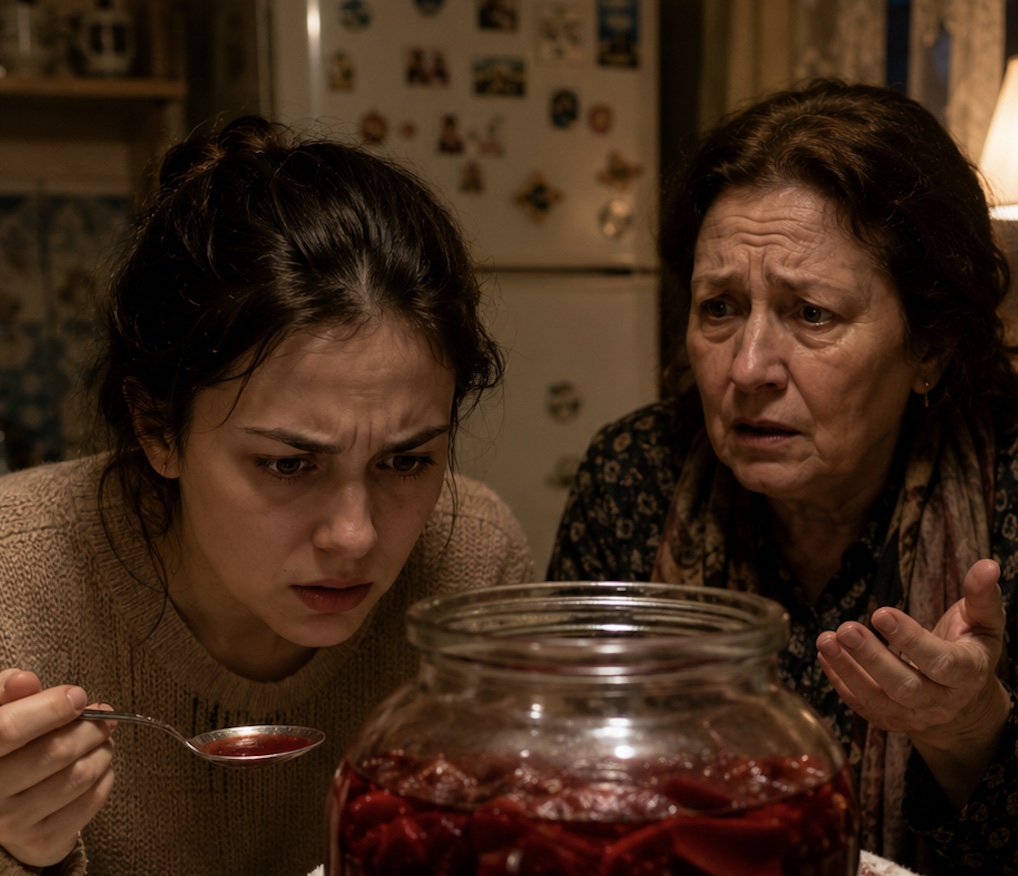
Marina had always been proud of her sense of smell. In her profession—she worked as a chemical technologist at a perfume factory—her nose was her greatest asset. She could tell natural patchouli oil from a synthetic substitute in a fraction of a second. She could smell a thunderstorm an hour before the first rumble of thunder. She knew the neighbor downstairs had decided to fry fish the moment he pulled the pan out of the cabinet.
But today, her gift was screaming danger.
On the kitchen table stood an innocent-looking three-liter glass jar wrapped in a towel. Inside it swayed a thick, dark crimson liquid, with neat slices of beetroot and golden droplets of fat floating on the surface. Real homemade borscht.
“Eat, Marinochka, eat,” said her mother-in-law, Tamara Stepanovna, her voice dripping with syrupy sweetness. “You’ve become so thin with all that work of yours. Pale as a ghost. Borscht gives strength. I made it especially for you. Spent the whole morning by the stove. With a nice marrow bone, just the way you like it.”
Tamara Stepanovna sat on a stool, hands folded on her lap, gazing devotedly into her daughter-in-law’s eyes. Marina had a name for that expression: “the holy martyr.” It usually appeared on her mother-in-law’s face five minutes before she asked her son Igor for money for “another very important medical examination” or tried to rearrange the furniture in their bedroom.
Things with Igor’s mother had gone wrong from the very first day. Tamara Stepanovna believed her “only precious falcon” deserved nothing less than the daughter of an oil magnate, not some “girl from a laboratory” who smelled either of alcohol or lavender.
“Thank you, Tamara Stepanovna,” Marina said, reaching for the lid. “This is perfect timing. Igor will be late today, and I was just wondering what to make for dinner.”
“Well, wonderful! I’ll be going then. My series is about to start. Don’t forget to wash the jar, dear. I’ll take it back later. And eat it hot, Marinochka. Borscht doesn’t like being cold.”
When the door closed behind her mother-in-law, Marina removed the plastic lid. The familiar aroma of garlic, fresh herbs, and rich broth rose up immediately. But behind that comforting domestic smell, something else was hiding. Something thin, barely noticeable, sickly sweet, with a distinct metallic edge.
An ordinary person would not have paid attention.
But Marina froze.
She knew that smell far too well.
And it had nothing to do with cooking.
Carefully, she scooped up some broth with a spoon and brought it close to her nose. Then she took a clean glass cup from the cupboard and poured a little of the liquid into it. Her hands began to tremble.
“No. It can’t be. She couldn’t have gone that far. That would be madness,” the thought pulsed in her head.
Marina went back into the room, picked up her phone, and called her husband.
“Igor, hi. Your mother stopped by. She brought borscht. Listen, is everything all right with her health? I mean… she hasn’t been mixing up her medicines, has she? Or maybe she took something from your garage?”
“Marina, not again,” Igor replied, his voice tired. “Mom was trying to do something nice. Yesterday she spent the whole evening worrying that you don’t eat properly. What medicine? What garage? Eat the borscht and stop messing with my head. I’m in a meeting.”
Marina ended the call.
She walked back to the jar. Her memory helpfully offered one chemical formula after another. Methanol? No, not that. Ethylene glycol? Similar, but the sweetness was different. Then she remembered an incident at the factory two years earlier, when one of the workers had mixed up canisters of industrial solvent.
At that very moment, the scrape of a key sounded in the hallway.
Igor had come home early.
“Mmm, smells like borscht!” he said cheerfully, stepping into the kitchen while taking off his jacket. “So Mom did make it over? Come on, pour me some. I’m starving.”
He reached for the jar, but Marina covered it with her palm.
“Don’t touch it, Igor.”
“What’s wrong with you?” He froze, staring at her pale face. “Marina, are you exhausted? Give me the jar. I’ll serve myself.”
“There is antifreeze in this borscht, Igor.”
The kitchen fell so silent that the ticking clock in the living room could be heard clearly. Igor slowly lowered his hand.
“What are you talking about? What antifreeze? My mother made this! You and your chemistry… Are you accusing my mother of—”
“I’m not accusing anyone. I’m telling you what I smell. There was a blue canister in the garage, remember? You said it was leaking. Igor, look at me. I’m a technologist. I know what poison smells like.”
Igor laughed, but the laugh was nervous.
“It’s probably some kind of spice! Mom is always experimenting with something. Marina, this is nonsense. Why would she do that?”
“To make me sick. Not to kill me, no. Judging by the smell, the dose isn’t lethal. But it’s enough to put me in the hospital for a week with ‘acute poisoning.’ And then who would come here to take care of you? Who would run this house while I’m hooked up to IVs? Who would become ‘the most needed person’ again?”
Igor stared silently at the jar.
He knew his mother. He knew her pathological jealousy, her endless fake illnesses whenever she wanted attention. But this…
“Let’s test it,” Marina said, taking several test strips from the first-aid kit. She sometimes brought them from work, “just in case.” “These react to certain groups of toxins.”
She dipped a strip into the cup of borscht.
A minute later, the edge of the strip turned a distinctive dirty violet color.
Igor sat down on the stool—the very same place where Tamara Stepanovna had been sitting ten minutes earlier. His face turned gray.
“She… she really did it? My mother?”
Without a word, Marina picked up the phone.
“What are you doing?” he asked, watching her dial.
“Calling the police, Igor.”
“Marina, wait! This will be a scandal! Think about the reputation… She’s my mother! Let’s just pour it out. I’ll talk to her. We’ll sort everything out…”
Marina looked at him coldly.
“You don’t understand. Today it’s antifreeze in borscht. Tomorrow it will be pills ‘accidentally’ mixed up when you get sick. The day after that, something else. She crossed a line, Igor. If I swallow this—literally and figuratively—I will never be safe in my own home again. Either I call the police, or I walk out right now, and you will never see me again. Choose. Your mother’s blood, or your wife.”
Igor covered his face with his hands.
Forty minutes later, the kitchen was crowded with uniformed officers. Marina handed the jar and the cup with the test sample to the expert. She spoke clearly and professionally, describing the chemical properties and everything she had noticed.
“You understand this is a very serious accusation?” the investigator asked. “Your mother-in-law claims she only wanted to help you.”
“Help me end up in intensive care?” Marina pointed to the jar. “Run the analysis. There is ethylene glycol in there. The same composition as the substance stored in our garage. I’m sure her fingerprints are still on the canister. She didn’t expect me to smell it.”
Tamara Stepanovna was detained that same evening. She sobbed, screamed about the “ungrateful snake” who had slandered an elderly woman, and swore that she had simply mixed up the jars while looking for “a secret ingredient for sourness.”
But in the garage, they really did find the canister—with traces of beetroot juice on the cap. Tamara Stepanovna had been careless in her hatred.
Igor did not go to the station to see his mother. He spent the entire night sitting in the kitchen, staring out the window.
“You know,” he said near dawn, when Marina came in to drink some water, “she always said you weren’t right for us. That you were too cold. But now I understand… You’re not cold. You just see the truth of things. Even when that truth is poison.”
Two months passed. The court gave Tamara Stepanovna a suspended sentence and ordered mandatory psychiatric treatment, taking into account her age and the fact that it was her first conviction. She was forbidden from approaching Marina’s home.
Igor changed. He replaced the locks without waiting for his wife to ask. He stopped excusing his mother’s actions as “good intentions.”
And Marina…
Marina still works at the factory. She creates perfumes. But now her collection includes a new fragrance. She named it “Revelation.”
It contains notes of lavender, bitter almond, and the faint, cold scent of steel.
The scent of a woman who once smelled borscht and chose herself over “family bonds” mixed with antifreeze.
And when her colleagues ask why she never eats homemade lunches in the cafeteria, Marina only smiles mysteriously.
She knows now: the most dangerous poison is often served under the sauce of boundless love.
But her nose will never betray her again.