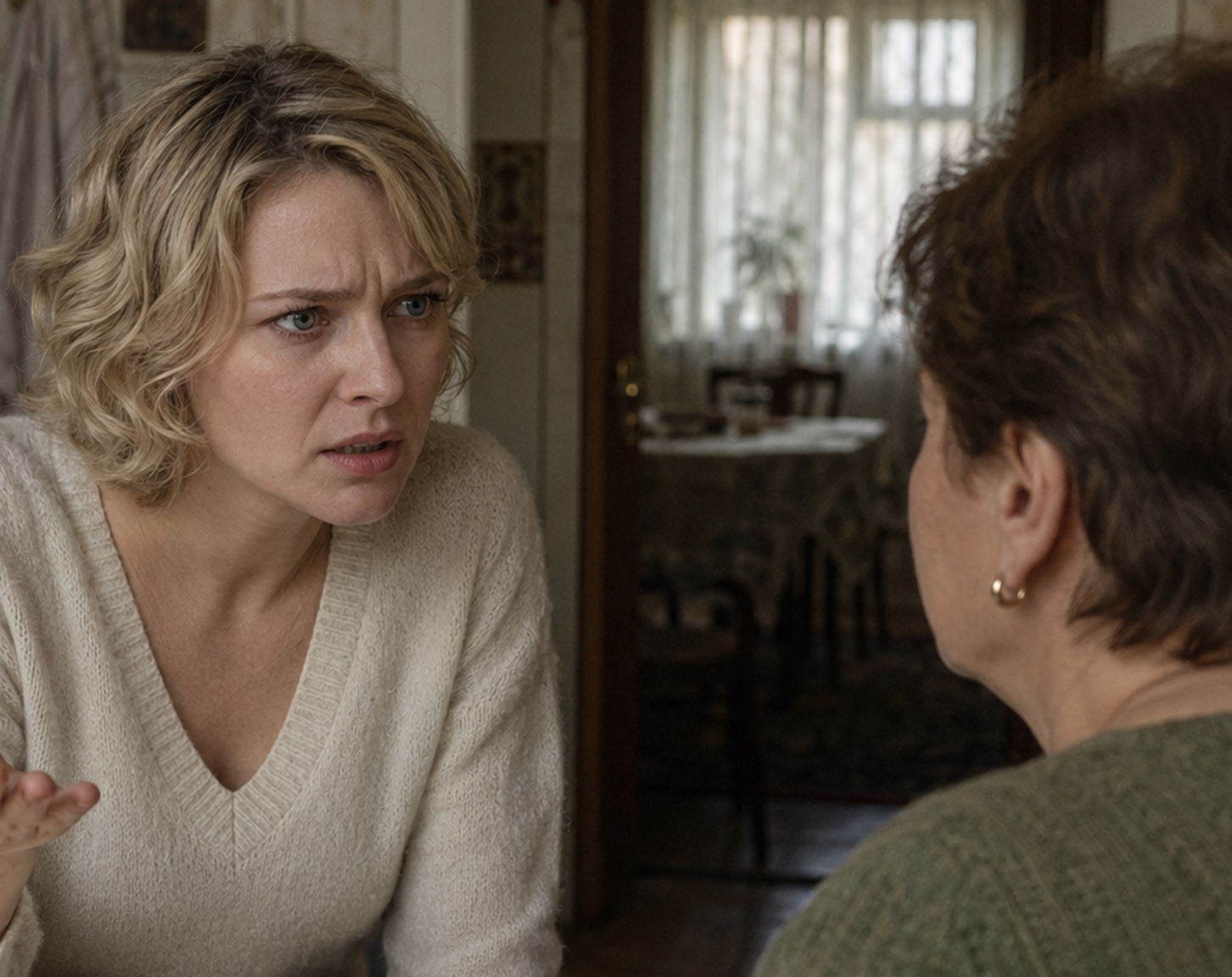
Marina put the kettle on the stove and sat down at the table. The final mortgage payment had gone through three days ago, and the feeling of freedom still hadn’t fully settled inside her. Twelve years. For twelve long years, she and Nikolai had carried that burden, denying themselves vacations, small comforts, and anything resembling a normal life.
Nikolai came into the kitchen with a strange, uncertain look on his face. He sat across from her, picked up the saltshaker, turned it in his hands, then put it back down. Marina immediately sensed that something was wrong.
“Kolya, what is it?” she asked gently. “Did something happen?”
“My mother called,” he said, not lifting his eyes. “She wants to talk. About the apartment.”
“About our apartment?” Marina smiled. “Well, let her come over. Now that the mortgage is paid off, we can finally do proper renovations.”
“No, Marin. Not about renovations. She thinks you should transfer your share to Artyom.”
Marina blinked. Artyom was Nikolai’s younger brother, twenty-six years old, a man who had never made a single serious decision on his own in his entire life. She waited, thinking this had to be some kind of bad joke.
“Wait,” she said, tilting her head slightly. “Transfer my share? My half of the apartment, the one I paid for for twelve years? To your brother?”
“Mother says you have a dacha. Your grandmother left it to you. And Artyom has nothing.”
“Kolya, that dacha is a summer cabin in a garden community. It doesn’t even have proper heating. Are you seriously saying this to me right now?”
Nikolai finally looked up at her, and in his eyes Marina saw not outrage, not support, but a guilty kind of pleading. It stung, but she forced herself not to rush to judgment. Maybe he was only repeating his mother’s words. Maybe deep down he understood how absurd it was.
“All right,” Marina exhaled. “Let’s stay calm. Let Zinaida Pavlovna come over and we’ll talk. I’m sure we can find common ground. Maybe she’s just worried about Artyom and doesn’t fully understand the situation.”
“She’s coming on Saturday,” Nikolai said quietly.
Saturday arrived quickly. Zinaida Pavlovna sat at the kitchen table, straight as a ruler, her lips pressed tightly together. Marina poured her tea and sat beside her. Nikolai stood near the refrigerator, leaning one shoulder against it.
“Zinaida Pavlovna, Kolya told me what you said,” Marina began in an even voice. “I want to understand why you think I should give away my share.”
“Because you have a dacha,” her mother-in-law snapped. “And poor Artyom has nothing. He’s twenty-six and has nowhere to live. Do you have any conscience at all?”
“I have a conscience, and I also have twelve years of monthly payments,” Marina replied calmly, patiently. “Zinaida Pavlovna, you have your own three-room apartment. Register Artyom there. Help him get on his feet.”
“My apartment is my business. I’m not asking you about my apartment.”
Marina looked at Nikolai. He said nothing. She waited for him to speak up for her, even with a single word. But he was studying a magnet on the refrigerator with such concentration that one might think it held the answers to every mystery of the universe.
“Kolya?” Marina called to him. “What do you think?”
“Well, Mother has a point,” he shrugged. “Artyom really doesn’t have anything. And you do have the dacha.”
Marina slowly set her cup down on the table. Something bitter rose inside her, but she still held herself together. She still wanted to believe this was a misunderstanding, something that could be settled with a conversation.
“Fine,” she said. “I’ll think about it. Don’t rush me, all right? This is a serious decision.”
Zinaida Pavlovna stood up, straightened her sweater, and headed for the door.
“Think, then. Just don’t take too long. Artyom has nowhere to live.”
When the door closed behind her, Marina turned to her husband.
“Kolya, explain something to me. Why didn’t you tell her this is our apartment? Ours. Jointly owned. The one we worked ourselves to the bone for twelve years to pay off.”
“Marin, she’s my mother. I can’t argue with her.”
“But you can argue with me? Your wife?”
He didn’t answer. He simply walked out of the kitchen. Marina remained alone with two cups of cooling tea and the feeling that the ground beneath her feet had cracked for the first time.
The next day, Marina called Tamara, Nikolai’s aunt, Zinaida Pavlovna’s sister. Tamara had always been simpler, easier to talk to. Marina thought perhaps she could explain what was really going on.
“Tamara Pavlovna, do you know why Zinaida Pavlovna suddenly decided this?” Marina asked carefully. “I don’t understand where it all came from.”
“Marinka, don’t get angry,” Tamara’s voice dropped lower. “But I’ll tell you this. My Svetka is about to receive a gift deed. Guess from whom?”
“From Zinaida Pavlovna?”
“Who else? Zina always wanted a daughter. She had two boys, but never a girl. And my Svetka is like a daughter to her. Zina decided to sign her apartment over to Svetka, and so that Artyom wouldn’t feel cheated, she wants your share to go to him. That’s the whole calculation.”
Marina stayed silent on the phone for a long time. Tamara cleared her throat.
“Just don’t tell Zina I told you, all right?”
“I won’t,” Marina said dryly. “Thank you, Tamara Pavlovna.”
She hung up and pressed her palms to her temples. So that was it. Her mother-in-law had decided to make her niece happy by gifting her a three-room apartment. And so her own son Artyom wouldn’t be left with nothing, she had found an elegant solution: take what belonged to someone else. Take it from Marina.
That evening, Marina waited for Nikolai. He came home late and tired, but she refused to postpone the conversation.
“Kolya, sit down. I need to tell you something.”
“Marin, I’m exhausted. Let’s do it tomorrow.”
“No. Now. Sit.”
He sat down, watching her warily. Marina spoke clearly, without emotion, laying out everything she had learned from Tamara. The gift deed. Svetka. Zinaida Pavlovna’s lifelong dream of having a daughter. The neat little calculation in which Marina’s share was simply one of the numbers.
Nikolai listened, gradually turning pale.
“Wait,” he straightened. “Mother wants to give the apartment to Svetka? Her three-room apartment—to Svetka?”
“Exactly.”
“But that’s… that’s our apartment too! I mean, Artyom and I are registered there!”
“You were registered there, Kolya. Were. When was the last time you checked?”
His face went slack. He grabbed his phone and called his mother. Marina could hear only his side of the conversation, but it was more than enough.
“Mom, is it true? Mom, answer me! Are you signing the apartment over to Svetka? And you deregistered us? When? What do you mean, two weeks ago?!”
He lowered the phone and looked at Marina. In his eyes she saw something she had never seen before: the delayed, useless horror of a man who realized he had been robbed while helping the thief hold the flashlight.
“She already signed the gift deed,” he said in a hollow voice. “To Svetka. And she removed both me and Artyom from the registration. Two weeks ago.”
“I told you.”
“But she’s my mother!”
“She is a mother who chose her niece. And now she wants me to pay for her choice. Do you understand that?”
Nikolai was silent for a minute. Then two. Then three. Finally, he raised his head, and with cold surprise Marina saw that his eyes had hardened. But that hardness was not directed at his mother.
“Then all the more reason,” he said. “All the more reason you should give your share to Artyom. Now he really has nothing. No registration, no home.”
“Kolya, are you serious right now?”
“My brother could end up on the street!”
“What does that have to do with me?! Your mother put him there. Not me.”
“You can help, but you don’t want to. You have a dacha.”
Marina stood up. Her hands were shaking, but her mind was clearer than ever.
“Then let me be very clear. I will not give away my share. Under any circumstances. It is my property, earned through my work. And if you choose to stand with your mother—the woman who just robbed her own sons—that is your decision.”
“You’re selfish, Marina.”
“And you’re a coward, Nikolai. Your mother stripped you of everything, and instead of confronting her, you came after me. Because I’m safer. I won’t bite. Isn’t that right?”
He slammed his palm on the table.
“You don’t understand!”
“I understand perfectly. I understood for twelve years. The real question is whether you understand anything at all.”
Three weeks passed in icy silence. Every day Nikolai started the same conversation, and every day he received the same answer. But Marina could see he was not backing down. Not because he believed his mother was right, but because he was afraid. Afraid of confronting her. Afraid of Artyom’s accusations. Afraid of being the one who said no.
One evening, Nikolai came home with someone else. Artyom was with him—thin, unkempt, and restless. Marina stood in the hallway and looked at them both.
“Marina,” Artyom began rudely, without even saying hello. “You’re an adult. What’s the big deal? Sign the papers and that’s it.”
“Hello, Artyom. Good evening to you too.”
“Fine, hello. So?”
“No.”
“What do you mean, no? I have nowhere to live. Mother gave the apartment to Svetka.”
“I know. And I’m sorry. But that is not my problem, Artyom. That is the problem your mother created with her decision. Go talk to her.”
“I did talk to her! She says Marina will give it to me.”
“And Marina says no.”
Artyom stepped toward her, and there was something in the movement that made Marina’s fists tighten. He loomed over her, using his height, trying to intimidate her.
“Do you even understand what you’re doing? You’re destroying the family!”
Marina did not step back. She looked up into his eyes calmly, firmly, without the slightest trace of fear. And when he reached out to jab his finger into her shoulder, Marina grabbed his hand, twisted it aside, and slapped him so hard that Artyom staggered back against the wall and froze, clutching his cheek.
The silence lasted five seconds.
“Don’t you dare,” Marina said quietly. “Don’t you dare touch me in my own apartment. Get out.”
Artyom stood there with his mouth open. He had not expected that. No one in his life—not his mother, not his brother, not anyone—had ever truly stood up to him. Not physically. Not clearly. Not without warning.
“Kolya!” he called, confused. “Did you see that?”
Nikolai stood in the doorway, silent. Marina turned to him.
“And you—choose. Right now. Me, or this madness. There is no third option. You have exactly one minute.”
“Marin, you understand…”
“Forty seconds.”
“Wait a minute!”
“Twenty.”
Nikolai looked at his brother, then at his wife. And he chose exactly as Marina had expected him to.
“Mother is right,” he said. “You need to give him your share.”
“Fine,” Marina nodded. “Then divorce. Tomorrow.”
She did not scream. She did not cry. She did not beg. She said it as if she were announcing the weather for the next day. And it was that calm inevitability that frightened Nikolai more than any shouting could have.
“Wait, what divorce? Marin!”
“You chose, Kolya. Now live with it.”
The divorce was finalized quickly. The apartment was divided legally, each of them receiving a share. Marina bought out Nikolai’s part at market price, borrowing the money from her mother.
Nikolai took the money and bought himself a one-room apartment on the resale market. Small, cramped, with wallpaper that looked as if it remembered the previous century. Artyom, of course, showed up to live with him the very next day. “Temporarily,” he said. Nikolai couldn’t refuse.
Six months passed. Marina lived alone in what had once been their apartment, and was now only hers. She renovated it. Hung new curtains. Learned to sleep in the middle of the bed. Was it hard? Yes. But for the first time in many years, she could breathe fully, without waiting for the next “Mother said.”
Nikolai and Artyom were squeezed together in the one-room flat. The brothers, who had never lived together as adults, discovered that tolerating each other was a separate form of torture. Artyom never cleaned up after himself, never cooked, never paid the utilities. Nikolai quietly lost his mind.
One evening, Nikolai called Marina. She stared at the screen for a long time before answering.
“What do you want, Kolya?”
“Marin, I wanted to say… You were right. About everything.”
“I know.”
“Mother… Mother gave the apartment to Svetka for good. Svetka already lives there. She’s renovating it.”
“And?”
“And now Mother… she’s coming to live with us. She says it’s uncomfortable for her at Svetka’s now. And we are her sons. We’re obligated.”
Marina stayed silent for ten seconds. Then she laughed—briefly, without cruelty, simply because of the absurdity of it all.
“Kolya, do you understand what is happening? Your mother gave her three-room apartment to her niece. She removed both of you from the registration. She demanded my share for Artyom. She destroyed our marriage—although, to be fair, you helped her do it. And now she is coming to live with you in a one-room apartment where you and your brother are already sitting on top of each other and hating every minute of it.”
“I understand,” he said, his voice dull, flat, crushed.
“She punished herself, Kolya. I didn’t even have to do anything.”
“Marin, maybe…”
“No. Don’t even ask. You and I are strangers now. You made your choice six months ago. Live with it. And with your mother. And with your brother. In your one-room apartment.”
She hung up.
A week later, Marina ran into Tamara at the store. Tamara looked embarrassed, but curiosity got the better of her.
“Marinka, did you hear? Zina moved in with the boys. The three of them are living in that tiny one-room place now.”
“I heard, Tamara Pavlovna.”
“Do you know what Svetka did?”
“What?”
“She sold the three-room apartment. Two days ago. Sold it and left for Krasnodar. Zina didn’t even know. A gift deed means ownership. Svetka had every legal right.”
Marina stopped in the middle of the aisle between the shelves and looked at Tamara. Tamara spread her hands helplessly.
“There’s your daughter,” she said. “There’s the dream of a lifetime.”
Marina silently took a pack of tea from the shelf, placed it in her basket, and walked to the checkout. There was no malice on her face. No triumph. Only a calm, hard-earned, completely justified indifference.
Zinaida Pavlovna had lost everything. The apartment she had given away. The respect of the sons she had betrayed. And the very “daughter” who turned out to be no better than the fears Zinaida had tried to buy off with someone else’s property.
And Marina brewed herself a cup of tea, sat in the kitchen of her own, lawful, fully paid-off apartment, and thought: how wonderful it is to owe nothing to anyone.