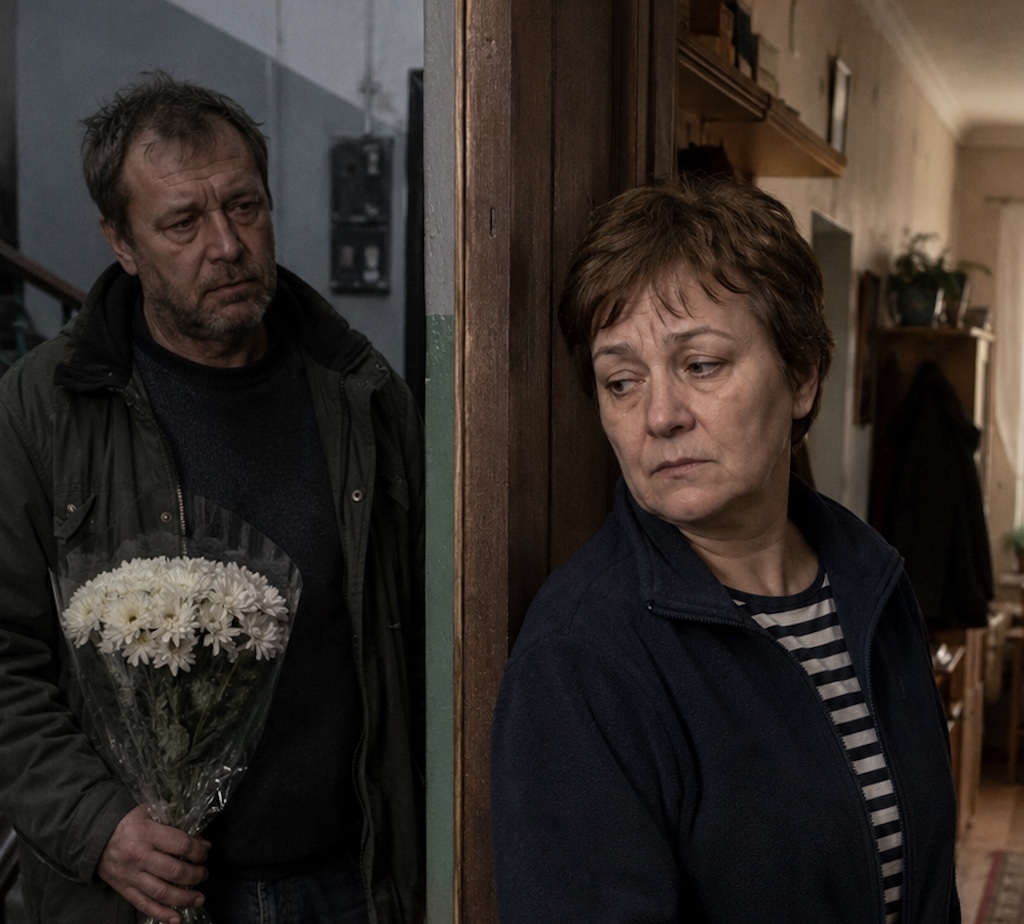
Inna stood in the doorway, looking at the man she had not seen for six months. He was holding a cheap bouquet of chrysanthemums in front of him — yellow ones, with bruised petals, wrapped in that thin transparent plastic they use for flowers sold near the metro.
Behind Vadim, a dim bulb glowed on the stairwell landing, and Inna suddenly thought: even here, in the entrance hall, someone had changed the light bulb. Someone had — but definitely not him.
“Innochka,” Vadim said, trying to smile.
But that came later.
It had all begun three years earlier.
They met at Nelya Zhukova’s birthday party. Nelya was a mutual acquaintance who worked as an administrator at the same neighborhood hair salon, Lokon, where Inna had been cutting hair for twelve years.
Nelya was turning forty-five. She had set the table at her dacha in the Ruza district, invited around twenty people, and among those twenty was Vadim — a distant relative of Nelya’s husband, who had come “to help with the barbecue.”
Inna was fifty-one then. She lived alone in a one-room apartment on Kashirskoye Highway. She had bought it on a mortgage ten years earlier, after divorcing her first husband. By then, the mortgage was already paid off. The apartment was completely hers.
She liked Vadim. He was forty-nine — broad-shouldered, with a deep voice and a way of speaking as if he had already tried everything in life and was simply sharing his experience. He told her he used to work as a long-haul truck driver and had traveled across half the country. Then his back started acting up, so he left the road. Now he was “looking for something.”
Back then, Inna did not pay much attention to that. Looking meant he was searching. Who among us has never searched?
Two months later, he moved his things into her apartment. There were not many things: a sports bag with clothes, a box full of cables and chargers, and a game console that Inna had bought him for his birthday. He had once mentioned he had always wanted one, and she bought it without thinking too much. Seven and a half thousand rubles — not her last money, but not pocket change either.
He carried the bag inside, put the console on the cabinet beside the television, and said:
“Well, here I am. Home.”
Inna smiled then.
Home.
Such a good word.
The first three months were fine. Not perfect — perfection does not happen when you are over fifty and used to living alone — but fine. Vadim cooked on weekends, though only scrambled eggs and navy-style pasta. Sometimes he met her after work, if it happened to be on his way. He got a job as a security guard at the Raduga shopping center through Nelya’s husband, who knew the head of security.
Inna worked six days a week. Her shift began at nine in the morning and ended at seven in the evening, sometimes later if her regular clients came in — women who booked only with her. In twelve years, she had built a loyal client base. Women came to her from neighboring districts, called in advance, waited for their turn. She cut hair, dyed it, styled it for weddings and anniversaries. Her hands were golden — everyone said so, and it was true.
Vadim lasted as a security guard for a month and a half. Then he announced that it was “not his kind of thing.”
“Standing at the entrance for eight hours watching old ladies shuffle in with shopping carts — that’s not work,” he said, stretched out on the sofa. The familiar game flickered on the TV screen. “I need something of my own.”
“And what would that be?” Inna asked, unpacking grocery bags. She had just come home from work, her legs buzzing with exhaustion, and that morning there had only been half a pack of butter and three eggs left in the fridge.
“I’m thinking about a tire service. Seryoga from Balashikha opened one — made his money back in six months.”
“And where would the investment come from?”
Vadim fell silent. Then he paused the game.
“Well, I thought maybe we could do it together… You earn decent money.”
Inna put the bag down on the table. Milk, bread, chicken thighs, onions, rice. All bought with her money. Just like last time. And the time before that.
“Vadim, I don’t earn that much. I have enough for utilities, groceries, and a little savings. How much does a tire service need?”
“Well, to start, maybe three hundred thousand…”
“I don’t have three hundred thousand.”
“We could take out a loan.”
“No.”
He looked at her, then pressed the button again. The game resumed. The conversation was over.
By the end of the first year, Inna began noticing things that had once seemed like small details. But small details are like fine rain: one drop will not soak you, but a thousand will leave you drenched.
Vadim never bought anything for the house.
Nothing at all.
A bulb burned out in the bathroom — Inna bought a new one and screwed it in herself. Dishwashing liquid ran out — she brought it home after work. The kitchen faucet broke — she called a plumber and paid him two thousand rubles. At that moment, Vadim was lying in the room “studying the franchise market,” which was what he now called lying around with his phone.
The tire service never happened. Instead, new ideas appeared: food delivery in his own car, though he had no car; repairing household appliances, though his hands were hopeless; “his own internet channel about fishing,” though he had neither a camera nor any interest in fishing. Each idea lived for a week or two, then faded away, and Vadim returned to his game console.
He knew exactly when Inna was paid. The fifteenth and thirtieth — advance and salary. On those days, he became lively.
“Inna, maybe we should order sushi? We haven’t eaten properly in ages.”
Or:
“Listen, I need winter boots. Mine are falling apart. Check how much they cost. I’ll pay you back later.”
Later never came.
Why she did not say anything, she herself could not explain later. Maybe she had got used to it. Maybe she was afraid of being alone. Or maybe she was ashamed to admit — to herself, not to others — that she, a grown independent woman, was feeding a healthy man who for more than half a year had not managed to force himself to leave the apartment farther than the shawarma kiosk.
The garbage was a separate story.
The bin stood in the kitchen by the door. When it filled up, Inna tied the bag, placed it near the front door, and said:
“Vadim, please take this out.”
“Mm-hmm,” he replied.
The bag stood there for an hour. Two. Three. Inna would come back from the bathroom, see it, pick it up, and take it out herself. Down from the third floor, in slippers, with wet hair after a shower.
She tried not reminding him. Just saying nothing — to see how long the bag would stand there. It stood for two days. It began to smell. Vadim stepped over it whenever he went to the kitchen for a sandwich.
On the third day, she could not take it anymore.
“Are you seriously not seeing it?”
“Seeing what?”
“The garbage. By the door. It’s been there for three days.”
“Oh, I thought you’d take it out yourself. You go past it anyway.”
She froze in the hallway and stared at him. He was standing there with a plate holding a sandwich — bread, butter, sausage. All bought by her.
“Vadim, you live in this apartment. You eat this food. You sleep on these sheets. You use this shower. I pay the utilities, I buy the groceries, I cook, I clean. The only thing I ask you to do is take out the garbage. One bag. To the bins in the yard. Fifty meters.”
“All right, all right,” he said, raising his hands. “Why are you getting so worked up? I’ll take it out. I’ll finish eating and take it.”
He finished eating. Then he went back to the room. Inna took out the garbage herself.
At work, Inna held herself together. There, she was different — collected, precise, with a light humor her clients loved. Her hands moved automatically: comb, scissors, hair dryer, mirror. “Turn your head, have a look. Do you like it? We’ll shorten it a little here so it holds its shape.”
Nelya, of course, knew. She always noticed everything. They worked side by side, and sometimes Inna let something slip.
“He didn’t pay for the internet again?”
“Nelya, don’t start.”
“Inna, I’m serious. Is he a man or a decoration for the sofa?”
“He’s going through a difficult period.”
“A difficult period is when you’ve been laid off and you spend two months looking for work. When you lie around for two years waiting for someone to bring you a sandwich, that’s not a period. That’s a lifestyle.”
Inna said nothing. She wrapped a strand of a client’s hair around her finger and checked the length. Even. Good.
“Nelya, you introduced me to him yourself.”
“I introduced you to a man who came to a barbecue and got the coals going in ten minutes. Not to a man who’s been sitting on your neck for two years and only knows how to fire up a game console.”
Inna gave a faint smile. Nelya knew how to put things.
By the middle of the third year, Vadim had started doing occasional work — irregularly, through acquaintances, unloading trucks at a food warehouse. Two or three times a month, whenever he was called. He was paid in cash — fifteen hundred or two thousand rubles per shift. He spent that money on himself: new headphones, some subscription to a gaming service, and once, a pair of sweatpants.
Not a single ruble went into the house.
One evening, Inna came home exhausted after a ten-hour shift. It was a Saturday, wedding season, three hairstyles back to back. She opened the fridge.
Empty.
Not entirely empty — there was a jar of mustard, yesterday’s kefir, and a piece of cheese with dried edges.
From the room came the familiar roar of the game console.
She closed the fridge. Took off her shoes. Her legs could barely hold her — ten hours standing, not a minute of rest.
“Vadim, did you eat today?”
“Yeah, I ordered myself shawarma.”
For himself.
“And me?”
A pause. Something exploded in the game behind the wall.
“You didn’t say you wanted any.”
Inna sat down on the kitchen stool. It was getting dark outside. The streetlight in the courtyard flickered — it had been flickering for three weeks, and no one had fixed it. On the windowsill stood a pot with a violet she had bought in the underpass a year earlier. The violet was blooming despite everything. Small, purple, stubborn.
I’m fifty-three years old, Inna thought. I’ve been cutting hair for fourteen years. I bought my own apartment. I paid off my own mortgage. And I am feeding a grown man who ordered shawarma for himself and did not think of me.
She did not cry. She had not cried in a long time — perhaps she had forgotten how. She simply sat there and looked at the violet.
In November, Inna fell ill.
It started like an ordinary cold — sore throat, fever, body aches. She went to work for two days because “she couldn’t let the clients down,” thinking it would pass. It did not. On the third day, her temperature climbed to thirty-nine and a half, her cough became deep and heavy, and Nelya practically forced her to go home.
“Go see a doctor and stop making things up!”
Inna called a doctor to the apartment. A young woman came, listened to her lungs, frowned, and sent her for an X-ray. The next day, the doctor said briefly: both lungs were inflamed. She prescribed a pile of medication and ordered her to stay in bed and not go anywhere. Sick leave — at least three weeks.
Three weeks without a normal salary meant sick pay, and although she had many years of work behind her, the payment would come late, and she would receive less than her usual thirty-eight thousand. For two people, that was barely enough.
The first few days, Inna lay in bed and could not get up. The fever stayed, the cough would not let go, and her whole body felt foreign. She asked Vadim:
“Please make some broth. Chicken broth. There’s chicken in the freezer. Just put it in water, add salt, let it boil for an hour.”
“All right,” he said.
There was no broth. Three hours later, she dragged herself to the kitchen. The stove was empty. Vadim was sitting in the room. The game console was on.
“You didn’t make it?”
“I forgot. I’ll do it now.”
“No. I’ll do it myself.”
She made the broth herself. With a temperature of thirty-eight point two. Standing by the stove and holding on to the counter because her head was spinning.
On the fourth day, Inna asked him to go to the pharmacy and buy the medicines on the prescription. She gave him money, a list, and the address of the pharmacy — two streets away. Vadim left and came back two hours later. Without the medicine.
“There was a line. I’ll go tomorrow.”
Nelya brought everything. After her shift, across the whole city, by metro with two transfers. She brought the medicine, a liter of orange juice, a pack of chicken fillet, and a bag of rice.
“Where’s that one of yours?” she whispered in the hallway.
“In the room.”
Nelya looked in. Vadim was lying on the sofa, the game roaring on the screen as usual. She looked, came back to the kitchen, and unpacked the groceries.
“Inna, I’m going to tell you something. Don’t be offended.”
“Say it.”
“A cat would be more useful.”
Ten days later, it happened.
Inna was lying in the bedroom — a small space she had separated from the main room with a wardrobe long before Vadim had appeared. Behind the wall, he was talking quietly on the phone. She was not listening; she had no strength. But separate words reached her.
“…yeah, it’s complicated here… no, I don’t know when she’ll get back on her feet… listen, let’s do Thursday, I’ll come…”
Then silence. Then footsteps.
Vadim entered the bedroom. He stopped in the doorway. His face looked strange — not guilty, not angry, but somehow… decided. The face of a person who had already closed everything inside himself.
“Inna, I need to tell you something.”
She lifted herself slightly on the pillows. Her head was swimming.
“I’m leaving.”
Silence. Somewhere outside, a car passed.
“Where?” Inna asked. Her voice was hoarse, worn down by coughing.
“To a woman I know. Remember Sveta, the manicurist? The one who came to Nelya’s birthday last year.”
Inna remembered. Svetlana — about thirty-five, bright, with long nails she showed off like a shop window. She worked from home, taking clients in her two-room apartment in Lyubertsy.
“You’re leaving for Sveta.”
“Yes.”
“Now.”
“Yes.”
Inna looked at him. At his healthy, well-fed face. At the hands that in three years had not put up a single shelf, had not screwed in a single light bulb, had not taken out a single garbage bag without ten minutes of persuasion. At his T-shirt — the very one she had bought him last year because “the old one was completely worn out.”
“Why?”
He shifted from one foot to the other.
“Try to understand. I need a healthy woman beside me. And here… well… you’ve been lying there for two weeks, no one knows when you’ll go back to work, there’s no money. I can’t live like this.”
He said, “There’s no money.”
She had inflamed lungs, a fever, a second week without proper food. And he said, “There’s no money.”
“Vadim, it’s my money. And my apartment. In three years, you haven’t bought a single light bulb for this place.”
“Oh, here we go…” He grimaced. “That’s not why I came, Inna. I came to say it properly, like a decent person.”
Like a decent person.
Inna leaned back onto the pillows. The ceiling above her was white and even — she had repainted it herself the previous summer, standing on a stepladder while Vadim “watched business training videos.”
“All right,” she said. “Go.”
He nodded. Left. She heard him moving around the apartment, gathering his things. Bags rustled, drawers knocked. Then came a familiar sound: the click of the game console being switched off, the rustle of cables being pulled from the socket.
He took the console.
The very one she had given him.
The front door slammed.
And then it became quiet.
Truly quiet.
For the first time in three years, the apartment was free of the booming from the console, that endless bang-bang-bang that had made the wall between the rooms vibrate.
Inna lay there and listened to the silence.
Then she got up. She made it to the kitchen, holding on to the walls. She boiled the kettle. Made tea with lemon — the last lemon Nelya had brought. She took a sip. Burned her tongue.
And then it hit her — but not in the way she expected.
Not grief.
Not resentment.
Not the dull ache she had prepared herself for.
She felt relief.
As if all this time she had been carrying an invisible backpack full of stones — every day another small, unnoticed pebble — and now someone had unfastened the straps. The backpack had fallen off.
Inna remained ill for another two weeks. Nelya came every other day, bringing food, medicine, and news from Lokon. Clients called, asking when she would return.
“Zinaida Fyodorovna Gritsko said she’ll wait only for you. Even until spring. ‘I won’t let anyone touch my head except Innochka,’” Nelya reported, imitating an old woman’s voice.
Inna smiled. For the first time in several days.
When she got back on her feet and left the apartment, it was the end of November. Cold, gray, with early dusk. She walked to the nearest shop and bought groceries — only for herself, for one plate, one cup, one person. It felt unfamiliar.
And good.
On the way home, she stopped by the entrance. A courtyard cat, gray and striped, was sitting on a bench, squinting in the last November sun. Inna sat down beside it and placed the shopping bag on her knees. The cat did not run away. On the contrary, it moved closer and bumped its forehead against the sleeve of her coat. Inna stroked it. Its fur was rough and cold, but the cat began to purr as if someone had given it a whole fish.
A strange thought came to her: in three years of living with Vadim, she had not once felt that anyone was simply happy she existed nearby. Not because she brought food, not because she paid for the internet, not because it was payday. Just because she was there.
In December, Inna returned to work. Her colleagues hugged her, the clients exclaimed, “Innochka, how did we survive without you? No one cuts hair like you!” Her hands trembled for the first couple of days — the weakness was still there — but then the precision returned, and everything went on as before.
No, not as before.
Better.
She received her first salary after recovering on December twentieth. Only now, she did not need to spend it on Vadim’s boots, subscriptions, and shawarma. Inna transferred five thousand to her savings account — for the first time in two years, she managed to put something aside.
Inna calculated that over three years, she had spent roughly four hundred thousand rubles on Vadim. That was counting minimally — only food, household items, things he promised to “pay back later.” The real number was probably higher. It was more than he had once asked for his tire service.
She had funded his entire tire service.
Only without the tire service.
In January, she adopted a cat. A ginger one, with a white chest and a shameless little face. She took him from a shelter and chose the calmest one. She named him Kuzya. Kuzya turned out to be the perfect roommate: he ate from his own bowl, used his own litter box, purred in the evenings, and — most importantly — did not ask for money, did not lie on the sofa with a game console, and never forgot his only duty: to be there.
Nelya saw the cat on a video call and said:
“There. That’s exactly what I meant.”
Kuzya settled into Inna’s armchair, curled into a ball, and fell asleep. The apartment became cozy in a different way: purring, the soft rustle of paws on the laminate floor, the quiet murmur of the radio in the kitchen.
Inna repainted the hallway walls from dull beige to warm terracotta. She bought new curtains. Finally fixed the bathroom faucet that had been leaking for six months. Vadim had promised to look at it and never did. She put up hooks for keys in the entryway — Vadim used to toss his onto the cabinet, and they would fall behind it, and she would have to crawl on all fours, reaching into the dust to get them.
Hooks.
A small thing.
But with every small thing like that, the apartment became more and more hers. The air was different. She could come home in the evening, close the door, and not drag around another person who gave nothing and only took.
She learned about Vadim and his manicurist in fragments — through mutual acquaintances, through Nelya’s husband, through that unavoidable network that exists in any district where everyone knows everyone.
The first month, everything was “wonderful.” Svetlana posted photos on social media: restaurants, flowers, captions like “My man.” Vadim looked pleased in the pictures — shoulders straight, smiling. In one photo, Inna noticed he was wearing a new jacket. Maybe Svetlana had bought it. Or maybe he had bought it with Svetlana’s money. What difference did it make?
By the third month, photos of Vadim disappeared. Instead, mysterious quotes appeared: “A strong woman is one who knows how to leave on time” and “Don’t let anyone sit on your neck.”
By the fourth month, as Inna learned through Nelya, the scandals had begun. Svetlana had quickly discovered what had taken Inna three years to understand: Vadim did not work. He had no intention of working. He ate, drank, slept, played video games, and the only thing he knew how to do was promise that his time was just about to come.
“Sveta told him: find a job within a week or get out,” Nelya reported, changing towels in the salon. “He ‘looked’ for a week. Then she threw him out.”
“Actually threw him out?”
“She packed his bag and put it by the door. Told him: take your console and goodbye.”
Inna said nothing. Something moved inside her — no, not pity. More like recognition. Like reading a book and realizing you already know how it ends because you have lived the plot yourself.
Vadim showed up in May.
Five months and twenty days after the day he had pulled the console plug from the socket and left a sick woman for a healthy one.
Inna was home. It was Sunday, her day off. She was sitting in the kitchen, drinking coffee, scrolling through news on her phone. Kuzya lay on her lap, purring. Outside, it was sunny, May-green. The violet on the windowsill had opened four new buds.
The doorbell rang.
Inna was not expecting anyone. Nelya always warned her in advance, and so did her neighbor Lyuba. A courier? She had not ordered anything.
She looked through the peephole.
Vadim.
He was standing on the landing in the same jacket she had seen in the social media photo — only now the jacket was wrinkled and dirty at the elbows. In his hands was a bouquet of chrysanthemums. Yellow, small, wrapped in cellophane. The kind they sell near the metro for one hundred and fifty rubles.
Inna stepped away from the door. Looked at Kuzya. Kuzya lifted his head and yawned.
She returned to the door and opened it.
“Inna,” Vadim said. “I…”
He stumbled over his words. Held out the chrysanthemums.
“Inna, I understand everything now. I’m guilty. You’re the only person I have. I’ve realized it, truly. There, with Svetka… it wasn’t right. She’s… well… she isn’t real. But you — you always understood me. Forgive me, huh? I’ll change. I’ll start right now. I’ll find a job, I’ll help around the house, I’ll be a normal man, honestly.”
He spoke quickly, swallowing the ends of words, like a person who had rehearsed a speech but still lost his way. His eyes darted from Inna to the door, from the door to the chrysanthemums, from the chrysanthemums back to Inna.
Inna stood in the doorway. She looked at him — at his face, at the crumpled jacket, at the cheap chrysanthemums with bruised petals — and remembered.
She remembered the empty fridge. The broth he had not made. The garbage bag standing by the door for two days. The shawarma “for himself.” The light bulbs she had screwed in herself. The four hundred thousand rubles that had gone into his sweatpants, boots, subscriptions, and sandwiches. The prescription he had not taken to the pharmacy because “there was a line.” His sentence — that monstrous, calm sentence — “I need a healthy woman beside me.”
She remembered lying there with a fever and cooking for herself because he had forgotten. How Nelya had traveled across the whole city with a bag of medicine. How the door had slammed and the apartment had gone quiet. How she had drunk tea with lemon and felt the backpack full of stones fall from her shoulders.
And she laughed.
Not bitterly. Not cruelly. Not hysterically.
She laughed for real.
Honestly, from deep in her belly, the way she had not laughed in a long time — maybe a year, maybe two. The laughter came from somewhere inside, from the very place where she had hidden the truth from herself for three years. And now the truth had jumped out on its own, without permission, and turned out to be funny.
Vadim stood there, not understanding.
“Inna… what are you doing?”
She looked at him through tears of laughter. At his confused face. At the chrysanthemums for one hundred and fifty rubles.
“Vadim,” she said once she had finished laughing. “In three years, you did not buy a single light bulb for this apartment. Not one. You never took out the garbage without being reminded. You did not bring me a glass of water when I was lying there unable to get up. You left me for another woman because I got sick. And you took the game console I gave you. Now you’re standing here with chrysanthemums for one hundred and fifty rubles, telling me you’ve realized everything.”
She shook her head.
“You know what you realized? You realized that Sveta kicked you out. You realized you have nowhere to live and nothing to live on. You didn’t come back to me. You came back to my apartment, my fridge, and my sofa.”
Vadim froze. The chrysanthemums trembled in his hand.
“Inna, come on, that’s not fair…”
“For the first time in three years, I am absolutely fair.”
And she closed the door.
Calmly, without slamming it.
She turned the lock. Then the second one. Then put on the chain.
She stood in the hallway for a moment. Then went back to the kitchen.
Kuzya was sitting in his place — on the chair that had once been “Vadim’s.” Ginger, warm, with a white chest. He looked at Inna with green eyes.
“Well, Kuzya,” she said. “Shall we have dinner?”
Kuzya meowed.
Approvingly.
Inna opened the fridge.
Full.
Chicken, vegetables, sour cream, herbs, eggs, her favorite cheese — the one she used to avoid buying because it was expensive, and after all, she had to feed two people.
There was no sound from the hallway. Vadim had probably left. Or maybe he was still standing there. She did not care.
She took out the food and put the frying pan on the stove. Outside, the evening sun lay across the rooftops, long and ginger-colored — just like Kuzya. The violet on the windowsill was blooming with four buds, small and stubborn, just like Inna herself.
Quiet.
Warm.
Right.
She turned on the radio softly in the background. Some calm melody played, without words.
And she began making dinner.
For one plate.
After eating, Kuzya jumped onto the armchair and curled into a ball. He purred so loudly she could hear him from the kitchen. Inna smiled as she wiped her hands on a towel.
For the first time in a long time, she did not want to change anything.
Nothing at all — not the curtains, not her job, not herself.
Everything was exactly as it should be.
What do you think — did Vadim find himself a third woman after that, or is he still looking for someone to feed him?