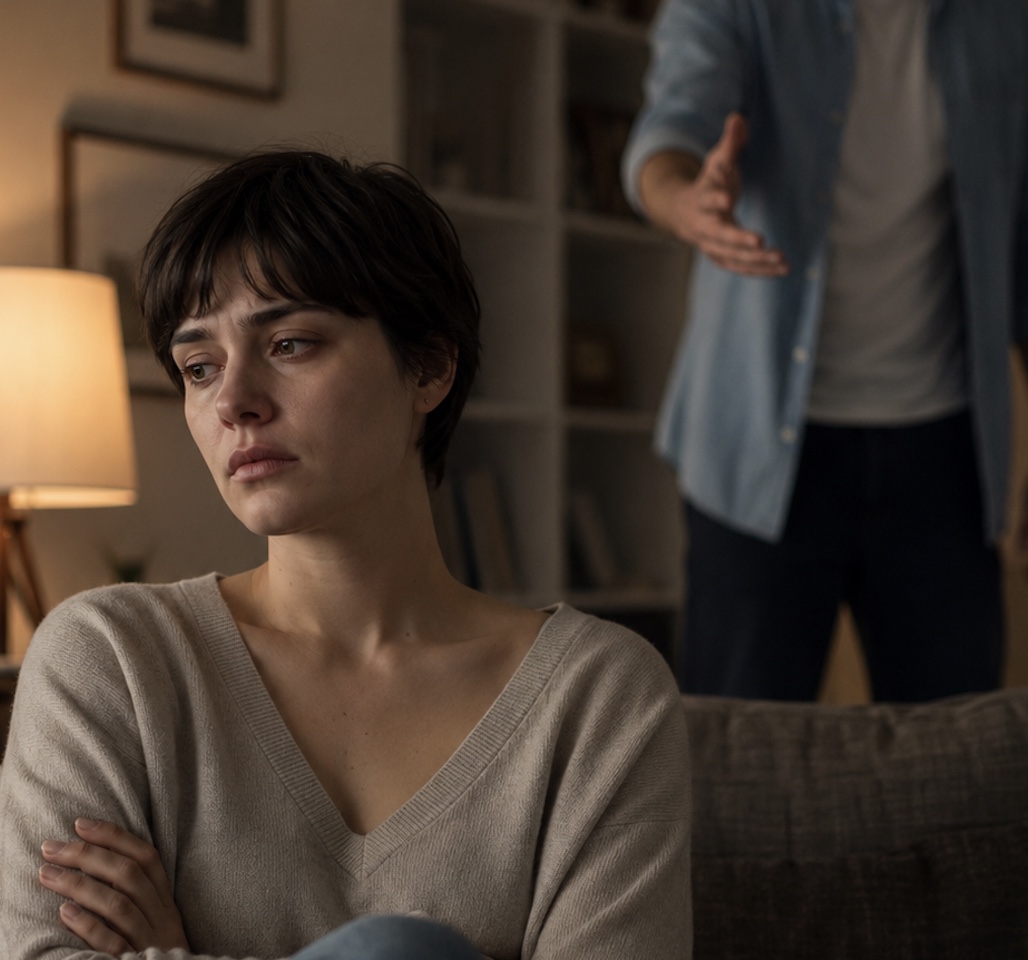
Veronika placed the bundle of money on the table and smoothed it with her palm, as if protecting it. Two hundred thousand for her father’s garage and three hundred for his old Volga. Half a million — a number that smelled of hope and a new life.
“Ivan, look,” she said, sliding the money closer to her husband. “Dad agreed. He offered to sell them himself. He said the grandchildren need their own apartment, not corners in rented places.”
Ivan took the bundle and flipped through the bills with his thumb like a deck of cards. His eyes turned oily, greedy. Veronika did not notice. She was looking at the printout from the bank’s website.
“A two-room apartment on Lomonosov Street. Did you see the listing?” She turned her phone toward him. “This covers the down payment perfectly. A fifteen-year mortgage, twenty-seven thousand a month. We can manage that, can’t we?”
“We can,” Ivan nodded, slipping the money into the inside pocket of his jacket. “I’ll stop by the bank tomorrow and ask about the paperwork.”
Veronika hugged him from behind and pressed her cheek to his shoulder. She believed him. She believed the way only people believe when they have waited for a long time and finally seen the shore.
“You know, Dad almost cried when they took the Volga,” she said quietly. “He drove it for twenty years. He did this for us.”
“I understand,” Ivan replied without turning around. “Everything will be fine.”
He left early, before Veronika woke up. There was a note on the nightstand: I’ll be back by lunchtime. Sorting things out at the bank. She smiled and went to cook porridge for the children.
He came back at three in the afternoon. Veronika heard an unfamiliar engine outside the window and looked out. A white crossover was standing in their parking spot, and Ivan was walking around it, stroking the hood.
“What is that?” Veronika asked, stepping out onto the stair landing.
“Come down, I’ll show you!” he shouted from below, in the voice of a man who considered himself victorious.
She went down. Her legs carried her by themselves, though her mind had already understood everything. She stood in front of the car and could not move.
“Ivan. Tell me you took it for a test drive.”
“Nika, listen,” he said, raising his hands like someone trying to calm a wild animal. “I calculated everything. A mortgage is slavery. Paying the bank for twenty years is madness. But a car is an investment. I can earn extra money with it, carry loads, and in a year we’ll double that amount.”
“You bought a car,” she said in an even voice. “With my father’s money. You bought. A car.”
“Not only with that money,” he quickly added. “I also took out a loan and paid the difference. A good interest rate, by the way.”
Veronika stepped back. Then another step.
“You looked me in the eyes yesterday. You nodded. You said, ‘We can manage.’ And today you’re standing here stroking the hood of a car bought with the money my father gave after selling something he had kept for twenty years.”
“You’re being dramatic!” Ivan raised his voice. “This is a practical decision. We can rent an apartment, but nowadays you can’t get anywhere without a car. You should support me.”
“I should?” Veronika shook her head. “I should? So my father sold his things so you could drive a white crossover?”
“Nika, don’t start,” he turned away. “I’m tired of explaining obvious things.”
“Obvious?” She stepped closer to him. “You’re a thief, Ivan. You stole from your own family.”
“Enough!” he barked. “I’m the husband! I make the decisions! The money was ours!”
“The money was Dad’s,” she cut him off. “And you know it.”
Ivan got into the car, started the engine, and drove away. Just drove off, leaving her standing in the parking lot in house slippers, her eyes wet.
That evening, she called her father. It took him a long time to answer. When she heard his voice — calm, trusting — she could not bring herself to tell him. She said everything was fine. That the bank had approved the application. That they would soon start looking at apartments. Then she hung up and covered her face with her hands.
Galina Petrovna arrived the next day. Veronika had called her during the night, when Ivan still had not come home. She told her everything — without embellishment, without tears, in a dry, frozen voice.
“Veronika, my dear,” Galina Petrovna said, sitting across from her at the kitchen table. “I will not defend him. I am ashamed. I am so ashamed of him I didn’t sleep all night.”
“Galina Petrovna, I don’t know what to do,” Veronika said, staring at the table. “I lied to Dad. I don’t trust Ivan anymore. And the children keep asking why Mom doesn’t smile.”
“I’ll talk to him,” Galina Petrovna said firmly. “He’ll come home, and I’ll talk to him.”
Ivan returned in the evening. When he saw his mother, he froze in the doorway. His face turned to stone.
“Mom, what are you doing here?” he asked in the tone of a man caught in the act.
“Sit down,” Galina Petrovna said, pointing to a chair. “Sit down and explain to me what you’ve done.”
“She already complained to you, did she?” he nodded toward Veronika. “That was quick.”
“Ivan,” his mother’s voice turned icy. “You took money from the sale of someone else’s property. Not yours. Someone else’s. Veronika’s father gave up what belonged to him for your children. And what did you do?”
“I bought a car!” he snapped. “A normal man’s decision. A family needs a car, not twenty years of debt to a bank!”
“A family needs a roof over its head,” Galina Petrovna stood up. “And you bought yourself a toy. Return the money.”
“I can’t,” he spread his hands. “The car is registered. The loan is signed. There’s no going back. And I don’t want to go back. It was the right decision, and in six months both of you will thank me.”
“We won’t,” Veronika said quietly from near the wall.
Ivan jumped up.
“You know what? I’m sick of this! Everyone around me is smart, and I’m the only fool! My wife whines, my mother comes to lecture me! Maybe I should get down on my knees too?”
He grabbed his jacket and slammed the door so hard the frame shook.
Galina Petrovna remained silent for a full minute. Then she turned to Veronika.
“I have a dacha. In Perelesye, remember? Six hundred square meters, a house, a bathhouse. I’ll sell it.”
“No!” Veronika raised her head sharply. “Galina Petrovna, no. That’s yours. It’s for you.”
“It’s for my grandchildren,” she said firmly. “A dacha is boards and land. Children are life. I’ll call the buyer tomorrow. He’s been asking about it for a long time.”
Two weeks later, Galina Petrovna brought the money. Four hundred and eighty thousand. She placed it on the table in front of Veronika — the same table where her father’s money had once lain.
“Take it. And don’t even think about returning it.”
Veronika hugged her. Tightly, silently, until it almost hurt.
Ivan found out that same evening. Veronika had expected anything — shame, gratitude, at least silence. But he came in and the first thing he said was:
“She sold the dacha? Why? Nobody asked her to!”
“She did what you should have done,” Veronika replied.
“She set me up!” Ivan paced the room like an animal in a cage. “Now everyone will think I’m some worthless loser who needs his mommy to rescue him!”
“Aren’t you?” Veronika asked calmly, looking straight into his eyes.
He stopped. Then he came close. Towering over her.
“Say that again,” he hissed.
Veronika stood up. She was a head shorter than him, but in that moment she seemed taller.
“A worthless loser,” she repeated clearly, syllable by syllable. “Who stole from his father-in-law and from his own mother.”
He grabbed her shoulder. Roughly. Painfully. And then Veronika swung her hand and slapped him across the face — loud and sharp, making his head jerk to the side.
Ivan recoiled. He stood there with his palm pressed to his cheek, staring at her as if he were seeing her for the first time.
“Don’t touch me,” she said. “Never. Touch. Me. Again.”
He left. This time he did not slam the door. He slipped out quietly, like someone escaping.
A month passed. Ivan lived in his white crossover — almost literally. He spent nights at friends’ places, with acquaintances, sometimes in the car itself. He came home only to pick up things and left without a word. Veronika did not speak to him. Neither did Galina Petrovna.
The call came on Thursday morning. An unfamiliar number. A woman’s voice from the insurance company.
“Veronika Dmitrievna? Your husband has been in an accident. He is alive, with bruises and scratches. But the vehicle is beyond repair.”
“What happened?” she asked.
“He ran a red light and collided with a truck. Your husband is at fault. His insurance policy does not cover the damage, as the traffic violation was confirmed by cameras.”
Veronika hung up. She sat there, staring at the wall. No joy, no satisfaction — only emptiness where something living used to be.
Ivan called her himself two hours later.
“Nika,” his voice was hoarse and trembling. “I need help.”
“What kind?” she asked evenly.
“The car is destroyed. The insurance company refused to pay. And I still have the loan. One hundred and twenty thousand left. I have nothing to pay it with. Nika, please.”
“Please what?”
“Help me. Give me the money. Temporarily. I’ll pay it back.”
“The way you paid back my father’s money?”
Silence. Long and heavy, like a lead blanket.
“I see,” he finally said. “You won’t help.”
“You understood correctly,” Veronika confirmed and ended the call.
Then he called his mother. She answered, listened to him, and said one sentence:
“You had a home, a family, and half a million. You turned it all into a pile of metal. Deal with it yourself, Ivan. I’m turning off my phone.”
Ivan stood in the impound lot beside what had recently been his white crossover. The hood was crushed like an accordion, the left fender was smashed inward, and the windshield was gone. The beautiful toy worth half a million had become a cube of compressed iron.
He called Veronika again.
“Nika, I know I’m guilty. But the children… We can’t go on like this.”
“The children are with me,” she replied. “The children are fine. For the first time in a month, they sleep peacefully because nobody is slamming doors or shouting that he’s the boss here. Don’t call me again, Ivan. I’ve filed for divorce.”
“You can’t!” his voice broke.
“I can now. And I already have. You’ll receive the papers tomorrow.”
The studio apartment on the fourth floor of a new building was thirty-two square meters, with high ceilings and a huge window. Veronika stood in the middle of the empty room and breathed. Simply breathed.
Galina Petrovna’s money had been enough for this studio without any mortgage. Not a two-room apartment on Lomonosov Street, no. But it was hers. Entirely, completely, unquestionably hers.
Galina Petrovna brought the children an inflatable mattress and three bags of bedding.
“How are you?” she asked, placing the bags by the door.
“Alive,” Veronika smiled. “For the first time in six months — alive.”
“He wrote to me yesterday,” Galina Petrovna said, sitting down on the windowsill. “Do you know what he wrote? ‘Mom, buy me lunch. I’ve been eating instant noodles for three days.’ Thirty-two years old, and he writes to his mother, ‘Buy me lunch.’”
“Did you buy it?” Veronika asked.
“No,” Galina Petrovna shook her head. “I replied, ‘Sell what’s left of the crossover and buy it yourself.’”
Veronika snorted. Then she laughed. Galina Petrovna laughed too.
“He’s selling it,” Galina Petrovna added after a pause. “For parts. Headlights, bumper, something else. He’s collected about forty thousand. He needs one hundred and twenty. Still a long way to go.”
“I don’t feel sorry for him,” Veronika said quietly. “I thought I would. I waited for that feeling like people wait for a train. But it never came.”
“And it won’t,” Galina Petrovna nodded. “Pity dies where respect dies. He killed it himself.”
That evening, Veronika called her father. This time, she would not lie.
“Dad, remember when I told you we had arranged the mortgage?”
“I remember,” he replied cautiously.
“I lied to you. Ivan spent the money on a car. Then he crashed it. We got divorced. And I bought a studio apartment — with my own money.”
Silence. A long one.
“What do you mean, your own money?”
“Galina Petrovna sold her dacha and gave me the money. I didn’t ask her, Dad. She did it herself.”
Her father was silent for so long that Veronika thought the connection had dropped.
“Dad?”
“I’m here. Tell Galina Petrovna… Tell her I owe her. Not money — something human. She is a real person.”
“I’ll tell her.”
“And tell Ivan… No. Don’t tell Ivan anything. To me, he’s an empty space.”
Veronika ended the call and sat on the windowsill. Behind the wall, the children were breathing softly in their sleep. On the floor lay the inflatable mattress. In the corner stood three boxes of belongings — everything she owned. A big studio, a big life. But honest.
And a week later, something unexpected came to light. Ivan, trying to collect money for the loan, put the wrecked car up for sale as a whole — for ninety thousand. A buyer appeared quickly. He came, inspected it, paid in cash. Ivan took the money to the bank. He breathed with relief. But the next morning, the bank called and told him the bills were counterfeit. Every single one. The buyer, of course, had disappeared. His number was switched off. And Ivan was left again with debt, without a car, without a family, without a roof over his head — with a handful of worthless scrap metal and a loan ticking like a clock mechanism.
Veronika learned about it from Galina Petrovna. She listened. Stayed silent for a moment. Then said:
“You know, Galina Petrovna, there’s such a thing as a boomerang. It always comes back. Always. Sometimes in the form of fake bills.”
Galina Petrovna sighed.
“I loved him, Veronika. I raised him alone. I gave him everything.”
“I loved him too,” Veronika replied. “But love is not a license for betrayal.”
She hung up, went over to the children, and tucked the blanket around her older daughter. A big studio, a big life. But her own. Suffered for, fought for, torn from the stone jaws of circumstance with her teeth. And no Ivan in the world would ever take it away from her.
And Ivan sat on a bench outside someone else’s building, scrolling through room rental ads on his phone — and for the first time understood the real price of that white crossover.
It had turned out to be monstrous.